13 · Workflow Streams: following a Workflow in real time
Level: sub-feature (Public Preview) · Read time: ~20 min Sources: Go SDK — Workflow Streams · Go SDK — Message passing ·
workflowstreamsAPI reference
🧪 Public Preview. Workflow Streams ships as a separate contrib module,
go.temporal.io/sdk/contrib/workflowstreams(v0.1.1 when this chapter was written). APIs may change before it is stable. Pin the version in yourgo.mod.
1. The problem
Users want to watch a long process while it runs:
- an order page that shows "validating → charging → shipping" live,
- a progress bar for a catalog import,
- an AI feature that prints the model's answer token by token.
With what you know so far, you would poll a Query every second (06). That works, but you get snapshots and not events. You miss intermediate states, you build your own "what changed since last time" logic, and a Query only reads Workflow state. An Activity that is producing tokens can't expose them that way without returning them to the Workflow first.
Workflow Streams adds a durable event channel to a Workflow. Publishers (the Workflow itself, its Activities, or any process with a Temporal Client) append events to named topics. Subscribers follow the stream from any offset and receive events in order, in near real time.
2. How it works
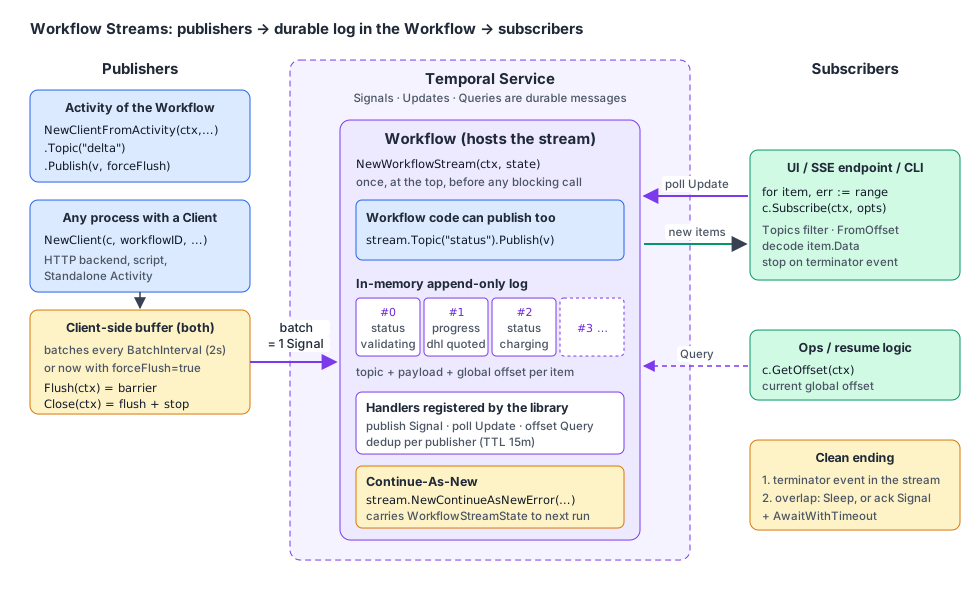
It is plain Temporal message passing, packaged as a library:
| Piece | Built on | What it does |
|---|---|---|
| The log | Workflow state | An in-memory, append-only list of items. Each item has a topic, a payload and a global offset. The Workflow hosts the log. |
| Publish | a Signal (__temporal_workflow_stream_publish) | Clients buffer events and send them in batches. Each batch is one Signal. |
| Subscribe | an Update (long poll) | Subscribers ask "give me items after offset N". The Update returns when new items exist. |
| Offset | a Query | Returns the current global offset of the stream. |
Because publishing and subscribing go through the Temporal Service, the stream gets Temporal's guarantees: ordered delivery, publisher deduplication (exactly-once inside the dedup window, see section 8), and survival across Continue-As-New.
Key rules:
- Construct exactly one
WorkflowStreamper Workflow, at the top of the Workflow function, before any blocking call. The constructor registers the three handlers. If you construct it after a blocking call, publishes that arrived earlier are missed. If you construct it twice, the handlers are registered twice (Go has no API to detect that). - The Workflow hosts the stream, but it doesn't read its own stream. Workflow logic depends on Activity results, not on streamed events.
Publishapplies no backpressure. A slow subscriber never slows a publisher. If you need a limit, apply it before callingPublish.
3. Core API at a glance
| Where you are | Constructor | Publish | Notes |
|---|---|---|---|
| Workflow code | workflowstreams.NewWorkflowStream(ctx, priorState, opts...) | stream.Topic("status").Publish(v) error | Appends synchronously to the in-memory log |
| Activity started by a Workflow | workflowstreams.NewClientFromActivity(ctx, opts) | streamClient.Topic("delta").Publish(v, forceFlush) | Finds the client and parent Workflow ID from the Activity context |
| Any process with a Client | workflowstreams.NewClient(c, workflowID, opts) | same | HTTP backends, scripts, Standalone Activities |
| Subscriber | NewClient (or NewClientFromActivity) | — | for item, err := range streamClient.Subscribe(ctx, opts) |
Client-side helpers:
Publish(value, forceFlush bool)appends to an in-memory buffer and returns immediately.forceFlush=truewakes the background flusher so this batch ships now instead of at the nextBatchInterval(default 2s).Flush(ctx)is a barrier: when it returns nil, the Temporal Service has received every prior publication.Close(ctx)flushes and stops the flusher. Always check its error. Subscribers don't needClose.GetOffset(ctx)runs the offset Query.
4. Publish from the Workflow and from an Activity
Example: an order tracking page. The Workflow publishes coarse status events. The shipping-quote Activity publishes fine-grained progress events from inside the Activity, while it calls carriers.
Event types
// file: tracking/events.go
package tracking

// Topic names shared by publishers and subscribers.
const (
	TopicStatus   = "status"
	TopicProgress = "progress"
)

// StatusEvent is published by the Workflow at each business milestone.
type StatusEvent struct {
	State    string // "validating", "quoting", "charging", "completed", "failed"
	Progress int    // 0..100
	Detail   string
}

// ProgressEvent is published from inside Activities.
type ProgressEvent struct {
	Message string
}
The Activities
QuoteShippingRates publishes one event per carrier. It uses NewClientFromActivity, so it needs neither the Temporal Client nor the Workflow ID in its input.
// file: tracking/activities.go
package tracking

import (
	"context"
	"fmt"
	"time"

	"go.temporal.io/sdk/activity"
	"go.temporal.io/sdk/contrib/workflowstreams"
)

type ShippingQuote struct {
	Carrier    string
	PriceCents int64
}

// CarrierAPI is the external rating service (fake it in tests).
type CarrierAPI interface {
	Quote(ctx context.Context, carrier, orderID string) (int64, error)
}

type OrderActivities struct {
	Carriers CarrierAPI
}

func (a *OrderActivities) ValidateOrder(ctx context.Context, orderID string) error { return nil }

func (a *OrderActivities) ChargePayment(ctx context.Context, orderID string, amountCents int64) error {
	return nil
}

func (a *OrderActivities) QuoteShippingRates(ctx context.Context, orderID string) (ShippingQuote, error) {
	streamClient, err := workflowstreams.NewClientFromActivity(ctx, workflowstreams.Options{
		BatchInterval: 200 * time.Millisecond,
	})
	if err != nil {
		return ShippingQuote{}, err // e.g. called as a Standalone Activity: no parent Workflow
	}
	progress := streamClient.Topic(TopicProgress)

	best := ShippingQuote{}
	for _, carrier := range []string{"colissimo", "dhl", "ups"} {
		price, err := a.Carriers.Quote(ctx, carrier, orderID)
		if err != nil {
			_ = streamClient.Close(ctx)
			return ShippingQuote{}, err
		}
		progress.Publish(ProgressEvent{Message: fmt.Sprintf("%s quoted %d cents", carrier, price)}, false)
		activity.RecordHeartbeat(ctx, carrier)
		if best.Carrier == "" || price < best.PriceCents {
			best = ShippingQuote{Carrier: carrier, PriceCents: price}
		}
	}
	// Close flushes the buffer. Return its error so a failed flush fails the Activity.
	if err := streamClient.Close(ctx); err != nil {
		return ShippingQuote{}, err
	}
	return best, nil
}
The Workflow
// file: tracking/workflow.go
package tracking
import (
"time"
"go.temporal.io/sdk/contrib/workflowstreams"
"go.temporal.io/sdk/workflow"
)
type OrderTrackingInput struct {
OrderID string
AmountCents int64
// nil on a fresh start; set only when continuing as new (see section 7).
StreamState *workflowstreams.WorkflowStreamState
}
func OrderTrackingWorkflow(ctx workflow.Context, in OrderTrackingInput) (ShippingQuote, error) {
// 1) FIRST thing, before any blocking call: create the stream (registers its handlers).
stream, err := workflowstreams.NewWorkflowStream(ctx, in.StreamState)
if err != nil {
return ShippingQuote{}, err
}
status := stream.Topic(TopicStatus)
ctx = workflow.WithActivityOptions(ctx, workflow.ActivityOptions{
StartToCloseTimeout: time.Minute,
HeartbeatTimeout: 20 * time.Second,
})
var a *OrderActivities
fail := func(err error) (ShippingQuote, error) {
_ = status.Publish(StatusEvent{State: "failed", Detail: err.Error()})
_ = workflow.Sleep(ctx, 30*time.Second) // let subscribers read the terminator
return ShippingQuote{}, err
}
if err := status.Publish(StatusEvent{State: "validating", Detail: "checking stock"}); err != nil {
return ShippingQuote{}, err
}
if err := workflow.ExecuteActivity(ctx, a.ValidateOrder, in.OrderID).Get(ctx, nil); err != nil {
return fail(err)
}
_ = status.Publish(StatusEvent{State: "quoting", Progress: 30, Detail: "asking carriers"})
var quote ShippingQuote
if err := workflow.ExecuteActivity(ctx, a.QuoteShippingRates, in.OrderID).Get(ctx, "e); err != nil {
return fail(err)
}
_ = status.Publish(StatusEvent{State: "charging", Progress: 70, Detail: "authorizing payment"})
total := in.AmountCents + quote.PriceCents
if err := workflow.ExecuteActivity(ctx, a.ChargePayment, in.OrderID, total).Get(ctx, nil); err != nil {
return fail(err)
}
// 2) In-band terminator: subscribers stop when they see "completed".
if err := status.Publish(StatusEvent{State: "completed", Progress: 100, Detail: "via " + quote.Carrier}); err != nil {
return ShippingQuote{}, err
}
// 3) Brief overlap so in-flight polls can fetch the terminator before the Workflow closes.
if err := workflow.Sleep(ctx, 30*time.Second); err != nil {
return ShippingQuote{}, err
}
return quote, nil
}WorkflowTopicHandle.Publish (Workflow side) returns an error. TopicHandle.Publish (client side) returns nothing and takes a forceFlush flag. Same name, different signatures.
5. Publish from any client
Any process that knows the Workflow ID can publish. Example: the warehouse scanner backend pushes "parcel scanned" events into the order's stream. It is an HTTP service, not an Activity, so it uses NewClient.
Flush is the mid-stream barrier: here we only mark the scan batch as forwarded once Temporal has it.
// file: tracking/warehouse_publisher.go
package tracking

import (
	"context"

	"go.temporal.io/sdk/client"
	"go.temporal.io/sdk/contrib/workflowstreams"
)

// ScanLog is the warehouse system's own table.
type ScanLog interface {
	MarkForwarded(ctx context.Context, orderID string, scans []string) error
}

func ForwardWarehouseScans(ctx context.Context, c client.Client, log ScanLog, orderID string, scans []string) (err error) {
	streamClient := workflowstreams.NewClient(c, orderID, workflowstreams.Options{})
	defer func() {
		// Close flushes whatever is still buffered. Don't lose its error.
		if closeErr := streamClient.Close(ctx); err == nil {
			err = closeErr
		}
	}()

	progress := streamClient.Topic(TopicProgress)
	for _, scan := range scans {
		progress.Publish(ProgressEvent{Message: "warehouse: " + scan}, false)
	}

	// Barrier: every event above has reached the Temporal Service.
	if err := streamClient.Flush(ctx); err != nil {
		return err
	}
	return log.MarkForwarded(ctx, orderID, scans) // only safe now
}
⚠️ The client publish path is not goroutine-safe. Don't call
Publishon the sameClientfrom several goroutines. Route events to one owner goroutine.
For a Standalone Activity there is no parent Workflow, so NewClientFromActivity returns an error. Use NewClient(activity.GetClient(ctx), workflowIDFromInput, opts) instead.
6. Subscribe
Subscribe returns an iter.Seq2[WorkflowStreamItem, error]. Range over it. It handles re-polling, pagination (a poll response is capped around 1 MB) and Workflow-side truncation for you.
SubscribeOptions:
| Field | Meaning | Default |
|---|---|---|
Topics | topic filter | empty = all topics |
FromOffset | global offset to start from (store it to resume after a reconnect) | 0 = beginning |
PollCooldown | minimum interval between polls when nothing is ready | 100 ms |
Each item.Data is the raw payload. Decode it with a converter that matches the publisher (the default data converter, unless you passed WithPayloadConverters). One subscription can read several topics with different types: switch on item.Topic.
The loop ends cleanly when the Workflow closes (Completed, Failed, Canceled, Terminated or Timed Out), but it doesn't tell you which. Call DescribeWorkflow afterwards when the outcome matters.
// file: cmd/order-tracker/main.go
package main

import (
	"context"
	"fmt"
	"log"
	"os"

	"github.com/acme/shop/tracking"
	"go.temporal.io/sdk/client"
	"go.temporal.io/sdk/contrib/workflowstreams"
	"go.temporal.io/sdk/converter"
)

// WatchOrder prints every status and progress event until the "completed" terminator arrives
// or the Workflow closes, then reports the final status.
func WatchOrder(ctx context.Context, c client.Client, orderID string, fromOffset int64) error {
	stream := workflowstreams.NewClient(c, orderID, workflowstreams.Options{}) // subscribe-only: no Close
	dc := converter.GetDefaultDataConverter()

	opts := workflowstreams.SubscribeOptions{
		Topics:     []string{tracking.TopicStatus, tracking.TopicProgress},
		FromOffset: fromOffset,
	}
loop:
	for item, err := range stream.Subscribe(ctx, opts) {
		if err != nil {
			return err
		}
		switch item.Topic {
		case tracking.TopicStatus:
			var evt tracking.StatusEvent
			if err := dc.FromPayload(item.Data, &evt); err != nil {
				return err
			}
			fmt.Printf("#%d [%3d%%] %s: %s\n", item.Offset, evt.Progress, evt.State, evt.Detail)
			if evt.State == "completed" || evt.State == "failed" {
				break loop
			}
		case tracking.TopicProgress:
			var evt tracking.ProgressEvent
			if err := dc.FromPayload(item.Data, &evt); err != nil {
				return err
			}
			fmt.Printf("#%d        %s\n", item.Offset, evt.Message)
		}
	}

	// The stream doesn't say how the Workflow ended. Ask Temporal.
	desc, err := c.DescribeWorkflow(ctx, orderID, "")
	if err != nil {
		return err
	}
	fmt.Println("Workflow status:", desc.Status)
	return nil
}

func main() {
	c, err := client.Dial(client.Options{})
	if err != nil {
		log.Fatalln(err)
	}
	defer c.Close()
	if err := WatchOrder(context.Background(), c, os.Args[1], 0); err != nil {
		log.Fatalln(err)
	}
}
7. Closing the stream cleanly
A for … range doesn't know when the publisher is done. The documented pattern has two parts:
- An in-band terminator. Publish an event the subscriber recognizes and stops on (
State: "completed"above). - A brief overlap before the Workflow returns. A poll still in flight when the Workflow closes is consumed silently, so a Workflow that returns right after the terminator can lose it.
Two ways to get the overlap:
| Option | How | Trade-off |
|---|---|---|
| Fixed sleep | workflow.Sleep(ctx, 30*time.Second) after the terminator (section 4) | Simple. Every run lasts 30s longer. |
| Ack handshake | Subscriber Signals the Workflow when it has the terminator. The Workflow waits with workflow.AwaitWithTimeout | Returns as soon as the subscriber confirms. The timeout is the fallback when nobody is subscribed. |
Full example: streaming generated product copy (ack handshake + retries)
An Activity calls an LLM and publishes text deltas as they arrive. The interesting part is the retry: a retried attempt is a new publisher, so the subscriber would see the failed attempt's partial text plus the new attempt's full text. From the second attempt on, the Activity publishes a retry event, and the consumer clears its buffer when it sees one.
// file: copywriting/activity.go
package copywriting

import (
	"context"
	"iter"
	"strings"
	"time"

	"go.temporal.io/sdk/activity"
	"go.temporal.io/sdk/contrib/workflowstreams"
)

const (
	TopicDelta = "delta"
	TopicRetry = "retry"
	TopicClose = "close"

	AckSignal = "subscriber-acknowledged-terminator"
)

type TextDelta struct{ Text string }

type RetryEvent struct{ Attempt int32 }

type ProductBrief struct {
	SKU      string
	Name     string
	Keywords []string
}

// generateDeltas stands in for your LLM SDK's streaming call. Disable the provider's own
// retries and let the Temporal Retry Policy own retries.
func generateDeltas(brief ProductBrief) iter.Seq[string] {
	words := append([]string{"Meet", "the", brief.Name + ":"}, brief.Keywords...)
	return func(yield func(string) bool) {
		for _, w := range words {
			if !yield(w + " ") {
				return
			}
		}
	}
}

func GenerateProductDescription(ctx context.Context, brief ProductBrief) (string, error) {
	attempt := activity.GetInfo(ctx).Attempt
	streamClient, err := workflowstreams.NewClientFromActivity(ctx, workflowstreams.Options{
		BatchInterval: 200 * time.Millisecond,
	})
	if err != nil {
		return "", err
	}
	deltas := streamClient.Topic(TopicDelta)

	// Tell consumers that an earlier attempt's deltas are stale. Flush now: latency matters.
	if attempt > 1 {
		streamClient.Topic(TopicRetry).Publish(RetryEvent{Attempt: attempt}, true)
	}

	var full strings.Builder
	first := true
	for token := range generateDeltas(brief) {
		// forceFlush only on the first delta so the user sees text immediately;
		// later deltas are batched every 200ms (one Signal per batch, not per token).
		deltas.Publish(TextDelta{Text: token}, first)
		first = false
		full.WriteString(token)
		activity.RecordHeartbeat(ctx)
	}
	streamClient.Topic(TopicClose).Publish(struct{}{}, false)

	if err := streamClient.Close(ctx); err != nil {
		return "", err
	}
	return full.String(), nil
}// file: copywriting/workflow.go
package copywriting
import (
"time"
"go.temporal.io/sdk/contrib/workflowstreams"
"go.temporal.io/sdk/temporal"
"go.temporal.io/sdk/workflow"
)
type ProductCopyInput struct {
Brief ProductBrief
StreamState *workflowstreams.WorkflowStreamState
}
func ProductCopyWorkflow(ctx workflow.Context, in ProductCopyInput) (string, error) {
// The Workflow hosts the stream; the Activity publishes to it.
if _, err := workflowstreams.NewWorkflowStream(ctx, in.StreamState); err != nil {
return "", err
}
subscriberDone := false
ackCh := workflow.GetSignalChannel(ctx, AckSignal)
workflow.Go(ctx, func(ctx workflow.Context) {
ackCh.Receive(ctx, nil)
subscriberDone = true
})
ctx = workflow.WithActivityOptions(ctx, workflow.ActivityOptions{
StartToCloseTimeout: 5 * time.Minute,
HeartbeatTimeout: 30 * time.Second,
RetryPolicy: &temporal.RetryPolicy{MaximumAttempts: 3},
})
var description string
if err := workflow.ExecuteActivity(ctx, GenerateProductDescription, in.Brief).Get(ctx, &description); err != nil {
return "", err
}
// Wait for the subscriber to ack the "close" event; 30s is the fallback when nobody listens.
_, _ = workflow.AwaitWithTimeout(ctx, 30*time.Second, func() bool { return subscriberDone })
return description, nil
}The consumer can be a CLI, a desktop UI, or an SSE endpoint that forwards to a browser. render stands for "redraw whatever displays the text".
// file: copywriting/consumer.go
package copywriting

import (
	"context"
	"strings"

	"go.temporal.io/sdk/client"
	"go.temporal.io/sdk/contrib/workflowstreams"
	"go.temporal.io/sdk/converter"
)

// StreamProductCopy follows one ProductCopyWorkflow (its Workflow ID is copyJobID) and calls
// render with the full text so far after every change.
func StreamProductCopy(ctx context.Context, c client.Client, copyJobID string, render func(string)) (string, error) {
	stream := workflowstreams.NewClient(c, copyJobID, workflowstreams.Options{})
	dc := converter.GetDefaultDataConverter()
	var text []string

	opts := workflowstreams.SubscribeOptions{Topics: []string{TopicDelta, TopicRetry, TopicClose}}
	for item, err := range stream.Subscribe(ctx, opts) {
		if err != nil {
			return "", err
		}
		switch item.Topic {
		case TopicRetry:
			// The previous attempt's deltas are stale: drop what we've shown.
			text = text[:0]
			render("")
		case TopicDelta:
			var d TextDelta
			if err := dc.FromPayload(item.Data, &d); err != nil {
				return "", err
			}
			text = append(text, d.Text)
			render(strings.Join(text, ""))
		case TopicClose:
			// Ack so the Workflow can return without waiting for its 30s fallback.
			if err := c.SignalWorkflow(ctx, copyJobID, "", AckSignal, nil); err != nil {
				return "", err
			}
			return strings.Join(text, ""), nil
		}
	}
	return strings.Join(text, ""), nil
}
8. Long-running streams and Continue-As-New
A Workflow that streams for hours accumulates history and must Continue-As-New (09). The stream's log and its dedup state live in Workflow memory, so they must be carried across the boundary. Subscribers follow the rollover automatically.
The recipe:
- Add a
*workflowstreams.WorkflowStreamStatefield to the Workflow input and pass it toNewWorkflowStream(nil on a fresh start). - Return
stream.NewContinueAsNewError(ctx, wfn, buildArgs)instead ofworkflow.NewContinueAsNewError. It detaches waiting pollers, waits for in-flight handlers, snapshots the state (15-minute publisher TTL), and callsbuildArgs(state)to build the next run's arguments.
Example: a shipment timeline that lives until the parcel is delivered and republishes every carrier scan it receives as a Signal.
// file: tracking/shipment_timeline.go
package tracking

import (
	"go.temporal.io/sdk/contrib/workflowstreams"
	"go.temporal.io/sdk/workflow"
)

const CarrierScanSignal = "carrier-scan"

type CarrierScan struct {
	Location  string
	Delivered bool
}

type ShipmentTimelineInput struct {
	TrackingNumber string
	ScansSeen      int
	StreamState    *workflowstreams.WorkflowStreamState
}

func ShipmentTimelineWorkflow(ctx workflow.Context, in ShipmentTimelineInput) error {
	stream, err := workflowstreams.NewWorkflowStream(ctx, in.StreamState)
	if err != nil {
		return err
	}
	scans := stream.Topic("scans")
	scanCh := workflow.GetSignalChannel(ctx, CarrierScanSignal)
	scansSeen := in.ScansSeen

	handle := func(scan CarrierScan) (delivered bool, err error) {
		scansSeen++
		return scan.Delivered, scans.Publish(scan)
	}

	for {
		var scan CarrierScan
		scanCh.Receive(ctx, &scan)
		delivered, err := handle(scan)
		if err != nil {
			return err
		}
		if delivered {
			return nil // a real Workflow would also add the closing overlap from section 7
		}

		if workflow.GetInfo(ctx).GetContinueAsNewSuggested() {
			// Don't lose Signals that already arrived: drain them into the stream first.
			for scanCh.ReceiveAsync(&scan) {
				delivered, err := handle(scan)
				if err != nil {
					return err
				}
				if delivered {
					return nil
				}
			}
			return stream.NewContinueAsNewError(ctx, ShipmentTimelineWorkflow,
				func(state *workflowstreams.WorkflowStreamState) []any {
					return []any{ShipmentTimelineInput{
						TrackingNumber: in.TrackingNumber,
						ScansSeen:      scansSeen,
						StreamState:    state,
					}}
				})
		}
	}
}
The manual recipe (custom TTL, other Continue-As-New options)
When you need a different publisher TTL, or other Continue-As-New options such as another Task Queue, do the steps yourself. Truncate(upToOffset) keeps the carried log small. Polls that ask for an offset before the new base then get a TruncatedOffset error.
// file: tracking/manual_rollover.go
package tracking

import (
	"time"

	"go.temporal.io/sdk/contrib/workflowstreams"
	"go.temporal.io/sdk/workflow"
)

// rolloverShipmentTimeline is the explicit version of stream.NewContinueAsNewError.
func rolloverShipmentTimeline(ctx workflow.Context, stream *workflowstreams.WorkflowStream,
	in ShipmentTimelineInput, keepFromOffset int64) error {
	// Drop old entries so the carried state stays well under the payload size limit.
	if err := stream.Truncate(keepFromOffset); err != nil {
		return err
	}
	stream.DetachPollers() // unblock waiting polls, reject new ones
	if err := workflow.Await(ctx, func() bool { return workflow.AllHandlersFinished(ctx) }); err != nil {
		return err
	}
	state, err := stream.GetState(30 * time.Minute) // custom publisher TTL (default is 15m)
	if err != nil {
		return err
	}
	ctx = workflow.WithWorkflowTaskQueue(ctx, "tracking-v2")
	in.StreamState = state
	return workflow.NewContinueAsNewError(ctx, ShipmentTimelineWorkflow, in)
}
⚠️ The carried state includes the whole in-memory log of the previous run. Streams with large items can hit the per-payload size limit at rollover. Keep items small (store big blobs elsewhere, for example with External Storage, and publish references), and truncate.
9. Delivery guarantees and tuning
| Knob | Default | What to know |
|---|---|---|
Options.BatchInterval | 2s | Time between automatic flushes. Lower means lower latency but more Signals in history. |
Options.MaxBatchSize | 0 (off) | Flush once the buffer holds this many items. |
forceFlush on Publish | false | Use for latency-sensitive events (first token, retry), not for every event. |
Options.MaxRetryDuration | 10m | How long a failed batch is retried. Then the batch is dropped and a *FlushTimeoutError is returned. |
Publisher TTL (GetState(ttl)) | 15m | At Continue-As-New, dedup entries for publishers silent longer than this are dropped. |
Options.PayloadConverters / WithPayloadConverters | default converters | Per-item serialization only. Use matching converters on both sides. |
What this means in practice:
- Exactly-once inside the dedup window.
MaxRetryDurationmust stay below the publisher TTL. Otherwise a publisher that comes back after a long partition can create duplicates. - A flush timeout is at-most-once. The dropped batch may or may not have reached the Workflow. The
FlushTimeoutErroralso stops the background flusher. Later publishes pile up until you callFlushorClose. - The codec chain runs once per batch. Encryption and compression from your client's data converter apply to the Signal/Update envelope, never per item. Items are never double-encoded.
- Retried Activities publish twice. Design consumers to reset on a
retryevent (section 7).
Key takeaways
- Workflow Streams = an ordered, durable event log hosted by a Workflow, built on a publish Signal, a poll Update and an offset Query. Contrib module, Public Preview.
- Create one
WorkflowStreamat the top of the Workflow. Publish from the Workflow, from Activities (NewClientFromActivity) or from any client (NewClient). - Client publishes are buffered and batched.
forceFlushfor latency,Flushas a barrier, and always checkClose. - Subscribers range over
Subscribe(...), decodeitem.Data, resume withFromOffset, and callDescribeWorkflowto learn how the run ended. - End streams with a terminator event plus an overlap (sleep or ack handshake).
- Long-lived streams carry
WorkflowStreamStatethroughstream.NewContinueAsNewError.
⬅️ Previous: 12 · Dynamic Workflows · ↩️ Back to the Roadmap