03 · Workflow Task failure vs Workflow Execution failure
Level: foundations · Read time: ~18 min Sources: Encyclopedia — Application failures · Detecting Workflow failures (Workflow Task Timeout, detecting Workflow Task failures) · Go SDK — Error handling (panics and deferred functions)
1. The problem
Two order Workflows are in trouble:
order-1042shows Failed in the Web UI. It's over: nothing will run again.order-1043shows Running, but nothing has happened for three days.
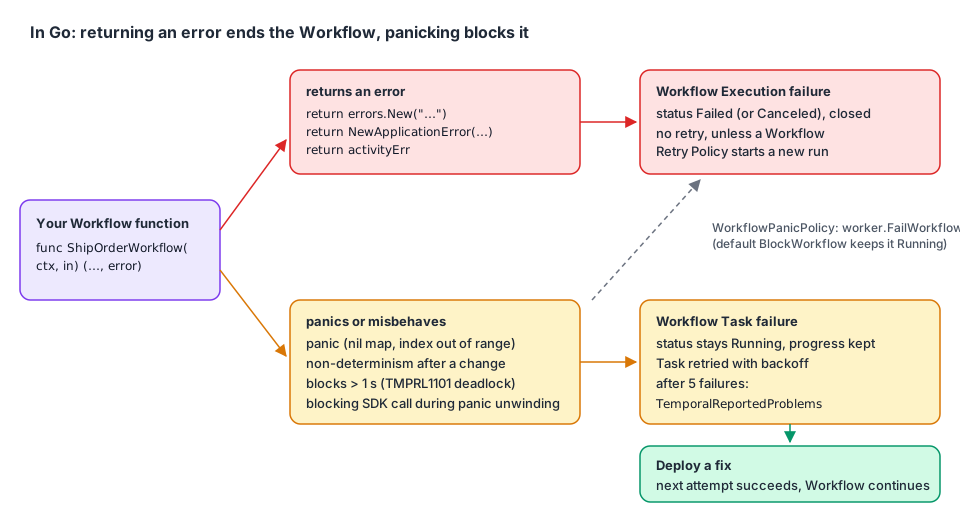
The first one hit a Workflow Execution failure. The second one hits a Workflow Task failure every few minutes. They need opposite reactions, and in Go which one you get depends on whether your Workflow returns an error or panics. The basics are in Workers, chapter 02; this chapter is the Go error-handling view.
2. The two outcomes
| Workflow Task failure | Workflow Execution failure | |
|---|---|---|
| Meaning | This Worker could not run this step of the Workflow code | The Workflow decided it can't succeed |
| Status | Stays Running | Failed (closed) |
| Retried? | Yes, automatically, with backoff (up to 10 min between attempts), until it succeeds or the Workflow times out | No. Only a Workflow Retry Policy starts a new run (chapter 07) |
| Progress | Kept. Deploy a fix and the Workflow continues | Final for this run |
| Typical cause | A bug: panic, non-determinism, blocking code | A business outcome: rejected order, failed payment |
3. What does what in Go
The Encyclopedia says that in Workflow code throwing a Temporal failure fails the Workflow Execution, while throwing any other error fails the Workflow Task. That's true for SDKs built on exceptions. Go is different: a Workflow function returns an error, and any returned error closes the Workflow.
Observed with SDK v1.50.0 and Server 1.32.0:
| Your Workflow code… | Result | What the Client's run.Get returns |
|---|---|---|
return errors.New("plain workflow error") | Execution Failed | WorkflowExecutionError → ApplicationError with Type() == "" |
return &OrderRejectedError{Reason: "fraud"} | Execution Failed | → ApplicationError with Type() == "OrderRejectedError" |
return err (an Activity's non-retryable error) | Execution Failed | → ActivityError → ApplicationError (CardDeclined) |
return ctx.Err() after cancellation | Execution Canceled | → CanceledError |
var m map[string]int; m["x"] = 1 (a panic) | Workflow Task failed, Running, retried | Nothing yet: Get keeps waiting |
| Non-determinism after a code change | Workflow Task failed, Running | Nothing yet |
time.Sleep(2 * time.Second) in Workflow code | Workflow Task failed: [TMPRL1101] Potential deadlock detected: workflow goroutine "root" didn't yield for over 1s | Nothing yet |
A panic, with WorkflowPanicPolicy: worker.FailWorkflow | Execution Failed | WorkflowExecutionError → PanicError (temporal.IsPanicError is true) |
So in Go, "return an error" means "this Workflow failed for good". A plain errors.New is not a safe "try again later" signal: it ends the Workflow just like a business failure. If the Workflow has a Retry Policy, a new run starts, from the beginning.
4. Return errors for business outcomes
Return an error only when the Workflow has really failed, and give it an explicit Type so callers can react (chapter 04):
// file: shipping/workflow.go
package shipping

import (
	"time"

	"go.temporal.io/sdk/temporal"
	"go.temporal.io/sdk/workflow"
)

const TaskQueue = "shipping"

type ShipOrderInput struct {
	OrderID     string
	Country     string
	Postcode    string
	WeightGrams int
}

type Shipment struct {
	OrderID     string
	TrackingRef string
}

var supportedCountries = map[string]bool{"FR": true, "DE": true, "BE": true}

func ShipOrderWorkflow(ctx workflow.Context, in ShipOrderInput) (Shipment, error) {
	// Business rule: a final answer. Failing the Workflow is correct.
	if !supportedCountries[in.Country] {
		return Shipment{}, temporal.NewNonRetryableApplicationError(
			"we don't ship to "+in.Country, "UnsupportedCountry", nil, in.Country)
	}

	postcode, err := NormalizePostcode(in.Country, in.Postcode)
	if err != nil {
		return Shipment{}, err // already an ApplicationError with Type "InvalidPostcode"
	}

	ctx = workflow.WithActivityOptions(ctx, workflow.ActivityOptions{StartToCloseTimeout: time.Minute})
	var a *Activities
	var tracking string
	if err := workflow.ExecuteActivity(ctx, a.BookCarrier, in.OrderID, in.Country, postcode, in.WeightGrams).Get(ctx, &tracking); err != nil {
		return Shipment{}, err // the Activity gave up: the shipment failed
	}
	return Shipment{OrderID: in.OrderID, TrackingRef: tracking}, nil
}// file: shipping/activities.go
package shipping
import "context"
type Carrier interface {
Book(ctx context.Context, orderID, country, postcode string, weightGrams int) (trackingRef string, err error)
}
type Activities struct{ Carrier Carrier }
func (a *Activities) BookCarrier(ctx context.Context, orderID, country, postcode string, weightGrams int) (string, error) {
return a.Carrier.Book(ctx, orderID, country, postcode, weightGrams)
}5. Let bugs fail the Workflow Task
A bug is the case Temporal handles best, if you let it panic. With the default WorkflowPanicPolicy (BlockWorkflow), a panicking Workflow stays Running, its Workflow Task is retried, and the Workflow continues where it was once a fixed Worker is deployed.
We checked it: an AllocateWorkflow that wrote to a nil map failed its Workflow Task six times; after a Worker with the fix was started, the same Workflow completed with allocated MUG-01. No data was lost, no one had to restart anything.
If you prefer bugs to fail Workflows (for example, short Workflows where a fast, visible failure beats a stuck one), set the policy on the Worker:
// file: cmd/worker/main.go
package main

import (
	"context"
	"log"
	"os"

	"go.temporal.io/sdk/client"
	"go.temporal.io/sdk/worker"

	"github.com/acme/shop/shipping"
)

// fakeCarrier stands in for the carrier's booking API.
type fakeCarrier struct{}

func (fakeCarrier) Book(_ context.Context, orderID, _, _ string, _ int) (string, error) {
	return "TRK-" + orderID, nil
}

func main() {
	c, err := client.Dial(client.Options{})
	if err != nil {
		log.Fatalln("Unable to create client", err)
	}
	defer c.Close()

	opts := worker.Options{}
	if os.Getenv("FAIL_WORKFLOW_ON_PANIC") == "true" {
		// Panics and non-determinism fail the Workflow Execution instead of blocking it.
		opts.WorkflowPanicPolicy = worker.FailWorkflow
	}
	w := worker.New(c, shipping.TaskQueue, opts)
	w.RegisterWorkflow(shipping.ShipOrderWorkflow)
	w.RegisterWorkflow(shipping.ProcessReturnWorkflow)
	w.RegisterActivity(&shipping.Activities{Carrier: fakeCarrier{}})
	if err := w.Run(worker.InterruptCh()); err != nil {
		log.Fatalln("Unable to start worker", err)
	}
}
With FailWorkflow, the panicking Workflow failed with Workflow failed on panic due to FailWorkflow workflow panic policy: assignment to entry in nil map. You lose the "fix and continue" property, so keep the default unless you have a reason.
6. Panics, recover and defer in Workflow code
The Go error-handling page says: "you cannot recover() from a panic inside a defer. Deferred functions that try to interact with the Temporal SDK during panic unwinding will re-panic immediately." What we observed is more precise:
| Code | Result |
|---|---|
defer func() { if r := recover(); r != nil { … } }() then a nil-map panic | Works. The Workflow completed with recovered: assignment to entry in nil map |
A defer that calls workflow.ExecuteActivity(…).Get when the function returns an error (no panic) | Works. The compensation Activity ran, then the Workflow failed with the original error |
A defer that calls workflow.Sleep (any blocking SDK call) while a panic unwinds | Workflow Task fails: yield during panic unwinding: a deferred function attempted to block the coroutine while a panic was in progress, and is retried |
So the rule is: never block on the SDK while a panic is unwinding. recover itself is allowed, and deferred compensation on the normal error path is fine.
Should you recover? Rarely. A recovered panic hides a bug that the default policy would have surfaced and let you fix in place. One reasonable use is around pure third-party code that may panic on odd input, to turn the panic into a business error:
// file: shipping/postcode.go
package shipping

import (
	"fmt"
	"strings"

	"go.temporal.io/sdk/temporal"
)

// formatPostcode stands for a third-party formatting library that panics on unexpected input.
func formatPostcode(country, raw string) string {
	s := strings.ToUpper(strings.ReplaceAll(raw, " ", ""))
	if country == "FR" && len(s) != 5 {
		panic(fmt.Sprintf("invalid FR postcode %q", raw))
	}
	return s
}

// NormalizePostcode is deterministic and calls no SDK API, so recovering here is safe.
func NormalizePostcode(country, raw string) (postcode string, err error) {
	defer func() {
		if r := recover(); r != nil {
			err = temporal.NewNonRetryableApplicationError(fmt.Sprint(r), "InvalidPostcode", nil, raw)
		}
	}()
	return formatPostcode(country, raw), nil
}
And compensation in a defer, on the error path only:
// file: shipping/returns.go
package shipping

import (
	"context"
	"time"

	"go.temporal.io/sdk/workflow"
)

func (a *Activities) ReserveReturnSlot(ctx context.Context, orderID string) (string, error) {
	return "slot-" + orderID, nil
}
func (a *Activities) ReleaseReturnSlot(ctx context.Context, slotID string) error { return nil }
func (a *Activities) PrintReturnLabel(ctx context.Context, orderID string) error { return nil }

func ProcessReturnWorkflow(ctx workflow.Context, orderID string) (err error) {
	ctx = workflow.WithActivityOptions(ctx, workflow.ActivityOptions{StartToCloseTimeout: time.Minute})
	var a *Activities

	var slotID string
	if err := workflow.ExecuteActivity(ctx, a.ReserveReturnSlot, orderID).Get(ctx, &slotID); err != nil {
		return err
	}
	defer func() {
		if err == nil {
			return
		}
		// Runs on the error path (no panic in flight), so blocking on an Activity is allowed.
		releaseCtx, _ := workflow.NewDisconnectedContext(ctx)
		_ = workflow.ExecuteActivity(releaseCtx, a.ReleaseReturnSlot, slotID).Get(releaseCtx, nil)
	}()

	return workflow.ExecuteActivity(ctx, a.PrintReturnLabel, orderID).Get(ctx, nil)
}
7. Finding Workflows that are stuck
A Workflow Task failure doesn't change the Workflow's status, so you need to look for it:
| Where | What you see |
|---|---|
| Event History | WorkflowTaskFailed events, cause WORKFLOW_TASK_FAILED_CAUSE_WORKFLOW_WORKER_UNHANDLED_FAILURE for a panic, with the panic message and stack |
DescribeWorkflowExecution | PendingWorkflowTask.Attempt keeps growing |
Search Attribute TemporalReportedProblems | Set after 5 consecutive Workflow Task failures, to ["category=WorkflowTaskFailed", "cause=WorkflowTaskFailedCauseWorkflowWorkerUnhandledFailure"]. Cleared when a Workflow Task succeeds |
| Web UI | The Task Failures saved view lists those Workflows |
| SDK metrics | temporal_workflow_task_execution_failed counter on the Worker |
On the dev server (Server 1.32.0, no extra config) the attribute appeared at attempt 6, after five failures, and the Web UI page's statement that self-hosted servers "need to update" the system.numConsecutiveWorkflowTaskProblemsToTriggerSearchAttribute dynamic config didn't hold: the default of 5 was already active. With the config set to 2, it appeared at attempt 3. Set it to 0 to turn the feature off.
The flag is not removed when a flagged Workflow is terminated: our terminated deadlock probe still matched the query. Filter on ExecutionStatus = "Running".
An operations helper that lists stuck Workflows with their attempt count:
// file: ops/stuck.go
package ops

import (
	"context"
	"fmt"

	"go.temporal.io/api/workflowservice/v1"
	"go.temporal.io/sdk/client"
)

type StuckWorkflow struct {
	WorkflowID   string
	WorkflowType string
	TaskAttempt  int32
}

// FindStuckWorkflows lists Running Workflows flagged with repeated Workflow Task failures.
func FindStuckWorkflows(ctx context.Context, c client.Client) ([]StuckWorkflow, error) {
	var stuck []StuckWorkflow
	var token []byte
	for {
		resp, err := c.ListWorkflow(ctx, &workflowservice.ListWorkflowExecutionsRequest{
			Query:         `ExecutionStatus = "Running" AND TemporalReportedProblems IN ("category=WorkflowTaskFailed")`,
			NextPageToken: token,
		})
		if err != nil {
			return nil, fmt.Errorf("list stuck workflows: %w", err)
		}
		for _, e := range resp.GetExecutions() {
			d, err := c.DescribeWorkflowExecution(ctx, e.GetExecution().GetWorkflowId(), e.GetExecution().GetRunId())
			if err != nil {
				return nil, fmt.Errorf("describe %s: %w", e.GetExecution().GetWorkflowId(), err)
			}
			stuck = append(stuck, StuckWorkflow{
				WorkflowID:   e.GetExecution().GetWorkflowId(),
				WorkflowType: e.GetType().GetName(),
				TaskAttempt:  d.GetPendingWorkflowTask().GetAttempt(),
			})
		}
		token = resp.GetNextPageToken()
		if len(token) == 0 {
			return stuck, nil
		}
	}
}
The same from the CLI:
temporal workflow list --query 'TemporalReportedProblems IN ("category=WorkflowTaskFailed")'8. The Workflow Task Timeout
A Workflow Task can also fail by timing out: the Worker took the Task and didn't answer within the Workflow Task Timeout (default 10 s, maximum 120 s). Its main job is to notice a Worker that died mid-Task, so the Task goes to another Worker. Raise it only for Workflows with very large histories that take long to replay; the Encyclopedia advises against going beyond the default.
Don't confuse it with Go's deadlock detector: Workflow code that doesn't yield for 1 s (DeadlockDetectionTimeout, see Workers, chapter 05) fails the Task with TMPRL1101 long before the 10 s timeout.
9. Key takeaways
- Task failure = the Workflow is stuck but alive; fix the code and it continues. Execution failure = the Workflow is over.
- In Go, any returned error fails the Workflow Execution,
errors.Newincluded. Only panics, non-determinism and blocking code fail the Workflow Task. - Keep the default
BlockWorkflowpolicy so bugs can be fixed in place;FailWorkflowturns them into failed Workflows. recover()works in Workflow code; blocking SDK calls during panic unwinding don't. Deferred compensation on the normal error path is fine.- Watch
TemporalReportedProblems, the Task Failures view andtemporal_workflow_task_execution_failedto find stuck Workflows.