05 · Handling errors in Workflows
Level: daily use · Read time: ~18 min Sources: Encyclopedia — Application failures: How errors propagate · Go SDK — Error handling ·
temporalpackage
1. The problem
workflow.ExecuteActivity(...).Get(ctx, &out) returned an error. Now what? The Workflow has to decide, in deterministic code, between very different situations:
- the card was declined: tell the customer, don't retry;
- the payment provider is down: try the backup provider;
- no warehouse has the items: refund, then report;
- something unexpected happened: fail loudly, with the whole story in the history.
In Go you make those decisions with errors.As on the right error types. This chapter shows which types arrive, how they're nested, and a complete checkout Workflow that handles each case.
2. What Get returns: always a wrapper, the cause inside
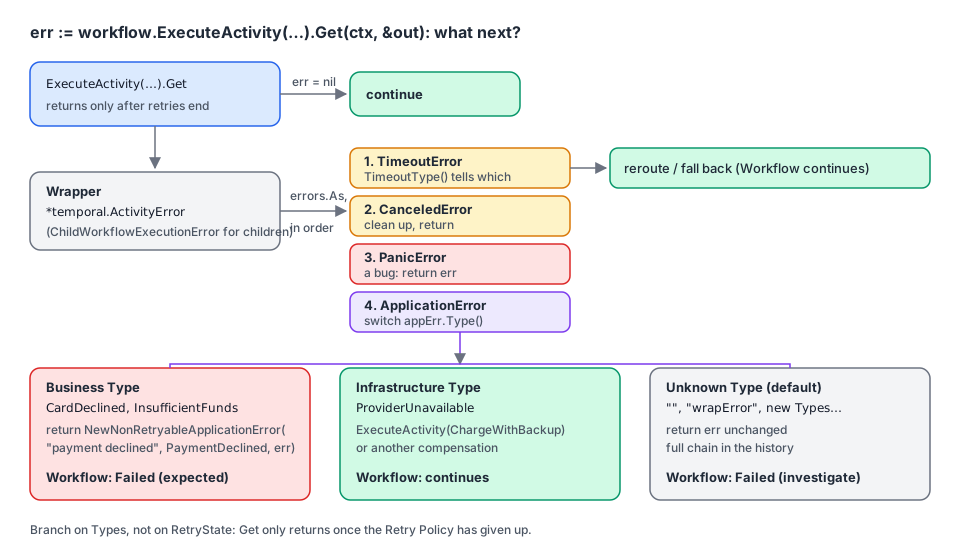
Temporal never hands the Workflow the Activity's error directly. It wraps it:
| You called | Outer error | The cause (errors.As target) |
|---|---|---|
ExecuteActivity | *temporal.ActivityError | *temporal.ApplicationError (your error, or a converted Go error), *temporal.TimeoutError, *temporal.CanceledError, *temporal.PanicError |
ExecuteChildWorkflow | *temporal.ChildWorkflowExecutionError | Whatever the child returned (often an ApplicationError), TimeoutError, CanceledError, TerminatedError |
errors.As walks the chain, so you rarely need the wrapper itself. When you do, it carries context:
| Wrapper | Useful methods |
|---|---|
ActivityError | ActivityType().GetName(), ActivityID(), RetryState(), Identity() |
ChildWorkflowExecutionError | WorkflowType(), WorkflowID(), RunID(), RetryState() |
RetryState() says why the retries stopped. Values seen on a dev server (SDK v1.50.0):
RetryState | When |
|---|---|
MaximumAttemptsReached | Retryable error, MaximumAttempts used up |
NonRetryableFailure | Non-retryable ApplicationError, or Type listed in NonRetryableErrorTypes |
Timeout | A timeout that isn't retried (e.g. ScheduleToStart, or ScheduleToClose reached) |
Don't branch on
RetryState. It's good for logs, but the SDK's test environment reportsRETRY_STATE_UNSPECIFIEDwhen retries run out (internal_workflow_testsuite.go), where a dev server reportsMaximumAttemptsReached. Logic that depends on it works in production and fails in unit tests. Branch on the Type instead:Getonly returns once the Retry Policy has given up anyway.
3. Every type, in one place
The Go SDK page shows a long if errors.As … block. It's an excerpt that doesn't compile on its own (it uses undefined outcome, failure and YourActivity), and it compares one Type with a string literal and the next with a constant. Here is the same idea as a small, compilable helper:
// file: checkout/classify.go
package checkout

import (
	"errors"
	"fmt"

	enumspb "go.temporal.io/api/enums/v1"
	"go.temporal.io/sdk/temporal"
)

// describeActivityError names the failure behind an Activity error. Every Activity
// error is a *temporal.ActivityError; the useful information is in its cause.
func describeActivityError(err error) string {
	var (
		appErr      *temporal.ApplicationError
		timeoutErr  *temporal.TimeoutError
		canceledErr *temporal.CanceledError
		panicErr    *temporal.PanicError
	)
	switch {
	case errors.As(err, &timeoutErr):
		switch timeoutErr.TimeoutType() {
		case enumspb.TIMEOUT_TYPE_SCHEDULE_TO_START:
			return "no Worker picked it up in time"
		case enumspb.TIMEOUT_TYPE_START_TO_CLOSE:
			return "an attempt ran too long"
		case enumspb.TIMEOUT_TYPE_SCHEDULE_TO_CLOSE:
			return "it ran out of overall time"
		case enumspb.TIMEOUT_TYPE_HEARTBEAT:
			return "it stopped heartbeating"
		}
		return "timeout"
	case errors.As(err, &canceledErr):
		return "canceled"
	case errors.As(err, &panicErr):
		// Message and stack trace of the panic inside the Activity.
		return "panicked: " + panicErr.Error()
	case errors.As(err, &appErr):
		return fmt.Sprintf("application error type=%q non-retryable=%v", appErr.Type(), appErr.NonRetryable())
	}
	return "unknown: " + err.Error()
}
Notes from the dev server:
- Order matters. A
TimeoutErrororCanceledErrorcan also contain an ApplicationError (the last failure before the timeout), so check them first. PanicError. An Activity that panics is reported as a*temporal.PanicErrorwith the panic message (andStackTrace()). It's retryable: the probe Activity was retried untilMaximumAttempts.- Your own Go types don't survive. An Activity returning
&CardDeclinedError{}arrives as an ApplicationError with Type"CardDeclinedError".errors.As(err, &*CardDeclinedError)is false in the Workflow, anderrors.Is(err, ErrOutOfStock)with a sentinel error is false too. Only Types, messages and Details cross the boundary (chapter 02). - Unknown Types. Keep a default branch: a newer Activity version can return a Type this Workflow has never seen.
4. A complete example: checkout with fallback, refund and clear errors
The Activities: a primary and a backup payment provider, and a refund.
// file: payments/errors.go
package payments

const (
	ErrTypeCardDeclined        = "CardDeclined"
	ErrTypeInsufficientFunds   = "InsufficientFunds"
	ErrTypeInvalidCard         = "InvalidCard"
	ErrTypeProviderUnavailable = "ProviderUnavailable"
)// file: payments/activities.go
package payments
import (
"context"
"go.temporal.io/sdk/temporal"
)
type ChargeRequest struct {
OrderID string
CardToken string
AmountCents int64
}
// Provider is one payment service provider's API.
type Provider interface {
// Charge returns an authorization ID, or declined=true for a refused card.
Charge(ctx context.Context, req ChargeRequest) (authID string, declined bool, err error)
Refund(ctx context.Context, authID string) error
}
type PaymentActivities struct {
Primary Provider
Backup Provider
}
func (a *PaymentActivities) ChargeWithPrimary(ctx context.Context, req ChargeRequest) (string, error) {
return charge(ctx, a.Primary, req)
}
func (a *PaymentActivities) ChargeWithBackup(ctx context.Context, req ChargeRequest) (string, error) {
return charge(ctx, a.Backup, req)
}
type RefundRequest struct {
Provider string // "primary" or "backup": refund where the money was taken
AuthorizationID string
}
func (a *PaymentActivities) RefundCharge(ctx context.Context, req RefundRequest) error {
if req.Provider == "backup" {
return a.Backup.Refund(ctx, req.AuthorizationID)
}
return a.Primary.Refund(ctx, req.AuthorizationID)
}
func charge(ctx context.Context, p Provider, req ChargeRequest) (string, error) {
authID, declined, err := p.Charge(ctx, req)
switch {
case err != nil:
return "", temporal.NewApplicationErrorWithCause("payment provider unreachable", ErrTypeProviderUnavailable, err)
case declined:
return "", temporal.NewNonRetryableApplicationError("card declined", ErrTypeCardDeclined, nil)
}
return authID, nil
}The Child Workflow that allocates stock:
// file: shipping/workflow.go
package shipping

import (
	"go.temporal.io/sdk/temporal"
	"go.temporal.io/sdk/workflow"
)

const ErrTypeOutOfStock = "OutOfStock"

type AllocateShipmentInput struct {
	OrderID string
	SKUs    []string
}

// AllocateShipmentWorkflow runs as a Child Workflow of PlaceOrderWorkflow.
func AllocateShipmentWorkflow(ctx workflow.Context, in AllocateShipmentInput) (string, error) {
	// ... pick a warehouse with Activities ...
	if len(in.SKUs) == 0 {
		return "", temporal.NewNonRetryableApplicationError("no warehouse has stock", ErrTypeOutOfStock, nil, in.OrderID)
	}
	return "warehouse-lyon-1", nil
}
The Workflow. Read it for the three kinds of outcome it produces:
// file: checkout/workflow.go
package checkout

import (
	"errors"
	"time"

	"go.temporal.io/sdk/temporal"
	"go.temporal.io/sdk/workflow"

	"github.com/acme/shop/payments"
	"github.com/acme/shop/shipping"
)

// Error types this Workflow returns to its callers.
const (
	ErrTypePaymentDeclined = "PaymentDeclined"
	ErrTypeOutOfStock      = "OutOfStock"
)

type PlaceOrderInput struct {
	OrderID     string
	CardToken   string
	AmountCents int64
	SKUs        []string
}

type PlaceOrderResult struct {
	AuthorizationID string
	Warehouse       string
}

func PlaceOrderWorkflow(ctx workflow.Context, in PlaceOrderInput) (PlaceOrderResult, error) {
	logger := workflow.GetLogger(ctx)
	ctx = workflow.WithActivityOptions(ctx, workflow.ActivityOptions{
		StartToCloseTimeout: 10 * time.Second,
		RetryPolicy:         &temporal.RetryPolicy{MaximumAttempts: 3},
	})
	var pa *payments.PaymentActivities
	req := payments.ChargeRequest{OrderID: in.OrderID, CardToken: in.CardToken, AmountCents: in.AmountCents}

	// 1. Charge, falling back to the backup provider if the primary is down.
	var authID string
	provider := "primary"
	err := workflow.ExecuteActivity(ctx, pa.ChargeWithPrimary, req).Get(ctx, &authID)
	if err != nil {
		var actErr *temporal.ActivityError
		if errors.As(err, &actErr) {
			logger.Warn("Primary charge failed",
				"activity", actErr.ActivityType().GetName(),
				"retryState", actErr.RetryState(), // e.g. MaximumAttemptsReached, NonRetryableFailure, Timeout
				"reason", describeActivityError(err))
		}
		switch {
		case isPaymentDecline(err):
			// A business outcome: report it to the caller, don't retry the Workflow.
			return PlaceOrderResult{}, temporal.NewNonRetryableApplicationError(
				"payment declined", ErrTypePaymentDeclined, err, in.OrderID)
		case primaryIsDown(err):
			provider = "backup"
			if err := workflow.ExecuteActivity(ctx, pa.ChargeWithBackup, req).Get(ctx, &authID); err != nil {
				if isPaymentDecline(err) {
					return PlaceOrderResult{}, temporal.NewNonRetryableApplicationError(
						"payment declined", ErrTypePaymentDeclined, err, in.OrderID)
				}
				return PlaceOrderResult{}, err
			}
		default:
			// Unknown failure: let it fail the Workflow with the full chain.
			return PlaceOrderResult{}, err
		}
	}

	// 2. Allocate stock in a Child Workflow. Refund if nothing can ship.
	var warehouse string
	err = workflow.ExecuteChildWorkflow(ctx, shipping.AllocateShipmentWorkflow,
		shipping.AllocateShipmentInput{OrderID: in.OrderID, SKUs: in.SKUs}).Get(ctx, &warehouse)
	if err != nil {
		var childErr *temporal.ChildWorkflowExecutionError
		var appErr *temporal.ApplicationError
		if errors.As(err, &childErr) && errors.As(err, &appErr) && appErr.Type() == shipping.ErrTypeOutOfStock {
			logger.Info("Nothing to ship, refunding", "child", childErr.WorkflowID())
			if err := workflow.ExecuteActivity(ctx, pa.RefundCharge,
				payments.RefundRequest{Provider: provider, AuthorizationID: authID}).Get(ctx, nil); err != nil {
				return PlaceOrderResult{}, err
			}
			return PlaceOrderResult{}, temporal.NewNonRetryableApplicationError(
				"items out of stock, payment refunded", ErrTypeOutOfStock, err, in.OrderID)
		}
		return PlaceOrderResult{}, err
	}
	return PlaceOrderResult{AuthorizationID: authID, Warehouse: warehouse}, nil
}

func isPaymentDecline(err error) bool {
	var appErr *temporal.ApplicationError
	if !errors.As(err, &appErr) {
		return false
	}
	switch appErr.Type() {
	case payments.ErrTypeCardDeclined, payments.ErrTypeInsufficientFunds, payments.ErrTypeInvalidCard:
		return true
	}
	return false
}

// primaryIsDown is true when the provider stayed unreachable for every attempt
// (Get only returns after the Retry Policy gave up), or an attempt timed out.
func primaryIsDown(err error) bool {
	var appErr *temporal.ApplicationError
	var timeoutErr *temporal.TimeoutError
	if errors.As(err, &timeoutErr) {
		return true
	}
	return errors.As(err, &appErr) && appErr.Type() == payments.ErrTypeProviderUnavailable
}| Situation | What the Workflow does | Workflow ends |
|---|---|---|
Primary down for all 3 attempts (Type ProviderUnavailable) | Charges with the backup | Completed |
Card declined (non-retryable CardDeclined) | Returns a non-retryable PaymentDeclined, original error as cause | Failed, Type PaymentDeclined |
Child returns OutOfStock | Refunds with the provider that charged, returns OutOfStock | Failed, Type OutOfStock |
| Anything else | Returns the error unchanged | Failed, full chain in history |
Design choices worth copying:
- Translate, don't leak. Callers of
PlaceOrderWorkflowseePaymentDeclined, not the provider'sCardDeclined. The original stays in the chain as the cause, for debugging. - Non-retryable business outcomes. If someone starts this Workflow with a Retry Policy, a declined card still won't be charged again.
- Unknown errors fail the Workflow. Swallowing them would hide bugs. Returning them keeps the whole chain in the
WorkflowExecutionFailedevent.
Checked on a dev server with the primary provider down: order 1 completed through the backup, order 2 (declined card) failed with PaymentDeclined, order 3 (no stock) was refunded through the backup and failed with OutOfStock. The Worker logged retryState MaximumAttemptsReached for the primary.
5. Child Workflow errors
ChildWorkflowExecutionError works like ActivityError: one errors.As for the wrapper (to log the child's Workflow ID), one for the cause (to read its Type). Checked on a dev server: both errors.As(err, &childErr) and errors.As(err, &appErr) with Type OutOfStock are true for the same error.
If the child itself failed because one of its Activities failed, the chain is deeper (ChildWorkflowExecutionError → ApplicationError/ActivityError → …). errors.As still finds the first ApplicationError from the outside, which is the one the child chose to return.
6. How the Client sees it
A Workflow failure reaches run.Get as a *temporal.WorkflowExecutionError, with your error as its cause. Map Types to responses at the edge of your system:
// file: api/orders.go
package api

import (
	"context"
	"errors"
	"net/http"

	"go.temporal.io/sdk/client"
	"go.temporal.io/sdk/temporal"

	"github.com/acme/shop/checkout"
)

// PlaceOrder starts the Workflow, waits for it, and maps its failure to an HTTP status.
func PlaceOrder(ctx context.Context, c client.Client, in checkout.PlaceOrderInput) (int, checkout.PlaceOrderResult) {
	run, err := c.ExecuteWorkflow(ctx, client.StartWorkflowOptions{
		ID:        "order-" + in.OrderID,
		TaskQueue: "checkout",
	}, checkout.PlaceOrderWorkflow, in)
	if err != nil {
		return http.StatusServiceUnavailable, checkout.PlaceOrderResult{}
	}

	var res checkout.PlaceOrderResult
	err = run.Get(ctx, &res)

	var wfErr *temporal.WorkflowExecutionError
	var appErr *temporal.ApplicationError
	switch {
	case err == nil:
		return http.StatusOK, res
	case errors.As(err, &wfErr) && errors.As(err, &appErr):
		switch appErr.Type() {
		case checkout.ErrTypePaymentDeclined:
			return http.StatusPaymentRequired, res
		case checkout.ErrTypeOutOfStock:
			return http.StatusConflict, res
		}
	}
	return http.StatusInternalServerError, res
}
Since the Workflow returned its own PaymentDeclined/OutOfStock errors, errors.As finds those first, not the inner provider errors. That's the payoff of translating errors in the Workflow. Other run.Get outcomes (timeouts, cancellation, termination) are covered in the Client guide: Getting Workflow results.
7. Testing the error paths
The test environment runs Activity retries with a mocked clock, so all three paths are quick unit tests (this file also uses github.com/stretchr/testify):
// file: checkout/workflow_test.go
package checkout

import (
	"errors"
	"testing"

	"github.com/stretchr/testify/mock"
	"github.com/stretchr/testify/require"
	"go.temporal.io/sdk/temporal"
	"go.temporal.io/sdk/testsuite"

	"github.com/acme/shop/payments"
	"github.com/acme/shop/shipping"
)

func newEnv(t *testing.T) (*testsuite.TestWorkflowEnvironment, *payments.PaymentActivities) {
	var ts testsuite.WorkflowTestSuite
	env := ts.NewTestWorkflowEnvironment()
	pa := &payments.PaymentActivities{}
	env.RegisterActivity(pa)
	env.RegisterWorkflow(shipping.AllocateShipmentWorkflow)
	return env, pa
}

var order = PlaceOrderInput{OrderID: "A-1001", CardToken: "tok_visa", AmountCents: 4999, SKUs: []string{"MUG-RED"}}

func TestFallsBackToBackupWhenPrimaryIsDown(t *testing.T) {
	env, pa := newEnv(t)
	down := temporal.NewApplicationError("payment provider unreachable", payments.ErrTypeProviderUnavailable)
	env.OnActivity(pa.ChargeWithPrimary, mock.Anything, mock.Anything).Return("", down).Times(3)
	env.OnActivity(pa.ChargeWithBackup, mock.Anything, mock.Anything).Return("auth-backup-77", nil).Once()

	env.ExecuteWorkflow(PlaceOrderWorkflow, order)

	require.NoError(t, env.GetWorkflowError())
	var res PlaceOrderResult
	require.NoError(t, env.GetWorkflowResult(&res))
	require.Equal(t, "auth-backup-77", res.AuthorizationID)
	env.AssertExpectations(t)
}

func TestDeclineFailsWithPaymentDeclined(t *testing.T) {
	env, pa := newEnv(t)
	declined := temporal.NewNonRetryableApplicationError("card declined", payments.ErrTypeCardDeclined, nil)
	env.OnActivity(pa.ChargeWithPrimary, mock.Anything, mock.Anything).Return("", declined).Once()

	env.ExecuteWorkflow(PlaceOrderWorkflow, order)

	var appErr *temporal.ApplicationError
	require.True(t, errors.As(env.GetWorkflowError(), &appErr))
	require.Equal(t, ErrTypePaymentDeclined, appErr.Type())
	require.True(t, appErr.NonRetryable())
}

func TestOutOfStockRefunds(t *testing.T) {
	env, pa := newEnv(t)
	env.OnActivity(pa.ChargeWithPrimary, mock.Anything, mock.Anything).Return("auth-1", nil)
	env.OnActivity(pa.RefundCharge, mock.Anything,
		payments.RefundRequest{Provider: "primary", AuthorizationID: "auth-1"}).Return(nil).Once()

	noSKUs := order
	noSKUs.SKUs = nil
	env.ExecuteWorkflow(PlaceOrderWorkflow, noSKUs)

	var appErr *temporal.ApplicationError
	require.True(t, errors.As(env.GetWorkflowError(), &appErr))
	require.Equal(t, ErrTypeOutOfStock, appErr.Type())
	env.AssertExpectations(t)
}
.Times(3) on the primary charge proves the Retry Policy ran before the fallback. All three tests pass with SDK v1.50.0.
8. Key takeaways
Getreturns a wrapper (ActivityError,ChildWorkflowExecutionError). Useerrors.Asto reach the cause:ApplicationError,TimeoutError,CanceledError,PanicError.- Check timeouts and cancellation before ApplicationError, and keep a default branch for unknown Types.
- Go error types and sentinel errors don't survive the trip. Branch on
appErr.Type(). - Branch on Types, not on
RetryState(): the test environment doesn't report it like the Service does. - Translate provider errors into your own Workflow-level Types, keep the original as the cause, and make business outcomes non-retryable.
- Return unknown errors unchanged so the Workflow fails with the full story in its history.