08 · Asynchronous Activity Completion
Level: sub-feature · Read time: ~15 min Sources: Encyclopedia — Asynchronous Activity Completion & Task Token · Go SDK — Asynchronous Activity Completion
1. The problem
Sometimes another system holds the final result of the work your Activity started:
- a human analyst reviews a high-risk order in a back-office console
- a partner warehouse confirms a pickup through its own API hours later
- a legacy batch system processes a file overnight and then calls back
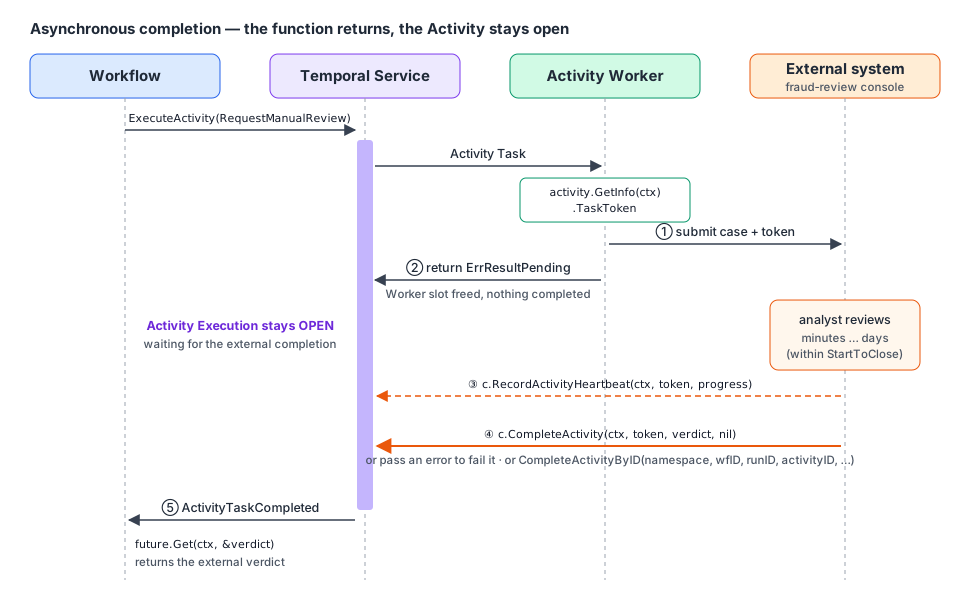
Keeping a Worker goroutine blocked for hours is wasteful and fragile. Asynchronous Activity Completion lets the Activity function return without completing the Activity Execution. The Execution stays open in the Service. Later, any process with a Temporal Client can heartbeat it and complete it (or fail it) with the real result.
2. Three steps
- The Activity gives the external system what it needs to identify the Execution: either the Task Token, or the Namespace + Workflow ID + Activity ID (for Standalone Activities: Namespace + Activity ID).
- The Activity returns
activity.ErrResultPending. This means "not done yet, someone else will finish me". - The external system calls the Temporal Client:
RecordActivityHeartbeatwhile it works, thenCompleteActivitywith a result or an error.
Step 1 & 2: the Activity
// file: fraudreview/activities.go
package fraudreview

import (
	"context"

	"go.temporal.io/sdk/activity"
)

type ReviewCase struct {
	OrderID     string
	CustomerID  string
	AmountCents int64
	RiskScore   float64
}

type ReviewVerdict struct {
	Approved  bool
	AnalystID string
	Comment   string
}

// ReviewQueue is the back-office system analysts work from (a DB table, a Jira project...).
type ReviewQueue interface {
	Submit(ctx context.Context, taskToken []byte, c ReviewCase) error
}

type ReviewActivities struct {
	Queue ReviewQueue
}

// RequestManualReview opens a case for a human and returns WITHOUT a result.
func (a *ReviewActivities) RequestManualReview(ctx context.Context, c ReviewCase) (ReviewVerdict, error) {
	// 1) Get the information needed to complete this Activity later.
	taskToken := activity.GetInfo(ctx).TaskToken

	// 2) Hand it to the external system.
	if err := a.Queue.Submit(ctx, taskToken, c); err != nil {
		return ReviewVerdict{}, err // normal failure: retried by the Retry Policy
	}

	// 3) Tell the SDK the result will arrive asynchronously.
	return ReviewVerdict{}, activity.ErrResultPending
}
The Workflow: nothing special, except the timeouts
From the Workflow's point of view it is a normal Activity call that just takes a long time. Size Start-To-Close for how long the human may take. Set an explicit ActivityID if the external side completes by ID.
// file: fraudreview/workflow.go
package fraudreview

import (
	"time"

	"go.temporal.io/sdk/temporal"
	"go.temporal.io/sdk/workflow"
)

func ManualReviewActivityID(orderID string) string { return "manual-review-" + orderID }

func HighRiskOrderWorkflow(ctx workflow.Context, c ReviewCase) (ReviewVerdict, error) {
	ctx = workflow.WithActivityOptions(ctx, workflow.ActivityOptions{
		ActivityID:          ManualReviewActivityID(c.OrderID),
		StartToCloseTimeout: 48 * time.Hour, // the analyst SLA
		HeartbeatTimeout:    2 * time.Hour,  // the console must ping at least every 2h
		RetryPolicy:         &temporal.RetryPolicy{MaximumAttempts: 3},
	})

	var a *ReviewActivities
	var verdict ReviewVerdict
	if err := workflow.ExecuteActivity(ctx, a.RequestManualReview, c).Get(ctx, &verdict); err != nil {
		return ReviewVerdict{}, err
	}
	return verdict, nil
}
Step 3: the external system completes the Activity
// file: cmd/review-console/main.go
package main

import (
	"context"
	"log"

	"github.com/acme/shop/fraudreview"
	"go.temporal.io/sdk/client"
	"go.temporal.io/sdk/temporal"
)

// ReviewConsole is the back-office service. It is NOT a Temporal Worker; it only holds a Client.
// The client is heavyweight: create it once per process.
type ReviewConsole struct {
	Temporal client.Client
}

// OnAnalystStillWorking is called periodically (e.g. when the analyst opens the case).
func (r *ReviewConsole) OnAnalystStillWorking(ctx context.Context, taskToken []byte, note string) error {
	return r.Temporal.RecordActivityHeartbeat(ctx, taskToken, note)
}

// OnAnalystDecision completes the Activity with the verdict.
func (r *ReviewConsole) OnAnalystDecision(ctx context.Context, taskToken []byte, v fraudreview.ReviewVerdict) error {
	// The result type must match the Activity's declared return type (ReviewVerdict).
	return r.Temporal.CompleteActivity(ctx, taskToken, v, nil)
}

// OnCaseInvalid fails the Activity. A non-retryable error stops the Retry Policy from
// starting another attempt (which would otherwise give the console a NEW task token).
func (r *ReviewConsole) OnCaseInvalid(ctx context.Context, taskToken []byte, reason string) error {
	failure := temporal.NewNonRetryableApplicationError(reason, "ReviewRejected", nil)
	return r.Temporal.CompleteActivity(ctx, taskToken, nil, failure)
}

func main() {
	c, err := client.Dial(client.Options{})
	if err != nil {
		log.Fatalln(err)
	}
	defer c.Close()
	console := &ReviewConsole{Temporal: c}
	_ = console // wire to your HTTP handlers / UI
}
CompleteActivity(ctx, taskToken, result, err):
taskToken: the binaryTaskTokenfromactivity.GetInfo(ctx)result: the value to record. Its type must match the Activity's return type.err: if notnil, the Activity fails andresultis ignored. A retryable error starts a new attempt under the Retry Policy, and that attempt has a new Task Token. A non-retryable error fails the Activity for good.
Completing by ID instead of Task Token
A Task Token belongs to one attempt. If the Activity fails after handing out its token but before returning ErrResultPending, it is retried, and the external system now holds a stale token. To avoid this, give the external system stable IDs instead:
// file: fraudreview/complete_by_id.go
package fraudreview

import (
	"context"

	"go.temporal.io/sdk/client"
)

// Workflow Activity: identify it by Namespace + Workflow ID (+ optional Run ID) + Activity ID.
func CompleteReviewByID(ctx context.Context, c client.Client, namespace, workflowID, orderID string, v ReviewVerdict) error {
	runID := "" // empty = latest Run of the Workflow
	return c.CompleteActivityByID(ctx, namespace, workflowID, runID, ManualReviewActivityID(orderID), v, nil)
}

// Standalone Activity: identify it by Namespace + Activity ID (+ optional Activity Run ID).
func CompleteStandaloneReviewByID(ctx context.Context, c client.Client, namespace, activityID string, v ReviewVerdict) error {
	return c.CompleteActivityByActivityID(ctx, namespace, activityID, "", v, nil)
}
📝 In the Go SDK,
CompleteActivityByIDworks only for Workflow Activities. UseCompleteActivityByActivityIDfor Standalone Activities (async completion works for both).
3. Async completion vs. Signals vs. polling
When an external system has the final result, there are three ways to get it to the Workflow:
| # | Approach | How |
|---|---|---|
| 1 | Async completion | The external system completes the Activity with the result |
| 2 | Signal | The Activity completes normally (without the result). Later, the external system Signals the Workflow with the result |
| 3 | Polling | A later Activity polls the external system for the result |
If you can't change the external system: poll (#3), or, if it can reliably call a webhook and retry on failure, write a webhook handler that Signals the Workflow (#2).
Choose #1 Async completion when:
- the external system is unreliable and might fail to Signal, or
- you want the external process to heartbeat or receive cancellation.
Otherwise, if it reliably Signals back and needs neither heartbeats nor cancellation, prefer Signals. The reason is retry timing:
| Human review that can take up to a week | Async completion | Signal |
|---|---|---|
| Start-To-Close on the Activity | 1 week | 1 minute |
| Activity notifies the review system and… | returns ErrResultPending | completes immediately |
| If the notification silently fails (the Worker dies) | the retry happens only after one week 😬 | the retry happens after one minute ✅ |
| Result delivered by | CompleteActivity | a Signal to the Workflow |
💡 Rule of thumb: async completion fits when the external party really takes part in the Activity's lifecycle (heartbeats, cancellation). For "notify and wait a long time", a short Activity plus a Signal recovers from failures faster.
Key takeaways
- Return
activity.ErrResultPendingto keep the Activity Execution open after the function returns. - Complete it from anywhere with a Client:
CompleteActivity(Task Token),CompleteActivityByID(Workflow Activity), orCompleteActivityByActivityID(Standalone). - Heartbeat from outside with
RecordActivityHeartbeat, and size Start-To-Close and Heartbeat timeouts for the external SLA. - Task Tokens change on every attempt. Prefer IDs if a retry could leave the external system with a stale token.
- For long human waits without heartbeat or cancellation needs, a Signal is often the better design.
⬅️ Previous: 07 · Local Activities · ➡️ Next: 09 · Dynamic Activities