08 · Worker Sessions
Level: advanced · Read time: ~15 min Sources: Go SDK — Worker Sessions · Task Routing and Worker Sessions ·
workflow.CreateSession
1. The problem
Chapter 07 pinned the transcoding steps to one GPU host by hand: a host-specific Task Queue, two Worker Entities per process, a Schedule-To-Start timeout to detect a dead host, a loop to start over. It works, but it's a lot of plumbing, and two things are still missing:
- A limit per host. A host with 4 GPUs should accept at most 4 videos at a time, whatever the number of Activities each video schedules.
- Fast failure detection. If the host dies between two steps, you want to know in seconds, not when a timeout you guessed expires.
The Go SDK packages this pattern as Worker Sessions. A Session is a group of Activities that the SDK guarantees run on the same Worker, without you naming any Task Queue. Sessions are Go only: the other SDKs use the manual pattern of chapter 07.
2. How a Session works
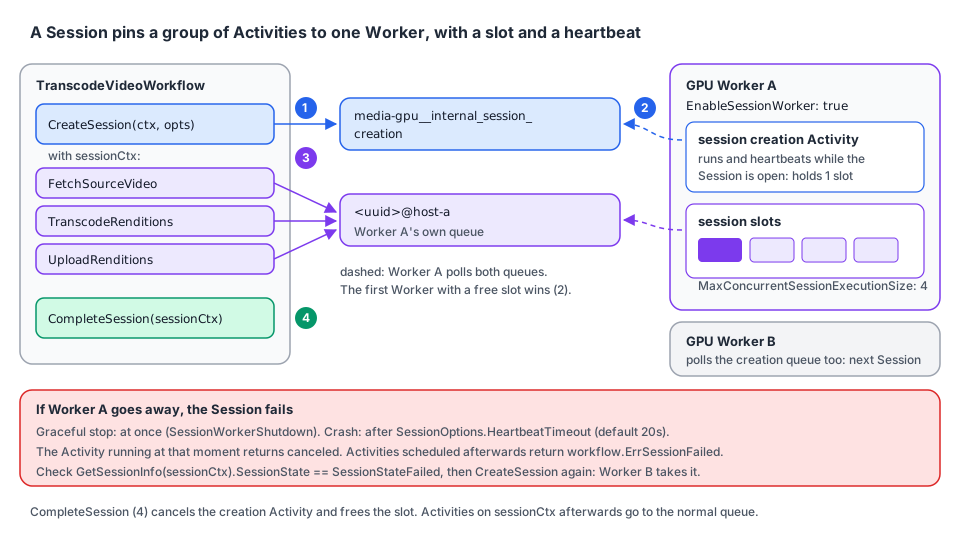
- The Worker opts in with
EnableSessionWorker: true. Besides its normal pollers, it then polls two internal queues:<task-queue>__internal_session_creationand a queue unique to this Worker (<uuid>@<hostname>). - The Workflow calls
workflow.CreateSession. The SDK schedules an internal session creation Activity on the creation queue. The first Worker with a free session slot takes it, and becomes the Session's Worker. - That creation Activity keeps running (and heartbeating) for the whole Session. It holds one of the Worker's
MaxConcurrentSessionExecutionSizeslots. - Every Activity scheduled with the returned session context goes to that Worker's unique queue.
workflow.CompleteSessioncancels the creation Activity and runs a completion Activity: the slot is released.
If the Worker goes away, the Session fails: its context is canceled, the Activities running in it are canceled, and new ExecuteActivity calls with the session context return workflow.ErrSessionFailed without being scheduled. How fast depends on how the Worker goes away:
- Graceful stop (
Stop(),SIGTERMthroughworker.InterruptCh()): the creation Activity fails at once withSessionWorkerShutdown(observed on a dev server). - Crash or network loss: the creation Activity stops heartbeating, and the Session fails after its
HeartbeatTimeout(20s by default).
3. The API
| Call | What it does |
|---|---|
worker.Options{EnableSessionWorker: true} | This Worker accepts Sessions |
worker.Options{MaxConcurrentSessionExecutionSize: n} | Max open Sessions on this Worker. Default 1,000 |
workflow.CreateSession(ctx, &workflow.SessionOptions{…}) | Creates a Session on a Worker polling the Task Queue set in the ActivityOptions of ctx (or the Workflow's queue) |
workflow.SessionOptions | CreationTimeout (required): how long to wait for a Worker with a free slot. ExecutionTimeout (required): max Session lifetime. HeartbeatTimeout (optional, default 20s): how fast a dead Worker is detected |
workflow.CompleteSession(sessionCtx) | Releases the slot and cancels the session context. Safe on a failed Session: call it with defer |
workflow.GetSessionInfo(sessionCtx) | SessionID, HostName, SessionState. nil if the context has no Session |
workflow.ErrSessionFailed | Returned by ExecuteActivity(...).Get for Activities scheduled after the Session failed |
info.GetRecreateToken() + workflow.RecreateSession(ctx, token, opts) | Open a new Session on the same Worker in another run (after Continue-As-New) |
Rules worth remembering:
- If no Worker has a free slot,
CreateSessionkeeps trying untilCreationTimeout, then returns an error. - Calling
CreateSessionwith a context that already holds an open Session returns an error. - An Activity failing doesn't fail the Session. You handle Activity errors as usual and decide whether to complete the Session.
- When the Session fails during an Activity, that Activity's
Getreturns a canceled error, notErrSessionFailed. Checkworkflow.GetSessionInfo(sessionCtx).SessionState == workflow.SessionStateFailedto tell the two apart (seesessionErrorbelow). - After
CompleteSession, the context still works, but Activities go back to the normal Task Queue (any Worker).
4. Example: the transcoding pipeline with a Session
The same pipeline as chapter 07, section 3. Compare: no host queue name, no second Worker Entity, no Schedule-To-Start timeout, and a per-host limit.
// file: media/activities.go
package media

import (
	"context"
	"fmt"
	"os"
	"path/filepath"

	"go.temporal.io/sdk/activity"
)

const (
	CPUTaskQueue = "media"
	GPUTaskQueue = "media-gpu"
)

type Rendition struct {
	Name      string
	LocalPath string
}

type ObjectStore interface {
	Download(ctx context.Context, key, localPath string) error
	Upload(ctx context.Context, localPath, key string) (url string, err error)
}

type Transcoder interface {
	Transcode(ctx context.Context, sourcePath, outDir, profile string) (string, error)
}

// GPUActivities run on GPU Workers, inside a Session.
type GPUActivities struct {
	Store      ObjectStore
	Transcoder Transcoder
	ScratchDir string
}

func (a *GPUActivities) FetchSourceVideo(ctx context.Context, videoID, sourceKey string) (string, error) {
	path := filepath.Join(a.ScratchDir, videoID, "source.mp4")
	if err := os.MkdirAll(filepath.Dir(path), 0o755); err != nil {
		return "", err
	}
	if err := a.Store.Download(ctx, sourceKey, path); err != nil {
		return "", fmt.Errorf("download %s: %w", sourceKey, err)
	}
	return path, nil
}

func (a *GPUActivities) TranscodeRenditions(ctx context.Context, sourcePath string, profiles []string) ([]Rendition, error) {
	out := make([]Rendition, 0, len(profiles))
	for _, p := range profiles {
		path, err := a.Transcoder.Transcode(ctx, sourcePath, filepath.Dir(sourcePath), p)
		if err != nil {
			return nil, fmt.Errorf("transcode %s: %w", p, err)
		}
		out = append(out, Rendition{Name: p, LocalPath: path})
		activity.RecordHeartbeat(ctx, p)
	}
	return out, nil
}

func (a *GPUActivities) UploadRenditions(ctx context.Context, videoID string, renditions []Rendition) (map[string]string, error) {
	urls := make(map[string]string, len(renditions))
	for _, r := range renditions {
		url, err := a.Store.Upload(ctx, r.LocalPath, fmt.Sprintf("videos/%s/%s.mp4", videoID, r.Name))
		if err != nil {
			return nil, err
		}
		urls[r.Name] = url
	}
	return urls, os.RemoveAll(filepath.Join(a.ScratchDir, videoID))
}// file: media/workflow.go
package media
import (
"errors"
"time"
"go.temporal.io/sdk/workflow"
)
type TranscodeVideoInput struct {
VideoID string
SourceKey string
Profiles []string
}
func TranscodeVideoWorkflow(ctx workflow.Context, in TranscodeVideoInput) (map[string]string, error) {
logger := workflow.GetLogger(ctx)
var urls map[string]string
var err error
for attempt := 1; attempt <= 3; attempt++ {
urls, err = transcodeInSession(ctx, in)
if !errors.Is(err, workflow.ErrSessionFailed) {
break
}
// The GPU Worker died: its local files are gone. Start over on another Worker.
logger.Warn("GPU session failed, retrying on another Worker", "attempt", attempt)
}
if err != nil {
return nil, err
}
cpuCtx := workflow.WithActivityOptions(ctx, workflow.ActivityOptions{StartToCloseTimeout: 30 * time.Second})
err = workflow.ExecuteActivity(cpuCtx, "PublishCatalogEntry", in.VideoID, urls).Get(ctx, nil)
return urls, err
}
func transcodeInSession(ctx workflow.Context, in TranscodeVideoInput) (map[string]string, error) {
// The Session is created on a Worker polling the Task Queue of these ActivityOptions.
ctx = workflow.WithActivityOptions(ctx, workflow.ActivityOptions{
TaskQueue: GPUTaskQueue,
StartToCloseTimeout: 2 * time.Hour,
HeartbeatTimeout: 2 * time.Minute,
})
sessionCtx, err := workflow.CreateSession(ctx, &workflow.SessionOptions{
CreationTimeout: 30 * time.Minute, // wait up to 30 min for a free GPU slot
ExecutionTimeout: 3 * time.Hour, // the whole video, all steps
HeartbeatTimeout: 30 * time.Second, // detect a dead GPU Worker within ~30s
})
if err != nil {
return nil, err
}
defer workflow.CompleteSession(sessionCtx)
info := workflow.GetSessionInfo(sessionCtx)
workflow.GetLogger(ctx).Info("transcoding session open", "sessionID", info.SessionID, "host", info.HostName)
var a *GPUActivities
var sourcePath string
if err := workflow.ExecuteActivity(sessionCtx, a.FetchSourceVideo, in.VideoID, in.SourceKey).Get(sessionCtx, &sourcePath); err != nil {
return nil, sessionError(sessionCtx, err)
}
var renditions []Rendition
if err := workflow.ExecuteActivity(sessionCtx, a.TranscodeRenditions, sourcePath, in.Profiles).Get(sessionCtx, &renditions); err != nil {
return nil, sessionError(sessionCtx, err)
}
var urls map[string]string
err = workflow.ExecuteActivity(sessionCtx, a.UploadRenditions, in.VideoID, renditions).Get(sessionCtx, &urls)
return urls, sessionError(sessionCtx, err)
}
// sessionError turns any Activity error caused by the Session's Worker going away into
// ErrSessionFailed. An Activity that was running at that moment returns a *canceled*
// error, not ErrSessionFailed: only the calls made after the failure get ErrSessionFailed.
func sessionError(sessionCtx workflow.Context, err error) error {
if err != nil && workflow.GetSessionInfo(sessionCtx).SessionState == workflow.SessionStateFailed {
return workflow.ErrSessionFailed
}
return err
}The GPU Worker: one Worker Entity, Sessions enabled, at most 4 videos at a time on this host.
// file: cmd/gpu-worker/main.go
package main

import (
	"context"
	"log"
	"os"
	"path/filepath"

	"go.temporal.io/sdk/client"
	"go.temporal.io/sdk/worker"

	"github.com/acme/shop/media"
)

type localStore struct{}

func (localStore) Download(_ context.Context, _, localPath string) error {
	return os.WriteFile(localPath, []byte("video"), 0o644)
}
func (localStore) Upload(_ context.Context, _, key string) (string, error) {
	return "https://cdn.example/" + key, nil
}

type fakeTranscoder struct{}

func (fakeTranscoder) Transcode(_ context.Context, _, outDir, profile string) (string, error) {
	return filepath.Join(outDir, profile+".mp4"), nil
}

func main() {
	c, err := client.Dial(client.Options{})
	if err != nil {
		log.Fatalln("unable to create Temporal client", err)
	}
	defer c.Close()

	w := worker.New(c, media.GPUTaskQueue, worker.Options{
		DisableWorkflowWorker:             true,
		EnableSessionWorker:               true,
		MaxConcurrentSessionExecutionSize: 4, // one video per GPU
	})
	w.RegisterActivity(&media.GPUActivities{
		Store:      localStore{},
		Transcoder: fakeTranscoder{},
		ScratchDir: filepath.Join(os.TempDir(), "transcode"),
	})

	if err := w.Run(worker.InterruptCh()); err != nil {
		log.Fatalln("gpu worker stopped", err)
	}
}
The media Worker that runs the Workflow and PublishCatalogEntry is the same as in chapter 07.
Checked on a dev server (Temporal CLI 1.9.1, Go SDK v1.50.0) with two GPU Workers: all three Activities of a video ran on the Worker that opened the Session. When that Worker was stopped during TranscodeRenditions, the Activity returned canceled and the Session state was Failed: sessionError turned it into ErrSessionFailed, and the loop opened a new Session on the other Worker and completed. Without sessionError, the Workflow failed with the canceled error. The Go page's sample has the same gap: it returns the Activity error as is.
5. Long Sessions and Continue-As-New
A Workflow that transcodes a whole 500-episode back-catalog on one host would grow a huge Event History. Split it with Continue-As-New, and use a recreate token so the next run gets a Session on the same Worker (whose disk still has the cached intro/outro assets):
// file: media/backcatalog.go
package media

import (
	"time"

	"go.temporal.io/sdk/workflow"
)

type BackCatalogInput struct {
	SeriesID      string
	EpisodeKeys   []string
	Profiles      []string
	RecreateToken []byte // set by the previous run
}

const episodesPerRun = 50

func TranscodeBackCatalogWorkflow(ctx workflow.Context, in BackCatalogInput) error {
	ctx = workflow.WithActivityOptions(ctx, workflow.ActivityOptions{
		TaskQueue:           GPUTaskQueue,
		StartToCloseTimeout: 2 * time.Hour,
		HeartbeatTimeout:    2 * time.Minute,
	})
	opts := &workflow.SessionOptions{CreationTimeout: time.Hour, ExecutionTimeout: 24 * time.Hour}

	var sessionCtx workflow.Context
	var err error
	if in.RecreateToken != nil {
		sessionCtx, err = workflow.RecreateSession(ctx, in.RecreateToken, opts)
	} else {
		sessionCtx, err = workflow.CreateSession(ctx, opts)
	}
	if err != nil {
		return err
	}

	var a *GPUActivities
	n := min(episodesPerRun, len(in.EpisodeKeys))
	for _, key := range in.EpisodeKeys[:n] {
		var src string
		if err := workflow.ExecuteActivity(sessionCtx, a.FetchSourceVideo, in.SeriesID, key).Get(sessionCtx, &src); err != nil {
			workflow.CompleteSession(sessionCtx)
			return err
		}
		if err := workflow.ExecuteActivity(sessionCtx, a.TranscodeRenditions, src, in.Profiles).Get(sessionCtx, nil); err != nil {
			workflow.CompleteSession(sessionCtx)
			return err
		}
	}

	token := workflow.GetSessionInfo(sessionCtx).GetRecreateToken()
	workflow.CompleteSession(sessionCtx)
	if n == len(in.EpisodeKeys) {
		return nil
	}
	return workflow.NewContinueAsNewError(ctx, TranscodeBackCatalogWorkflow, BackCatalogInput{
		SeriesID:      in.SeriesID,
		EpisodeKeys:   in.EpisodeKeys[n:],
		Profiles:      in.Profiles,
		RecreateToken: token,
	})
}
Checked on a dev server with two session-enabled GPU Workers: 120 episodes, three runs chained by Continue-As-New, and all 120 downloads ran on the same Worker.
RecreateSession returns errors in the same cases as CreateSession (no free slot before CreationTimeout), and also when the token can't be decoded.
6. Limits and caveats
| Topic | What to know |
|---|---|
| Scope of the limit | MaxConcurrentSessionExecutionSize is counted per Worker that has EnableSessionWorker (each gets its own internal ID). The docs' FAQ says "per Worker Process", which is the same thing if you run one session-enabled Worker per process, as advised |
| Default limit | The Go page says the default is "a very large value". In SDK v1.50.0 it is 1,000 (defaultMaxConcurrentSessionExecutionSize) |
| Worker restarts | A restarted process is a new Worker: open Sessions on the old one fail. The docs list automatic re-establishment as future work |
| One resource type | All Sessions consume the same kind of slot. You can't say "this Session needs a GPU, that one only disk" (also listed as future work) |
| Worker Versioning | The SDK panics on EnableSessionWorker + the deprecated UseBuildIDForVersioning (cannot set both EnableSessionWorker and UseBuildIDForVersioning, see sdk-go#1227). With the current DeploymentOptions.UseVersioning, worker.New accepts it and the SDK unversions the Worker's internal session queue, but no doc page covers Sessions with Worker Versioning (chapter 11). Test it before relying on it |
7. Key takeaways
- A Session pins a group of Activities to one Worker, without naming Task Queues. Go only.
- Enable it on the Worker (
EnableSessionWorker), cap it withMaxConcurrentSessionExecutionSize(default 1,000, per session-enabled Worker). CreateSessionuses the Task Queue of the context's ActivityOptions. Alwaysdefer workflow.CompleteSession(sessionCtx).- A Worker that stops fails its Sessions at once. A crashed one is detected after the Session's
HeartbeatTimeout(default 20s). - The Activity running at that moment returns canceled, later ones
ErrSessionFailed: checkSessionState == SessionStateFailed, then start over with a new Session. GetRecreateToken+RecreateSessioncarry a Session's Worker across Continue-As-New.