12 · Serverless Workers: Workers that Temporal starts for you
Level: production · Read time: ~20 min Sources: Encyclopedia — Serverless Workers · Go SDK — Serverless Workers · linked from it: AWS Lambda, GCP Cloud Run
Public Preview. AWS Lambda and GCP Cloud Run support are in Public Preview (Amazon Bedrock AgentCore Runtime is Pre-release). APIs and configuration may change.
1. The problem
The invoicing team runs one Workflow per customer at month-end: a huge burst on the 1st, then almost nothing for four weeks. A fleet of long-lived Workers sized for the 1st sits idle 29 days a month. Sized for the quiet days, it falls behind on the 1st.
A Serverless Worker is a normal Temporal Worker (same SDK, same registration) that runs on serverless compute. Temporal starts Workers when Tasks wait on the Task Queue and stops them when the work drains. You don't run or scale a Worker process.
2. How it works
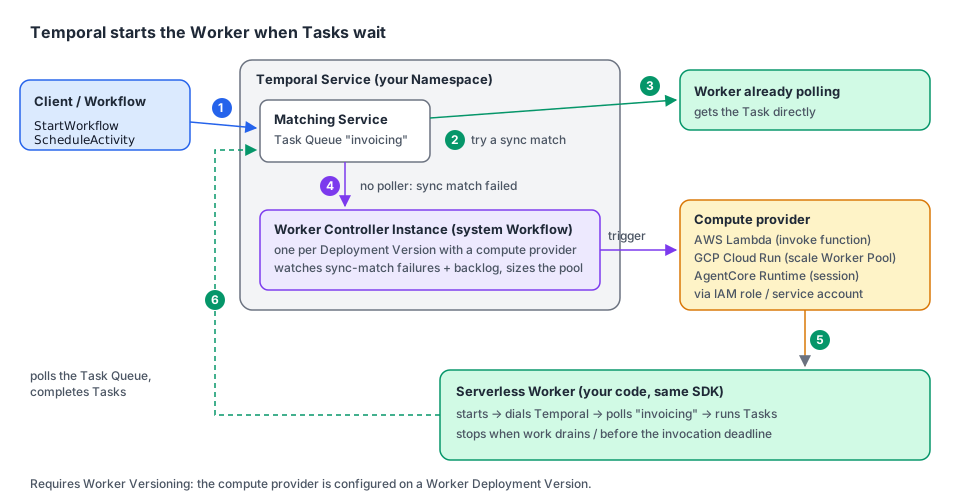
The pieces:
| Piece | Role |
|---|---|
| Compute provider | Configuration on a Worker Deployment Version (chapter 11): provider type, what to invoke (Lambda ARN, Cloud Run Worker Pool…), and the credentials Temporal uses (an IAM role to assume, a service account to impersonate). |
| Worker Controller Instance (WCI) | A system Workflow, one per Version with a compute provider, in your Namespace. It watches the Task Queue and adds or removes Workers. ID: temporal-sys-worker-controller-instance:<deployment>:<build-id>. |
| Your Worker | Started by the provider. It creates a Client, polls, processes Tasks, then stops. |
The invocation flow:
- A Task is created (
StartWorkflow,ScheduleActivity…). - The Matching Service tries to hand it straight to a polling Worker (sync match).
- If one is polling, done.
- If none is (sync match fails), Matching signals the WCI, which triggers the compute provider.
- The Serverless Worker starts, dials Temporal, polls the Task Queue.
- It processes Tasks.
Sync-match failures are one signal. The WCI also reacts to the backlog, and, depending on the provider, periodically resizes the pool from the rate of incoming work.
You can inspect the WCIs like any Workflow:
temporal workflow list \
  --query 'TemporalNamespaceDivision = "TemporalWorkerControllerInstance"'
Compute providers
| Provider | Execution model | Activity duration limit | Worker code |
|---|---|---|---|
| AWS Lambda | Short invocations: start, poll, drain before the deadline | 15 min (Lambda max) minus the shutdown buffer | lambdaworker package |
| Amazon Bedrock AgentCore Runtime (Pre-release) | Sessions with idle and max-lifetime limits | 8 h session lifetime | Standard Worker |
| GCP Cloud Run | A Worker Pool of long-lived instances that Temporal scales | none per invocation | Standard Worker |
Serverless and long-lived Workers can share a Task Queue. How the WCI accounts for the long-lived ones depends on the provider (see the provider pages).
3. Constraints
| Constraint | Detail |
|---|---|
| Worker Versioning is required | Every Serverless Worker belongs to a Worker Deployment Version, and every Workflow needs a Pinned or AutoUpgrade behavior. Each Version must invoke an immutable build (a Lambda version/alias, a Cloud Run image digest). |
| Activity duration | Per provider (table above). |
| Workflow duration | Unlimited: a Workflow runs across as many Workers as needed. |
| Multi-cloud Replication | Not supported during Preview: after a failover to another cloud, Serverless Workers can't be invoked. |
| Multi-region Replication | The compute provider is regional: after a failover, the WCI keeps invoking the original region until you repoint it. |
4. Failure handling
Serverless Workers rely on the usual Temporal guarantees:
| What happens | Effect |
|---|---|
| A Worker crashes (OOM, panic, killed) | The Activity times out and is retried on another Worker. Nothing to do manually. |
| The provider's concurrency limit is hit (Lambda account concurrency, Cloud Run max instances) | The WCI can't add Workers. Tasks wait in the backlog. No data loss, just slower. |
| One Activity exhausts memory | It can take down the other Activities on the same Worker. To isolate: put Activities in their own Worker Deployment and set Activity slots to 1 (MaxConcurrentActivityExecutionSize: 1). |
So the same habits as chapter 10 apply, more strongly: short Activities, heartbeats with checkpoints, a HeartbeatTimeout.
5. AWS Lambda in Go: lambdaworker
The package go.temporal.io/sdk/contrib/aws/lambdaworker (v0.1.1) turns a Lambda function into a Worker. Each invocation dials Temporal, starts a Worker, polls until shortly before the invocation deadline, stops the Worker, runs your shutdown hooks, and returns.
The Workflow and Activities are ordinary code:
// file: invoicing/workflow.go
package invoicing

import (
	"context"
	"fmt"
	"time"

	"go.temporal.io/sdk/workflow"
)

const TaskQueue = "invoicing"

type MonthlyInvoiceInput struct {
	CustomerID string
	Month      string // "2026-10"
}

type Activities struct{}

func (a *Activities) ComputeUsage(ctx context.Context, in MonthlyInvoiceInput) (int64, error) {
	return 4200, nil
}

func (a *Activities) RenderInvoicePDF(ctx context.Context, in MonthlyInvoiceInput, amountCents int64) (string, error) {
	return fmt.Sprintf("s3://acme-invoices/%s/%s.pdf", in.Month, in.CustomerID), nil
}

func MonthlyInvoiceWorkflow(ctx workflow.Context, in MonthlyInvoiceInput) (string, error) {
	ctx = workflow.WithActivityOptions(ctx, workflow.ActivityOptions{
		StartToCloseTimeout: 2 * time.Minute, // well under the Lambda limit
		HeartbeatTimeout:    20 * time.Second,
	})
	var a *Activities
	var amount int64
	if err := workflow.ExecuteActivity(ctx, a.ComputeUsage, in).Get(ctx, &amount); err != nil {
		return "", err
	}
	var pdf string
	err := workflow.ExecuteActivity(ctx, a.RenderInvoicePDF, in, amount).Get(ctx, &pdf)
	return pdf, err
}
The Lambda entry point:
// file: cmd/invoicing-lambda/main.go
package main

import (
	"context"
	"log"
	"time"

	"github.com/acme/shop/invoicing"
	"go.temporal.io/sdk/contrib/aws/lambdaworker"
	"go.temporal.io/sdk/worker"
	"go.temporal.io/sdk/workflow"
)

// buildID is set at build time: go build -ldflags "-X main.buildID=$GIT_SHA"
var buildID = "dev"

func main() {
	lambdaworker.RunWorker(worker.WorkerDeploymentVersion{
		DeploymentName: "shop-invoicing",
		BuildID:        buildID,
	}, func(opts *lambdaworker.Options) error {
		opts.TaskQueue = invoicing.TaskQueue // or the TEMPORAL_TASK_QUEUE env var

		// Give in-flight Activities 20s to finish when the invocation ends, and move the
		// shutdown start accordingly: the buffer is NOT recomputed from WorkerStopTimeout.
		opts.WorkerOptions.WorkerStopTimeout = 20 * time.Second
		opts.ShutdownDeadlineBuffer = opts.WorkerOptions.WorkerStopTimeout + 2*time.Second

		opts.RegisterWorkflowWithOptions(invoicing.MonthlyInvoiceWorkflow, workflow.RegisterOptions{
			VersioningBehavior: workflow.VersioningBehaviorPinned,
		})
		opts.RegisterActivity(&invoicing.Activities{})

		opts.OnShutdown(func(ctx context.Context) error {
			log.Println("invocation done, flushing telemetry")
			return nil
		})
		return nil
	})
}
What lambdaworker does for you (checked in the v0.1.1 source):
| Behavior | Detail |
|---|---|
| Versioning | Always on: UseVersioning = true, Version = the one you pass. An empty Version is a fatal error. |
| Connection | Loaded with envconfig from env vars and an optional TOML file: $TEMPORAL_CONFIG_FILE, else $LAMBDA_TASK_ROOT/temporal.toml, else ./temporal.toml. |
| Task Queue | opts.TaskQueue, pre-filled from TEMPORAL_TASK_QUEUE if set (the Go page doesn't mention this variable). Missing both is a fatal error. |
| Identity | <aws-request-id>@<function-arn> per invocation, unless you set ClientOptions.Identity. |
| Logger | JSON slog to stderr if you don't set one. |
| Fatal config errors | Printed to stderr, then os.Exit(1). |
| Too-short timeout | The invocation fails if the Lambda timeout leaves ≤ 1s of work after the buffer. It warns below 5s. |
Lambda-tuned defaults (applied only to fields you leave at zero, except eager Activities):
| Setting | Lambda default | Standard Worker default |
|---|---|---|
MaxConcurrentActivityExecutionSize | 2 | 1,000 |
MaxConcurrentWorkflowTaskExecutionSize | 10 | 1,000 |
MaxConcurrentLocalActivityExecutionSize | 2 | 1,000 |
MaxConcurrentNexusTaskExecutionSize | 5 | 1,000 |
MaxConcurrentActivityTaskPollers / …WorkflowTaskPollers / …NexusTaskPollers | 1 / 2 / 1 | 2 / 2 / 2 |
WorkerStopTimeout | 5s | 0 |
DisableEagerActivities | always true (can't be overridden) | false |
| Sticky cache size | 100 | 10,000 |
ShutdownDeadlineBuffer | WorkerStopTimeout + 2s, computed before your callback | — |
Gotcha. The Go page says the buffer's default "is
WorkerStopTimeout+ 2 seconds". It is computed once, from the 5s default, before your configure callback runs. If you raiseopts.WorkerOptions.WorkerStopTimeoutin the callback, also raiseopts.ShutdownDeadlineBuffer(the package's own doc comment says so). Otherwise the Worker starts stopping only 7s before the deadline and Lambda kills it mid-drain. Raise the Lambda--timeoutwith them.
For metrics and traces, go.temporal.io/sdk/contrib/aws/lambdaworker/otel has otel.ApplyDefaults(opts, &opts.ClientOptions, otel.Options{}), which exports to the ADOT Lambda layer's collector on localhost:4317.
6. GCP Cloud Run in Go: a standard versioned Worker
On Cloud Run, the Worker is a normal long-lived process in a Worker Pool. Temporal only changes how many instances run. The one requirement is Worker Versioning:
// file: cmd/invoicing-cloudrun/main.go
package main

import (
	"log"
	"os"
	"time"

	"github.com/acme/shop/invoicing"
	"go.temporal.io/sdk/client"
	"go.temporal.io/sdk/contrib/envconfig"
	"go.temporal.io/sdk/worker"
	"go.temporal.io/sdk/workflow"
)

func main() {
	opts, err := envconfig.LoadDefaultClientOptions() // TEMPORAL_ADDRESS, TEMPORAL_NAMESPACE, TEMPORAL_API_KEY…
	if err != nil {
		log.Fatalln("invalid Temporal configuration:", err)
	}
	c, err := client.Dial(opts)
	if err != nil {
		log.Fatalln("unable to create Temporal client:", err)
	}
	defer c.Close()

	w := worker.New(c, invoicing.TaskQueue, worker.Options{
		WorkerStopTimeout: 8 * time.Second, // Cloud Run sends SIGTERM 10s before SIGKILL
		DeploymentOptions: worker.DeploymentOptions{
			UseVersioning: true,
			Version: worker.WorkerDeploymentVersion{
				DeploymentName: "shop-invoicing",
				BuildID:        os.Getenv("BUILD_ID"), // must match `temporal worker deployment create-version`
			},
			DefaultVersioningBehavior: workflow.VersioningBehaviorPinned,
		},
	})
	w.RegisterWorkflow(invoicing.MonthlyInvoiceWorkflow)
	w.RegisterActivity(&invoicing.Activities{})

	if err := w.Run(worker.InterruptCh()); err != nil {
		log.Fatalln("worker stopped:", err)
	}
}
The WCI decides to scale in from Task Queue activity, not from what one instance is doing, so an instance can be stopped in the middle of a long Activity. Heartbeat a checkpoint so the retry resumes:
// file: invoicing/batch.go
package invoicing

import (
	"context"

	"go.temporal.io/sdk/activity"
)

// SendInvoiceEmails sends one email per customer, resuming after the last one sent.
func (a *Activities) SendInvoiceEmails(ctx context.Context, customerIDs []string) (int, error) {
	start := 0
	if activity.HasHeartbeatDetails(ctx) {
		var last int
		if err := activity.GetHeartbeatDetails(ctx, &last); err == nil {
			start = last + 1
		}
	}
	for i := start; i < len(customerIDs); i++ {
		if err := ctx.Err(); err != nil {
			return i, err
		}
		// … send the email for customerIDs[i] …
		activity.RecordHeartbeat(ctx, i)
	}
	return len(customerIDs), nil
}
For a meaningful Worker identity on Cloud Run, the Go page uses the go.temporal.io/sdk/contrib/gcp/cloudrun/id plugin (id.NewCloudRunIDPlugin(), identity <instance-id>@<revision>), added to client.Options.Plugins. It needs the Cloud Run metadata server, so it fails when run elsewhere.
7. When to use Serverless Workers
| Choose Serverless when… | Stay with long-lived Workers when… |
|---|---|
| Load is bursty or mostly idle | Load is steady: always-on is cheaper and has no cold start |
| You don't want to operate a Worker fleet | You need large in-memory caches (sticky cache is tiny on Lambda) |
| Activities are short (Lambda) or you use Cloud Run | Activities run longer than 15 minutes and you want Lambda |
| You already use Worker Versioning, or are ready to | You need Multi-cloud Replication today |
8. Key takeaways
- A Serverless Worker is a regular Worker whose lifecycle Temporal manages: the WCI system Workflow starts Workers through a compute provider when Tasks wait, and removes them as work drains.
- Worker Versioning is mandatory: the compute provider lives on a Worker Deployment Version, and every Workflow needs
PinnedorAutoUpgrade. - Lambda: use
lambdaworker.RunWorker. Its defaults are small. If you raiseWorkerStopTimeout, raiseShutdownDeadlineBufferand the Lambda timeout too. - Cloud Run: a standard versioned Worker. Expect scale-in in the middle of an Activity: heartbeat a checkpoint.
- Crashes become Activity retries and capacity limits become backlog. Nothing is lost.
- Back to the roadmap.