07 · Task Routing: sending work to the right Workers
Level: advanced · Read time: ~18 min Sources: Task Routing and Worker Sessions · Task Queues · Go file processing sample
1. The problem
By default, every Activity of a Workflow runs on whichever Worker polls the Workflow's Task Queue first (chapter 03). That's what you want most of the time. But some work can't run "anywhere":
- Transcoding needs a GPU. Your GPU boxes are expensive and few.
- Card data may only be processed inside the PCI-compliant network.
- The transcoder writes a 4 GB file to local disk: the upload step must run on the same host.
- An Activity loads a 2 GB ML model into memory once: later calls should hit the same process.
- Premium customers' jobs should overtake the free tier's backlog.
Task Routing is the answer to all of these: you choose the Task Queue of each Activity (or Child Workflow), and you decide which Workers poll which queue. There is no other routing mechanism to learn.
2. The building block: one queue per kind of Worker
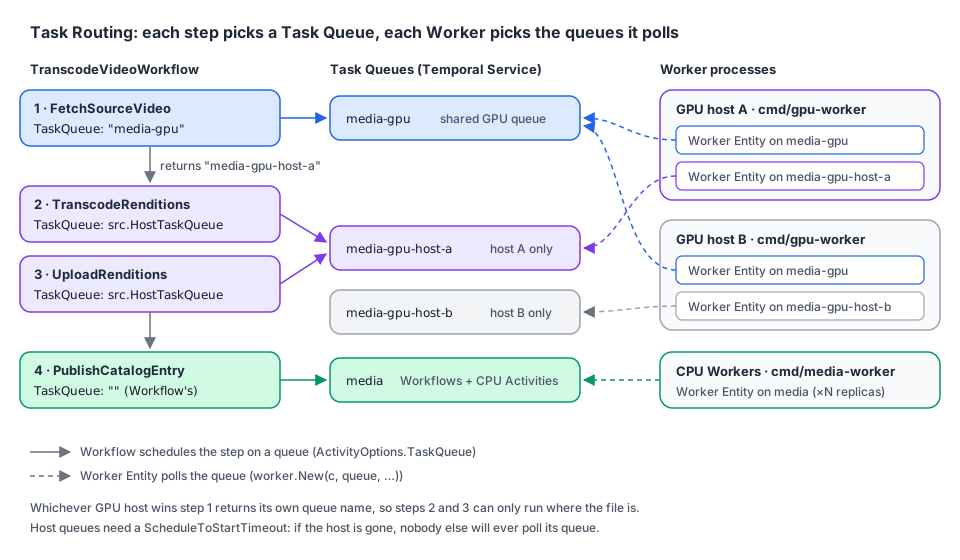
A Task Queue is just a name (chapter 03): a Workflow can schedule each Activity on any queue it wants with ActivityOptions.TaskQueue. The Activity inherits the Workflow's queue only when you leave it empty.
| Pattern | Task Queues | Who polls |
|---|---|---|
| Specific environment (GPU, PCI, a region, a data center) | one per environment: media-gpu, payments-pci | only Workers running in that environment |
| Specific host (files on local disk) | one per host: media-gpu-<hostname> | only the Worker on that host |
| Specific process (in-memory cache) | one per process: ml-<hostname>-<pid> | only that process |
| Priority | one per priority (reports-high, reports-low), or one queue with Priority | a Worker pool per queue, or one pool |
| Versioning | a new queue for a breaking change (billing-v2) | Workers with the new code |
All Workers on a given queue must register the same Activities (and Workflows) for that queue, or Tasks fail with "not found" until a Worker that knows them picks them up.
3. Example: a video-transcoding pipeline
The media team transcodes uploaded videos:
- Fetch the source video to local disk: needs a GPU box, any of them.
- Transcode it to several renditions: same host as step 1 (the file is there).
- Upload the renditions to object storage: same host again.
- Publish the catalog entry: any regular (CPU) Worker.
Steps 2 and 3 use a host-specific Task Queue. The trick is that step 1 returns the name of that queue: whichever GPU Worker downloads the file tells the Workflow where to send the rest.
3.1 Activities
// file: media/activities.go
package media

import (
	"context"
	"fmt"
	"os"
	"path/filepath"

	"go.temporal.io/sdk/activity"
)

const (
	// CPUTaskQueue is polled by the regular media Workers (and runs the Workflows).
	CPUTaskQueue = "media"
	// GPUTaskQueue is polled by every GPU Worker.
	GPUTaskQueue = "media-gpu"
)

// HostTaskQueue is the queue only the GPU Worker on this host polls.
func HostTaskQueue(hostname string) string { return GPUTaskQueue + "-" + hostname }

type FetchSourceResult struct {
	LocalPath     string
	HostTaskQueue string // where the next steps must run
}

type Rendition struct {
	Name      string // "1080p", "720p", …
	LocalPath string
}

// ObjectStore and Transcoder are external systems (fakes in tests).
type ObjectStore interface {
	Download(ctx context.Context, key, localPath string) error
	Upload(ctx context.Context, localPath, key string) (url string, err error)
}

type Transcoder interface {
	Transcode(ctx context.Context, sourcePath, outDir, profile string) (string, error)
}

// GPUActivities run on GPU Workers. HostTaskQueue is set at Worker startup.
type GPUActivities struct {
	Store         ObjectStore
	Transcoder    Transcoder
	ScratchDir    string
	HostTaskQueue string
}

func (a *GPUActivities) FetchSourceVideo(ctx context.Context, videoID, sourceKey string) (FetchSourceResult, error) {
	path := filepath.Join(a.ScratchDir, videoID, "source.mp4")
	if err := os.MkdirAll(filepath.Dir(path), 0o755); err != nil {
		return FetchSourceResult{}, err
	}
	if err := a.Store.Download(ctx, sourceKey, path); err != nil {
		return FetchSourceResult{}, fmt.Errorf("download %s: %w", sourceKey, err)
	}
	return FetchSourceResult{LocalPath: path, HostTaskQueue: a.HostTaskQueue}, nil
}

func (a *GPUActivities) TranscodeRenditions(ctx context.Context, sourcePath string, profiles []string) ([]Rendition, error) {
	out := make([]Rendition, 0, len(profiles))
	for _, p := range profiles {
		path, err := a.Transcoder.Transcode(ctx, sourcePath, filepath.Dir(sourcePath), p)
		if err != nil {
			return nil, fmt.Errorf("transcode %s: %w", p, err)
		}
		out = append(out, Rendition{Name: p, LocalPath: path})
		activity.RecordHeartbeat(ctx, p)
	}
	return out, nil
}

func (a *GPUActivities) UploadRenditions(ctx context.Context, videoID string, renditions []Rendition) (map[string]string, error) {
	urls := make(map[string]string, len(renditions))
	for _, r := range renditions {
		url, err := a.Store.Upload(ctx, r.LocalPath, fmt.Sprintf("videos/%s/%s.mp4", videoID, r.Name))
		if err != nil {
			return nil, err
		}
		urls[r.Name] = url
	}
	// The local files are no longer needed.
	return urls, os.RemoveAll(filepath.Join(a.ScratchDir, videoID))
}

// Catalog is the video catalog service.
type Catalog interface {
	Publish(ctx context.Context, videoID string, renditionURLs map[string]string) error
}

// CatalogActivities run on the regular (CPU) Workers.
type CatalogActivities struct {
	Catalog Catalog
}

func (a *CatalogActivities) PublishCatalogEntry(ctx context.Context, videoID string, urls map[string]string) error {
	return a.Catalog.Publish(ctx, videoID, urls)
}
3.2 The Workflow
// file: media/workflow.go
package media

import (
	"errors"
	"time"

	enumspb "go.temporal.io/api/enums/v1"
	"go.temporal.io/sdk/temporal"
	"go.temporal.io/sdk/workflow"
)

type TranscodeVideoInput struct {
	VideoID   string
	SourceKey string
	Profiles  []string
}

func TranscodeVideoWorkflow(ctx workflow.Context, in TranscodeVideoInput) (map[string]string, error) {
	var gpu *GPUActivities
	var catalog *CatalogActivities
	logger := workflow.GetLogger(ctx)

	var urls map[string]string
	var err error
	// If the GPU host dies between steps, its files are gone: start over on another host.
	for attempt := 1; attempt <= 3; attempt++ {
		urls, err = transcodeOnOneHost(ctx, gpu, in)
		if err == nil || !hostLost(err) {
			break
		}
		logger.Warn("GPU host lost, restarting on another host", "attempt", attempt, "error", err)
	}
	if err != nil {
		return nil, err
	}

	// Step 4 on the regular Workers: the Workflow's own Task Queue is used when TaskQueue is empty.
	cpuCtx := workflow.WithActivityOptions(ctx, workflow.ActivityOptions{StartToCloseTimeout: 30 * time.Second})
	err = workflow.ExecuteActivity(cpuCtx, catalog.PublishCatalogEntry, in.VideoID, urls).Get(ctx, nil)
	return urls, err
}

func transcodeOnOneHost(ctx workflow.Context, gpu *GPUActivities, in TranscodeVideoInput) (map[string]string, error) {
	// Step 1: any GPU Worker.
	fetchCtx := workflow.WithActivityOptions(ctx, workflow.ActivityOptions{
		TaskQueue:           GPUTaskQueue,
		StartToCloseTimeout: 10 * time.Minute,
	})
	var src FetchSourceResult
	if err := workflow.ExecuteActivity(fetchCtx, gpu.FetchSourceVideo, in.VideoID, in.SourceKey).Get(ctx, &src); err != nil {
		return nil, err
	}

	// Steps 2 and 3: only the Worker on the host that has the file.
	hostCtx := workflow.WithActivityOptions(ctx, workflow.ActivityOptions{
		TaskQueue: src.HostTaskQueue,
		// Nobody else polls this queue: if the host is gone, fail fast instead of waiting forever.
		ScheduleToStartTimeout: time.Minute,
		StartToCloseTimeout:    2 * time.Hour,
		HeartbeatTimeout:       2 * time.Minute,
	})
	var renditions []Rendition
	if err := workflow.ExecuteActivity(hostCtx, gpu.TranscodeRenditions, src.LocalPath, in.Profiles).Get(ctx, &renditions); err != nil {
		return nil, err
	}
	var urls map[string]string
	err := workflow.ExecuteActivity(hostCtx, gpu.UploadRenditions, in.VideoID, renditions).Get(ctx, &urls)
	return urls, err
}

// hostLost reports whether a host-pinned Activity was never picked up (the host is gone)
// or lost its heartbeat (the host died mid-way).
func hostLost(err error) bool {
	var timeoutErr *temporal.TimeoutError
	if !errors.As(err, &timeoutErr) {
		return false
	}
	return timeoutErr.TimeoutType() == enumspb.TIMEOUT_TYPE_SCHEDULE_TO_START ||
		timeoutErr.TimeoutType() == enumspb.TIMEOUT_TYPE_HEARTBEAT
}
Why
ScheduleToStartTimeoutmatters here. On a shared queue you almost never set it: another Worker will pick the Task up. On a host-specific queue only one Worker exists. Without a Schedule-To-Start timeout, a Task sent to a dead host's queue waits until its Schedule-To-Close or the Workflow's own timeout. A Schedule-To-Start timeout is not retried: the Activity fails at once with a*temporal.TimeoutError, andhostLostsends the whole sequence to another host. A host that dies during a step is detected by theHeartbeatTimeout.
3.3 The Workers: one process, two Worker Entities
Each GPU host runs one process with two Worker Entities: one on the shared media-gpu queue (to win step 1) and one on its own media-gpu-<hostname> queue (for steps 2 and 3). Both register the same Activities struct, so the Activity knows which host queue to return.
// file: cmd/gpu-worker/main.go
package main

import (
	"context"
	"log"
	"os"
	"path/filepath"

	"go.temporal.io/sdk/client"
	"go.temporal.io/sdk/worker"

	"github.com/acme/shop/media"
)

// Fakes standing in for the object store client and the ffmpeg wrapper.
type localStore struct{}

func (localStore) Download(_ context.Context, _, localPath string) error {
	return os.WriteFile(localPath, []byte("video"), 0o644)
}
func (localStore) Upload(_ context.Context, _, key string) (string, error) {
	return "https://cdn.example/" + key, nil
}

type fakeTranscoder struct{}

func (fakeTranscoder) Transcode(_ context.Context, _, outDir, profile string) (string, error) {
	return filepath.Join(outDir, profile+".mp4"), nil
}

func main() {
	hostname, err := os.Hostname()
	if err != nil {
		log.Fatalln("hostname", err)
	}
	c, err := client.Dial(client.Options{})
	if err != nil {
		log.Fatalln("unable to create Temporal client", err)
	}
	defer c.Close()

	acts := &media.GPUActivities{
		Store:         localStore{},
		Transcoder:    fakeTranscoder{},
		ScratchDir:    filepath.Join(os.TempDir(), "transcode"),
		HostTaskQueue: media.HostTaskQueue(hostname),
	}

	// Shared GPU queue: any GPU host can fetch a source video.
	shared := worker.New(c, media.GPUTaskQueue, worker.Options{
		DisableWorkflowWorker:              true,
		MaxConcurrentActivityExecutionSize: 4, // limited by local disk and GPUs
	})
	shared.RegisterActivity(acts)

	// Host queue: only this process polls it.
	host := worker.New(c, acts.HostTaskQueue, worker.Options{DisableWorkflowWorker: true})
	host.RegisterActivity(acts)

	if err := host.Start(); err != nil {
		log.Fatalln("start host worker", err)
	}
	defer host.Stop()
	// Run the shared Worker last: a host that can't serve its own queue must not win new videos.
	if err := shared.Run(worker.InterruptCh()); err != nil {
		log.Fatalln("gpu worker stopped", err)
	}
}// file: cmd/media-worker/main.go
package main
import (
"context"
"log"
"go.temporal.io/sdk/client"
"go.temporal.io/sdk/worker"
"github.com/acme/shop/media"
)
type fakeCatalog struct{}
func (fakeCatalog) Publish(context.Context, string, map[string]string) error { return nil }
// Regular (CPU) Worker: runs the Workflows and the catalog Activity.
func main() {
c, err := client.Dial(client.Options{})
if err != nil {
log.Fatalln("unable to create Temporal client", err)
}
defer c.Close()
w := worker.New(c, media.CPUTaskQueue, worker.Options{})
w.RegisterWorkflow(media.TranscodeVideoWorkflow)
w.RegisterActivity(&media.CatalogActivities{Catalog: fakeCatalog{}})
if err := w.Run(worker.InterruptCh()); err != nil {
log.Fatalln("media worker stopped", err)
}
}Checked on a dev server (Temporal CLI 1.9.1, Go SDK v1.50.0): both renditions are transcoded and uploaded by the host that fetched the source. In a second run, the host that won step 1 never polled its host queue: after the 1-minute Schedule-To-Start timeout the Workflow logged "GPU host lost, restarting on another host" and completed on the other host.
The Workflow is started on media (StartWorkflowOptions{TaskQueue: media.CPUTaskQueue}). The GPU Workers never run Workflow code (DisableWorkflowWorker: true), so they don't need the Workflow's dependencies.
The Go SDK has a built-in version of steps 1–3: Worker Sessions (chapter 08) create the host-specific queue, detect a dead host and limit concurrent sessions for you. The manual pattern above is still worth knowing: it works in every SDK, and you control every timeout.
4. Routing to one process
When the thing to reuse is in memory (a loaded ML model, a warmed cache), route to a process, not a host: build the queue name from something unique to the process, for example fmt.Sprintf("fraud-model-%s-%d", hostname, os.Getpid()), or a random ID generated at startup. Everything else is the same as section 3. A restart creates a new queue, so Tasks routed to the old one hit their Schedule-To-Start timeout: plan for it as in hostLost above.
5. Priorities
Two ways, from the Task Routing page:
One Task Queue per priority, each with its own Worker pool. Simple and isolated: a flood of free-tier reports can't slow premium ones, because they don't share Workers. But you pay for idle capacity in each pool.
// file: reports/queues.go
package reports

const (
	PremiumTaskQueue  = "reports-premium"
	StandardTaskQueue = "reports-standard"
)

// ReportTaskQueue picks the queue (and so the Worker pool) for a customer tier.
func ReportTaskQueue(tier string) string {
	if tier == "premium" {
		return PremiumTaskQueue
	}
	return StandardTaskQueue
}
One Task Queue with Task priorities. ActivityOptions.Priority (also on StartWorkflowOptions and ChildWorkflowOptions) takes a temporal.Priority. PriorityKey goes from 1 (highest) to 5 by default, and unset means 3. When the queue has a backlog, lower keys are dispatched first. The same struct carries FairnessKey / FairnessWeight to share throughput between tenants. See Task Queue Priority and Fairness for its availability on your Temporal Service.
// file: reports/workflow.go
package reports

import (
	"time"

	"go.temporal.io/sdk/temporal"
	"go.temporal.io/sdk/workflow"
)

type MonthlyReportInput struct {
	CustomerID string
	Tier       string
	Month      string
}

func MonthlyStatementWorkflow(ctx workflow.Context, in MonthlyReportInput) (string, error) {
	priority := temporal.Priority{PriorityKey: 4, FairnessKey: in.CustomerID}
	if in.Tier == "premium" {
		priority.PriorityKey = 1
	}
	ctx = workflow.WithActivityOptions(ctx, workflow.ActivityOptions{
		TaskQueue:           StandardTaskQueue,
		StartToCloseTimeout: 10 * time.Minute,
		Priority:            priority,
	})
	var pdfURL string
	err := workflow.ExecuteActivity(ctx, "RenderStatementPDF", in.CustomerID, in.Month).Get(ctx, &pdfURL)
	return pdfURL, err
}
6. Versioning by Task Queue
The Task Routing page calls a new Task Queue "the simplest way to version your code": when an Activity changes incompatibly, register the new version on billing-v2, point new Workflows at it, and keep billing Workers running until the old Workflows finish. It works, but you manage the queues, the Worker fleets and the switch by hand. Worker Versioning does the same job without new queue names (chapter 11).
7. Key takeaways
- Task Routing = choosing a Task Queue per Activity (
ActivityOptions.TaskQueue) and choosing which Workers poll which queue. - Use dedicated queues for special environments (GPU, PCI). Run Activity-only Workers there with
DisableWorkflowWorker: true. - For host affinity, have the first Activity return a host-specific queue name, and run two Worker Entities per host process: shared + host.
- On a queue only one Worker polls, set a
ScheduleToStartTimeoutand handle the timeout by starting over elsewhere. - Priorities: one queue per priority (isolation), or
temporal.Priorityon one queue (shared capacity). - In Go, Worker Sessions (chapter 08) automate host affinity.