01 · The big picture: who runs what
Level: core concept · Read time: ~10 min Sources: Encyclopedia — Temporal architecture · How Temporal works · About Temporal SDKs
1. The problem
You already know how to write a Go service that processes an order: reserve stock, charge the card, send an email. The hard part is everything around it:
| What goes wrong | What you would build yourself |
|---|---|
| The process crashes between "charge" and "email" | A status column, a recovery job, a "stuck orders" dashboard |
| The payment API is down for 10 minutes | Retry loops, backoff, a queue to park the work |
| You need 50 machines to keep up with Black Friday | Work distribution, locking, leader election |
| Someone asks "where is order ORD-1042 right now?" | Logging every step, then digging through logs |
Temporal gives you all of this as a platform. To use it well, you need a clear picture of which part runs where. Most beginner confusion ("why does my Workflow not start?", "where does my code actually run?", "is the Server calling my API?") comes from a fuzzy picture of this split.
2. Two sides: your environment and the Temporal Service
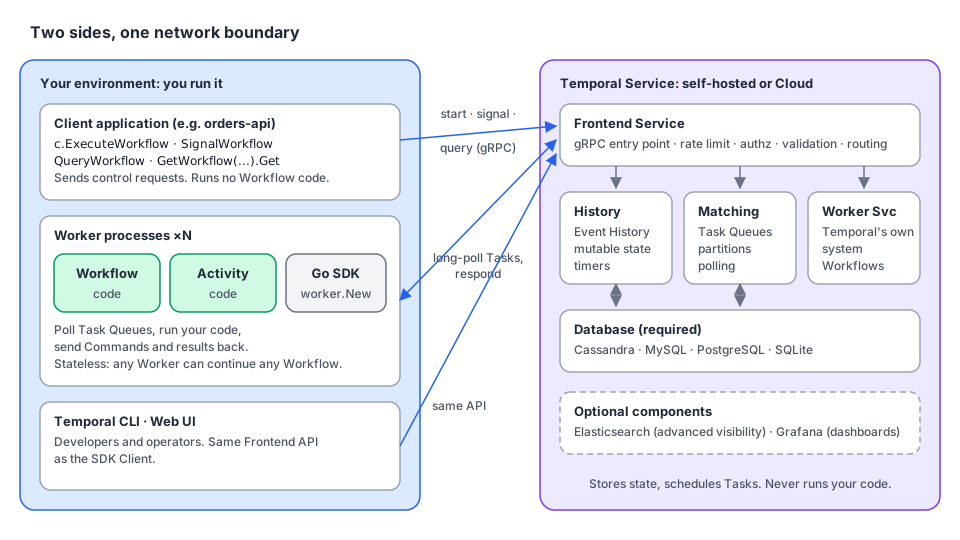
There are two sides, and they only talk over the network (gRPC):
| Side | Who runs it | What it contains |
|---|---|---|
| Your environment | You | Your Temporal Application: Workflow Definitions, Activity Definitions, the code that creates a Temporal Client, and the code that configures and starts Workers. All of it uses a Temporal SDK (here, the Go SDK). |
| The Temporal Service | You (self-hosted) or Temporal (Temporal Cloud) | The Temporal Server (Frontend, History, Matching and Worker services), its database, and optional components such as Elasticsearch (advanced visibility) and Grafana (dashboards). |
Two sentences from the docs to remember:
- The Client does not execute Workflow or Activity code. It only sends control requests.
- The Server does not run your application code. Your code runs only in your Workers.
The Temporal Service is the source of truth: it records what happened, decides what should happen next and puts that work on queues. Your Workers do the work. Your application gets its durability, scalability and reliability from the Service, not from your Worker processes.
3. The three kinds of clients
Three things talk to the Temporal Server, and all of them go through the same front door, the Frontend Service:
| Client | Typical use |
|---|---|
The Temporal CLI (temporal …) | Start the dev server, start or inspect Workflows, operate in production |
| The Web UI (http://localhost:8233 with the dev server) | See Workflow Executions, their Event History, pending Activities |
| A Temporal Client from an SDK, inside your application | Start Workflows from an HTTP handler, send Signals, read results |
Workers also connect to the Frontend, with the same Client object, to poll for work. More on this in chapter 05.
4. One application, file by file
Here is a complete, minimal Temporal Application. The order is processed by a Workflow that calls three Activities. Look at who runs each file.
| File | Runs in | Role |
|---|---|---|
orders/workflow.go | Your Worker process | Workflow Definition: the steps, in order |
orders/activities.go | Your Worker process | Activity Definitions: the side effects |
cmd/worker/main.go | Your Worker process | Connects to the Service, registers the code, polls a Task Queue |
cmd/starter/main.go | Any process (API, CLI, cron) | Uses a Temporal Client to start a Workflow and wait for its result |
| — | The Temporal Service | Records Events, schedules Tasks, retries, timers. No code of yours. |
// file: orders/workflow.go
package orders

import (
	"time"

	"go.temporal.io/sdk/workflow"
)

// TaskQueue is the queue that Workers for the orders domain poll.
const TaskQueue = "orders"

type ProcessOrderInput struct {
	OrderID       string
	CustomerEmail string
	SKU           string
	Quantity      int
	AmountCents   int64
}

type ProcessOrderResult struct {
	OrderID   string
	PaymentID string
}

// ProcessOrderWorkflow is the whole order process, written as ordinary Go.
// It runs in a Worker, never in the Temporal Server.
func ProcessOrderWorkflow(ctx workflow.Context, in ProcessOrderInput) (ProcessOrderResult, error) {
	ctx = workflow.WithActivityOptions(ctx, workflow.ActivityOptions{
		StartToCloseTimeout: 30 * time.Second,
	})

	var a *Activities // only used to name the Activity methods

	if err := workflow.ExecuteActivity(ctx, a.ReserveInventory, in.SKU, in.Quantity).Get(ctx, nil); err != nil {
		return ProcessOrderResult{}, err
	}

	var paymentID string
	if err := workflow.ExecuteActivity(ctx, a.ChargePayment, in.OrderID, in.AmountCents).Get(ctx, &paymentID); err != nil {
		return ProcessOrderResult{}, err
	}

	if err := workflow.ExecuteActivity(ctx, a.SendConfirmation, in.CustomerEmail, in.OrderID).Get(ctx, nil); err != nil {
		return ProcessOrderResult{}, err
	}

	return ProcessOrderResult{OrderID: in.OrderID, PaymentID: paymentID}, nil
}// file: orders/activities.go
package orders
import (
"context"
"go.temporal.io/sdk/activity"
)
// External systems are interfaces: swap in your real clients.
type Inventory interface {
Reserve(ctx context.Context, sku string, quantity int) error
}
type PaymentGateway interface {
Charge(ctx context.Context, orderID string, amountCents int64) (paymentID string, err error)
}
type Mailer interface {
Send(ctx context.Context, to, subject, body string) error
}
// Activities holds the side effects of the order process.
// The Worker calls these methods when it receives an Activity Task.
type Activities struct {
Inventory Inventory
Payments PaymentGateway
Mailer Mailer
}
func (a *Activities) ReserveInventory(ctx context.Context, sku string, quantity int) error {
activity.GetLogger(ctx).Info("Reserving stock", "sku", sku, "quantity", quantity)
return a.Inventory.Reserve(ctx, sku, quantity)
}
func (a *Activities) ChargePayment(ctx context.Context, orderID string, amountCents int64) (string, error) {
return a.Payments.Charge(ctx, orderID, amountCents)
}
func (a *Activities) SendConfirmation(ctx context.Context, email, orderID string) error {
return a.Mailer.Send(ctx, email, "Order "+orderID+" confirmed", "Thanks for your order!")
}// file: orders/fakes.go
package orders
import (
"context"
"fmt"
"log"
)
// Fakes so the example runs without real infrastructure.
type FakeInventory struct{}
func (FakeInventory) Reserve(context.Context, string, int) error { return nil }
type FakePayments struct{}
func (FakePayments) Charge(_ context.Context, orderID string, _ int64) (string, error) {
return fmt.Sprintf("pay_%s", orderID), nil
}
type LogMailer struct{}
func (LogMailer) Send(_ context.Context, to, subject, _ string) error {
log.Printf("email to %s: %s", to, subject)
return nil
}// file: cmd/worker/main.go
package main
import (
"log"
"go.temporal.io/sdk/client"
"go.temporal.io/sdk/worker"
"github.com/acme/shop/orders"
)
// The Worker process: YOUR code, YOUR infrastructure.
func main() {
// Connects to the Frontend Service (default 127.0.0.1:7233, "default" Namespace).
c, err := client.Dial(client.Options{})
if err != nil {
log.Fatalln("unable to create Temporal client", err)
}
defer c.Close()
w := worker.New(c, orders.TaskQueue, worker.Options{})
w.RegisterWorkflow(orders.ProcessOrderWorkflow)
w.RegisterActivity(&orders.Activities{
Inventory: orders.FakeInventory{},
Payments: orders.FakePayments{},
Mailer: orders.LogMailer{},
})
// Blocks and polls the "orders" Task Queue until SIGINT/SIGTERM.
if err := w.Run(worker.InterruptCh()); err != nil {
log.Fatalln("worker stopped", err)
}
}// file: cmd/starter/main.go
package main
import (
"context"
"log"
"go.temporal.io/sdk/client"
"github.com/acme/shop/orders"
)
// The starter: any process that holds a Temporal Client. It runs no Workflow code.
func main() {
c, err := client.Dial(client.Options{})
if err != nil {
log.Fatalln("unable to create Temporal client", err)
}
defer c.Close()
run, err := c.ExecuteWorkflow(context.Background(),
client.StartWorkflowOptions{ID: "order-ORD-1042", TaskQueue: orders.TaskQueue},
orders.ProcessOrderWorkflow,
orders.ProcessOrderInput{
OrderID: "ORD-1042", CustomerEmail: "jane@example.com",
SKU: "MUG-BLUE", Quantity: 2, AmountCents: 2598,
},
)
if err != nil {
log.Fatalln("unable to start workflow", err)
}
var result orders.ProcessOrderResult
if err := run.Get(context.Background(), &result); err != nil {
log.Fatalln("workflow failed", err)
}
log.Printf("order %s paid with %s", result.OrderID, result.PaymentID)
}Run it
temporal server start-dev          # terminal 1: the Temporal Service (dev mode, UI on :8233)
go run ./cmd/worker                # terminal 2: your Worker
go run ./cmd/starter               # terminal 3: your Client
Now try the experiment that makes the architecture click:
- Stop the Worker (Ctrl+C) and run the starter again. The starter does not fail: the Workflow is created, and its first Task waits on the
ordersTask Queue. The Web UI shows it as Running. - Start the Worker again. It picks up the waiting Task and the order completes.
The Service kept the state. The Worker was only borrowed to run the code.
5. Where to go next
| Question | Chapter |
|---|---|
| What exactly does the Go SDK give me? | 02 · Temporal SDKs |
| What can a Client do, and how does it connect? | 03 · The Temporal Client |
| What are Frontend, History, Matching? | 04 · Inside the Temporal Server |
| How do Workers get their work? | 05 · Workers |
| What happens on the wire, step by step? | 06 · Life of a Workflow Execution |
6. Key takeaways
- A Temporal Application is your code: Workflows, Activities, Client setup, Worker setup. It is built with an SDK.
- The Temporal Service (Server + database + optional components) stores state and schedules work. It never runs your code.
- Clients send control requests. Workers run Workflow and Activity code. Both talk to the Frontend over gRPC.
- If no Worker is running, work waits on a Task Queue. Nothing is lost.