06 · Standalone Activities: durable jobs without a Workflow
Level: execution mode · Read time: ~25 min Sources: Encyclopedia — Standalone Activity · Go SDK — Standalone Activities quickstart · Go SDK — Standalone Activities feature guide
1. The problem: "I just need one reliable background job"
You often need to run one thing reliably: send an email, process a webhook, sync a record, export a customer's data, transcode a file. Before Standalone Activities, Temporal gave you two options, neither of them great:
- wrap the single call in a one-step Workflow, which adds code, latency and cost, or
- use a separate job queue (Celery, Sidekiq, SQS + workers), which has its own retry semantics, visibility and operations.
A Standalone Activity is a top-level Activity Execution started directly by a Client, with no Workflow. It is Temporal's job queue: the job is persisted, dispatched to one of your Workers, retried on failure, and addressable by its ID the whole time.
| In a job queue | In Temporal |
|---|---|
| The function a job runs | An Activity Definition, a normal function registered by name |
| One enqueued job | A Standalone Activity Execution, one durable run addressable by its Activity ID |
| The queue | A Task Queue that your Workers poll |
| A worker process | An Activity Worker, your process running your code |
Use it for a single Activity run reliably. Use a Workflow when steps depend on each other. The two coexist in the same application, and you can add Workflow orchestration later without rewriting the Activity.
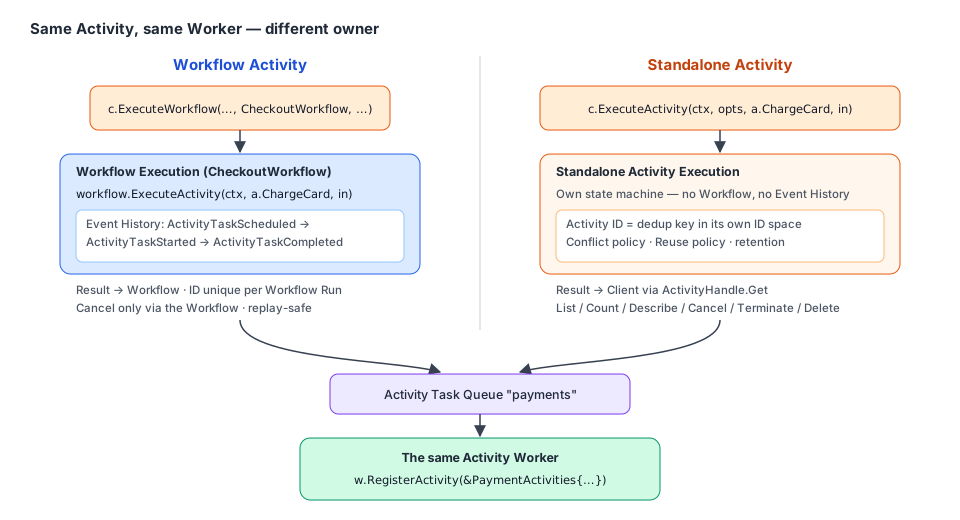
| Standalone Activity | Workflow Activity | |
|---|---|---|
| Started by | a Client (client.ExecuteActivity) | Workflow code (workflow.ExecuteActivity) |
| Lifetime | Independent top-level execution | Scoped to the Workflow Run |
| Result delivered to | The Client, through an ActivityHandle | The Workflow |
| Event History | None (own state machine, no replay) | Yes |
| Activity ID space | Separate ID space with dedup policies | Scoped to the Workflow Run |
| Cancel / Terminate / Delete directly | ✅ | ❌ (only through the Workflow) |
| Cost and latency for a single call | Fewer Billable Actions, fewer round trips | Higher |
| Best for | Durable job processing | Multi-step orchestration |
The execution semantics are the same: queued, retried until success or Schedule-To-Close, and your code must be idempotent.
2. Prerequisites
| Component | Minimum version |
|---|---|
| Go | 1.24+ |
| Temporal Go SDK | v1.49.0+ |
| Temporal CLI | v1.9.1+ (brew install temporal, check with temporal --version) |
| Temporal Server | v1.32.0+ (the CLI dev server bundles one) |
| Temporal Cloud | GA in all regions |
temporal server start-dev # dev server on localhost:7233, Web UI on http://localhost:82333. Define and register the Activity (nothing new)
The Activity Definition and Worker registration are identical to regular Activities. The Worker doesn't know, and doesn't care, whether a Workflow or a Client starts the Activity.
Our example is a GDPR-style customer data export job, plus an abandoned-cart reminder email:
// file: jobs/activities.go
package jobs

import (
	"context"
	"fmt"
	"time"

	"go.temporal.io/sdk/activity"
)

const TaskQueue = "customer-jobs"

type ExportCustomerDataInput struct {
	CustomerID  string
	Format      string // "json" | "csv"
	RequestedBy string
}

type ExportCustomerDataResult struct {
	ArchiveURL string
	Records    int
}

type CartReminderInput struct {
	CustomerID string
	CartID     string
	Email      string
}

type DataExportActivities struct {
	// e.g. a DB pool, an S3 client, an email provider...
}

// ExportCustomerData gathers every table that mentions the customer and uploads a ZIP.
// It heartbeats per table so it can resume and be cancelled.
func (a *DataExportActivities) ExportCustomerData(ctx context.Context, in ExportCustomerDataInput) (ExportCustomerDataResult, error) {
	tables := []string{"profile", "orders", "addresses", "payments", "support_tickets"}

	start := 0
	if activity.HasHeartbeatDetails(ctx) {
		_ = activity.GetHeartbeatDetails(ctx, &start) // resume after the last finished table
	}

	records := 0
	for i := start; i < len(tables); i++ {
		select {
		case <-ctx.Done():
			return ExportCustomerDataResult{}, ctx.Err()
		case <-time.After(200 * time.Millisecond): // pretend to dump one table
		}
		records += 100
		activity.RecordHeartbeat(ctx, i+1)
	}
	return ExportCustomerDataResult{
		ArchiveURL: fmt.Sprintf("s3://gdpr-exports/%s.%s.zip", in.CustomerID, in.Format),
		Records:    records,
	}, nil
}

func (a *DataExportActivities) SendCartReminderEmail(ctx context.Context, in CartReminderInput) error {
	activity.GetLogger(ctx).Info("Sending cart reminder", "cartID", in.CartID, "to", in.Email)
	return nil
}// file: cmd/jobs-worker/main.go
package main
import (
"log"
"github.com/acme/shop/jobs"
"go.temporal.io/sdk/client"
"go.temporal.io/sdk/contrib/envconfig"
"go.temporal.io/sdk/worker"
)
func main() {
// envconfig reads TEMPORAL_ADDRESS / TEMPORAL_NAMESPACE / TEMPORAL_API_KEY / TLS vars or a TOML
// profile, so the same binary works on the dev server and on Temporal Cloud.
c, err := client.Dial(envconfig.MustLoadDefaultClientOptions())
if err != nil {
log.Fatalln("Unable to create client", err)
}
defer c.Close()
w := worker.New(c, jobs.TaskQueue, worker.Options{})
w.RegisterActivity(&jobs.DataExportActivities{})
if err := w.Run(worker.InterruptCh()); err != nil {
log.Fatalln("Unable to start worker", err)
}
}4. Start a job: client.ExecuteActivity
client.ExecuteActivity(ctx, client.StartActivityOptions, activity, args...) persists the job and returns an ActivityHandle right after the start RPC. It doesn't wait for the result.
StartActivityOptions requires: ID, TaskQueue, and ScheduleToCloseTimeout or StartToCloseTimeout.
| Option | What it controls |
|---|---|
ID | The deduplication key. Use a business identifier you already have. |
TaskQueue | Which Workers get the job |
StartToCloseTimeout / ScheduleToCloseTimeout / ScheduleToStartTimeout / HeartbeatTimeout | Same meaning as for Workflow Activities (chapter 04) |
RetryPolicy | Default is at-least-once with exponential backoff. MaximumAttempts: 1 gives at-most-once. |
ActivityIDConflictPolicy | What to do if a job with this ID is running (§6) |
ActivityIDReusePolicy | Whether a closed job's ID can be reused (§6) |
StartDelay | Dispatch the first attempt after a delay (§7) |
Priority | Priority and fairness when jobs compete for the same Workers |
TypedSearchAttributes | Your own indexed fields, usable in List and Count queries |
Summary / StaticDetails | Human-readable text shown in the UI and CLI |
// file: cmd/request-export/main.go
package main

import (
	"context"
	"errors"
	"log"
	"time"

	"github.com/acme/shop/jobs"
	enumspb "go.temporal.io/api/enums/v1"
	"go.temporal.io/api/serviceerror"
	"go.temporal.io/sdk/client"
	"go.temporal.io/sdk/contrib/envconfig"
	"go.temporal.io/sdk/temporal"
)

func main() {
	c, err := client.Dial(envconfig.MustLoadDefaultClientOptions())
	if err != nil {
		log.Fatalln("Unable to create client", err)
	}
	defer c.Close()

	customerID := "CUST-4821"
	opts := client.StartActivityOptions{
		ID:                     "export-" + customerID, // one export per customer at a time
		TaskQueue:              jobs.TaskQueue,
		StartToCloseTimeout:    10 * time.Minute,
		ScheduleToCloseTimeout: 2 * time.Hour,
		HeartbeatTimeout:       30 * time.Second,
		RetryPolicy: &temporal.RetryPolicy{
			InitialInterval: 5 * time.Second,
			MaximumAttempts: 10,
		},
		// Customer clicks "Export my data" twice? Attach to the running job instead of failing.
		ActivityIDConflictPolicy: enumspb.ACTIVITY_ID_CONFLICT_POLICY_USE_EXISTING,
		// A new export is allowed only if the previous one did not succeed.
		ActivityIDReusePolicy: enumspb.ACTIVITY_ID_REUSE_POLICY_ALLOW_DUPLICATE_FAILED_ONLY,
		Summary:               "GDPR export for " + customerID,
	}

	var acts *jobs.DataExportActivities
	handle, err := c.ExecuteActivity(context.Background(), opts, acts.ExportCustomerData,
		jobs.ExportCustomerDataInput{CustomerID: customerID, Format: "json", RequestedBy: "self-service"})

	var already *serviceerror.ActivityExecutionAlreadyStarted
	if errors.As(err, &already) {
		log.Println("An export already succeeded for this customer within the retention period")
		return
	}
	if err != nil {
		log.Fatalln("Unable to start export", err)
	}

	// Store these IDs (DB, API response...) to check on the job later.
	log.Println("Export job accepted", "ActivityID", handle.GetID(), "RunID", handle.GetRunID())
}
You can also pass the Activity as a string Activity Type, which is handy when the starter doesn't import the Worker's package:
// file: jobs/start_by_name.go
package jobs

import (
	"context"
	"time"

	"go.temporal.io/sdk/client"
)

func StartCartReminderByName(ctx context.Context, c client.Client, in CartReminderInput) (client.ActivityHandle, error) {
	return c.ExecuteActivity(ctx, client.StartActivityOptions{
		ID:                  "cart-reminder-" + in.CartID,
		TaskQueue:           TaskQueue,
		StartToCloseTimeout: 30 * time.Second,
	}, "SendCartReminderEmail", in)
}
Or from the CLI:
temporal activity execute \
  --type ExportCustomerData \
  --activity-id export-CUST-4821 \
  --task-queue customer-jobs \
  --start-to-close-timeout 10m \
  --input '{"CustomerID":"CUST-4821","Format":"json","RequestedBy":"ops"}'
💡 Long jobs: start the job and keep the handle (or the ID) instead of blocking on the result. That way a caller's slot and connection aren't held for the whole job.
5. Work with the job: handle, result, describe, cancel, terminate
ActivityHandle is to a Standalone Activity what WorkflowRun is to a Workflow.
| Method | Purpose |
|---|---|
GetID() / GetRunID() | Identity (RunID is empty for a handle obtained by ID only; Describe returns it) |
Get(ctx, &result) | Block until the job closes. Fills result or returns the failure as an error |
Describe(ctx, client.DescribeActivityOptions{...}) | Status, run state, attempt count, last heartbeat, retry info... |
Cancel(ctx, client.CancelActivityOptions{Reason}) | Request Cancel: graceful, delivered on heartbeat |
Terminate(ctx, client.TerminateActivityOptions{Reason}) | Forceful close, no cleanup |
Use client.GetActivityHandle to get a handle again later, for example from another process. RunID is optional: leave it empty to target the latest execution with that ID.
// file: cmd/export-status/main.go
package main

import (
	"context"
	"log"
	"os"
	"time"

	"github.com/acme/shop/jobs"
	"go.temporal.io/sdk/client"
	"go.temporal.io/sdk/contrib/envconfig"
)

func main() {
	c, err := client.Dial(envconfig.MustLoadDefaultClientOptions())
	if err != nil {
		log.Fatalln(err)
	}
	defer c.Close()

	handle := c.GetActivityHandle(client.GetActivityHandleOptions{
		ActivityID: "export-CUST-4821",
		RunID:      "", // latest execution with this Activity ID
	})

	// 1) Describe: cheap status check, e.g. for a "your export is being prepared" page.
	desc, err := handle.Describe(context.Background(), client.DescribeActivityOptions{IncludeLastFailure: true})
	if err != nil {
		log.Fatalln("describe failed", err)
	}
	log.Printf("status=%v runState=%v attempt=%d lastHeartbeat=%s",
		desc.Status, desc.RunState, desc.Attempt, desc.LastHeartbeatTime.Format(time.RFC3339))

	// 2) Operator actions.
	if len(os.Args) > 1 {
		switch os.Args[1] {
		case "cancel":
			// Graceful: the job sees ctx.Done() on its next heartbeat and can clean up.
			err = handle.Cancel(context.Background(), client.CancelActivityOptions{Reason: "customer withdrew request"})
		case "terminate":
			// Forceful: no cleanup runs. Use when Cancel was not honored.
			err = handle.Terminate(context.Background(), client.TerminateActivityOptions{Reason: "stuck export"})
		}
		if err != nil {
			log.Fatalln("operation failed", err)
		}
		return
	}

	// 3) Wait for the result, but no longer than 1 minute on the client side.
	//    (This context limits only the client wait, not the job.)
	waitCtx, cancel := context.WithTimeout(context.Background(), time.Minute)
	defer cancel()
	var res jobs.ExportCustomerDataResult
	if err := handle.Get(waitCtx, &res); err != nil {
		log.Fatalln("export failed or still running", err)
	}
	log.Println("export ready:", res.ArchiveURL, "records:", res.Records)
}
CLI equivalents:
temporal activity result   --activity-id export-CUST-4821   # wait for the result
temporal activity describe -a export-CUST-4821               # status, attempt, last error
temporal activity cancel   --activity-id export-CUST-4821 --reason "No longer needed"
temporal activity terminate --activity-id export-CUST-4821 --reason "Bad input"
temporal activity delete   --activity-id export-CUST-4821    # terminate if running, then delete
Lifecycle control in one paragraph
A Standalone Activity has no Workflow that owns it, so you act on it directly by Activity ID: Request Cancel asks it to close gracefully, Terminate closes it now with no cleanup, and Delete terminates it if it's running and then deletes the record asynchronously. Interrupting a running attempt is cooperative: the Activity must heartbeat. If the Worker doesn't respond, the cancel takes effect at the next attempt boundary, for example when Start-To-Close elapses. Only Terminate and Delete always discard progress, whether or not the code cooperates. Details are in chapter 10.
6. Deduplication: Activity ID, Conflict Policy and Reuse Policy
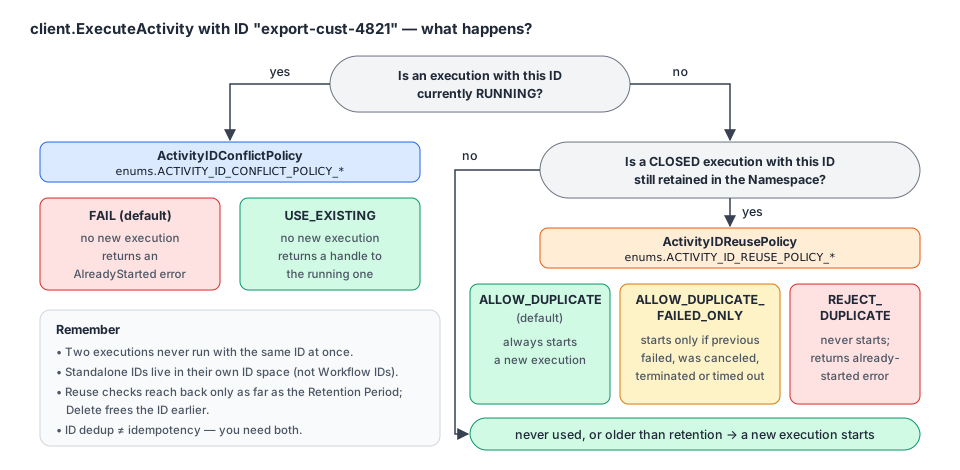
Use a business identifier as the Activity ID (export-CUST-4821, webhook-evt_9f2c, transcode-video-8812). Temporal then enforces uniqueness for you, in an ID space separate from Workflow IDs:
Conflict Policy: a job with this ID is running.
| Value | Behavior |
|---|---|
ACTIVITY_ID_CONFLICT_POLICY_FAIL (default) | Don't start. Return ActivityExecutionAlreadyStarted. |
ACTIVITY_ID_CONFLICT_POLICY_USE_EXISTING | Don't start. Return a handle to the running job. |
Reuse Policy: a job with this ID is closed but still retained.
| Value | Behavior |
|---|---|
ACTIVITY_ID_REUSE_POLICY_ALLOW_DUPLICATE (default) | Always allowed to start again |
ACTIVITY_ID_REUSE_POLICY_ALLOW_DUPLICATE_FAILED_ONLY | Start only if the previous one failed, was canceled, was terminated or timed out |
ACTIVITY_ID_REUSE_POLICY_REJECT_DUPLICATE | Never start again. Return ActivityExecutionAlreadyStarted. |
⚠️ Deduplication ≠ idempotency, and you need both. The Activity ID stops you submitting the same job twice. Idempotent code stops one job's side effects from happening twice when it is retried.
Result retention
A closed Standalone Activity and its result are kept for the Namespace Retention Period, like any closed Execution. During that window it stays visible to describe and list, and the Reuse Policy checks against it. After retention, the record is deleted and the ID can be reused. Run temporal activity delete to remove it sooner.
7. Schedule a job for later: Start Delay
StartDelay dispatches the first attempt after a delay. Use it for a reminder email or a deferred cleanup. Retries follow the Retry Policy, not the delay. This is a one-time delayed job, not a recurring schedule.
// file: jobs/reminder.go
package jobs

import (
	"context"
	"time"

	"go.temporal.io/sdk/client"
)

// ScheduleCartReminder emails the customer 1 hour after they abandoned their cart.
// If they come back and pay, call CancelCartReminder.
func ScheduleCartReminder(ctx context.Context, c client.Client, in CartReminderInput) error {
	var acts *DataExportActivities
	_, err := c.ExecuteActivity(ctx, client.StartActivityOptions{
		ID:                  "cart-reminder-" + in.CartID,
		TaskQueue:           TaskQueue,
		StartToCloseTimeout: 30 * time.Second,
		StartDelay:          time.Hour,
	}, acts.SendCartReminderEmail, in)
	return err
}

func CancelCartReminder(ctx context.Context, c client.Client, cartID string) error {
	h := c.GetActivityHandle(client.GetActivityHandleOptions{ActivityID: "cart-reminder-" + cartID})
	return h.Cancel(ctx, client.CancelActivityOptions{Reason: "cart checked out"})
}temporal activity start --activity-id cart-reminder-C-991 --type SendCartReminderEmail \
--task-queue customer-jobs --start-to-close-timeout 5m --start-delay 1hStarting a Standalone Activity from a recurring Schedule is not supported. For recurring work, schedule a Workflow that calls the Activity. It then runs as a Workflow Activity.
8. Visibility: list and count jobs
ListActivities and CountActivities take a List Filter query, using the same syntax as Workflow visibility. They return only Standalone Activities, not Activities running inside Workflows.
// file: jobs/visibility.go
package jobs

import (
	"context"
	"log"

	"go.temporal.io/sdk/client"
)

func ReportRunningExports(ctx context.Context, c client.Client) error {
	resp, err := c.ListActivities(ctx, client.ListActivitiesOptions{
		Query: "ActivityType = 'ExportCustomerData' AND ExecutionStatus = 'Running'",
	})
	if err != nil {
		return err
	}
	for info, err := range resp.Results { // Go 1.23+ range-over-func iterator
		if err != nil {
			return err
		}
		log.Printf("ActivityID=%s Type=%s Status=%v Scheduled=%s",
			info.ActivityID, info.ActivityType, info.Status, info.ScheduleTime)
	}

	count, err := c.CountActivities(ctx, client.CountActivitiesOptions{
		Query: "TaskQueue = '" + TaskQueue + "' GROUP BY ExecutionStatus",
	})
	if err != nil {
		return err
	}
	log.Println("total executions:", count.Count) // executions (Running, Completed, Failed...), NOT queued tasks
	for _, g := range count.Groups {
		log.Println("  ", g.GroupValues, g.Count)
	}
	return nil
}temporal activity list --query "ExecutionStatus='Running'"
temporal activity count --query "GROUP BY ExecutionStatus"All the usual Activity metrics (scheduled, started, completed, failed, timed out, canceled) also apply to Standalone Activities.
9. Production notes
Worker throughput. An Activity Worker's default poller count is lower than many job-queue frameworks use, and some of those prefetch several tasks per poll. When you compare throughput after a migration, match the poller settings first.
Serverless Workers (Public Preview: AWS Lambda, GCP Cloud Run). Job load is bursty, so Temporal can start a Worker on demand when a job arrives and no Worker is free. The Worker must belong to a Worker Deployment Version with a compute provider configured.
Priority and fairness. Priority is strict: higher priority is dispatched first. Fairness gives each fairness key its own virtual queue, so one tenant's backlog can't starve others. On Temporal Cloud, Fairness has a per-Action surcharge.
Temporal Cloud. No code change thanks to
envconfig. Set the environment variables:bash# mTLS export TEMPORAL_ADDRESS=<namespace>.<account>.tmprl.cloud:7233 export TEMPORAL_NAMESPACE=<namespace>.<account> export TEMPORAL_TLS_CLIENT_CERT_PATH=path/to/client.pem export TEMPORAL_TLS_CLIENT_KEY_PATH=path/to/client.key # or API key export TEMPORAL_API_KEY=<api-key>
Release stages and limitations (at the time of writing)
- GA: Standalone Activities, Start Delay, Request Cancel, Terminate, Delete.
- Public Preview: Pause, Unpause, Reset, Update Options; batch Request Cancel, Terminate and Delete by query.
- Not supported yet: the
TerminateExistingconflict policy; starting from a recurring Schedule or from Nexus; batch Reset, Pause, Unpause, Update Options, Complete and Fail; Export.
Key takeaways
client.ExecuteActivity= enqueue a durable job. Same Activity code and same Worker as for Workflows.- Required:
ID,TaskQueue, and a Start-To-Close or Schedule-To-Close timeout. - The Activity ID is your dedup key, with Conflict and Reuse policies, in an ID space separate from Workflows.
ActivityHandle:Get,Describe,Cancel,Terminate. Get a handle again withGetActivityHandle.StartDelayis for one-off deferred jobs.ListActivitiesandCountActivitiesgive you visibility.- When steps start depending on each other, wrap the same Activity in a Workflow.
⬅️ Previous: 05 · Failures & cancellation · ➡️ Next: 07 · Local Activities