02 · Connecting: defaults, environment variables, config files
Level: core concept, daily use · Read time: ~12 min Sources: Go SDK — Connect to development Temporal Service · Environment Configuration reference
1. The problem
The same binary runs on your laptop against temporal server start-dev, in CI against a test cluster, and in production against Temporal Cloud. Hard-coding HostPort: "localhost:7233" works on day one and becomes a deployment bug on day ten. Putting API keys in code is worse.
The Go SDK lets you build the connection options from code, environment variables or a TOML configuration file, and mix them. The SDK docs recommend environment variables or a config file to manage connection options securely.
2. What client.Dial needs
client.Dial(client.Options{…}) creates a client.Client. The connection-related options are:
| Option | Meaning | Default |
|---|---|---|
HostPort | Address of the Frontend Service | 127.0.0.1:7233 (client.DefaultHostPort), the dev server |
Namespace | Namespace to work in | default |
ConnectionOptions.TLS | TLS configuration (*tls.Config) | none (plaintext) |
Credentials | API key or mTLS credentials | none |
So against the dev server, client.Options{} is enough. Everything else is covered in chapter 03.
3. Where options come from, and who wins
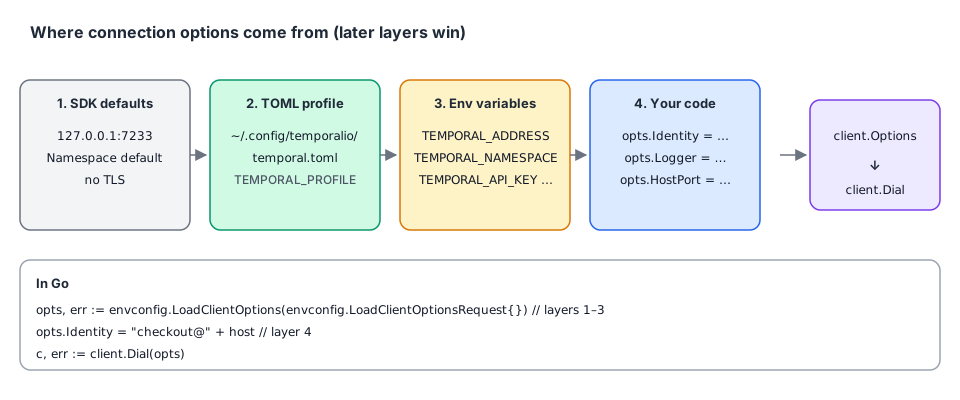
The go.temporal.io/sdk/contrib/envconfig package loads options in layers:
- SDK defaults (
127.0.0.1:7233,default). - A profile from a TOML file:
~/.config/temporalio/temporal.tomlby default, or the path inTEMPORAL_CONFIG_FILE. The profile isdefaultunless you choose another one. - Environment variables (
TEMPORAL_ADDRESS,TEMPORAL_NAMESPACE,TEMPORAL_API_KEY, …). They override the file. - Your code, last:
envconfigreturns a plainclient.Optionsthat you can change before callingclient.Dial.
The main environment variables:
| Variable | Sets |
|---|---|
TEMPORAL_ADDRESS | HostPort |
TEMPORAL_NAMESPACE | Namespace |
TEMPORAL_API_KEY | API key credentials (turns TLS on) |
TEMPORAL_TLS_CLIENT_CERT_PATH / _DATA | mTLS client certificate |
TEMPORAL_TLS_CLIENT_KEY_PATH / _DATA | mTLS client private key |
TEMPORAL_TLS_SERVER_CA_CERT_PATH, TEMPORAL_TLS_SERVER_NAME | Server CA and name, for self-hosted TLS |
TEMPORAL_CONFIG_FILE | Path of the TOML file |
TEMPORAL_PROFILE | Which profile of the TOML file to use |
TEMPORAL_GRPC_META_<NAME> | Extra gRPC headers |
Environment variable and config file support were added in Go SDK v1.28.0.
4. The four ways, in Go
4.1 In code (fine for local development and tests)
// file: internal/temporalconn/code.go
package temporalconn

import "go.temporal.io/sdk/client"

// DialLocal connects to the dev server started by `temporal server start-dev`.
func DialLocal() (client.Client, error) {
	return client.Dial(client.Options{
		HostPort:  client.DefaultHostPort, // "127.0.0.1:7233"
		Namespace: "default",
	})
}
4.2 From environment variables (and the default profile, if a file exists)
// file: internal/temporalconn/env.go
package temporalconn

import (
	"fmt"

	"go.temporal.io/sdk/client"
	"go.temporal.io/sdk/contrib/envconfig"
)

// DialFromEnv reads the "default" profile of the config file (if any), then TEMPORAL_* env vars.
// LoadDefaultClientOptions returns an error. MustLoadDefaultClientOptions panics instead.
func DialFromEnv() (client.Client, error) {
	opts, err := envconfig.LoadDefaultClientOptions()
	if err != nil {
		return nil, fmt.Errorf("load Temporal client options: %w", err)
	}
	return client.Dial(opts)
}
4.3 From a named profile in a TOML file
# file: ~/.config/temporalio/temporal.toml
[profile.default]
address = "localhost:7233"
namespace = "default"

[profile.staging]
address = "temporal.staging.acme.internal:7233"
namespace = "shop-staging"
[profile.staging.grpc_meta]
team = "checkout"// file: internal/temporalconn/profile.go
package temporalconn
import (
"fmt"
"go.temporal.io/sdk/client"
"go.temporal.io/sdk/contrib/envconfig"
)
// DialProfile loads one profile. An empty configFile means TEMPORAL_CONFIG_FILE or the default path.
// Env vars still override what the profile says.
func DialProfile(profile, configFile string) (client.Client, error) {
opts, err := envconfig.LoadClientOptions(envconfig.LoadClientOptionsRequest{
ConfigFilePath: configFile,
ConfigFileProfile: profile,
})
if err != nil {
return nil, fmt.Errorf("load profile %q: %w", profile, err)
}
return client.Dial(opts)
}4.4 Load, then override in code
// file: internal/temporalconn/override.go
package temporalconn

import (
	"fmt"
	"os"

	"go.temporal.io/sdk/client"
	"go.temporal.io/sdk/contrib/envconfig"
)

// DialForService loads the shared configuration, then sets what only the code knows:
// an Identity that shows up in the Web UI and in poller lists.
func DialForService(serviceName string) (client.Client, error) {
	opts, err := envconfig.LoadDefaultClientOptions()
	if err != nil {
		return nil, fmt.Errorf("load Temporal client options: %w", err)
	}
	host, _ := os.Hostname()
	opts.Identity = fmt.Sprintf("%s@%s", serviceName, host)
	return client.Dial(opts)
}
Then a binary doesn't care where it runs:
go run ./cmd/checkout                                         # laptop: default profile or defaults
TEMPORAL_PROFILE=staging go run ./cmd/checkout                # staging profile from the TOML file
TEMPORAL_ADDRESS=10.0.3.7:7233 TEMPORAL_NAMESPACE=shop-ci ./checkout   # CI: env vars only
5. When does the connection happen?
| Constructor | Behavior |
|---|---|
client.Dial(opts) | Connects now and checks the Service is reachable. Returns an error if it isn't. |
client.DialContext(ctx, opts) | Same, bounded by ctx (e.g. a startup timeout). |
client.NewLazyClient(opts) | Connects on first use. Useful when the Service may start after your process. |
client.NewClientFromExisting(c, opts) | A second Client (e.g. another Namespace) that reuses the connection of c. |
A small startup check makes misconfiguration obvious instead of a mysterious timeout later:
// file: cmd/temporal-doctor/main.go
package main

import (
	"context"
	"log"
	"time"

	"go.temporal.io/sdk/client"
	"go.temporal.io/sdk/contrib/envconfig"
)

// temporal-doctor prints which Service and Namespace this environment points to, and checks them.
func main() {
	opts, err := envconfig.LoadDefaultClientOptions()
	if err != nil {
		log.Fatalln("bad Temporal configuration:", err)
	}
	host := opts.HostPort
	if host == "" {
		host = client.DefaultHostPort
	}
	ns := opts.Namespace
	if ns == "" {
		ns = "default"
	}
	log.Printf("connecting to %s, namespace %q, TLS=%t", host, ns, opts.ConnectionOptions.TLS != nil)

	ctx, cancel := context.WithTimeout(context.Background(), 5*time.Second)
	defer cancel()
	c, err := client.DialContext(ctx, opts)
	if err != nil {
		log.Fatalln("cannot reach Temporal:", err)
	}
	defer c.Close()

	if _, err := c.CheckHealth(ctx, &client.CheckHealthRequest{}); err != nil {
		log.Fatalln("Temporal is not healthy:", err)
	}
	log.Println("OK")
}
6. Key takeaways
- Defaults target the dev server:
127.0.0.1:7233, Namespacedefault. - Prefer env vars or a TOML profile (loaded with
envconfig) over hard-coded options. - Precedence: defaults < TOML profile <
TEMPORAL_*env vars < your code. - Pick the profile with
TEMPORAL_PROFILEorConfigFileProfile, and the file withTEMPORAL_CONFIG_FILEorConfigFilePath. Dialconnects eagerly.DialContextadds a timeout.NewLazyClientdefers the connection.