08 · Cancel, Terminate, Pause and Reset: stopping and steering a Workflow
Level: core concept + operations · Read time: ~20 min Sources: Encyclopedia — Cancellation and Termination · Encyclopedia — Workflow Pause · Encyclopedia — Event History (Reset) · Go SDK — Cancel a Workflow
1. The problem
A Workflow can run for minutes or for months. During that time, the world changes:
- the customer cancels the trip they were booking, and the flight you already reserved must be released
- a Workflow is stuck on a bug and can't process anything, so you need it gone now
- a downstream supplier is down, and you want to hold a Workflow in place until it recovers, without losing state
- you shipped a fix for a non-determinism bug, and the broken Workflow should continue from just before the bad step
Temporal gives you four controls for these situations. They differ in one key question: does your Workflow code get a say?
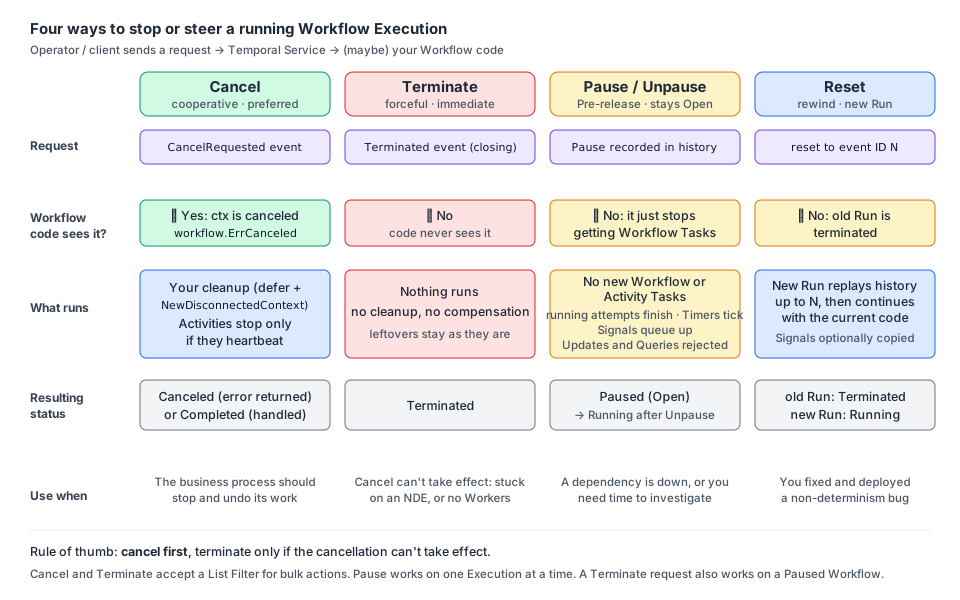
| Control | What it does | Workflow code notified? | CLI |
|---|---|---|---|
| Cancel | Asks the Workflow to stop, and lets it clean up first | ✅ Yes | temporal workflow cancel |
| Terminate | Closes the Workflow Execution immediately, no cleanup | ❌ No | temporal workflow terminate |
| Pause (Pre-release) | Holds the Execution in place, Open, state kept | ❌ No (it just stops getting Workflow Tasks) | temporal workflow pause / unpause |
| Reset | Terminates the current Run and starts a new Run from a chosen point in the Event History | ❌ No (the new Run replays up to the reset point) | temporal workflow reset |
📌 Rule of thumb: prefer Cancel. Use Terminate only when the Workflow can't process a cancellation, for example when it's blocked on a non-deterministic error or has no Workers to run its Tasks.
2. Cancellation: cooperative stop
What happens when you cancel a Workflow
- A
WorkflowExecutionCancelRequestedevent is recorded, with the requester's identity and the reason. - The Temporal Service schedules a new Workflow Task so the Workflow can react.
- The Go SDK cancels the root
workflow.Context. Every blocking call on that context (Geton an Activity future,workflow.Sleep,Receiveon a channel…) returns a canceled error, andctx.Err()returnsworkflow.ErrCanceled. - Your Workflow runs whatever cleanup it implements.
- The closing status depends on what your code returns:
| Your Workflow… | Closing status | Closing event |
|---|---|---|
| returns the cancellation error (or doesn't handle it) | Canceled | WorkflowExecutionCanceled |
handles the request and returns nil / a result | Completed | WorkflowExecutionCompleted |
Both are valid. Which one you want is a business decision, not a technical one.
Two rules you must know
- A canceled context can't schedule new work. Cleanup that calls Activities must run in a context created with
workflow.NewDisconnectedContext(ctx). It's a context that is not canceled when the parent is. - Activities only learn about cancellation when they heartbeat. An Activity that doesn't heartbeat can't receive a cancellation: it runs to completion, fails or times out. Heartbeat throttling can also delay delivery. If a long-running Activity must stop when its Workflow is canceled, it has to heartbeat, and it needs a
HeartbeatTimeout.
Set WaitForCancellation: true in the Activity options when the Workflow should wait for the Activity to acknowledge the cancellation before the future resolves. Without it, the future resolves as canceled immediately.
Example: a trip booking saga that cleans up on cancel
A traveler books a flight, a hotel and a car. The booking holds them for a review period. If the traveler cancels at any point, we release whatever we already reserved, then close the Workflow as Canceled.
First the Activities. Each reservation runs the supplier call in a goroutine and heartbeats every 2 seconds, so a cancellation reaches it quickly.
// file: travel/activities.go
package travel

import (
	"context"
	"fmt"
	"time"

	"go.temporal.io/sdk/activity"
)

// Supplier is a reservation system (airline GDS, hotel channel manager, car rental API).
// The trip ID is passed as the idempotency key so a retried call doesn't book twice.
type Supplier interface {
	Reserve(ctx context.Context, idempotencyKey, offerID string) (confirmationID string, err error)
	Release(ctx context.Context, confirmationID string) error
}

type TripRequest struct {
	TripID      string
	TravelerID  string
	FlightOffer string
	HotelOffer  string
	CarOffer    string // empty = no car
	HoldPeriod  time.Duration
}

type Reservation struct {
	Kind           string // "flight", "hotel", "car"
	ConfirmationID string
}

type TripActivities struct {
	Flights Supplier
	Hotels  Supplier
	Cars    Supplier
}

func (a *TripActivities) BookFlight(ctx context.Context, req TripRequest) (Reservation, error) {
	return reserveWithHeartbeat(ctx, a.Flights, "flight", req.TripID, req.FlightOffer)
}

func (a *TripActivities) BookHotel(ctx context.Context, req TripRequest) (Reservation, error) {
	return reserveWithHeartbeat(ctx, a.Hotels, "hotel", req.TripID, req.HotelOffer)
}

func (a *TripActivities) RentCar(ctx context.Context, req TripRequest) (Reservation, error) {
	return reserveWithHeartbeat(ctx, a.Cars, "car", req.TripID, req.CarOffer)
}

// ReleaseReservation is the compensation for any of the bookings above.
func (a *TripActivities) ReleaseReservation(ctx context.Context, r Reservation) error {
	supplier := map[string]Supplier{"flight": a.Flights, "hotel": a.Hotels, "car": a.Cars}[r.Kind]
	if supplier == nil {
		return fmt.Errorf("unknown reservation kind %q", r.Kind)
	}
	return supplier.Release(ctx, r.ConfirmationID)
}

// NotifyTraveler sends an email or push notification.
func (a *TripActivities) NotifyTraveler(ctx context.Context, travelerID, message string) error {
	activity.GetLogger(ctx).Info("Notify traveler", "traveler", travelerID, "message", message)
	return nil
}

// reserveWithHeartbeat calls the supplier and heartbeats while it waits.
// Heartbeating is what lets a Workflow cancellation reach this Activity.
func reserveWithHeartbeat(ctx context.Context, s Supplier, kind, tripID, offerID string) (Reservation, error) {
	type result struct {
		id  string
		err error
	}
	done := make(chan result, 1)
	go func() {
		id, err := s.Reserve(ctx, tripID+"-"+kind, offerID)
		done <- result{id, err}
	}()

	ticker := time.NewTicker(2 * time.Second)
	defer ticker.Stop()
	for {
		select {
		case r := <-done:
			if r.err != nil {
				return Reservation{}, r.err
			}
			return Reservation{Kind: kind, ConfirmationID: r.id}, nil
		case <-ticker.C:
			activity.RecordHeartbeat(ctx, kind)
		case <-ctx.Done():
			// The Workflow was canceled (delivered through the heartbeat response).
			return Reservation{}, ctx.Err()
		}
	}
}
Now the Workflow. The defer block runs on any failure, including cancellation. It uses a disconnected context so the compensations can still be scheduled.
// file: travel/workflow.go
package travel

import (
	"errors"
	"time"

	"go.temporal.io/sdk/temporal"
	"go.temporal.io/sdk/workflow"
)

const TaskQueue = "travel"

func TripWorkflowID(tripID string) string { return "trip-" + tripID }

type TripItinerary struct {
	TripID       string
	Reservations []Reservation
}

func TripBookingWorkflow(ctx workflow.Context, req TripRequest) (TripItinerary, error) {
	logger := workflow.GetLogger(ctx)
	var a *TripActivities
	var booked []Reservation

	// Saga cleanup: runs when the Workflow fails OR is canceled.
	var err error
	defer func() {
		if err == nil {
			return
		}
		// ctx is canceled at this point if we were canceled. A disconnected context is not,
		// so Activities can still be scheduled from it.
		cleanupCtx, _ := workflow.NewDisconnectedContext(ctx)
		cleanupCtx = workflow.WithActivityOptions(cleanupCtx, workflow.ActivityOptions{
			StartToCloseTimeout: time.Minute,
			RetryPolicy:         &temporal.RetryPolicy{MaximumAttempts: 10},
		})
		for i := len(booked) - 1; i >= 0; i-- {
			if relErr := workflow.ExecuteActivity(cleanupCtx, a.ReleaseReservation, booked[i]).Get(cleanupCtx, nil); relErr != nil {
				logger.Error("Compensation failed, needs manual follow-up", "reservation", booked[i], "error", relErr)
			}
		}
		msg := "Your trip could not be booked. Nothing was charged."
		if errors.Is(ctx.Err(), workflow.ErrCanceled) {
			msg = "Your trip was cancelled. All reservations were released."
		}
		_ = workflow.ExecuteActivity(cleanupCtx, a.NotifyTraveler, req.TravelerID, msg).Get(cleanupCtx, nil)
	}()

	ctx = workflow.WithActivityOptions(ctx, workflow.ActivityOptions{
		StartToCloseTimeout: 5 * time.Minute,
		HeartbeatTimeout:    10 * time.Second, // required to notice cancellation (and crashes) quickly
		WaitForCancellation: true,             // wait until the Activity really stopped before cleaning up
	})

	steps := []any{a.BookFlight, a.BookHotel}
	if req.CarOffer != "" {
		steps = append(steps, a.RentCar)
	}
	for _, step := range steps {
		var r Reservation
		if err = workflow.ExecuteActivity(ctx, step, req).Get(ctx, &r); err != nil {
			return TripItinerary{}, err // a canceled error here closes the Workflow as Canceled
		}
		booked = append(booked, r)
	}

	// Hold the reservations during the review period. A cancel request during
	// this durable Timer makes Sleep return a canceled error.
	if err = workflow.Sleep(ctx, req.HoldPeriod); err != nil {
		return TripItinerary{}, err
	}

	return TripItinerary{TripID: req.TripID, Reservations: booked}, nil
}
Why it works:
erris declared before thedefer, so the deferred function sees the error that the Workflow returns.- Returning the canceled error unchanged gives the status Canceled and the event
WorkflowExecutionCanceled. WaitForCancellation: truemakes sure an in-flightBookHotelhas stopped before we release the flight. Otherwise a hotel reservation could land after cleanup.
Variant: treat cancellation as a normal end (status Completed)
Sometimes "cancel" just means "stop watching". This price watcher returns its last result when it's canceled, so the Execution closes as Completed:
// file: travel/price_watch.go
package travel

import (
	"context"
	"errors"
	"time"

	"go.temporal.io/sdk/workflow"
)

type PriceWatchResult struct {
	Route         string
	LowestPriceEU int64 // cents
	Checks        int
}

// FetchFare is a short Activity that reads the current fare for a route.
func FetchFare(ctx context.Context, route string) (int64, error) { return 18900, nil }

func FarePriceWatchWorkflow(ctx workflow.Context, route string) (PriceWatchResult, error) {
	ctx = workflow.WithActivityOptions(ctx, workflow.ActivityOptions{StartToCloseTimeout: 30 * time.Second})
	res := PriceWatchResult{Route: route}

	for {
		var fare int64
		if err := workflow.ExecuteActivity(ctx, FetchFare, route).Get(ctx, &fare); err != nil {
			if errors.Is(ctx.Err(), workflow.ErrCanceled) {
				return res, nil // cancellation handled: status Completed
			}
			return res, err
		}
		res.Checks++
		if res.LowestPriceEU == 0 || fare < res.LowestPriceEU {
			res.LowestPriceEU = fare
		}
		if err := workflow.Sleep(ctx, 6*time.Hour); err != nil {
			if errors.Is(ctx.Err(), workflow.ErrCanceled) {
				return res, nil
			}
			return res, err
		}
		// A real watcher would Continue-As-New regularly: see chapter 09.
	}
}
Sending a cancellation
From a Temporal Client, pass the Workflow ID (and optionally a Run ID). Use the WithOptions variant to record a reason:
// file: travel/client_cancel.go
package travel

import (
	"context"

	"go.temporal.io/sdk/client"
)

// CancelTrip is called by the customer-facing API when the traveler clicks "Cancel trip".
func CancelTrip(ctx context.Context, c client.Client, tripID, reason string) error {
	return c.CancelWorkflowWithOptions(ctx, client.CancelWorkflowOptions{
		WorkflowID: TripWorkflowID(tripID),
		// RunID empty = the current Run of this Workflow ID.
		Reason: reason,
	})
}
💡
CancelWorkflowreturns as soon as the Service records the request. It doesn't wait for the cleanup to finish. To know the outcome, callc.GetWorkflow(ctx, id, "").Get(ctx, &out): it returns a canceled error if the Workflow closed as Canceled.
Heartbeating after a cancellation
An Activity can keep running after it was canceled, for example to send one final heartbeat with its progress. activity.RecordHeartbeat still sends the heartbeat. The SDK logs WARN RecordActivityHeartbeat with error Error context canceled, and the call returns a context canceled error.
3. Cancelling another Workflow
A Workflow can ask another Workflow to cancel with workflow.RequestCancelExternalWorkflow. The requesting Workflow records RequestCancelExternalWorkflowExecutionInitiated, then ExternalWorkflowExecutionCancelRequested once the Service delivers the request.
// file: travel/group_trip.go
package travel

import "go.temporal.io/sdk/workflow"

type GroupCancellation struct {
	GroupID string
	TripIDs []string
}

// GroupTripCancellationWorkflow cancels every traveler's TripBookingWorkflow when a group trip is called off.
// Each trip runs its own cleanup (see TripBookingWorkflow).
func GroupTripCancellationWorkflow(ctx workflow.Context, in GroupCancellation) error {
	futures := make([]workflow.Future, 0, len(in.TripIDs))
	for _, tripID := range in.TripIDs {
		futures = append(futures, workflow.RequestCancelExternalWorkflow(ctx, TripWorkflowID(tripID), ""))
	}
	for i, f := range futures {
		if err := f.Get(ctx, nil); err != nil {
			workflow.GetLogger(ctx).Warn("Could not cancel trip", "tripID", in.TripIDs[i], "error", err)
		}
	}
	return nil
}
For Child Workflows, the parent decides with the Parent Close Policy what happens to children when it closes: TERMINATE (default), REQUEST_CANCEL or ABANDON. A canceled child closes with ChildWorkflowExecutionCanceled in the parent's history. See 07 · Child Workflows.
4. Termination: forceful stop
What happens when you terminate a Workflow
- A
WorkflowExecutionTerminatedevent is recorded with the reason and the requester's identity. It's the closing event. - Workflow code can't see or respond to it. No
defer, no cleanup, no compensation. - Pending Activities get no chance to stop cleanly.
Everything the Workflow would have cleaned up stays as it was: reserved seats stay reserved, held locks stay held, partial writes stay written. So: cancel first, terminate only if the cancellation doesn't take effect.
The reason is optional and defaults to the current user's name. Always give one: it's the only record of why the Execution was stopped.
Cancel vs Terminate
| Cancellation | Termination | |
|---|---|---|
| Workflow code notified? | Yes, as a Cancelled Failure | No |
| Cleanup and compensation | Runs, if the Workflow implements it | Doesn't run |
| Closing status | Canceled, or Completed if the Workflow handles it and returns normally | Terminated |
| Closing event | WorkflowExecutionCanceled | WorkflowExecutionTerminated |
| Takes effect | On the next Workflow Task | Immediately |
| Works on a stuck Workflow | No, the Workflow has to process the request | Yes |
| Failure type | Cancelled Failure | Terminated Failure |
Both operations are available from the CLI, the Web UI, the SDK Clients and the gRPC API. Both accept a List Filter instead of a Workflow ID to act on many Executions at once.
temporal workflow cancel    --workflow-id trip-T-1042 --reason "Traveler cancelled from the app"
temporal workflow terminate --workflow-id trip-T-1042 --reason "Stuck on NDE after bad deploy, cancel had no effect"

# Bulk, with a List Filter
temporal workflow cancel --query 'WorkflowType="TripBookingWorkflow" AND ExecutionStatus="Running"' \
  --reason "Supplier contract ended"
5. Workflow Pause: hold in place, keep state
Pre-release. In Temporal Cloud, access is invite-only. Self-hosted needs Temporal Server v1.30.0+ with
frontend.WorkflowPauseEnabledenabled, Temporal CLI v1.6.0+, and UI v2.47.2+.
Pause stops one Workflow Execution from making new progress until it's Unpaused. The Execution stays Open with status Paused, and no state is lost. Use it when:
- a downstream dependency is unhealthy and the Workflow shouldn't continue until it recovers
- you need time to inspect or fix an issue before the Workflow schedules more work
- you're rolling out a Worker change and want to hold specific Executions until the deploy is done
What happens while a Workflow is Paused
| Thing | Behavior while Paused |
|---|---|
| Workflow Tasks | Not dispatched. Workflow code doesn't run. |
| New Activity Tasks and Activity retries | Not dispatched |
| Activity attempts already running | Not interrupted. They can complete, fail, time out and heartbeat. Their results are recorded, and the Workflow processes them after Unpause. |
| Signals | Accepted and recorded. Handlers run after Unpause. |
| Timers | Keep advancing. Timers that fire are processed after Unpause. |
| Updates and Queries | Rejected |
| Cancel requests | Recorded. Take effect after Unpause. |
| Terminate requests | Take effect immediately |
| Timeouts (Execution, Run, Activity) | Keep advancing: Pause doesn't stop time |
| Reset | Terminates the current Run and starts a new one from the reset point |
| Event History | Pause and Unpause are recorded with identity, reason and request ID |
On Unpause, Workflow and Activity Tasks are dispatched again, queued Signals and fired Timers are processed, and pending Activity retries continue (unless the Activity itself is Paused with Activity Pause).
What Pause is not
- It's not Activity Pause. Workflow Pause doesn't interrupt a running Activity attempt.
- It's not bulk: one Execution at a time. There is no auto-pause policy either.
- It doesn't pause Child Workflows, Schedules, Task Queues or Namespaces.
- It's an operational control, not meant to be called from Workflow code.
- A Paused Run still counts as running for a Schedule's Overlap Policy (see 10 · Schedules).
- In Temporal Cloud, a Paused Execution still counts toward Active Storage.
- There is no indicator that all in-flight Activity attempts have finished after a Pause.
Pause from the CLI (the normal way)
temporal workflow pause   --workflow-id trip-T-1042 --reason "Hotel supplier outage INC-2291"
temporal workflow unpause --workflow-id trip-T-1042 --reason "Supplier recovered"

# Find Paused Executions
temporal workflow list --query 'ExecutionStatus = "Paused"'
temporal workflow describe --workflow-id trip-T-1042
6. Reset: rewind to a known-good point
A Reset terminates the current Run and creates a new Run with the same Workflow Type and Workflow ID. The Event History is copied up to and including the reset point, and the new Run continues from there with the current code. Progress after the reset point is discarded.
- Valid reset points:
WorkflowTaskStarted,WorkflowTaskCompleted,WorkflowTaskTimedOut,WorkflowTaskFailed. - Signals from the original history can optionally be copied to the new history.
- Typical use: a Workflow is blocked by a non-deterministic error (chapter 03) that you've since fixed and deployed.
- Reset only helps if the underlying problem is fixed. Always give a reason: it's recorded in the Event History.
- Because Reset creates a new Run ID, don't store or branch on the current Run ID in your code (see 04 · Workflow Execution and IDs).
temporal workflow reset \
    --workflow-id trip-T-1042 \
    --event-id 4 \
    --reason "Fixed non-deterministic code in TripBookingWorkflow (PR #812)"

# Specific run / namespace
temporal workflow reset --workflow-id trip-T-1042 --run-id <run-id> \
    --event-id 4 --reason "..." --namespace travel-prod
In the Web UI: open the Workflow Execution → Reset in the top-right menu → pick the Event ID → give a reason → confirm. The UI shows valid reset points and links to the new Execution.
7. Go implementation: a small ops tool
Support engineers need these controls without remembering CLI flags. Here is a trip-admin command that wraps them. Cancel and Terminate use the Go SDK Client. The Go SDK v1.50.0 Client has no Pause method, so Pause and Unpause call the gRPC API (WorkflowService().PauseWorkflowExecution / UnpauseWorkflowExecution). That API is Pre-release.
// file: cmd/trip-admin/main.go
package main

import (
	"context"
	"fmt"
	"log"
	"os"
	"time"

	"github.com/acme/shop/travel"
	"go.temporal.io/api/workflowservice/v1"
	"go.temporal.io/sdk/client"
)

const usage = "usage: trip-admin <cancel|terminate|pause|unpause> <trip-id> <reason>"

func main() {
	if len(os.Args) != 4 {
		log.Fatalln(usage)
	}
	cmd, tripID, reason := os.Args[1], os.Args[2], os.Args[3]
	workflowID := travel.TripWorkflowID(tripID)

	c, err := client.Dial(client.Options{Identity: "trip-admin@" + hostname()})
	if err != nil {
		log.Fatalln(err)
	}
	defer c.Close()

	ctx, cancel := context.WithTimeout(context.Background(), 10*time.Second)
	defer cancel()

	switch cmd {
	case "cancel":
		// Cooperative: TripBookingWorkflow releases its reservations, then closes as Canceled.
		err = c.CancelWorkflowWithOptions(ctx, client.CancelWorkflowOptions{WorkflowID: workflowID, Reason: reason})
	case "terminate":
		// Forceful: no cleanup runs. Use only when cancel had no effect.
		err = c.TerminateWorkflowWithOptions(ctx, client.TerminateWorkflowOptions{WorkflowID: workflowID, Reason: reason})
	case "pause":
		// Pre-release: requires server support (frontend.WorkflowPauseEnabled).
		_, err = c.WorkflowService().PauseWorkflowExecution(ctx, &workflowservice.PauseWorkflowExecutionRequest{
			Namespace:  client.DefaultNamespace,
			WorkflowId: workflowID,
			Reason:     reason,
			Identity:   "trip-admin",
			RequestId:  fmt.Sprintf("pause-%s-%d", workflowID, time.Now().UnixNano()),
		})
	case "unpause":
		_, err = c.WorkflowService().UnpauseWorkflowExecution(ctx, &workflowservice.UnpauseWorkflowExecutionRequest{
			Namespace:  client.DefaultNamespace,
			WorkflowId: workflowID,
			Reason:     reason,
			Identity:   "trip-admin",
			RequestId:  fmt.Sprintf("unpause-%s-%d", workflowID, time.Now().UnixNano()),
		})
	default:
		log.Fatalln(usage)
	}
	if err != nil {
		log.Fatalf("%s %s failed: %v", cmd, workflowID, err)
	}

	desc, err := c.DescribeWorkflow(ctx, workflowID, "")
	if err != nil {
		log.Fatalln(err)
	}
	log.Printf("%s requested for %s, current status: %s", cmd, workflowID, desc.Status)
}

func hostname() string {
	h, _ := os.Hostname()
	return h
}
📝 Right after
cancel, the status is usually stillRunning: cancellation takes effect on the next Workflow Task, and the cleanup Activities still have to run. Afterterminateit'sTerminatedat once.
And the Worker that runs the trip Workflows:
// file: cmd/travel-worker/main.go
package main

import (
	"log"

	"github.com/acme/shop/travel"
	"go.temporal.io/sdk/client"
	"go.temporal.io/sdk/worker"
)

func main() {
	c, err := client.Dial(client.Options{})
	if err != nil {
		log.Fatalln(err)
	}
	defer c.Close()

	w := worker.New(c, travel.TaskQueue, worker.Options{})
	w.RegisterWorkflow(travel.TripBookingWorkflow)
	w.RegisterWorkflow(travel.FarePriceWatchWorkflow)
	w.RegisterWorkflow(travel.GroupTripCancellationWorkflow)
	w.RegisterActivity(&travel.TripActivities{ /* real supplier clients here */ })
	w.RegisterActivity(travel.FetchFare)

	log.Fatalln(w.Run(worker.InterruptCh()))
}
8. Which control should I use?
Should the Workflow stop for good?
├── Yes → Can it still process Workflow Tasks (Workers up, no non-determinism error)?
│         ├── Yes → CANCEL     (cleanup runs, status Canceled or Completed)
│         └── No  → TERMINATE  (no cleanup: fix leftovers by hand), or fix the code and RESET
└── No, it should continue later
          ├── Something outside is broken and it must not move → PAUSE, then UNPAUSE
          └── Its history contains a bug you have fixed       → RESET to a point before the bad step
Key takeaways
- Cancel is cooperative: the root
workflow.Contextis canceled, your code cleans up, and the status is Canceled if you return the error or Completed if you handle it and return normally. - Run cleanup Activities in a
workflow.NewDisconnectedContext. A canceled context can't schedule work. - Activities only see cancellation through heartbeats: give long Activities a
HeartbeatTimeout, and useWaitForCancellationwhen cleanup must wait for them. - Terminate is immediate and silent: no cleanup. Use it when cancel can't work, and always give a reason.
- Pause (Pre-release) holds an Execution Open without losing state. Time and Timers keep running, Signals queue up, Updates and Queries are rejected.
- Reset rewinds to a Workflow Task event and continues with the current code in a new Run. Use it after fixing a non-determinism bug.
⬅️ Previous: 07 · Child Workflows · ➡️ Next: 09 · Continue-As-New