03 · Determinism and replay: how a Workflow really runs
Level: core concept (how it works) · Read time: ~25 min Sources: Encyclopedia — Temporal Workflow (replay) · Workflow Definition (deterministic constraints) · Workflow Execution (commands, cache) · Events and Event History · Go SDK — Workflow basics · Go SDK — Side Effects · Go SDK — Versioning (runtime checking)
1. The problem
Chapter 01 promised that a Workflow "continues where it left off" after a crash. Temporal doesn't snapshot memory to do that. It re-runs your function from the top and uses a recorded log to steer it back to the same state.
That trick only works if your code makes the same decisions every time it runs with the same history. If you don't understand it, you will one day:
- read
time.Now()and take a different branch during replay, - deploy a "harmless" reorder of two Activity calls and break thousands of running Executions,
- log every line twice, or send an email from Workflow code on each replay.
This chapter explains the mechanism so these rules make sense instead of feeling arbitrary.
2. Commands, Events and the Event History
A Workflow Execution does only two things:
- Issue Commands (schedule an Activity, start a Timer, start a Child Workflow, complete…).
- Wait on awaitables (Futures): an Activity result, a Timer, a Signal, a Child result.
The loop looks like this:
- The Service puts a Workflow Task on the Task Queue.
- A Worker picks it up and runs your Workflow function until it can't progress without a result (a
Get, aSleep, aReceive…). - The Worker sends the batch of Commands produced so far when the Workflow Task completes.
- The Service turns each Command into Events in the Event History (
ActivityTaskScheduled,TimerStarted, …) and acts on them. - When something happens (an Activity completes, a Timer fires, a Signal arrives), a new Event is appended and a new Workflow Task is scheduled. Back to step 1.
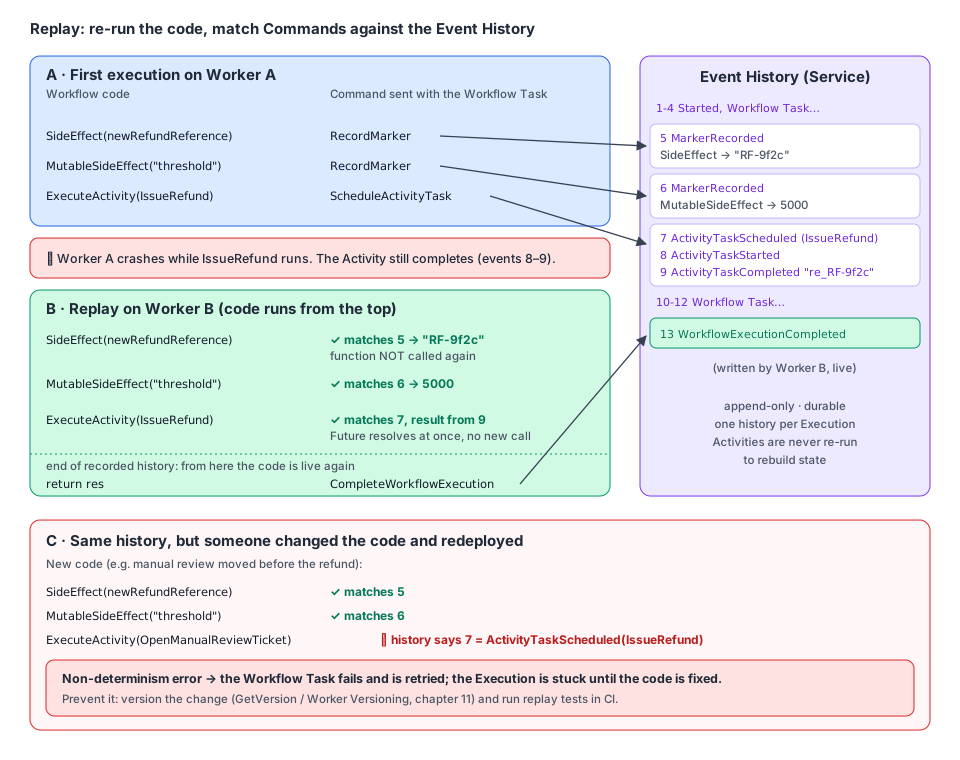
The Event History is an append-only log, durably persisted by the Service. It is the source of truth for your Workflow's state and doubles as an audit log. A history could read:
1  WorkflowExecutionStarted
2  WorkflowTaskScheduled
3  WorkflowTaskStarted
4  WorkflowTaskCompleted
5  MarkerRecorded              (SideEffect: refund reference)
6  MarkerRecorded              (MutableSideEffect: auto-approve threshold)
7  ActivityTaskScheduled       (IssueRefund)
8  ActivityTaskStarted
9  ActivityTaskCompleted       (result: "re_RF-9f2c")
10 WorkflowTaskScheduled
…
Every WorkflowTaskCompleted matches a completion request from the Worker. That's where the Commands came from.
3. Replay: rebuilding state by re-running code
When a Worker needs to continue an Execution it doesn't have in memory (after a crash, a deploy, or a cache eviction):
- It fetches the Event History.
- It runs your Workflow function from the beginning.
- Each time the code would issue a Command, the SDK compares it with the Event at the same position in the history.
- It matches → the SDK does not re-send it. If the history has a result for it (an Activity result, a fired Timer), the Future resolves immediately with the recorded value.
- It doesn't match → non-determinism error. The Workflow Task fails and is retried until the code is fixed.
- When the code reaches the end of the recorded history, it is "live" again and new Commands go to the Service.
Activities are not executed again during replay. Their recorded results are reused.
The Workflow cache and sticky execution
Replaying from scratch on every Workflow Task would be expensive. So each Worker keeps an in-memory LRU Workflow cache of Executions it has processed. The Service sends the next Workflow Tasks of a cached Execution to the same Worker through a dedicated sticky queue. The Worker then just continues from memory.
If the Execution is evicted (cache full, Worker restarted), the next Worker that gets it replays the full history to rebuild the state. Replay is the normal recovery path, not an edge case.
4. The determinism rules
Deterministic here means: given the same input and the same history, your code makes the same Workflow API calls, in the same order.
What produces Commands (must not be added, removed or reordered without versioning)
- starting or cancelling a Timer (
workflow.Sleep,workflow.NewTimer) - scheduling or cancelling an Activity, including Local Activities
- starting or cancelling a Child Workflow
- signalling or cancelling an external Workflow
- scheduling or cancelling a Nexus operation
- ending the Execution (complete, fail, cancel, continue-as-new)
GetVersioncalls (they follow their own patching rules)- upserting Search Attributes or Memos
SideEffect/MutableSideEffect
Changes that are safe on running Executions
- the inputs, return values and timeouts of Activities and Child Workflows (not their type or ID)
- the input of a Signal sent to an external Workflow
- a Timer duration, except changing it to or from 0 (non-deterministic in Go)
- adding or removing calls that don't produce Commands, e.g.
workflow.GetInfo, logging - adding a Signal handler for a Signal Type that was never sent to this Execution
Anything else (new step, removed step, swapped order, a different Activity) needs versioning (chapter 11).
What the Go SDK checks for you
At replay, the Go SDK flags these calls if they were added, removed or reordered:
workflow.ExecuteActivity() · workflow.ExecuteChildWorkflow() · workflow.NewTimer() · workflow.RequestCancelWorkflow() · workflow.SideEffect() · workflow.SignalExternalWorkflow() · workflow.Sleep()
⚠️ The check is shallow. It doesn't compare Activity arguments or Timer durations. Replay tests (section 7) are your real safety net.
📝 The Go runtime-check list in the docs names
workflow.RequestCancelWorkflow(). In SDK v1.50.0 the function is calledworkflow.RequestCancelExternalWorkflow().
Intrinsic non-determinism
The second source of bugs is code that branches on values not in the history:
// ❌ Anti-pattern (not compiled): every line here can change between the first run and a replay.
if time.Now().Hour() < 12 { // wall clock of whichever Worker replays
	_ = workflow.Sleep(ctx, time.Hour)
}
if rand.Intn(100) < 10 { // a new random number on every replay
	_ = workflow.ExecuteActivity(ctx, a.FlagForManualReview, req).Get(ctx, nil)
}
for carrier := range quotesByCarrier { // Go randomizes map order
	_ = workflow.ExecuteActivity(ctx, a.BookCarrier, carrier).Get(ctx, nil)
}
resp, _ := http.Get("https://fx.example.com/eur-usd") // network I/O outside an Activity
The rule: everything that isn't a pure computation on Workflow state goes through a Temporal API (workflow.Now, workflow.SideEffect, an Activity…) so its value is recorded and replayed.
5. Recording non-deterministic values
workflow.SideEffect: run once, record, replay the value
SideEffect runs a short function once, stores its return value in the history (a MarkerRecorded Event), and returns the recorded value on every replay.
- Use it for local, cheap, infallible values: a UUID, a random number.
- It must not fail. A panic or error fails the Workflow Task and the function may run again. Anything that can fail belongs in an Activity.
- Return the value. Don't modify Workflow variables inside the function: it doesn't run during replay.
// ❌ Anti-pattern (not compiled): `ref` stays "" on replay, because the function isn't re-executed.
var ref string
workflow.SideEffect(ctx, func(ctx workflow.Context) any {
	ref = newRefundReference()
	return nil
})
The correct shape is in the example below: return the value, then .Get(&ref).
Side Effects exist in Go, Java and PHP. A Local Activity fits the same use case, and so does a regular Activity when the value comes from an external system.
workflow.MutableSideEffect: a value that may change over time
MutableSideEffect(ctx, id, fn, equals) runs fn each time it's called, but only records a new Marker when the value for that ID changes (compared with equals). On replay it returns the recorded values without calling fn. Typical use: a configuration value, such as a feature flag or a threshold, read in a loop.
workflow.IsReplaying: for side channels only
workflow.IsReplaying(ctx) tells you if the code is currently replaying. Use it to avoid duplicate metrics or notifications from interceptors. Never use it to change business logic: that is non-deterministic by definition. (workflow.GetLogger already skips logs during replay.)
6. Example: a deterministic refund Workflow
Activities and configuration
// file: refunds/activities.go
package refunds

import (
	"context"
	"sync/atomic"
)

// PaymentProvider is the PSP. Its calls are side effects, so they live in Activities.
type PaymentProvider interface {
	Refund(ctx context.Context, chargeID string, amountCents int64, reference string) (string, error)
}

type RefundActivities struct {
	PSP PaymentProvider
}

func (a *RefundActivities) IssueRefund(ctx context.Context, chargeID string, amountCents int64, reference string) (string, error) {
	return a.PSP.Refund(ctx, chargeID, amountCents, reference)
}

func (a *RefundActivities) OpenManualReviewTicket(ctx context.Context, reference string, amountCents int64) (string, error) {
	return "TICKET-" + reference, nil
}

// autoApproveThreshold is hot-reloaded by the Worker from its config file. Reading it directly in
// Workflow code would be non-deterministic; MutableSideEffect records it.
var autoApproveThreshold atomic.Int64

func SetAutoApproveThresholdCents(v int64) { autoApproveThreshold.Store(v) }

func autoApproveThresholdCents() int64 { return autoApproveThreshold.Load() }
Workflow
// file: refunds/workflow.go
package refunds

import (
	"crypto/rand"
	"encoding/hex"
	"time"

	"go.temporal.io/sdk/workflow"
)

const TaskQueue = "refunds"

type RefundRequest struct {
	OrderID     string
	ChargeID    string
	AmountCents int64
}

type RefundResult struct {
	Reference    string
	ProviderID   string
	TicketID     string
	RequestedAt  time.Time
	SLADeadline  time.Time
	AutoApproved bool
}

func newRefundReference() string {
	b := make([]byte, 6)
	_, _ = rand.Read(b)
	return "RF-" + hex.EncodeToString(b)
}

func RefundRequestWorkflow(ctx workflow.Context, req RefundRequest) (RefundResult, error) {
	logger := workflow.GetLogger(ctx)
	ctx = workflow.WithActivityOptions(ctx, workflow.ActivityOptions{StartToCloseTimeout: 30 * time.Second})
	var a *RefundActivities

	// ✅ Replay-safe time: the time of the current Workflow Task, identical on replay.
	res := RefundResult{RequestedAt: workflow.Now(ctx)}
	res.SLADeadline = res.RequestedAt.Add(48 * time.Hour)

	// ✅ Random value recorded once as a Marker, returned as-is on every replay.
	if err := workflow.SideEffect(ctx, func(ctx workflow.Context) any {
		return newRefundReference()
	}).Get(&res.Reference); err != nil {
		return RefundResult{}, err
	}

	// ✅ Config value recorded under the ID "auto-approve-threshold"; a new Marker only if it changed.
	var threshold int64
	err := workflow.MutableSideEffect(ctx, "auto-approve-threshold",
		func(ctx workflow.Context) any { return autoApproveThresholdCents() },
		func(a, b any) bool { return a.(int64) == b.(int64) },
	).Get(&threshold)
	if err != nil {
		return RefundResult{}, err
	}

	if req.AmountCents > threshold {
		// Big refunds go to a human first.
		if err := workflow.ExecuteActivity(ctx, a.OpenManualReviewTicket, res.Reference, req.AmountCents).Get(ctx, &res.TicketID); err != nil {
			return RefundResult{}, err
		}
		logger.Info("Refund needs manual review", "ticket", res.TicketID, "deadline", res.SLADeadline)
		return res, nil
	}

	// ✅ Network call in an Activity: executed once, its result recorded and reused on replay.
	res.AutoApproved = true
	if err := workflow.ExecuteActivity(ctx, a.IssueRefund, req.ChargeID, req.AmountCents, res.Reference).Get(ctx, &res.ProviderID); err != nil {
		return RefundResult{}, err
	}
	if workflow.Now(ctx).After(res.SLADeadline) {
		logger.Warn("Refund issued after SLA", "reference", res.Reference)
	}
	return res, nil
}
The Event History of an auto-approved refund contains two MarkerRecorded Events (the reference and the threshold) followed by the IssueRefund Activity Events. Replay it next month with a different threshold in the config file and you still get the same decision.
Worker
// file: cmd/refunds-worker/main.go
package main

import (
	"context"
	"log"

	"github.com/acme/shop/refunds"
	"go.temporal.io/sdk/client"
	"go.temporal.io/sdk/worker"
)

type fakePSP struct{}

func (fakePSP) Refund(ctx context.Context, chargeID string, amountCents int64, reference string) (string, error) {
	return "re_" + reference, nil
}

func main() {
	refunds.SetAutoApproveThresholdCents(50_00) // in real life: loaded and reloaded from config

	c, err := client.Dial(client.Options{})
	if err != nil {
		log.Fatalln("Unable to create client", err)
	}
	defer c.Close()

	w := worker.New(c, refunds.TaskQueue, worker.Options{})
	w.RegisterWorkflow(refunds.RefundRequestWorkflow)
	w.RegisterActivity(&refunds.RefundActivities{PSP: fakePSP{}})
	if err := w.Run(worker.InterruptCh()); err != nil {
		log.Fatalln("Unable to start Worker", err)
	}
}
7. Replay testing: catch non-determinism before production
The SDK's runtime check is shallow. The reliable way to know a code change is safe is to replay real histories against the new code in a unit test:
- Export histories of real Executions (from production or staging):
temporal workflow show --workflow-id refund-o-1001 --output json > refunds/testdata/refund-o-1001.json - Replay them with
worker.NewWorkflowReplayer()in CI. A non-determinism error fails the test.
// file: refunds/replay_test.go
package refunds

import (
	"path/filepath"
	"testing"

	"go.temporal.io/sdk/worker"
)

func TestRefundRequestWorkflow_ReplaysRecordedHistories(t *testing.T) {
	files, err := filepath.Glob(filepath.Join("testdata", "refund-*.json"))
	if err != nil {
		t.Fatal(err)
	}
	if len(files) == 0 {
		t.Skip("no recorded histories in testdata/")
	}

	replayer := worker.NewWorkflowReplayer()
	replayer.RegisterWorkflow(RefundRequestWorkflow)

	for _, f := range files {
		t.Run(filepath.Base(f), func(t *testing.T) {
			// nil = the SDK default logger, not a no-op one (see the Testing guide, chapter 07)
			if err := replayer.ReplayWorkflowHistoryFromJSONFile(nil, f); err != nil {
				t.Fatalf("history %s is not compatible with the current code: %v", f, err)
			}
		})
	}
}
Keep a few histories per Workflow Type and per important code path (auto-approved, manual review). Every time you change the Workflow, this test tells you if running Executions would break.
Key takeaways
- Workflow code emits Commands; the Service records Events; the Event History is the source of truth.
- Recovery = replay: the code re-runs from the top and its Commands are matched against the history. Activities aren't re-executed; their results are reused.
- A Worker cache with sticky queues avoids most replays, but you must design for full replays anyway.
- Never branch on wall-clock time, randomness, map order, or I/O in Workflow code. Use
workflow.Now,SideEffect,MutableSideEffect,DeterministicKeysand Activities. - Adding, removing or reordering Command-producing calls needs versioning. Prove compatibility with replay tests.
⬅️ Previous: 02 · Defining Workflows in Go · ➡️ Next: 04 · Workflow Execution, IDs and lifecycle