10 · Graceful shutdown: deploying without losing work
Level: production · Read time: ~15 min Sources: Encyclopedia — Worker Shutdown Behavior · Go SDK — Run a Worker: Shut down a Worker ·
worker.Options
1. The problem
Workers restart all the time: every deploy, every autoscaling event, every node drain. Each time, some Activities are running: a 40-second carrier API call, a 3-minute CSV export. What happens to them?
Temporal never loses them: an Activity that doesn't report back is retried by the Service after its timeout. But "retried after its timeout" can mean minutes of delay, duplicated side effects and noisy alerts on every deploy. Graceful shutdown lets a Worker finish (or cleanly hand back) its current work before it exits.
2. The shutdown sequence
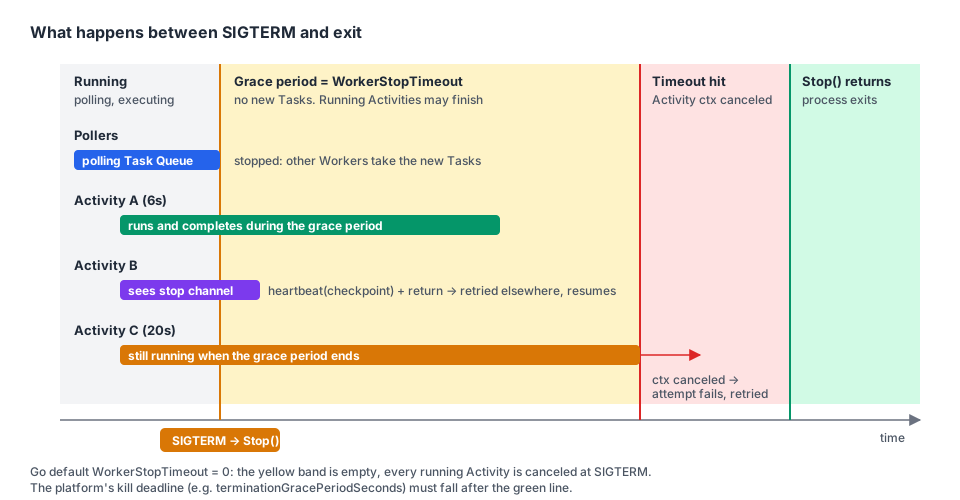
When Stop() is called (directly, or by Run when the process gets SIGINT/SIGTERM):
- The Worker stops polling: it takes no new Tasks from its Task Queues.
- The Worker stop channel closes. Activities can see it with
activity.GetWorkerStopChannel(ctx). - In-flight Activities keep running for up to
WorkerStopTimeout. - When the timeout hits (or immediately, if it is 0), the Activity contexts are canceled. Each canceled attempt is reported as failed and retried by the Service according to its Retry Policy.
- In-flight Workflow Tasks are completed. They are short (milliseconds) unless Workflow code blocks incorrectly or runs Local Activities (see §5).
Stop()returns.
Workflows are never affected by a Worker stopping: their state lives in the Event History, and the next Workflow Task goes to any other Worker (chapter 06).
3. WorkerStopTimeout defaults to 0
The Go page says that on SIGINT/SIGTERM the Worker "waits for in-flight Tasks to finish, up to the WorkerStopTimeout". It doesn't say that the default is 0s, which means no wait at all.
Observed on a dev server (Go SDK v1.50.0, Temporal Server 1.32.0). An Activity that sleeps for a given duration, Stop() called 2 seconds after it starts:
WorkerStopTimeout | Activity duration | Stop() returned after | What happened to the Activity |
|---|---|---|---|
0 (default) | 6s | 0s | Context canceled immediately. Attempt 1 failed with context canceled, attempt 2 scheduled |
10s | 6s | ~4s | Completed normally. Stop waited only as long as needed |
5s | 20s | 5s | Ran 5 more seconds, then context canceled. Attempt 2 scheduled |
So with the defaults, every deploy cancels every running Activity. Always set WorkerStopTimeout in production, to a bit more than your typical Activity duration.
The Encyclopedia notes a Go-specific detail: if an Activity ignores cancellation after the timeout, Go's Stop() still returns, and the Activity goroutine keeps running and holding its slot until the process exits. (Core-based SDKs wait for it instead.) Honor ctx.Done() in long Activities.
4. Write Activities that shut down well
A long export reads the stop channel. When the Worker is stopping, it records its progress in a heartbeat and returns a retryable error at once, instead of waiting to be canceled. The next attempt, on another Worker, resumes from the checkpoint.
// file: reporting/export.go
package reporting

import (
	"context"
	"fmt"

	"go.temporal.io/sdk/activity"
	"go.temporal.io/sdk/temporal"
)

type ExportShipmentsInput struct {
	Day         string
	ShipmentIDs []string
}

// Warehouse is the external system we export to.
type Warehouse interface {
	PushShipment(ctx context.Context, day, shipmentID string) error
}

type Activities struct {
	Warehouse Warehouse
}

// ExportShipments pushes each shipment once, checkpointing progress with heartbeats.
func (a *Activities) ExportShipments(ctx context.Context, in ExportShipmentsInput) (int, error) {
	next := 0
	if activity.HasHeartbeatDetails(ctx) {
		var done int
		if err := activity.GetHeartbeatDetails(ctx, &done); err == nil {
			next = done // resume where the previous attempt stopped
		}
	}

	stopping := activity.GetWorkerStopChannel(ctx)
	for i := next; i < len(in.ShipmentIDs); i++ {
		select {
		case <-stopping:
			// Hand the rest back now. The heartbeat carries the checkpoint to the retry.
			activity.RecordHeartbeat(ctx, i)
			return i, temporal.NewApplicationError("worker shutting down, will resume", "WorkerShutdown")
		case <-ctx.Done():
			return i, ctx.Err()
		default:
		}
		if err := a.Warehouse.PushShipment(ctx, in.Day, in.ShipmentIDs[i]); err != nil {
			return i, fmt.Errorf("push shipment %s: %w", in.ShipmentIDs[i], err)
		}
		activity.RecordHeartbeat(ctx, i+1)
	}
	return len(in.ShipmentIDs), nil
}// file: reporting/warehouse.go
package reporting
import "context"
// warehouseClient stands in for the real warehouse API client.
type warehouseClient struct{}
func (warehouseClient) PushShipment(ctx context.Context, day, shipmentID string) error { return nil }
func NewWarehouseClient() Warehouse { return warehouseClient{} }// file: reporting/workflow.go
package reporting
import (
"time"
"go.temporal.io/sdk/temporal"
"go.temporal.io/sdk/workflow"
)
const TaskQueue = "reporting"
func DailyShipmentExportWorkflow(ctx workflow.Context, in ExportShipmentsInput) (int, error) {
ctx = workflow.WithActivityOptions(ctx, workflow.ActivityOptions{
StartToCloseTimeout: 30 * time.Minute,
// A dead Worker is detected in 30s instead of 30min.
HeartbeatTimeout: 30 * time.Second,
RetryPolicy: &temporal.RetryPolicy{InitialInterval: time.Second},
})
var a *Activities
var exported int
err := workflow.ExecuteActivity(ctx, a.ExportShipments, in).Get(ctx, &exported)
return exported, err
}Checked on a dev server with 8 shipments taking 1s each and WorkerStopTimeout: 45s: Worker A pushed shipments 1 to 4, Stop() returned 0.5s later (the time to finish shipment 4), and Worker B's attempt resumed at shipment 5. No shipment was pushed twice and the Workflow completed with 8.
Three habits make this work:
- Honor
ctx.Done()in every loop and blocking call (passctxto your HTTP and DB clients). - Heartbeat a checkpoint so a retry continues instead of restarting.
- Set a
HeartbeatTimeout, so if the process is killed hard (OOM,SIGKILL) the Service notices in seconds, not after the fullStartToCloseTimeout.
5. Local Activities and Workflow Tasks
Local Activities run inside a Workflow Task, so shutdown treats them differently (Encyclopedia):
| Phase | Local Activities |
|---|---|
| During the graceful period | The current one, and the next ones of the same Workflow Task, may run and complete |
| When the period is over | The running attempt gets a cancel signal. No new Local Activity is started or retried |
| After that | The Worker still waits for the current Workflow Task to finish. A hung Local Activity can block shutdown until the Workflow Task times out |
Keep Local Activities short (seconds) and make them honor ctx.Done(). Anything long belongs in a normal Activity.
6. Wiring shutdown into your process
6.1 A dedicated Worker process
Run(worker.InterruptCh()) is enough: it starts the Worker, blocks until SIGINT or SIGTERM (the SDK's InterruptCh listens to both), then calls Stop().
// file: cmd/reporting-worker/main.go
package main

import (
	"log"
	"time"

	"github.com/acme/shop/reporting"
	"go.temporal.io/sdk/client"
	"go.temporal.io/sdk/worker"
)

func main() {
	c, err := client.Dial(client.Options{})
	if err != nil {
		log.Fatalln("unable to create Temporal client:", err)
	}
	defer c.Close()

	w := worker.New(c, reporting.TaskQueue, worker.Options{
		// Longer than a typical export batch, shorter than the platform's kill deadline.
		WorkerStopTimeout: 45 * time.Second,
	})
	w.RegisterWorkflow(reporting.DailyShipmentExportWorkflow)
	w.RegisterActivity(&reporting.Activities{Warehouse: reporting.NewWarehouseClient()})

	if err := w.Run(worker.InterruptCh()); err != nil {
		log.Fatalln("worker stopped with error:", err)
	}
	log.Println("worker stopped cleanly")
}
6.2 A Worker inside an HTTP service
When the Worker shares the process with an API, use Start() and Stop() and drive both from one signal context:
// file: cmd/shop-api/main.go
package main

import (
	"context"
	"errors"
	"log"
	"net/http"
	"os/signal"
	"syscall"
	"time"

	"github.com/acme/shop/reporting"
	"go.temporal.io/sdk/client"
	"go.temporal.io/sdk/worker"
)

func main() {
	ctx, stop := signal.NotifyContext(context.Background(), syscall.SIGINT, syscall.SIGTERM)
	defer stop()

	c, err := client.Dial(client.Options{})
	if err != nil {
		log.Fatalln("unable to create Temporal client:", err)
	}
	defer c.Close() // runs last: after the Worker and the HTTP server are stopped

	w := worker.New(c, reporting.TaskQueue, worker.Options{WorkerStopTimeout: 45 * time.Second})
	w.RegisterWorkflow(reporting.DailyShipmentExportWorkflow)
	w.RegisterActivity(&reporting.Activities{Warehouse: reporting.NewWarehouseClient()})
	if err := w.Start(); err != nil {
		log.Fatalln("unable to start worker:", err)
	}

	srv := &http.Server{Addr: ":8080", Handler: http.NewServeMux()}
	go func() {
		if err := srv.ListenAndServe(); err != nil && !errors.Is(err, http.ErrServerClosed) {
			log.Println("http server:", err)
			stop()
		}
	}()

	<-ctx.Done()
	log.Println("shutting down")

	shutdownCtx, cancel := context.WithTimeout(context.Background(), 10*time.Second)
	defer cancel()
	_ = srv.Shutdown(shutdownCtx) // stop accepting HTTP requests
	w.Stop()                      // blocks up to WorkerStopTimeout
}
6.3 Give the platform enough time
The platform kills the process some time after SIGTERM. That deadline must be longer than WorkerStopTimeout, plus the time the rest of your shutdown takes:
# Kubernetes Deployment (excerpt)
spec:
  template:
    spec:
      terminationGracePeriodSeconds: 60   # > WorkerStopTimeout (45s) + HTTP shutdown
      containers:
        - name: reporting-worker
image: registry.acme.dev/shop/reporting-worker:2026.10.25| Platform | Setting to align with WorkerStopTimeout |
|---|---|
| Kubernetes | terminationGracePeriodSeconds (default 30s) |
| AWS ECS | stopTimeout (default 30s) |
| systemd | TimeoutStopSec |
| Docker | docker stop -t (default 10s) |
| AWS Lambda (Serverless) | handled by lambdaworker's ShutdownDeadlineBuffer (chapter 12) |
7. Key takeaways
- Stopping a Worker stops polling, closes the stop channel, lets Activities run for up to
WorkerStopTimeout, then cancels them. Canceled attempts are retried, never lost. - In Go,
WorkerStopTimeoutdefaults to 0: without it, every deploy cancels every running Activity. - Long Activities should honor
ctx.Done(), watchactivity.GetWorkerStopChannel, and heartbeat a checkpoint with aHeartbeatTimeout. - Keep Local Activities short: a hung one can hold up shutdown.
- Make the platform's kill deadline longer than
WorkerStopTimeout. Next: Worker Versioning, for deploys that change Workflow code.