06 · Designing your Namespaces
Level: production · Read time: ~15 min Sources: Encyclopedia — Temporal Namespace · Go SDK — Namespaces · Multi-tenant application patterns · Temporal Nexus
1. The problem
The shop started with everything in default. Now there are three teams (checkout, shipping, billing), a staging environment, an audit requirement to keep invoices for 90 days, and an incident where a load test in staging slowed down production Workflows. Someone asks: "how many Namespaces should we have, and how do they talk to each other?"
Namespaces are cheap to create, but they are hard boundaries: Workflows in one can't call Workflows in another directly. This chapter helps you draw those boundaries on purpose.
2. What a Namespace boundary gives you
| Per Namespace | Why it matters |
|---|---|
| Workflow ID uniqueness | order-1042 can run in shop-prod and shop-staging at the same time (chapter 01) |
| Resource isolation | Heavy traffic in one Namespace doesn't slow down another on the same Service |
| Retention and archival | Billing keeps 90 days, staging 3 days (chapter 04) |
| Search Attributes | Each Namespace has its own custom attributes (chapter 04) |
| Access control | An Authorizer (self-hosted) or roles and API keys (Cloud) per Namespace |
| Lifecycle | Deprecate and delete one without touching the others (chapter 05) |
| On Temporal Cloud | Its own rate limits, high-availability replication, tags and endpoint |
What it does not give you: a separate deployment of your code. The same Worker binary can serve shop-staging and shop-prod; only the Client's Namespace option changes (chapter 02).
3. Where to draw the lines
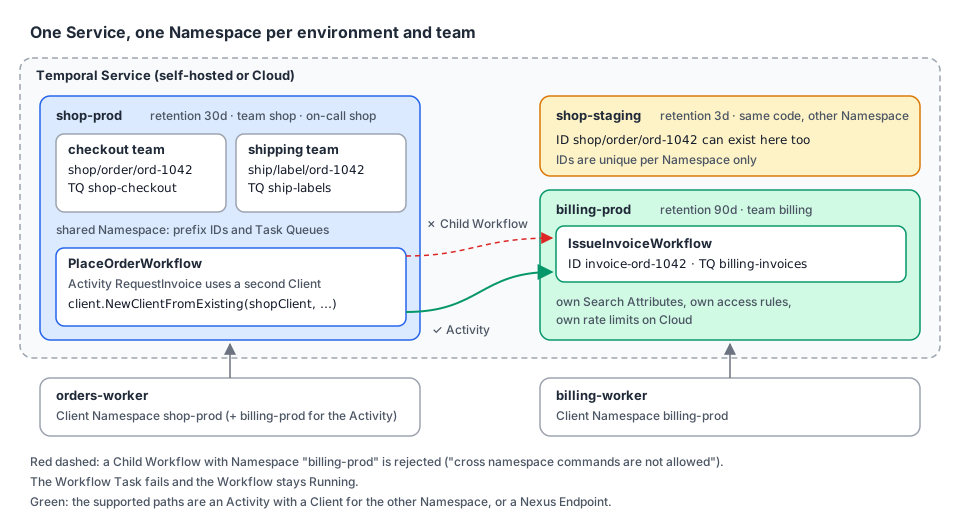
Three common splits, usually combined:
| Split by | Example | Choose it when |
|---|---|---|
| Environment | shop-staging, shop-prod | Always. Staging tests must never share IDs, load or retention with production |
| Team / bounded context | shop-prod, billing-prod | Teams deploy on their own, need different retention or access, or own a clear service boundary |
| Tenant | acme-eu-prod for a large customer | A customer needs hard isolation (contract, data residency, its own rate limits). Rare: most tenants share a Namespace |
A few rules of thumb:
- Start coarse. One Namespace per environment and team is enough for most companies. Splitting later is easier than merging: Workflows can't move between Namespaces.
- Name for humans and tools:
<domain>-<env>, lowercase, stable. Tools likeRetireNamespacematch on these names. - Don't use a Namespace per developer in a shared Service. Use the dev server locally (
temporal server start-dev --namespace shop-dev).
4. Sharing a Namespace safely
Inside one Namespace, everyone shares the Workflow ID space and the Task Queue names. Two teams that both start order-1042, or both poll default-queue, will collide: the second start is refused or joins the wrong Workflow, and Workers pick up Tasks they can't run. Prefix both with the owning team:
// file: internal/tenancy/names.go
package tenancy

import "fmt"

// When several teams share one Namespace, Workflow IDs and Task Queues are
// shared too. Prefix both with the owning team so they never collide.

// WorkflowID builds "<team>/<kind>/<businessKey>", e.g. "shop/order/ord-1042".
func WorkflowID(team, kind, businessKey string) string {
	return fmt.Sprintf("%s/%s/%s", team, kind, businessKey)
}

// TaskQueue builds "<team>-<purpose>", e.g. "shop-checkout".
func TaskQueue(team, purpose string) string {
	return team + "-" + purpose
}
The checkout team then starts shop/order/ord-1042 on shop-checkout, and shipping starts ship/label/ord-1042 on ship-labels, in the same shop-prod Namespace. For more patterns (one Task Queue per tenant, fairness keys), see the Multi-tenant application patterns page.
5. Crossing Namespaces
Checkout must ask billing for an invoice. Billing's Workflows live in billing-prod.
The path that no longer works: a cross-Namespace Child Workflow
workflow.ChildWorkflowOptions still has a Namespace field, but the SDK marks it deprecated: "Cross-namespace operations are disabled by default as of server 1.30.1." The code compiles:
// file: orders/child_cross_namespace.go
package orders

import (
	"go.temporal.io/sdk/workflow"

	"github.com/acme/shop/billing"
)

// Don't do this: the Service rejects Child Workflows in another Namespace.
// The Workflow Task fails with BadStartChildExecutionAttributes and the Workflow
// stays Running, retrying the same failing Task.
func PlaceOrderWithChildInvoiceWorkflow(ctx workflow.Context, order Order) (string, error) {
	ctx = workflow.WithChildOptions(ctx, workflow.ChildWorkflowOptions{
		Namespace: "billing-prod", // deprecated field: cross-Namespace commands are off by default
		TaskQueue: billing.TaskQueue,
	})
	var inv billing.Invoice
	err := workflow.ExecuteChildWorkflow(ctx, billing.IssueInvoiceWorkflow, billing.InvoiceRequest{
		OrderID: order.ID, CustomerID: order.CustomerID, AmountCents: order.AmountCents,
	}).Get(ctx, &inv)
	return inv.InvoiceNumber, err
}
On a dev server (Server 1.32.0), the parent's Workflow Task failed with BadStartChildExecutionAttributes: cross namespace commands are not allowed. The Workflow didn't fail: it stayed Running, retrying the same Task. This is the Workflow Task failure pattern from the Error handling guide.
Path 1: an Activity with a Client for the other Namespace
An Activity can do anything, including calling Temporal. Give it a Client for billing-prod, built from the Worker's own connection with client.NewClientFromExisting (Client guide, chapter 09). The billing team keeps its Workflow and its Worker:
// file: billing/workflow.go
package billing

import (
	"fmt"

	"go.temporal.io/sdk/workflow"
)

// Owned by the billing team, running in the billing Namespace.
const TaskQueue = "billing-invoices"

type InvoiceRequest struct {
	OrderID     string
	CustomerID  string
	AmountCents int64
}

type Invoice struct {
	InvoiceNumber string
	OrderID       string
}

func IssueInvoiceWorkflow(ctx workflow.Context, req InvoiceRequest) (Invoice, error) {
	// A real implementation would call Activities (tax, PDF, e-mail).
	return Invoice{InvoiceNumber: fmt.Sprintf("INV-%s", req.OrderID), OrderID: req.OrderID}, nil
}// file: cmd/billing-worker/main.go
package main
import (
"log"
"os"
"go.temporal.io/sdk/client"
"go.temporal.io/sdk/worker"
"github.com/acme/shop/billing"
)
func main() {
ns := os.Getenv("BILLING_NAMESPACE")
if ns == "" {
ns = "billing-prod"
}
c, err := client.Dial(client.Options{Namespace: ns})
if err != nil {
log.Fatal(err)
}
defer c.Close()
w := worker.New(c, billing.TaskQueue, worker.Options{})
w.RegisterWorkflow(billing.IssueInvoiceWorkflow)
if err := w.Run(worker.InterruptCh()); err != nil {
log.Fatal(err)
}
}The checkout side calls it through an Activity. The Workflow ID invoice-<order> with USE_EXISTING makes Activity retries safe: a retry joins the same invoice instead of issuing a second one (Client guide, chapter 05):
// file: orders/invoicing.go
package orders

import (
	"context"

	enumspb "go.temporal.io/api/enums/v1"
	"go.temporal.io/sdk/client"

	"github.com/acme/shop/billing"
)

// InvoicingActivities reach the billing Namespace with their own Client.
// Workflows can't start a Child Workflow in another Namespace; an Activity can.
type InvoicingActivities struct {
	Billing client.Client // a Client for the billing Namespace
}

// RequestInvoice starts (or joins) the billing Workflow for this order and waits for it.
// The Workflow ID makes retries of this Activity safe.
func (a *InvoicingActivities) RequestInvoice(ctx context.Context, req billing.InvoiceRequest) (billing.Invoice, error) {
	run, err := a.Billing.ExecuteWorkflow(ctx, client.StartWorkflowOptions{
		ID:                       "invoice-" + req.OrderID,
		TaskQueue:                billing.TaskQueue,
		WorkflowIDConflictPolicy: enumspb.WORKFLOW_ID_CONFLICT_POLICY_USE_EXISTING,
	}, billing.IssueInvoiceWorkflow, req)
	if err != nil {
		return billing.Invoice{}, err
	}
	var inv billing.Invoice
	err = run.Get(ctx, &inv)
	return inv, err
}// file: orders/workflow.go
package orders
import (
"time"
"go.temporal.io/sdk/workflow"
"github.com/acme/shop/billing"
)
const TaskQueue = "shop-checkout"
type Order struct {
ID string
CustomerID string
AmountCents int64
}
func PlaceOrderWorkflow(ctx workflow.Context, order Order) (string, error) {
ctx = workflow.WithActivityOptions(ctx, workflow.ActivityOptions{StartToCloseTimeout: 2 * time.Minute})
var a *InvoicingActivities
var inv billing.Invoice
err := workflow.ExecuteActivity(ctx, a.RequestInvoice, billing.InvoiceRequest{
OrderID: order.ID, CustomerID: order.CustomerID, AmountCents: order.AmountCents,
}).Get(ctx, &inv)
if err != nil {
return "", err
}
return inv.InvoiceNumber, nil
}// file: cmd/orders-worker/main.go
package main
import (
"log"
"os"
"go.temporal.io/sdk/client"
"go.temporal.io/sdk/worker"
"github.com/acme/shop/orders"
)
func main() {
shopNS := envOr("SHOP_NAMESPACE", "shop-prod")
billingNS := envOr("BILLING_NAMESPACE", "billing-prod")
shop, err := client.Dial(client.Options{Namespace: shopNS})
if err != nil {
log.Fatal(err)
}
defer shop.Close()
// Same connection, other Namespace (see the Client guide, chapter 09).
billingClient, err := client.NewClientFromExisting(shop, client.Options{Namespace: billingNS})
if err != nil {
log.Fatal(err)
}
defer billingClient.Close()
w := worker.New(shop, orders.TaskQueue, worker.Options{})
w.RegisterWorkflow(orders.PlaceOrderWorkflow)
w.RegisterActivity(&orders.InvoicingActivities{Billing: billingClient})
if err := w.Run(worker.InterruptCh()); err != nil {
log.Fatal(err)
}
}
func envOr(key, fallback string) string {
if v := os.Getenv(key); v != "" {
return v
}
return fallback
}On a dev server, PlaceOrderWorkflow in the shop Namespace completed with "INV-ord-1042". The invoice-ord-1042 Workflow existed only in the billing Namespace (describing it in the shop Namespace returned "workflow not found").
The cost of this path: checkout needs credentials for billing-prod, and the Activity's Start-To-Close timeout must cover the whole billing Workflow.
Path 2: Nexus
Nexus is the path the Encyclopedia names for calls between Namespaces. Billing publishes a Nexus Endpoint with typed operations; checkout calls it from its Workflow, without credentials for billing-prod and without knowing its Task Queues or Workflow IDs. See the Go Nexus guide. Prefer it when the two sides belong to different teams.
| Activity + second Client | Nexus | |
|---|---|---|
| Setup | Nothing new | An Endpoint and a Nexus Service |
| Caller needs | Access to the other Namespace | Access to the Endpoint only |
| Contract | Workflow type + Task Queue (implicit) | Named operations with typed input and output |
| Good for | Same team, two Namespaces | Team-to-team APIs |
6. Access control
The boundary is only as strong as who can reach it:
- Self-hosted: the Service has no per-Namespace permissions out of the box. Add a custom Authorizer to the Frontend Service to decide who can use, create, update or delete each Namespace. Restrict
DeleteNamespaceto the platform team: the Service itself won't stop anyone (chapter 05). - Temporal Cloud: use the built-in Namespace roles and API keys or mTLS certificates per Namespace. A Worker for
shop-prodshould hold credentials forshop-prodonly, plus whatever Path 1 above needs.
7. Namespaces as code
Keep the list of Namespaces in Git and apply it on every deploy. Chapter 03's Ensure creates missing Namespaces. Reconcile goes one step further and also corrects drift: someone changed the retention by hand, or the spec gained a new label:
// file: internal/nsadmin/reconcile.go
package nsadmin
import (
"context"
"errors"
"fmt"
"maps"
"time"
namespacepb "go.temporal.io/api/namespace/v1"
"go.temporal.io/api/serviceerror"
"go.temporal.io/api/workflowservice/v1"
"go.temporal.io/sdk/client"
"google.golang.org/protobuf/types/known/durationpb"
)
// DesiredNamespace is the desired state of one Namespace, kept in Git.
type DesiredNamespace struct {
Name string
Retention time.Duration
Description string
OwnerEmail string
Data map[string]string // e.g. team, cost-center
}
// Reconcile makes the Namespace match spec: it registers it if it's missing and
// updates it if it drifted (chapter 03's Ensure only does the first part).
// Safe to run on every deploy. It returns "created", "updated" or "unchanged".
func Reconcile(ctx context.Context, nc client.NamespaceClient, spec DesiredNamespace) (string, error) {
desc, err := nc.Describe(ctx, spec.Name)
var notFound *serviceerror.NamespaceNotFound
switch {
case errors.As(err, ¬Found):
err = nc.Register(ctx, &workflowservice.RegisterNamespaceRequest{
Namespace: spec.Name,
Description: spec.Description,
OwnerEmail: spec.OwnerEmail,
Data: spec.Data,
WorkflowExecutionRetentionPeriod: durationpb.New(spec.Retention),
})
var exists *serviceerror.NamespaceAlreadyExists
if errors.As(err, &exists) {
// Another deploy created it between our Describe and Register: reconcile it next run.
return "unchanged", nil
}
if err != nil {
return "", fmt.Errorf("register %q: %w", spec.Name, err)
}
return "created", nil
case err != nil:
return "", fmt.Errorf("describe %q: %w", spec.Name, err)
}
info, cfg := desc.GetNamespaceInfo(), desc.GetConfig()
req := &workflowservice.UpdateNamespaceRequest{Namespace: spec.Name}
if cfg.GetWorkflowExecutionRetentionTtl().AsDuration() != spec.Retention {
req.Config = &namespacepb.NamespaceConfig{WorkflowExecutionRetentionTtl: durationpb.New(spec.Retention)}
}
if info.GetDescription() != spec.Description || info.GetOwnerEmail() != spec.OwnerEmail || !containsAll(info.GetData(), spec.Data) {
// Empty strings mean "don't change", and Data is merged: Update can't clear values.
req.UpdateInfo = &namespacepb.UpdateNamespaceInfo{
Description: spec.Description,
OwnerEmail: spec.OwnerEmail,
Data: spec.Data,
}
}
if req.Config == nil && req.UpdateInfo == nil {
return "unchanged", nil
}
if err := updateWhenVisible(ctx, nc, req); err != nil {
return "", fmt.Errorf("update %q: %w", spec.Name, err)
}
return "updated", nil
}
// updateWhenVisible retries Update while the Service still answers NamespaceNotFound.
// Right after a Namespace is registered, Describe already finds it but Update and
// Workflow starts can miss it for a moment (about 1s on a dev server, when the name was
// looked up before it existed). The docs allow up to 10 seconds.
func updateWhenVisible(ctx context.Context, nc client.NamespaceClient, req *workflowservice.UpdateNamespaceRequest) error {
ctx, cancel := context.WithTimeout(ctx, 10*time.Second)
defer cancel()
for {
err := nc.Update(ctx, req)
var notFound *serviceerror.NamespaceNotFound
if !errors.As(err, ¬Found) {
return err
}
select {
case <-ctx.Done():
return err
case <-time.After(250 * time.Millisecond):
}
}
}
func containsAll(have, want map[string]string) bool {
merged := maps.Clone(have)
if merged == nil {
merged = map[string]string{}
}
maps.Copy(merged, want)
return maps.Equal(merged, have)
}// file: cmd/ns-reconcile/main.go
package main
import (
"context"
"log"
"time"
"go.temporal.io/sdk/client"
"go.temporal.io/sdk/contrib/envconfig"
"github.com/acme/shop/internal/nsadmin"
)
// desired is the source of truth for the Namespaces of this self-hosted Service.
var desired = []nsadmin.DesiredNamespace{
{Name: "shop-prod", Retention: 30 * 24 * time.Hour, Description: "Checkout, orders, shipping", OwnerEmail: "shop-oncall@acme.example", Data: map[string]string{"team": "shop", "env": "prod"}},
{Name: "billing-prod", Retention: 90 * 24 * time.Hour, Description: "Invoices and refunds", OwnerEmail: "billing-oncall@acme.example", Data: map[string]string{"team": "billing", "env": "prod"}},
{Name: "shop-staging", Retention: 3 * 24 * time.Hour, Description: "Checkout, staging", OwnerEmail: "shop-oncall@acme.example", Data: map[string]string{"team": "shop", "env": "staging"}},
}
func main() {
opts, err := envconfig.LoadDefaultClientOptions()
if err != nil {
log.Fatal(err)
}
nc, err := client.NewNamespaceClient(opts)
if err != nil {
log.Fatal(err)
}
defer nc.Close()
ctx, cancel := context.WithTimeout(context.Background(), time.Minute)
defer cancel()
for _, spec := range desired {
action, err := nsadmin.Reconcile(ctx, nc, spec)
if err != nil {
log.Fatal(err)
}
log.Printf("%-14s %s", spec.Name, action)
}
}On a dev server, five runs of Reconcile against one spec gave created, unchanged, updated (retention 14d → 30d), updated (a cost-center label added) and unchanged.
Two details from those runs:
Updatecan lag behindRegister. When the name had been looked up before it existed (theDescribeat the top ofReconciledoes exactly that),Updateand Workflow starts returnedNamespaceNotFoundfor about a second afterRegister, whileDescribealready found it. That's whyReconcileretriesNamespaceNotFoundfor up to 10 seconds, the delay the Go page warns about (chapter 03).- It can only add.
Updateignores empty strings and mergesData, soReconcilecan't remove a label or clear a description (chapter 04). Remove those by hand, and keep deletion out of the reconciler: retire Namespaces with the guarded tool from chapter 05.
On Temporal Cloud, use the Cloud Terraform provider or temporal cloud namespace commands instead: NamespaceClient doesn't work there.
8. Key takeaways
- Split Namespaces by environment always, by team or bounded context when teams deploy or retain data differently, and by tenant only for hard isolation needs.
- Inside a shared Namespace, prefix Workflow IDs and Task Queues with the owning team.
- Cross-Namespace Child Workflows are rejected by the Service (Workflow Task failure, Workflow stuck Running). Cross with an Activity and a second Client, or with Nexus between teams.
- Protect Namespaces with an Authorizer (self-hosted) or roles and per-Namespace credentials (Cloud).
- Manage Namespaces as code with an idempotent
Reconcile, and retryNamespaceNotFoundbriefly after creating one.