01 · Testing strategy: what to test and with which tool
Level: foundations · Read time: ~10 min Sources: Go SDK — Testing · Go SDK — Debugging ·
testsuitepackage
1. The problem
PlaceOrderWorkflow reserves stock, charges the customer and books a shipment. You want to know, before it reaches production, that:
- the happy path returns a tracking number;
- a declined card stops the order and doesn't ship anything;
- a flaky payment gateway is retried, but not forever;
- a 3-day "remind the customer" timer fires, without the test waiting 3 days;
- tomorrow's version of the code can still resume the orders started today.
A Workflow is not a plain function. It talks to a Temporal Service, its Activities call external systems, its timers can last months, and its code is replayed from history after a crash. A plain go test that calls PlaceOrderWorkflow(ctx, in) doesn't work: there is no workflow.Context to pass it. The Go SDK gives you dedicated tools for each of these questions.
2. Three kinds of tests
The Go SDK docs sort Temporal tests into three kinds:
| Kind | What runs | Example |
|---|---|---|
| End-to-end | A Temporal Server, a Worker with all its Workflows and Activities, a Client that starts and interacts with Workflows | Start PlaceOrderWorkflow on a dev server and wait for its result |
| Integration | Anything between end-to-end and unit | A Workflow run in the test environment with mocked Activities; an Activity run with a mocked context |
| Unit | One piece of Workflow or Activity code (a function or method), with everything it calls mocked | A pure helper that computes a shipping fee |
The docs recommend writing most of your tests as integration tests. In Go, that mostly means the Workflow test environment: it runs your real Workflow code, in the test process, with the Activities you choose to mock.
3. The four Go tools
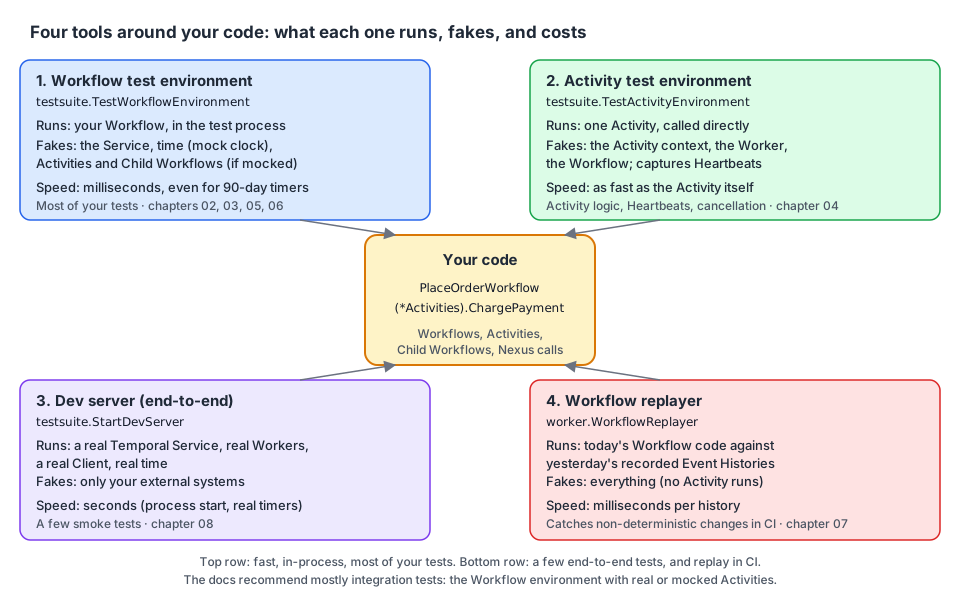
| Tool | Package | What it runs | What it fakes | Speed |
|---|---|---|---|---|
| Workflow test environment | testsuite.TestWorkflowEnvironment | Your Workflow, as a coroutine in the test process | The Service, time (a mock clock), Activities and Child Workflows you mock | Milliseconds, even for long timers |
| Activity test environment | testsuite.TestActivityEnvironment | One Activity, called directly | The Activity context, the Worker, the Workflow | As fast as the Activity |
| Dev server | testsuite.StartDevServer | A real Temporal Service (the CLI's dev server), real Workers, real Client | Only your external systems | Seconds |
| Workflow replayer | worker.WorkflowReplayer | Today's Workflow code against recorded Event Histories | Everything: no Activity runs | Milliseconds per history |
Two things that the docs say in general terms and that are worth spelling out for Go:
- The Workflow test environment is not a server. There is no Temporal Service, no Task Queue polling and no network: the environment plays the Service's role in memory. It's what makes these tests fast, and it's also why a few behaviors differ from production (covered in chapter 03 and later chapters).
- The docs say to "use the test server" for end-to-end and integration tests with Workers "because the test server supports skipping time". The Go SDK has no time-skipping test server: in Go, time skipping lives in the Workflow test environment, and
testsuite.StartDevServerruns a regular dev server where timers take real time.
4. Which question, which tool
| You want to check… | Tool | Chapter |
|---|---|---|
| The Workflow's logic: order of steps, branches, results, errors | Workflow test environment | 02 |
| What happens when an Activity fails, is retried, or a Child Workflow returns something | Workflow test environment + mocks | 03 |
| An Activity's own logic, its Heartbeats, its reaction to cancellation | Activity test environment | 04 |
| Timers, Signals, Queries and Updates, without waiting | Workflow test environment (mock clock, delayed callbacks) | 05 |
| A Workflow that calls a Nexus Operation | Workflow test environment + Nexus mocks | 06 |
| That a code change doesn't break running Workflows | Workflow replayer | 07 |
| That everything is wired together: Worker registration, Task Queue names, data conversion | Dev server | 08 |
| Why a Workflow behaves oddly, in a debugger or in production | TEMPORAL_DEBUG, replay, Web UI, CLI | 09 |
5. A first test
The example module has a PlaceOrderWorkflow and its Activities. External systems are interfaces, so tests never call a real payment gateway.
// file: orders/workflow.go
package orders

import (
	"time"

	"go.temporal.io/sdk/workflow"
)

type PlaceOrderInput struct {
	OrderID     string
	CustomerID  string
	SKU         string
	Quantity    int
	AmountCents int64
}

type PlaceOrderResult struct {
	OrderID        string
	PaymentID      string
	TrackingNumber string
}

// PlaceOrderWorkflow reserves stock, charges the customer, then ships.
func PlaceOrderWorkflow(ctx workflow.Context, in PlaceOrderInput) (PlaceOrderResult, error) {
	ctx = workflow.WithActivityOptions(ctx, workflow.ActivityOptions{
		StartToCloseTimeout: 30 * time.Second,
	})
	var a *Activities // nil: only the method references are used to name the Activities

	if err := workflow.ExecuteActivity(ctx, a.ReserveInventory, in.SKU, in.Quantity).Get(ctx, nil); err != nil {
		return PlaceOrderResult{}, err
	}
	var paymentID string
	if err := workflow.ExecuteActivity(ctx, a.ChargePayment, in.CustomerID, in.AmountCents).Get(ctx, &paymentID); err != nil {
		return PlaceOrderResult{}, err
	}
	var tracking string
	if err := workflow.ExecuteActivity(ctx, a.CreateShipment, in.OrderID).Get(ctx, &tracking); err != nil {
		return PlaceOrderResult{}, err
	}
	return PlaceOrderResult{OrderID: in.OrderID, PaymentID: paymentID, TrackingNumber: tracking}, nil
}// file: orders/activities.go
package orders
import "context"
// External systems, behind interfaces.
type Inventory interface {
Reserve(ctx context.Context, sku string, qty int) error
}
type PaymentGateway interface {
Charge(ctx context.Context, customerID string, amountCents int64) (paymentID string, err error)
}
type Carrier interface {
CreateShipment(ctx context.Context, orderID string) (trackingNumber string, err error)
}
type Activities struct {
Inventory Inventory
Payments PaymentGateway
Carrier Carrier
}
func (a *Activities) ReserveInventory(ctx context.Context, sku string, qty int) error {
return a.Inventory.Reserve(ctx, sku, qty)
}
func (a *Activities) ChargePayment(ctx context.Context, customerID string, amountCents int64) (string, error) {
return a.Payments.Charge(ctx, customerID, amountCents)
}
func (a *Activities) CreateShipment(ctx context.Context, orderID string) (string, error) {
return a.Carrier.CreateShipment(ctx, orderID)
}The first test runs the real Workflow in the Workflow test environment and mocks the three Activities with fixed answers:
// file: orders/workflow_test.go
package orders

import (
	"testing"

	"github.com/stretchr/testify/mock"
	"github.com/stretchr/testify/require"
	"go.temporal.io/sdk/testsuite"
)

func TestPlaceOrderWorkflow_HappyPath(t *testing.T) {
	var ts testsuite.WorkflowTestSuite
	env := ts.NewTestWorkflowEnvironment()

	var a *Activities
	env.OnActivity(a.ReserveInventory, mock.Anything, "SKU-RED-MUG", 2).Return(nil)
	env.OnActivity(a.ChargePayment, mock.Anything, "cus_42", int64(2400)).Return("pay_9001", nil)
	env.OnActivity(a.CreateShipment, mock.Anything, "ord_1001").Return("1Z999AA10123456784", nil)

	env.ExecuteWorkflow(PlaceOrderWorkflow, PlaceOrderInput{
		OrderID: "ord_1001", CustomerID: "cus_42", SKU: "SKU-RED-MUG", Quantity: 2, AmountCents: 2400,
	})

	require.True(t, env.IsWorkflowCompleted())
	require.NoError(t, env.GetWorkflowError())
	var res PlaceOrderResult
	require.NoError(t, env.GetWorkflowResult(&res))
	require.Equal(t, "pay_9001", res.PaymentID)
	require.Equal(t, "1Z999AA10123456784", res.TrackingNumber)
	env.AssertExpectations(t)
}$ go test -v ./orders
=== RUN TestPlaceOrderWorkflow_HappyPath
--- PASS: TestPlaceOrderWorkflow_HappyPath (0.04s)
PASS
ok github.com/acme/shop/orders 0.412sgo test -v also prints DEBUG log lines from the test environment (one per Activity result, for instance). That's the environment's default logger; they don't mean anything went wrong.
Three things to notice:
- The mocks name Activities through a nil
*Activities:a.ChargePaymentis only used to find the Activity's name and signature, never called. The real struct isn't even registered. - The first mock argument is the Activity's
context.Context, matched withmock.Anything. The others are the Activity's arguments. Theint64(2400)matters: a plain2400is anintand wouldn't match. env.AssertExpectations(t)fails the test if a mock you set up was never called. It catches a Workflow that silently skipped a step.
6. A strategy that scales
For a Workflow like PlaceOrderWorkflow:
- Many Workflow-environment tests (02, 03): one per branch, error and retry case, with mocked Activities. They run in milliseconds, so there can be dozens.
- A few Activity-environment tests per Activity (04), with fakes for the external systems.
- A replay test in CI (07) on histories of real executions, so a code change that would break running orders fails the build instead of production.
- One or two end-to-end tests (08) on a dev server, to prove the Worker is wired correctly: names, Task Queue, registration, data conversion.
7. Key takeaways
- A Workflow can't be called like a plain function: test it through the Go SDK's
testsuite. - The docs recommend mostly integration tests. In Go, that's the Workflow test environment with real or mocked Activities.
- Four tools: Workflow test environment, Activity test environment, dev server, Workflow replayer. Pick by the question you're asking, not by habit.
- The Workflow test environment is in-process, has a mock clock, and runs no server. The Go SDK has no time-skipping test server: the dev server runs in real time.
env.AssertExpectations(t)turns an unused mock into a test failure.