01 · Observability in Temporal: what you can see and what you add
Level: foundations · Read time: ~12 min Sources: Go SDK — Observability · Encyclopedia — Context Propagation · Go SDK — OpenTelemetry v2 integration
1. The problem
In a classic web service, one request is one process, one goroutine, a few hundred milliseconds. Logs, metrics and a trace all line up on the same timeline.
An order in the shop is different. PlaceOrderWorkflow starts from an HTTP handler, charges the card on one Worker, waits two days for the warehouse, ships from another Worker after a deploy, and retries the shipping label three times because the carrier's API is flaky. During those two days the Workflow may be replayed several times. When a merchant asks "why did order A-1001 take three days?", you need to answer:
- What happened, step by step, for this one order?
- Is it just this order, or are all orders slow right now?
- Where did the time go: in our code, in the payment provider, in the queue waiting for a Worker?
- Who was it for: which merchant, which request?
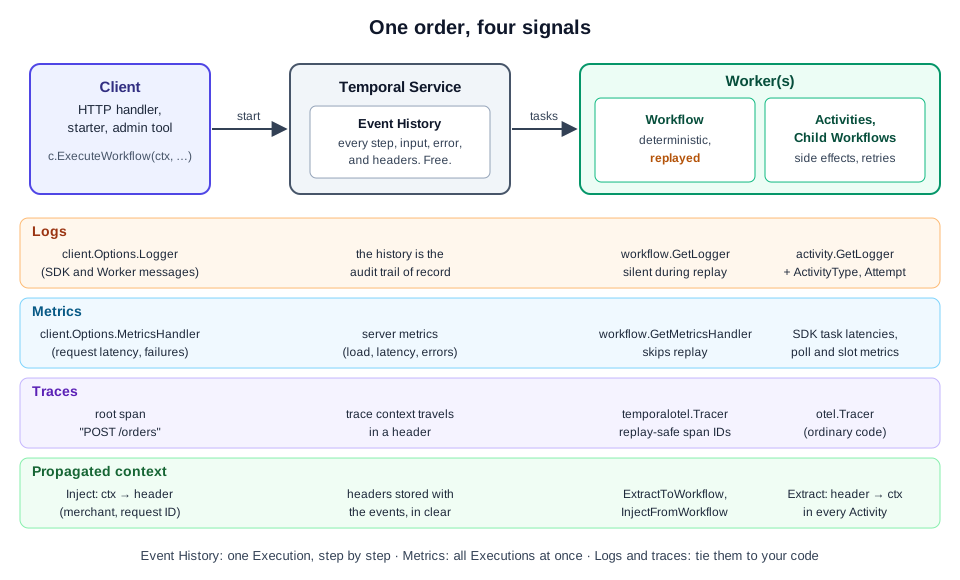
Temporal already records a lot of this. The rest you add: logs, metrics, traces, and the context that ties them together. This guide covers both.
2. The mental model
| Signal | Answers | Where it comes from | Chapter |
|---|---|---|---|
| Event History | What happened to this Execution, in order, with inputs and errors | Recorded by the Temporal Service, for free | this chapter |
| Logs | What our code did and decided | workflow.GetLogger, activity.GetLogger, client.Options.Logger | 02 |
| Propagated context | Who and what this work is for (merchant, request ID) | A context propagator writing Temporal headers | 03, 04 |
| Metrics | How much, how fast, how often, across all Executions | client.Options.MetricsHandler, SDK metrics | 05 |
| Traces | Where the time went, across services and Workers | The OpenTelemetry v2 plugin | 06, 07 |
The Event History answers questions about one Execution. Metrics answer questions about all of them. Logs and traces connect the two to your own code and to the systems around Temporal. Chapter 08 puts them together into dashboards, alerts and an incident routine.
3. What Temporal gives you without any code
Before adding anything, know what is already there:
| Tool | Shows | Example |
|---|---|---|
| Web UI | Every Execution, its status, its Event History, pending Activities with their last failure | http://localhost:8233 with temporal server start-dev |
temporal workflow describe | Status, pending Activities, attempt count, last failure, next retry | below |
temporal workflow show | The full Event History, in order | temporal workflow show -w order-A-1001 |
temporal workflow stack | Where the Workflow code is blocked right now | needs a running Worker |
| Temporal Service metrics | Server-side load, latencies, errors | the dev server exposes them at http://localhost:<metrics-port>/metrics |
Here is the order Workflow of section 5, with a payment provider that is down for the first two attempts. While it retries, describe already tells you most of the story:
$ temporal workflow describe -w order-A-1001
Execution Info:
  WorkflowId            order-A-1001
  RunId                 01a17532-e56d-7639-9d6d-0dd4157c6b4e
  Type                  PlaceOrderWorkflow
  Namespace             default
  TaskQueue             orders
  AssignedBuildId
  StartTime             14 seconds ago
  ExecutionTime         14 seconds ago
  SearchAttributes      map[BuildIds:metadata:{key:"encoding" value:"json/plain"} metadata:{key:"type" value:"KeywordList"} data:"[\"unversioned\",\"unversioned:85c1cdd69d9ac7be3aeabbb4a3fa69fe\"]"]
  StateTransitionCount  6
  HistoryLength         5
  HistorySize           701
  RootWorkflowId        order-A-1001
  RootRunId             01a17532-e56d-7639-9d6d-0dd4157c6b4e
Extended Execution Info:
  CancelRequested    false
  OriginalStartTime  14 seconds ago

Pending Activities: 1

  ActivityId          5
  Type                ChargePayment
  State               Scheduled
  Attempt             3
  MaximumAttempts     0
  ScheduledTime       15 seconds from now
  LastFailure         {"message":"payment provider: 503 service unavailable","source":"GoSDK","applicationFailureInfo":{}}
  LastWorkerIdentity  99136@J9L636DG4L@

Pending Child Workflows: 0
Pending Nexus Operations: 0
The pending Activity says it all, without a single log line: ChargePayment failed twice (LastFailure), attempt 3 is Scheduled 15 seconds from now, and MaximumAttempts 0 means it will retry forever. What describe can't tell you: which merchant this is, whether every order is failing the same way, or how long the payment provider takes when it answers. That's what you add.
4. Replay changes the rules
Workflow code is replayed: when a Worker doesn't have the Workflow in its cache (after a restart, a deploy, a full cache), it re-runs the code from the beginning against the Event History. Anything with a side effect runs again. For observability that means:
| Naive approach in a Workflow | During replay | Use instead | Chapter |
|---|---|---|---|
fmt.Println, slog.Info | Prints again | workflow.GetLogger(ctx): silent while replaying | 02 |
| Counting with a Prometheus counter | Counts again | workflow.GetMetricsHandler(ctx): skips replay | 05 |
otel.Tracer(…).Start | Emits a duplicate span with a new random ID and a wrong start time | temporalotel.Tracer(…) with the replay-safe tracer provider | 06 |
| Reading a value from a global variable set by the starter | Not there: the Workflow runs on another process | A context propagator | 03 |
Activities are not replayed. In Activity code, ordinary logging, metrics and tracing libraries work, as long as they get the Activity's context.Context.
5. Wiring it once: shared Client options
Every process that creates a Client (Workers, starters, admin tools) needs the same logger, propagators, metrics handler and tracing plugin. Build the options in one function and grow it as you go through the guide:
// file: internal/observability/options.go
package observability

import (
	"log/slog"
	"os"

	"go.temporal.io/sdk/client"
	"go.temporal.io/sdk/log"
	"go.temporal.io/sdk/workflow"
)

// ClientOptions returns the Client options every process of the shop uses.
// Workers created from the Client inherit all of them.
func ClientOptions(service string, propagators ...workflow.ContextPropagator) client.Options {
	logger := slog.New(slog.NewJSONHandler(os.Stdout, &slog.HandlerOptions{Level: slog.LevelInfo}))
	return client.Options{
		HostPort: os.Getenv("TEMPORAL_ADDRESS"), // empty: localhost:7233

		// Chapter 02: a structured, levelled logger instead of the SDK default.
		Logger: log.NewStructuredLogger(logger.With("service", service)),

		// Chapter 03: tenant and request IDs carried in Temporal headers.
		ContextPropagators: propagators,

		// Chapter 05: MetricsHandler. Chapter 06: Plugins (OpenTelemetry).
	}
}
The Workflow and Activity:
// file: orders/workflow.go
package orders

import (
	"time"

	"go.temporal.io/sdk/temporal"
	"go.temporal.io/sdk/workflow"
)

type PlaceOrderInput struct {
	OrderID     string
	AmountCents int64
}

func PlaceOrderWorkflow(ctx workflow.Context, in PlaceOrderInput) (string, error) {
	logger := workflow.GetLogger(ctx)
	logger.Info("Placing order", "OrderID", in.OrderID)

	ctx = workflow.WithActivityOptions(ctx, workflow.ActivityOptions{
		StartToCloseTimeout: 10 * time.Second,
		RetryPolicy: &temporal.RetryPolicy{
			InitialInterval:    10 * time.Second,
			BackoffCoefficient: 2,
		},
	})
	var a *Activities
	var paymentRef string
	if err := workflow.ExecuteActivity(ctx, a.ChargePayment, in.OrderID, in.AmountCents).Get(ctx, &paymentRef); err != nil {
		return "", err
	}
	logger.Info("Order paid", "OrderID", in.OrderID, "PaymentRef", paymentRef)
	return paymentRef, nil
}// file: orders/activities.go
package orders
import (
"context"
"errors"
"fmt"
"sync/atomic"
"go.temporal.io/sdk/activity"
)
// PaymentGateway charges a card through the payment provider.
type PaymentGateway interface {
Charge(ctx context.Context, orderID string, amountCents int64) (string, error)
}
type Activities struct {
Gateway PaymentGateway
}
func (a *Activities) ChargePayment(ctx context.Context, orderID string, amountCents int64) (string, error) {
activity.GetLogger(ctx).Info("Charging card", "OrderID", orderID, "AmountCents", amountCents)
return a.Gateway.Charge(ctx, orderID, amountCents)
}
// UnstableGateway fails its first FailFirst calls, like a provider in an outage.
type UnstableGateway struct {
FailFirst int32
calls atomic.Int32
}
func (g *UnstableGateway) Charge(_ context.Context, orderID string, amountCents int64) (string, error) {
if g.calls.Add(1) <= g.FailFirst {
return "", errors.New("payment provider: 503 service unavailable")
}
return fmt.Sprintf("pay_%s_%d", orderID, amountCents), nil
}// file: cmd/worker/main.go
package main
import (
"log"
"go.temporal.io/sdk/client"
"go.temporal.io/sdk/worker"
"github.com/acme/shop/internal/observability"
"github.com/acme/shop/orders"
)
func main() {
c, err := client.Dial(observability.ClientOptions("orders-worker"))
if err != nil {
log.Fatalln("dial:", err)
}
defer c.Close()
w := worker.New(c, "orders", worker.Options{})
w.RegisterWorkflow(orders.PlaceOrderWorkflow)
w.RegisterActivity(&orders.Activities{Gateway: &orders.UnstableGateway{FailFirst: 2}})
if err := w.Run(worker.InterruptCh()); err != nil {
log.Fatalln("worker:", err)
}
}// file: cmd/starter/main.go
package main
import (
"context"
"log"
"go.temporal.io/sdk/client"
"github.com/acme/shop/internal/observability"
"github.com/acme/shop/orders"
)
func main() {
c, err := client.Dial(observability.ClientOptions("orders-api"))
if err != nil {
log.Fatalln("dial:", err)
}
defer c.Close()
run, err := c.ExecuteWorkflow(context.Background(), client.StartWorkflowOptions{
ID: "order-A-1001",
TaskQueue: "orders",
}, orders.PlaceOrderWorkflow, orders.PlaceOrderInput{OrderID: "A-1001", AmountCents: 4999})
if err != nil {
log.Fatalln("start:", err)
}
var ref string
if err := run.Get(context.Background(), &ref); err != nil {
log.Fatalln("order failed:", err)
}
log.Println("paid:", ref)
}The Worker's log for this order, in JSON (fields trimmed to the interesting ones):
{"time": "23:33:52.241", "level": "INFO", "msg": "Placing order", "service": "orders-worker", "WorkflowID": "order-A-1001", "Attempt": 1, "OrderID": "A-1001"}
{"time": "23:33:52.243", "level": "INFO", "msg": "Charging card", "service": "orders-worker", "WorkflowID": "order-A-1001", "ActivityType": "ChargePayment", "Attempt": 1, "OrderID": "A-1001"}
{"time": "23:33:52.243", "level": "ERROR", "msg": "Activity error.", "service": "orders-worker", "WorkflowID": "order-A-1001", "ActivityType": "ChargePayment", "Attempt": 1, "Error": "payment provider: 503 service unavailable"}
{"time": "23:34:02.247", "level": "INFO", "msg": "Charging card", "service": "orders-worker", "WorkflowID": "order-A-1001", "ActivityType": "ChargePayment", "Attempt": 2, "OrderID": "A-1001"}
{"time": "23:34:02.247", "level": "ERROR", "msg": "Activity error.", "service": "orders-worker", "WorkflowID": "order-A-1001", "ActivityType": "ChargePayment", "Attempt": 2, "Error": "payment provider: 503 service unavailable"}
{"time": "23:34:22.253", "level": "INFO", "msg": "Charging card", "service": "orders-worker", "WorkflowID": "order-A-1001", "ActivityType": "ChargePayment", "Attempt": 3, "OrderID": "A-1001"}
{"time": "23:34:22.258", "level": "INFO", "msg": "Order paid", "service": "orders-worker", "WorkflowID": "order-A-1001", "Attempt": 1, "OrderID": "A-1001", "PaymentRef": "pay_A-1001_4999"}
The two failed attempts appear as the SDK's own "Activity error." lines; the third succeeds about 30 seconds after the first (10 s, then 20 s of backoff).
6. Where each Go API lives
| I want to… | Go API | Chapter |
|---|---|---|
| Log from a Workflow without duplicates | workflow.GetLogger(ctx) | 02 |
| Log from an Activity with its IDs | activity.GetLogger(ctx) | 02 |
| Send SDK logs to my backend | client.Options{Logger: log.NewStructuredLogger(slog.New(h))} | 02 |
| Carry a merchant ID across every call | client.Options{ContextPropagators: …} + a workflow.ContextPropagator | 03 |
| Propagate to Signals, Updates, tests, Nexus | headers, interceptors, SetContextPropagators | 04 |
| Emit SDK and custom metrics | client.Options{MetricsHandler: …}, workflow.GetMetricsHandler(ctx) | 05 |
| Trace across Client, Workflow, Activities | temporalotel.NewPlugin, temporalotel.NewReplaySafeTracerProvider | 06 |
| Add my own spans in a Workflow | temporalotel.Tracer(name).Start(ctx, …) | 06 |
| Tune or migrate tracing | PluginOptions, tracing.TracerOptions | 07 |
7. Key takeaways
- Temporal records what happened to each Execution (Event History, UI,
describe,show,stack) without any code. Start there. - You add logs (what your code decided), metrics (all Executions at once), traces (where the time went) and propagated context (who it was for).
- Workflow code is replayed: use the SDK's replay-aware logger, metrics handler and tracer, never the plain libraries.
- Build the Client options (logger, propagators, metrics, plugins) in one function and use it in every process.