02 · Temporal SDKs: what the library gives you
Level: core concept · Read time: ~12 min Sources: Encyclopedia — About Temporal SDKs · Go SDK developer guide
1. The problem
Without Temporal, a reliable multi-step process needs a home-grown supervisor: a component that remembers which step ran, retries failed steps, times them out, and resumes after a crash. Every team writes a different one, and the business logic gets buried under state machines and retry loops.
A Temporal SDK replaces that supervisor with a library. You write the business steps as plain code, and the SDK, together with the Temporal Service, "steps through that code at runtime to guarantee execution progression".
2. What an SDK is, and what a Temporal Application is
A Temporal SDK is the open-source library you add to your application to use Temporal, in one programming language. It gives you APIs to configure a Temporal Client, to write Workflows and Activities, and to run Workers that you scale out as your load grows.
A Temporal Application is the code you write with it:
- Workflow Definitions
- Activity Definitions
- code that configures Temporal Clients
- code that configures and starts Workers
A Workflow Definition is written once and executed many times: each start creates a new Workflow Execution. The platform can support millions to billions of concurrent Workflow Executions, and one execution can live for seconds or for years, through load spikes and failures.
Official and third-party SDKs
| Official (supported by Temporal) | Third-party (not officially supported) |
|---|---|
| Go, Java, Python, TypeScript, .NET, Ruby, PHP, Rust | Swift, Haskell, Clojure, Scala |
All official SDKs talk to the same Temporal Service with the same protocol. A Go Worker and a Python Worker can serve the same Namespace, and a TypeScript Client can start a Go Workflow, as long as they agree on Workflow Type names, Task Queues and payloads.
3. The major components, mapped to Go packages
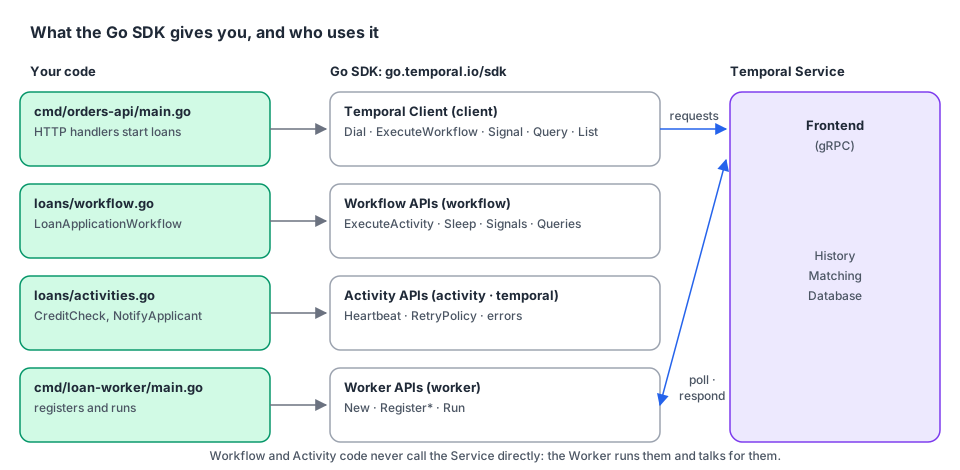
The Encyclopedia lists three big pieces (Client, Workflow APIs, Worker APIs) plus Activity customization. In Go they map to packages:
| SDK component | What it does | Go package |
|---|---|---|
| Temporal Client | The bridge to the Temporal Service: start, Signal, Query, list Workflows, get results | go.temporal.io/sdk/client |
| Workflow APIs | Orchestrate Activities, handle Queries/Signals/Updates, talk to other Workflows, timers | go.temporal.io/sdk/workflow |
| Worker APIs | Configure and run Workers that poll Task Queues and run your code | go.temporal.io/sdk/worker |
| Activity APIs | Logging, heartbeats, info inside an Activity | go.temporal.io/sdk/activity |
| Activity customization | Timeouts, Retry Policy, Heartbeat timeout, async completion | workflow.ActivityOptions, go.temporal.io/sdk/temporal |
| Testing | Run Workflows in-memory, mock Activities, replay histories | go.temporal.io/sdk/testsuite, worker.NewWorkflowReplayer |
| Connection config | Load addresses, Namespaces, TLS, API keys from env vars or a TOML file | go.temporal.io/sdk/contrib/envconfig |
4. The development pattern: code that mirrors the business process
The Encyclopedia uses a bank loan as its example, in pseudocode:
func LoanApplicationWorkflow {
    sdk.ExecuteActivity(CreditCheck)
    sdk.ExecuteActivity(AutomatedApproval)
    sdk.ExecuteActivity(NotifyApplicant)
}
Here it is as real, compilable Go. Notice that the Workflow reads like the business process, and that reliability (timeouts, retries, heartbeats) is configuration, not code.
// file: loans/types.go
package loans

const TaskQueue = "loan-applications"

type LoanApplication struct {
	ApplicationID  string
	ApplicantID    string
	ApplicantEmail string
	AmountCents    int64
	TermMonths     int
}

type CreditReport struct {
	Score        int
	DebtToIncome float64
}

type Decision struct {
	Approved bool
	Reason   string
	APR      float64
}// file: loans/workflow.go
package loans
import (
"time"
"go.temporal.io/sdk/temporal"
"go.temporal.io/sdk/workflow"
)
// LoanApplicationWorkflow orchestrates the loan process. Each step is an Activity.
func LoanApplicationWorkflow(ctx workflow.Context, app LoanApplication) (Decision, error) {
logger := workflow.GetLogger(ctx)
// Activity customization: timeouts and Retry Policy, set once for the steps below.
ctx = workflow.WithActivityOptions(ctx, workflow.ActivityOptions{
StartToCloseTimeout: 2 * time.Minute,
HeartbeatTimeout: 20 * time.Second,
RetryPolicy: &temporal.RetryPolicy{
InitialInterval: time.Second,
BackoffCoefficient: 2.0,
MaximumInterval: time.Minute,
NonRetryableErrorTypes: []string{"ApplicantNotFound"},
},
})
var a *Activities
var report CreditReport
if err := workflow.ExecuteActivity(ctx, a.CreditCheck, app.ApplicantID).Get(ctx, &report); err != nil {
return Decision{}, err
}
var decision Decision
if err := workflow.ExecuteActivity(ctx, a.AutomatedApproval, app, report).Get(ctx, &decision); err != nil {
return Decision{}, err
}
if err := workflow.ExecuteActivity(ctx, a.NotifyApplicant, app.ApplicantEmail, decision).Get(ctx, nil); err != nil {
return Decision{}, err
}
logger.Info("Loan application decided", "applicationID", app.ApplicationID, "approved", decision.Approved)
return decision, nil
}// file: loans/activities.go
package loans
import (
"context"
"errors"
"fmt"
"go.temporal.io/sdk/activity"
"go.temporal.io/sdk/temporal"
)
var ErrApplicantNotFound = errors.New("applicant not found")
type CreditBureau interface {
FetchReport(ctx context.Context, applicantID string) (CreditReport, error)
}
type Notifier interface {
Email(ctx context.Context, to, subject, body string) error
}
type Activities struct {
Bureau CreditBureau
Notifier Notifier
}
// CreditCheck calls an external bureau. It can fail, so it is an Activity:
// the SDK retries it according to the Retry Policy set by the Workflow.
func (a *Activities) CreditCheck(ctx context.Context, applicantID string) (CreditReport, error) {
activity.RecordHeartbeat(ctx, "calling bureau") // tells the Service we are alive
report, err := a.Bureau.FetchReport(ctx, applicantID)
if errors.Is(err, ErrApplicantNotFound) {
// Retrying will not help: stop now.
return CreditReport{}, temporal.NewNonRetryableApplicationError("no such applicant", "ApplicantNotFound", err)
}
return report, err
}
// AutomatedApproval is pure business rules. It is still an Activity so the rules
// can change without breaking running Workflows.
func (a *Activities) AutomatedApproval(_ context.Context, app LoanApplication, r CreditReport) (Decision, error) {
switch {
case r.Score < 620:
return Decision{Approved: false, Reason: "credit score below 620"}, nil
case r.DebtToIncome > 0.43:
return Decision{Approved: false, Reason: "debt-to-income above 43%"}, nil
case app.AmountCents > 5_000_000:
return Decision{Approved: false, Reason: "amount needs manual review"}, nil
default:
return Decision{Approved: true, Reason: "auto-approved", APR: 6.9}, nil
}
}
func (a *Activities) NotifyApplicant(ctx context.Context, email string, d Decision) error {
subject := "Your loan application was declined"
if d.Approved {
subject = fmt.Sprintf("Your loan is approved at %.1f%% APR", d.APR)
}
return a.Notifier.Email(ctx, email, subject, d.Reason)
}The SDK also makes this Workflow testable without a server. The test environment runs the Workflow in memory and lets you mock each Activity:
// file: loans/workflow_test.go
package loans

import (
	"testing"

	"github.com/stretchr/testify/mock"
	"go.temporal.io/sdk/testsuite"
)

func TestLoanApplicationWorkflow_LowScoreIsDeclined(t *testing.T) {
	var suite testsuite.WorkflowTestSuite
	env := suite.NewTestWorkflowEnvironment()

	a := &Activities{}
	env.RegisterActivity(a)
	env.OnActivity(a.CreditCheck, mock.Anything, "APPL-77").Return(CreditReport{Score: 580, DebtToIncome: 0.2}, nil)
	env.OnActivity(a.NotifyApplicant, mock.Anything, "sam@example.com", mock.Anything).Return(nil)
	// AutomatedApproval is not mocked: the real rules run.

	env.ExecuteWorkflow(LoanApplicationWorkflow, LoanApplication{
		ApplicationID: "LOAN-2024-0091", ApplicantID: "APPL-77",
		ApplicantEmail: "sam@example.com", AmountCents: 1_500_000, TermMonths: 36,
	})

	if !env.IsWorkflowCompleted() {
		t.Fatal("workflow did not complete")
	}
	if err := env.GetWorkflowError(); err != nil {
		t.Fatal(err)
	}
	var d Decision
	if err := env.GetWorkflowResult(&d); err != nil {
		t.Fatal(err)
	}
	if d.Approved {
		t.Fatalf("expected a decline, got %+v", d)
	}
}
And the Worker that hosts it:
// file: cmd/loan-worker/main.go
package main

import (
	"context"
	"log"

	"go.temporal.io/sdk/client"
	"go.temporal.io/sdk/worker"

	"github.com/acme/shop/loans"
)

type stubBureau struct{}

func (stubBureau) FetchReport(context.Context, string) (loans.CreditReport, error) {
	return loans.CreditReport{Score: 712, DebtToIncome: 0.31}, nil
}

type logNotifier struct{}

func (logNotifier) Email(_ context.Context, to, subject, _ string) error {
	log.Printf("email to %s: %s", to, subject)
	return nil
}

func main() {
	c, err := client.Dial(client.Options{})
	if err != nil {
		log.Fatalln("unable to create Temporal client", err)
	}
	defer c.Close()

	w := worker.New(c, loans.TaskQueue, worker.Options{})
	w.RegisterWorkflow(loans.LoanApplicationWorkflow)
	w.RegisterActivity(&loans.Activities{Bureau: stubBureau{}, Notifier: logNotifier{}})

	if err := w.Run(worker.InterruptCh()); err != nil {
		log.Fatalln("worker stopped", err)
	}
}
5. How the SDK works with the Service: a choreographer, not a conductor
The Temporal Service does not push work to a chosen Worker. It puts Tasks on a Task Queue and Workers poll for them. If a Worker goes down, its Tasks wait for the next Worker.
When LoanApplicationWorkflow calls workflow.ExecuteActivity(ctx, a.CreditCheck, …):
- The Worker does not run
CreditCheck. The SDK records aScheduleActivityTaskCommand and the Workflow code blocks on.Get. - The Worker sends the Command to the Service, which appends an
ActivityTaskScheduledEvent to the Event History and puts an Activity Task on the Task Queue. - A Worker with free capacity (the same one or another) picks up the Activity Task and runs
CreditCheck. If it fails, the Service retries it according to the Retry Policy. - The result is stored in the Event History, and a new Workflow Task wakes the Workflow up.
Each Task goes through three recorded steps:
| Step | Meaning |
|---|---|
| Scheduled | The Service added the Task to the Task Queue |
| Started | A Worker dequeued the Task |
| Completed | The Worker finished the Task and responded to the Service |
Chapter 06 walks through this flow message by message.
6. Replay: why the SDK can resume after a crash
Because every step is persisted in the Event History, the SDK can replay a Workflow: re-run the Workflow code from the start, feeding it recorded results instead of re-executing Activities, until it reaches the point where it was interrupted. Then it continues for real.
This only works if the Workflow code makes the same decisions every time it runs, which is why Workflow code must be deterministic and why every side effect lives in an Activity. If replay produces a Command that doesn't match the recorded history, the SDK raises a non-determinism error. Chapter 07 shows this in Go.
7. Key takeaways
- An SDK is a per-language library. Your Temporal Application = Workflows + Activities + Client setup + Worker setup.
- In Go:
clientto talk to the Service,workflowandactivityto write code,workerto run it,temporalfor retries and errors,testsuiteto test. - Reliability is configured (
ActivityOptions,RetryPolicy), not hand-coded. - The Service is a choreographer: it queues Tasks, Workers poll. A Workflow calling an Activity only sends a Command.
- Replay rebuilds Workflow state from the Event History, so Workflow code must be deterministic.