08 · Running it for real: dev server, self-hosted, Cloud
Level: production · Read time: ~15 min Sources: Encyclopedia — Temporal architecture · How Temporal works — Server · Go SDK — Temporal Client · Go SDK — Run a Worker
1. The problem
The same Workers and Clients must run against a laptop dev server, a staging cluster and production. The only things that should change between them are where the Temporal Service is and how to authenticate. Your Workflow and Activity code shouldn't change at all.
2. Three ways to get a Temporal Service
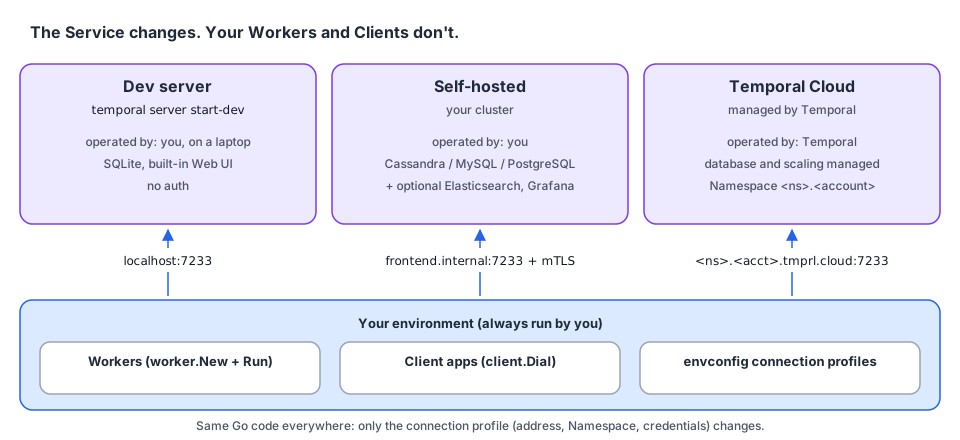
The Server can run in three places. Your side of the architecture (Clients and Workers) is the same in all three:
| Dev server | Self-hosted | Temporal Cloud | |
|---|---|---|---|
| Start it with | temporal server start-dev | Your deployment of the Temporal Server services | Sign up, create a Namespace |
| Who operates the Server | You, on your laptop | You (Frontend, History, Matching, Worker services, upgrades, scaling) | Temporal |
| Database | SQLite (in memory, or a file with --db-filename) | Cassandra, MySQL or PostgreSQL. You provision it | Managed |
| Optional components | Built-in UI | Elasticsearch (advanced visibility), Grafana (dashboards), the Web UI | Managed |
| Address | 127.0.0.1:7233, UI http://localhost:8233 | Your Frontend's address | <namespace>.<account>.tmprl.cloud:7233 |
| Auth | None | Whatever you configure (e.g. mTLS) | API key or mTLS |
| Who runs your Workers | You | You | Still you |
In every case, your Workers run on your infrastructure. Temporal Cloud runs "the same kind of service" as a self-hosted cluster, operated for you. It never runs your code.
3. One codebase, every environment: connection profiles
The Go SDK recommends keeping connection settings out of the code, in environment variables or a TOML file, and loading them with go.temporal.io/sdk/contrib/envconfig.
The TOML file lives at ~/.config/temporalio/temporal.toml by default, or wherever TEMPORAL_CONFIG_FILE points. Each profile is one environment:
# file: deploy/temporal.toml
[profile.default]                       # laptop: temporal server start-dev
address = "localhost:7233"
namespace = "default"

[profile.staging]                       # self-hosted cluster with mTLS
address = "temporal-frontend.staging.internal:7233"
namespace = "shop-staging"
[profile.staging.tls]
client_cert_path = "/etc/temporal/certs/client.pem"
client_key_path = "/etc/temporal/certs/client.key"

[profile.prod]                          # Temporal Cloud with an API key
address = "shop-prod.a1b2c.tmprl.cloud:7233"
namespace = "shop-prod.a1b2c"
# api_key comes from the TEMPORAL_API_KEY env var, never from a committed file
Environment variables (TEMPORAL_ADDRESS, TEMPORAL_NAMESPACE, TEMPORAL_API_KEY, TEMPORAL_TLS_CLIENT_CERT_PATH, …) override the file. TLS is turned on automatically when a TLS section or an API key is present.
Then every binary (Workers, APIs, tools) dials the same way:
// file: internal/temporalconn/dial.go
package temporalconn

import (
	"fmt"

	"go.temporal.io/sdk/client"
	"go.temporal.io/sdk/contrib/envconfig"
)

// Dial connects to the Temporal Service described by the active profile.
//
// The profile is the TEMPORAL_PROFILE env var, or "default". The file is
// TEMPORAL_CONFIG_FILE, or ~/.config/temporalio/temporal.toml. TEMPORAL_* env vars
// override what the file says.
func Dial() (client.Client, error) {
	opts, err := envconfig.LoadClientOptions(envconfig.LoadClientOptionsRequest{})
	if err != nil {
		return nil, fmt.Errorf("load Temporal connection profile: %w", err)
	}
	c, err := client.Dial(opts)
	if err != nil {
		return nil, fmt.Errorf("dial Temporal at %s (namespace %s): %w", opts.HostPort, opts.Namespace, err)
	}
	return c, nil
}go run ./cmd/orders-worker # laptop, profile "default"
TEMPORAL_PROFILE=staging TEMPORAL_CONFIG_FILE=deploy/temporal.toml go run ./cmd/orders-worker
TEMPORAL_PROFILE=prod TEMPORAL_API_KEY=$(cat /run/secrets/temporal-api-key) ./orders-worker4. Temporal Cloud from code
If you'd rather configure Cloud in code (or need to override one setting), these are the pieces the Go SDK docs list: the endpoint <namespace>.<account>.tmprl.cloud:7233, the Namespace<namespace_id>.<account_id>, TLS, and either an API key or an mTLS client certificate.
// file: internal/temporalconn/cloud.go
package temporalconn

import (
	"context"
	"crypto/tls"
	"sync/atomic"

	"go.temporal.io/sdk/client"
)

// DialCloudWithAPIKey connects with an API key that can be rotated at runtime:
// call key.Store(newKey) and the next request uses it.
func DialCloudWithAPIKey(endpoint, namespace string, key *atomic.Value) (client.Client, error) {
	return client.Dial(client.Options{
		HostPort:          endpoint,  // shop-prod.a1b2c.tmprl.cloud:7233
		Namespace:         namespace, // shop-prod.a1b2c
		ConnectionOptions: client.ConnectionOptions{TLS: &tls.Config{}},
		Credentials: client.NewAPIKeyDynamicCredentials(func(context.Context) (string, error) {
			return key.Load().(string), nil
		}),
	})
}

// DialCloudWithMTLS reads the client certificate on every new connection, so you can
// rotate it by replacing the files, without restarting the Worker.
func DialCloudWithMTLS(endpoint, namespace, certPath, keyPath string) (client.Client, error) {
	return client.Dial(client.Options{
		HostPort:  endpoint,
		Namespace: namespace,
		ConnectionOptions: client.ConnectionOptions{
			TLS: &tls.Config{
				GetClientCertificate: func(*tls.CertificateRequestInfo) (*tls.Certificate, error) {
					cert, err := tls.LoadX509KeyPair(certPath, keyPath)
					if err != nil {
						return nil, err
					}
					return &cert, nil
				},
			},
		},
	})
}
5. A production-shaped Worker
Pulling the previous chapters together: profile-based connection, an identity that shows up in the poller list, a graceful shutdown that fits Kubernetes' SIGTERM handling, and a readiness check based on the Frontend's health.
// file: orders/orders.go
package orders

import (
	"context"
	"time"

	"go.temporal.io/sdk/workflow"
)

const TaskQueue = "orders"

type Activities struct{}

func (a *Activities) ReserveInventory(ctx context.Context, orderID string) error { return nil }

func ProcessOrderWorkflow(ctx workflow.Context, orderID string) error {
	ctx = workflow.WithActivityOptions(ctx, workflow.ActivityOptions{StartToCloseTimeout: 30 * time.Second})
	var a *Activities
	return workflow.ExecuteActivity(ctx, a.ReserveInventory, orderID).Get(ctx, nil)
}// file: cmd/orders-worker/main.go
package main
import (
"context"
"log"
"net/http"
"os"
"time"
"go.temporal.io/sdk/client"
"go.temporal.io/sdk/worker"
"github.com/acme/shop/internal/temporalconn"
"github.com/acme/shop/orders"
)
func main() {
c, err := temporalconn.Dial()
if err != nil {
log.Fatalln(err)
}
defer c.Close()
pod, _ := os.Hostname() // the Kubernetes pod name
w := worker.New(c, orders.TaskQueue, worker.Options{
Identity: "orders-worker@" + pod,
WorkerStopTimeout: 25 * time.Second, // below the pod's terminationGracePeriodSeconds (30s)
})
w.RegisterWorkflow(orders.ProcessOrderWorkflow)
w.RegisterActivity(&orders.Activities{})
// Readiness probe: ready when the Frontend answers. Workers need no other inbound port.
go func() {
http.HandleFunc("/readyz", func(rw http.ResponseWriter, r *http.Request) {
ctx, cancel := context.WithTimeout(r.Context(), 2*time.Second)
defer cancel()
if _, err := c.CheckHealth(ctx, &client.CheckHealthRequest{}); err != nil {
http.Error(rw, err.Error(), http.StatusServiceUnavailable)
return
}
rw.WriteHeader(http.StatusOK)
})
log.Println(http.ListenAndServe(":8080", nil))
}()
// SIGTERM → stop polling, finish in-flight Tasks (up to WorkerStopTimeout), exit.
if err := w.Run(worker.InterruptCh()); err != nil {
log.Fatalln("worker stopped", err)
}
}6. Production checklist, from the architecture
| Architecture fact | What to do |
|---|---|
| Clients and Workers only talk to the Frontend | Open outbound gRPC (port 7233) from your pods to the Frontend or Cloud endpoint. Workers need no inbound port. |
| The Frontend authorizes requests | Use mTLS or API keys outside your laptop. Keep secrets in env vars or mounted files, not in TOML in git. |
| Matching spreads Tasks across pollers | Scale Workers horizontally per Task Queue. Watch for "no pollers" (temporal task-queue describe). |
| All Workers on a Task Queue must register the same types | One Deployment per Task Queue. Don't share a queue name between services. |
| History keeps state, Workers are disposable | Use rolling deploys freely, but make Workflow changes replay-safe (replay tests + versioning). |
| The database is required, Elasticsearch and Grafana are optional (self-hosted) | Size the database first. Add Elasticsearch when you need rich visibility search. Add dashboards for operations. |
| A Client is a gRPC connection | One Client per process. Close it on shutdown. |
7. Key takeaways
- Dev server, self-hosted cluster or Temporal Cloud: the Service changes, your code doesn't. You always run the Workers.
- Keep connection settings in
envconfigprofiles (TEMPORAL_PROFILE,TEMPORAL_CONFIG_FILE,TEMPORAL_*env vars). - Temporal Cloud = endpoint
<ns>.<acct>.tmprl.cloud:7233+ Namespace<ns>.<acct>+ API key or mTLS. - Production Workers: an identity, a graceful stop timeout, a readiness check, one Deployment per Task Queue.