06 · Tracing with OpenTelemetry
Level: advanced · Read time: ~16 min Sources: Go SDK — OpenTelemetry v2 integration · Go SDK — Observability: Tracing ·
contrib/opentelemetry-v2· OpenTelemetry traces
1. The problem
A customer clicks Pay and nothing happens for 40 seconds. Your HTTP service has a trace for POST /orders that ends after 30 ms: it started a Workflow and returned 202 Accepted. The rest of the story (inventory reserved, card charged, parcel booked) ran on Workers, maybe on other machines, maybe after a Worker restart. Without help, each of those pieces is a separate trace fragment, or no trace at all.
Workflows make tracing harder in two ways:
- The trace crosses process boundaries through the Temporal Service. The Client, the Workflow and each Activity run in different processes, and the only thing they share is the Workflow's Event History.
- Workflow code replays. A Worker that picks up a Workflow after a restart re-runs the Workflow code from the start. A normal tracer would create every span again, with new random IDs and new start times.
The OpenTelemetry v2 integration solves both: it carries the span context in Temporal headers, and it gives you a replay-safe Tracer Provider and Tracer for Workflow code. This chapter wires it into the shop checkout and looks at the traces it really produces.
2. Install
go get go.temporal.io/sdk/contrib/opentelemetry-v2@latest
go get go.opentelemetry.io/otel/exporters/otlp/otlptrace/otlptracegrpc
The examples import the module as temporalotel.
| Module | Version used here | Status |
|---|---|---|
go.temporal.io/sdk/contrib/opentelemetry-v2 | v0.1.0 | Pre-release. The README says "Experimental: APIs may change between releases"; every exported symbol is marked NOTE: Experimental |
go.temporal.io/sdk | v1.50.0 | The module requires v1.48.0 or later |
go.opentelemetry.io/otel, …/sdk | v1.44.0 |
The older interceptor-based module, go.temporal.io/sdk/contrib/opentelemetry (v0.8.1), still exists. Chapter 07 compares the two and shows how to migrate.
3. A replay-safe Tracer Provider
A standard OpenTelemetry Tracer Provider gives each new span a random span ID. When a Workflow replays, the same tracer.Start call runs again and would get a different ID: the "same" span would exist twice in your backend.
temporalotel.NewReplaySafeTracerProvider wraps the OpenTelemetry SDK's provider and replaces its ID generator. Inside a Workflow, span and trace IDs are read from a deterministic random stream tied to the Workflow (workflow.GetRandomStream); elsewhere, from crypto/rand. Same Workflow, same code path, same IDs on every replay.
// file: internal/telemetry/tracing.go
package telemetry

import (
	"context"
	"fmt"

	"go.opentelemetry.io/otel"
	"go.opentelemetry.io/otel/exporters/otlp/otlptrace/otlptracegrpc"
	"go.opentelemetry.io/otel/sdk/resource"
	sdktrace "go.opentelemetry.io/otel/sdk/trace"
	semconv "go.opentelemetry.io/otel/semconv/v1.41.0"
	temporalotel "go.temporal.io/sdk/contrib/opentelemetry-v2"
)

// SetupTracing creates the replay-safe Tracer Provider, exporting over OTLP/gRPC
// to a collector (Jaeger, Tempo, Honeycomb…), and installs it as the global one.
// Call it before temporalotel.NewPlugin. The caller must Shutdown the provider.
func SetupTracing(ctx context.Context, serviceName, collector string) (*temporalotel.ReplaySafeTracerProvider, error) {
	exporter, err := otlptracegrpc.New(ctx,
		otlptracegrpc.WithEndpoint(collector), // e.g. "otel-collector:4317"
		otlptracegrpc.WithInsecure(),          // plain gRPC inside the cluster
	)
	if err != nil {
		return nil, fmt.Errorf("otlp trace exporter: %w", err)
	}

	provider := temporalotel.NewReplaySafeTracerProvider(
		// WithBatcher exports in the background, outside the Workflow goroutine.
		sdktrace.WithBatcher(exporter),
		sdktrace.WithResource(resource.NewWithAttributes(
			semconv.SchemaURL,
			semconv.ServiceName(serviceName),
		)),
	)
	otel.SetTracerProvider(provider) // must happen before NewPlugin and Tracer
	return provider, nil
}
Three rules, all from the module's source:
| Rule | What happens otherwise |
|---|---|
Install the provider with otel.SetTracerProvider before calling NewPlugin or temporalotel.Tracer | Both panic with global tracer provider must be created by NewReplaySafeTracerProvider. NewPlugin has an error return value, but this case doesn't use it |
Don't pass your own sdktrace.WithIDGenerator | It's silently overridden: the provider appends its own generator last |
Use WithBatcher in production | Export I/O happens in the background, not in the Workflow goroutine. Tests can use WithSyncer |
Your application owns the provider. Shut it down after the Worker and the Client have stopped, so the last spans are flushed (section 4).
4. The plugin on the Client
temporalotel.NewPlugin returns a Client plugin. Put it in client.Options.Plugins: every Worker created from that Client inherits it, so you don't configure Workers separately.
// file: cmd/worker/main.go
package main

import (
	"context"
	"log"
	"os"
	"time"

	"go.temporal.io/sdk/client"
	temporalotel "go.temporal.io/sdk/contrib/opentelemetry-v2"
	"go.temporal.io/sdk/interceptor/tracing"
	"go.temporal.io/sdk/worker"

	"github.com/acme/shop/checkout"
	"github.com/acme/shop/internal/telemetry"
)

type stripeGateway struct{}

func (stripeGateway) Charge(ctx context.Context, customerID string, amountCents int64) (string, error) {
	return "ch_live_123", nil
}

func main() {
	ctx := context.Background()

	// 1. Tracer Provider first: NewPlugin panics without a replay-safe global one.
	provider, err := telemetry.SetupTracing(ctx, "shop-checkout-worker", os.Getenv("OTEL_COLLECTOR"))
	if err != nil {
		log.Fatalln(err)
	}
	// 4. Runs last: flush the spans still in the batcher.
	defer func() {
		shutdownCtx, cancel := context.WithTimeout(context.Background(), 5*time.Second)
		defer cancel()
		if err := provider.Shutdown(shutdownCtx); err != nil {
			log.Println("tracer provider shutdown:", err)
		}
	}()

	// 2. The plugin, on the Client. Workers built from this Client inherit it.
	plugin, err := temporalotel.NewPlugin(temporalotel.PluginOptions{
		TracerOptions: tracing.TracerOptions{AddTemporalSpans: true},
	})
	if err != nil {
		log.Fatalln(err)
	}
	c, err := client.Dial(client.Options{
		HostPort: os.Getenv("TEMPORAL_ADDRESS"),
		Plugins:  []client.Plugin{plugin},
	})
	if err != nil {
		log.Fatalln(err)
	}
	defer c.Close() // 3b. runs before the provider shutdown

	// 3. The Worker.
	w := worker.New(c, checkout.TaskQueue, worker.Options{})
	w.RegisterWorkflow(checkout.CheckoutWorkflow)
	w.RegisterActivity(&checkout.Activities{Gateway: stripeGateway{}})
	if err := w.Run(worker.InterruptCh()); err != nil { // 3a. stops on SIGINT/SIGTERM
		log.Println("worker:", err)
	}
}
Shutdown runs in the reverse order of setup, which defer gives you for free:
w.Runreturns onSIGINT/SIGTERM, after the Worker has stopped polling and running Tasks have finished.c.Close()closes the connection to the Service.provider.Shutdownflushes the spans still in the batcher, then stops the exporter.
If the process exits without step 3, the batcher's buffer is lost: typically the last spans, which are the ones you wanted when investigating a crash.
What the plugin does by default
With PluginOptions{}, the plugin creates no spans of its own. It only propagates the span context: on every outbound call (start a Workflow, schedule an Activity, start a Child Workflow, signal…) it writes the current span context into a Temporal header, and on every inbound call it reads it back. Spans that your code creates stay connected across processes.
AddTemporalSpans: true (in TracerOptions, from go.temporal.io/sdk/interceptor/tracing) also creates one span per Temporal operation: StartWorkflow, RunWorkflow, StartActivity, RunActivity, SignalWorkflow, HandleSignal, QueryWorkflow, HandleQuery, ContinueAsNew and so on. The worker above turns it on; section 7 shows the difference.
5. Your own spans: Workflows vs Activities
In a Workflow: temporalotel.Tracer
otel.Tracer isn't safe in Workflow code: it stamps spans with the wall clock and ends them again on every replay. Use temporalotel.Tracer instead. Its spans:
- get replay-stable IDs from the provider of section 3;
- start at
workflow.Nowwhen they are recreated during a replay; - are not ended again during replay, so they are exported once.
// file: checkout/workflow.go
package checkout

import (
	"time"

	temporalotel "go.temporal.io/sdk/contrib/opentelemetry-v2"
	"go.temporal.io/sdk/workflow"
)

const TaskQueue = "checkout"

type Order struct {
	ID          string
	CustomerID  string
	SKU         string
	AmountCents int64
}

type Receipt struct {
	OrderID    string
	ChargeID   string
	TrackingID string
}

func CheckoutWorkflow(ctx workflow.Context, order Order) (Receipt, error) {
	// A replay-safe Tracer: span IDs come from the Workflow's deterministic random
	// stream, and a span that already ended isn't exported again during replay.
	// Get it here, not in a package-level var: Tracer panics if the global
	// provider isn't replay-safe yet, and package vars run before main.
	tracer := temporalotel.Tracer("github.com/acme/shop/checkout")
	ctx, span := tracer.Start(ctx, "checkout")
	defer span.End()

	ctx = workflow.WithActivityOptions(ctx, workflow.ActivityOptions{
		StartToCloseTimeout: 30 * time.Second,
	})
	var a *Activities // nil receiver: only the method names are used

	if err := workflow.ExecuteActivity(ctx, a.ReserveInventory, order).Get(ctx, nil); err != nil {
		return Receipt{}, err
	}
	var chargeID string
	if err := workflow.ExecuteActivity(ctx, a.ChargePayment, order).Get(ctx, &chargeID); err != nil {
		return Receipt{}, err
	}
	var trackingID string
	if err := workflow.ExecuteActivity(ctx, a.ShipOrder, order).Get(ctx, &trackingID); err != nil {
		return Receipt{}, err
	}
	return Receipt{OrderID: order.ID, ChargeID: chargeID, TrackingID: trackingID}, nil
}
tracer.Start returns a new workflow.Context carrying the span. Pass that context to ExecuteActivity so the Activity spans become children of checkout.
Trap: a package-level Workflow Tracer panics
The first version of this file had var tracer = temporalotel.Tracer("…") at package level. The test binary crashed before any test ran:
panic: global tracer provider must be created by NewReplaySafeTracerProvider
...
github.com/acme/shop/checkout.init()
	checkout/workflow.go:28
Tracer looks up the global provider when it is called, and package variables are initialized before main installs the provider. Call it inside the Workflow function. It's cheap.
In an Activity, a Client or an HTTP handler: otel.Tracer
Outside Workflows nothing replays, so the ordinary OpenTelemetry Tracer is right. The plugin has already put the parent span in the Activity's context.Context:
// file: checkout/activities.go
package checkout

import (
	"context"

	"go.opentelemetry.io/otel"
	"go.opentelemetry.io/otel/attribute"
	"go.opentelemetry.io/otel/codes"
)

// PaymentGateway is the card processor (Stripe, Adyen…), faked in tests.
type PaymentGateway interface {
	Charge(ctx context.Context, customerID string, amountCents int64) (chargeID string, err error)
}

type Activities struct {
	Gateway PaymentGateway
}

func (a *Activities) ReserveInventory(ctx context.Context, order Order) error {
	return nil
}

func (a *Activities) ChargePayment(ctx context.Context, order Order) (string, error) {
	// Outside Workflows, use an ordinary OpenTelemetry Tracer.
	ctx, span := otel.Tracer("github.com/acme/shop/checkout").Start(ctx, "payment-gateway.charge")
	defer span.End()
	span.SetAttributes(
		attribute.String("shop.order_id", order.ID),
		attribute.Int64("shop.amount_cents", order.AmountCents),
	)

	chargeID, err := a.Gateway.Charge(ctx, order.CustomerID, order.AmountCents)
	if err != nil {
		span.RecordError(err)
		span.SetStatus(codes.Error, "charge failed")
		return "", err
	}
	return chargeID, nil
}

func (a *Activities) ShipOrder(ctx context.Context, order Order) (string, error) {
	return "TRK-" + order.ID, nil
}
Here too, the Tracer is fetched inside the function rather than stored in a package variable. A package variable works in a long-running process, but OpenTelemetry's global delegation binds a Tracer obtained before the first otel.SetTracerProvider to that first provider forever. In a test that installs a fresh provider per sub-test, such a Tracer kept writing to the first, already shut down, provider: the payment-gateway.charge span silently disappeared from the second sub-test.
Status is your job in your own spans. On a failed Activity, the plugin marks its own RunActivity and RunWorkflow spans as errors (see section 8), but your checkout span stays Unset unless you call span.SetStatus.
6. A root span at the edge
The trace should start where the user's request enters your system. The API creates the root span and passes its ctx to ExecuteWorkflow; the plugin on the API's Client injects it into the Workflow's headers.
// file: cmd/api/main.go
package main

import (
	"context"
	"encoding/json"
	"log"
	"net/http"
	"os"

	"go.opentelemetry.io/otel"
	"go.opentelemetry.io/otel/codes"
	"go.temporal.io/sdk/client"
	temporalotel "go.temporal.io/sdk/contrib/opentelemetry-v2"

	"github.com/acme/shop/checkout"
	"github.com/acme/shop/internal/telemetry"
)

var apiTracer = otel.Tracer("github.com/acme/shop/api")

func placeOrder(c client.Client) http.HandlerFunc {
	return func(w http.ResponseWriter, r *http.Request) {
		// The root span of the trace. Every Temporal span will be its descendant.
		ctx, span := apiTracer.Start(r.Context(), "POST /orders")
		defer span.End()

		var order checkout.Order
		if err := json.NewDecoder(r.Body).Decode(&order); err != nil {
			http.Error(w, "bad order", http.StatusBadRequest)
			return
		}
		// Pass ctx: the plugin injects the span context into the Workflow's headers.
		run, err := c.ExecuteWorkflow(ctx, client.StartWorkflowOptions{
			ID:        "checkout-" + order.ID,
			TaskQueue: checkout.TaskQueue,
		}, checkout.CheckoutWorkflow, order)
		if err != nil {
			span.RecordError(err)
			span.SetStatus(codes.Error, "start workflow failed")
			http.Error(w, "could not start checkout", http.StatusInternalServerError)
			return
		}
		w.WriteHeader(http.StatusAccepted)
		_ = json.NewEncoder(w).Encode(map[string]string{"workflow_id": run.GetID()})
	}
}

func main() {
	ctx := context.Background()
	provider, err := telemetry.SetupTracing(ctx, "shop-api", os.Getenv("OTEL_COLLECTOR"))
	if err != nil {
		log.Fatalln(err)
	}
	defer func() { _ = provider.Shutdown(context.Background()) }()

	plugin, err := temporalotel.NewPlugin(temporalotel.PluginOptions{})
	if err != nil {
		log.Fatalln(err)
	}
	c, err := client.Dial(client.Options{
		HostPort: os.Getenv("TEMPORAL_ADDRESS"),
		Plugins:  []client.Plugin{plugin},
	})
	if err != nil {
		log.Fatalln(err)
	}
	defer c.Close()

	http.HandleFunc("POST /orders", placeOrder(c))
	log.Fatalln(http.ListenAndServe(":8080", nil))
}
In a real service, an HTTP middleware such as otelhttp would create this server span and also extract a traceparent sent by the browser or the API gateway. The principle is the same: whatever span is in ctx when you call the Temporal Client becomes the parent of the Workflow.
7. What the trace looks like
You don't need a Jaeger instance to see the trace. The OpenTelemetry SDK's in-memory exporter collects spans in a slice, and testsuite.StartDevServer gives you a real Temporal Service. This test runs the checkout once with each value of AddTemporalSpans and prints the span tree.
// file: checkout/trace_test.go
package checkout

import (
	"context"
	"fmt"
	"os"
	"sort"
	"strings"
	"testing"

	"go.opentelemetry.io/otel"
	sdktrace "go.opentelemetry.io/otel/sdk/trace"
	"go.opentelemetry.io/otel/sdk/trace/tracetest"
	"go.opentelemetry.io/otel/trace"
	"go.temporal.io/sdk/client"
	temporalotel "go.temporal.io/sdk/contrib/opentelemetry-v2"
	"go.temporal.io/sdk/interceptor/tracing"
	"go.temporal.io/sdk/testsuite"
	"go.temporal.io/sdk/worker"
)

type fakeGateway struct{}

func (fakeGateway) Charge(ctx context.Context, customerID string, amountCents int64) (string, error) {
	return "ch_test_1", nil
}

func TestCheckoutTrace(t *testing.T) {
	for _, addTemporalSpans := range []bool{false, true} {
		t.Run(fmt.Sprintf("AddTemporalSpans=%v", addTemporalSpans), func(t *testing.T) {
			ctx := context.Background()

			// In-memory exporter: spans are kept in a slice we can inspect.
			exporter := tracetest.NewInMemoryExporter()
			provider := temporalotel.NewReplaySafeTracerProvider(sdktrace.WithSyncer(exporter))
			otel.SetTracerProvider(provider)
			defer func() { _ = provider.Shutdown(ctx) }()

			srv, err := testsuite.StartDevServer(ctx, testsuite.DevServerOptions{
				ExistingPath: os.Getenv("TEMPORAL_CLI"), // empty: the SDK downloads the CLI
				LogLevel:     "error",
			})
			if err != nil {
				t.Fatal(err)
			}
			defer func() { _ = srv.Stop() }()

			plugin, err := temporalotel.NewPlugin(temporalotel.PluginOptions{
				TracerOptions: tracing.TracerOptions{AddTemporalSpans: addTemporalSpans},
			})
			if err != nil {
				t.Fatal(err)
			}
			c, err := client.Dial(client.Options{HostPort: srv.FrontendHostPort(), Plugins: []client.Plugin{plugin}})
			if err != nil {
				t.Fatal(err)
			}
			defer c.Close()

			w := worker.New(c, TaskQueue, worker.Options{})
			w.RegisterWorkflow(CheckoutWorkflow)
			w.RegisterActivity(&Activities{Gateway: fakeGateway{}})
			if err := w.Start(); err != nil {
				t.Fatal(err)
			}
			defer w.Stop()

			rootCtx, root := otel.Tracer("test").Start(ctx, "POST /orders")
			run, err := c.ExecuteWorkflow(rootCtx, client.StartWorkflowOptions{ID: "checkout-A1001", TaskQueue: TaskQueue},
				CheckoutWorkflow, Order{ID: "A1001", CustomerID: "C42", SKU: "MUG-01", AmountCents: 1800})
			if err != nil {
				t.Fatal(err)
			}
			if err := run.Get(ctx, nil); err != nil {
				t.Fatal(err)
			}
			root.End()

			spans := exporter.GetSpans()
			for _, s := range spans {
				if s.SpanContext.TraceID() != root.SpanContext().TraceID() {
					t.Errorf("span %q is in another trace", s.Name)
				}
			}
			t.Logf("%d spans, one trace\n%s", len(spans), tree(spans))
		})
	}
}

// tree prints spans as an indented parent/child tree, ordered by start time.
func tree(spans tracetest.SpanStubs) string {
	children := map[trace.SpanID][]tracetest.SpanStub{}
	for _, s := range spans {
		children[s.Parent.SpanID()] = append(children[s.Parent.SpanID()], s)
	}
	var b strings.Builder
	var walk func(parent trace.SpanID, depth int)
	walk = func(parent trace.SpanID, depth int) {
		kids := children[parent]
		sort.Slice(kids, func(i, j int) bool { return kids[i].StartTime.Before(kids[j].StartTime) })
		for _, s := range kids {
			fmt.Fprintf(&b, "%s%s\n", strings.Repeat("  ", depth), s.Name)
			walk(s.SpanContext.SpanID(), depth+1)
		}
	}
	walk(trace.SpanID{}, 0)
	return b.String()
}$ TEMPORAL_CLI=$(which temporal) go test -run TestCheckoutTrace -v ./checkout
trace_test.go:86: 3 spans, one trace
POST /orders
checkout
payment-gateway.charge
trace_test.go:86: 11 spans, one trace
POST /orders
StartWorkflow:CheckoutWorkflow
RunWorkflow:CheckoutWorkflow
checkout
StartActivity:ReserveInventory
RunActivity:ReserveInventory
StartActivity:ChargePayment
RunActivity:ChargePayment
payment-gateway.charge
StartActivity:ShipOrder
RunActivity:ShipOrder
--- PASS: TestCheckoutTrace (2.52s)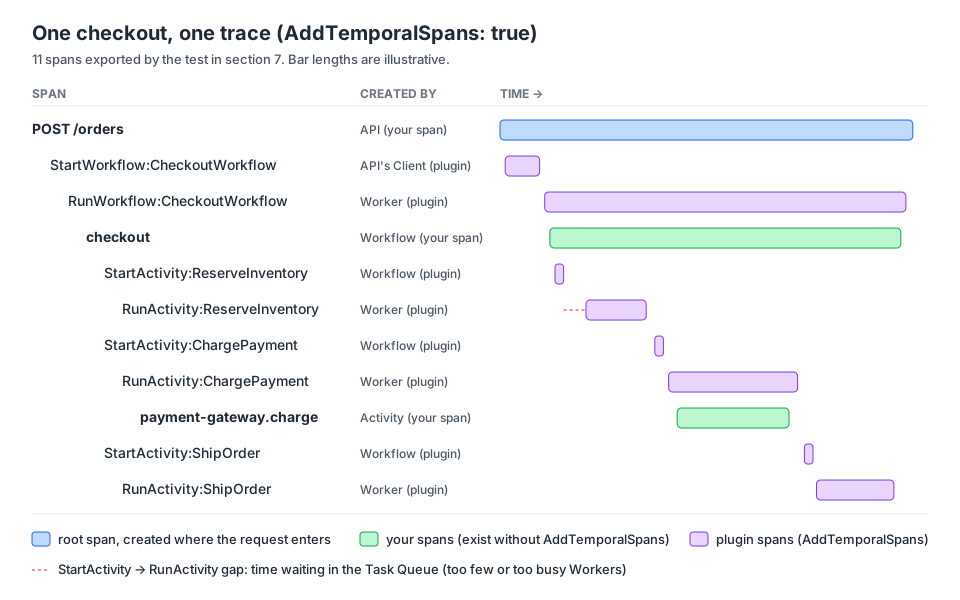
What to read in it:
- One trace. The test checks that every span has the root's trace ID: the context went from the test, through the Service, into the Workflow, and from the Workflow into each Activity.
- Without
AddTemporalSpans, only your spans exist, but they're still connected:checkout(created on the Worker) is a child ofPOST /orders(created in the test process). - With
AddTemporalSpans, the Temporal operations appear between them.StartActivityis the Workflow scheduling the Activity;RunActivityis the Activity running on a Worker. A gap between the two is time spent in the Task Queue: a strong signal that Workers are too few or too busy. ReserveInventoryandShipOrderhave no custom span;RunActivitystill gives you their duration.
Start with AddTemporalSpans: true. If the volume is too high, sample in the collector, or switch it off and keep only your own spans.
8. Replay, retries and Worker restarts
Replay safety is the reason this module exists, so it's worth checking. The same checkout code ran on a dev server with AddTemporalSpans: true, in situations that make Workflow code run more than once.
| Situation | What was exported |
|---|---|
Full replay on every Workflow Task (worker.SetStickyWorkflowCacheSize(0)) | Each span once. No duplicates despite the Workflow code running three times |
| Workflow restarted on another Worker: Worker 1 stopped while the Workflow waited for a Signal, Worker 2 finished it | RunWorkflow and checkout exported once, by Worker 2, with the original start time (from workflow.Now of the first Workflow Task) and ended when the Workflow completed. Worker 1 exported nothing for them |
| A Workflow Task failed twice (a panic in Workflow code) then succeeded | RunWorkflow and checkout exported three times with the same span ID: two zero-length copies from the failed attempts, then the real one |
Activity returned a non-retryable ApplicationError | RunActivity and RunWorkflow have status Error; StartActivity and your checkout span stay Unset |
Activity returned an error with Category: ApplicationErrorCategoryBenign | All spans Unset. The plugin records the error but doesn't mark the span as failed |
| Two Queries on a running Workflow, from a Client without a parent span | Each Query is its own small trace: QueryWorkflow → HandleQuery, with a new random ID every time (Queries run in a read-only context, which never replays) |
| A Signal from a Client without a parent span | Its own trace: SignalWorkflow → HandleSignal, not part of the checkout trace |
Practical consequences:
- Long Workflows produce long spans.
checkoutis exported when the Workflow ends. For a 30-day subscription Workflow, that is 30 days later, and the span is missing from your backend until then. Prefer spans around steps (one per order phase) over one span around the whole Workflow. - Failed Workflow Tasks show up as duplicate span IDs. Most backends display them as repeated spans. It's a useful signal: a Workflow Task failure is a bug in Workflow code (see the Error handling guide).
- Queries and Signals join the trace only if you give them a parent. Start them with a
ctxthat carries the request's span, as the API does forExecuteWorkflow.
9. Key takeaways
- Install
temporalotel.NewReplaySafeTracerProviderwithotel.SetTracerProviderfirst;NewPluginandtemporalotel.Tracerpanic otherwise. - Put
temporalotel.NewPlugininclient.Options.Plugins. Workers inherit it. By default it only propagates context;AddTemporalSpans: trueaddsStartWorkflow,RunWorkflow,StartActivity,RunActivity… spans. - In Workflows, use
temporalotel.Tracer(called inside the function, not in a package variable). In Activities, Clients and handlers, useotel.Tracer. - Start a root span where the request enters, and pass its
ctxto the Temporal Client. - Shut down in reverse order: Worker, Client, then the Tracer Provider, or the last spans are lost.
- Replay doesn't duplicate spans, and a Workflow moved to another Worker keeps one span with its original start time. Failed Workflow Tasks do produce repeated span IDs.
- The module is pre-release (v0.1.0): pin its version.