03 · Calling Activities from a Workflow (Workflow Activities)
Level: core concept · Read time: ~20 min Sources: Encyclopedia — Workflow Activity · Activity Execution · Go SDK — Activity Execution
A Workflow Activity is an Activity Execution started as a step in a Workflow. Its lifetime is scoped to the Workflow Run, and every step is recorded in that Workflow's Event History. Use it whenever you orchestrate several steps: run them in order, branch on a result, compensate a failure, or wait for a Signal or a Timer between steps.
To run just one Activity with no orchestration, a Standalone Activity is simpler and cheaper.
1. What happens when you call workflow.ExecuteActivity
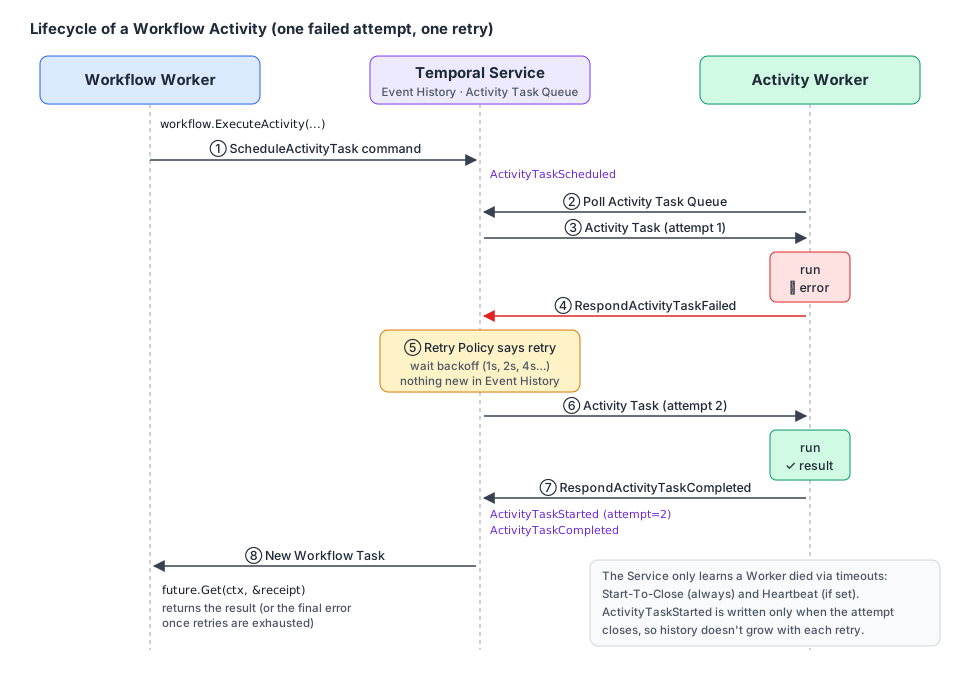
- Your Workflow code calls
workflow.ExecuteActivity(...). At the end of the Workflow Task, the Worker sends aScheduleActivityTaskcommand. - The Service writes
ActivityTaskScheduledto the Event History and puts an Activity Task on the Activity's Task Queue. - An Activity Worker polling that queue picks up the task and runs your function. This is one attempt, also called an Activity Task Execution.
- If the attempt fails, the Retry Policy decides whether to try again after a backoff.
- When an attempt succeeds, or the Activity finally fails, the Service writes
ActivityTaskStartedand thenActivityTaskCompleted(orFailed,TimedOut,Canceled). - A new Workflow Task delivers the result to your Workflow, and
future.Getreturns.
📝 Temporal doesn't detect a lost task or a crashed Worker directly. It relies on the Start-To-Close Timeout: when it expires, the attempt is considered failed and retried. If the Retry Policy allows only 1 attempt and a timeout happens, the Activity is not retried.
2. The basic call
workflow.ExecuteActivity(ctx, activity, args...) needs:
- a
workflow.Contextthat carriesActivityOptions(set withworkflow.WithActivityOptions) - the Activity, either as a function reference (the SDK validates the argument types) or as a string Activity Type
- the arguments
It returns a workflow.Future right away. The Activity runs asynchronously.
Future method | Behavior |
|---|---|
Get(ctx, &result) | Blocks the Workflow until the Activity Execution closes, then fills result or returns the error |
IsReady() | true once the result is available, so a later Get won't block |
The type you pass to Get must match the Activity's return type.
3. ActivityOptions reference
Set with workflow.WithActivityOptions(ctx, workflow.ActivityOptions{...}) and passed to ExecuteActivity through ctx.
| Field | Required | Default | What it does |
|---|---|---|---|
StartToCloseTimeout | Yes, or ScheduleToCloseTimeout | = ScheduleToCloseTimeout | Max duration of one attempt |
ScheduleToCloseTimeout | Yes, or StartToCloseTimeout | ∞ | Max duration of the whole Execution, retries included |
ScheduleToStartTimeout | No | ∞ | Max time an Activity Task waits in the queue (not retryable) |
HeartbeatTimeout | No | none | Max gap between two heartbeats |
RetryPolicy | No | 1s initial, ×2 backoff, max 100s, unlimited attempts | How failed attempts are retried |
TaskQueue | No | the Workflow's Task Queue | Routes the Activity Task to a specific pool of Workers |
ActivityID | No | generated | Identifier, unique among the open Activities of this Workflow Run |
WaitForCancellation | No | false | On cancel, wait for the Activity to acknowledge before returning |
Timeouts and retries are covered in chapter 04 and cancellation in chapter 05.
💡
workflow.WithActivityOptionsreturns a new context. Derive one context per kind of call when the options differ, for example a short timeout for a DB write and a long one plus a heartbeat for a PDF render.
4. A realistic example: order fulfillment with routing, parallelism and compensation
The OrderFulfillmentWorkflow:
- scores fraud and reserves inventory in parallel
- charges the card
- creates the shipment on a dedicated Task Queue (
warehouse-eu) served by Workers inside the warehouse network - if shipping fails, compensates: refunds the charge and releases the stock
- sends the confirmation and renders the invoice PDF in parallel
Shared types and Activities
// file: fulfillment/types.go
package fulfillment

type OrderLine struct {
	SKU      string
	Quantity int
}

type FulfillOrderInput struct {
	OrderID       string
	CustomerID    string
	CustomerEmail string
	Lines         []OrderLine
	AmountCents   int64
	PaymentToken  string
	ShipTo        string
}

type FulfillOrderResult struct {
	ChargeID       string
	TrackingNumber string
	InvoiceURL     string
}

type ReservationResult struct{ ReservationID string }
type ChargeReceipt struct{ ChargeID string }
type Shipment struct{ TrackingNumber string }
type InvoiceDocument struct{ URL string }// file: fulfillment/activities.go
package fulfillment
import (
"context"
"fmt"
"go.temporal.io/sdk/activity"
)
// InventoryActivities runs on the default "orders" Task Queue.
type InventoryActivities struct{}
func (a *InventoryActivities) ReserveInventory(ctx context.Context, orderID string, lines []OrderLine) (ReservationResult, error) {
return ReservationResult{ReservationID: "RSV-" + orderID}, nil
}
func (a *InventoryActivities) ReleaseInventory(ctx context.Context, reservationID string) error {
activity.GetLogger(ctx).Info("Releasing stock", "reservationID", reservationID)
return nil
}
func (a *InventoryActivities) ScoreFraud(ctx context.Context, customerID string, amountCents int64) (float64, error) {
return 0.12, nil
}
// PaymentActivities wraps the payment provider.
type PaymentActivities struct{}
func (a *PaymentActivities) ChargeCard(ctx context.Context, orderID, token string, amountCents int64) (ChargeReceipt, error) {
return ChargeReceipt{ChargeID: "ch_" + orderID}, nil
}
func (a *PaymentActivities) RefundCharge(ctx context.Context, chargeID string) error {
return nil
}
// ShippingActivities is registered ONLY by the warehouse Workers (Task Queue "warehouse-eu").
type ShippingActivities struct{}
func (a *ShippingActivities) CreateShipment(ctx context.Context, orderID, shipTo string) (Shipment, error) {
return Shipment{TrackingNumber: fmt.Sprintf("1Z-%s", orderID)}, nil
}
// DocumentActivities renders documents and sends emails.
type DocumentActivities struct{}
func (a *DocumentActivities) GenerateInvoicePDF(ctx context.Context, orderID string, amountCents int64) (InvoiceDocument, error) {
return InvoiceDocument{URL: "s3://invoices/" + orderID + ".pdf"}, nil
}
func (a *DocumentActivities) SendOrderConfirmation(ctx context.Context, email, orderID, tracking string) error {
return nil
}The Workflow
// file: fulfillment/workflow.go
package fulfillment

import (
	"errors"
	"time"

	"go.temporal.io/sdk/temporal"
	"go.temporal.io/sdk/workflow"
)

const WarehouseTaskQueue = "warehouse-eu"

var ErrFraudSuspected = errors.New("order rejected: fraud score too high")

func OrderFulfillmentWorkflow(ctx workflow.Context, in FulfillOrderInput) (FulfillOrderResult, error) {
	logger := workflow.GetLogger(ctx)

	// Default options for quick, idempotent calls.
	ctx = workflow.WithActivityOptions(ctx, workflow.ActivityOptions{
		StartToCloseTimeout: 10 * time.Second,
		RetryPolicy: &temporal.RetryPolicy{
			InitialInterval:    time.Second,
			BackoffCoefficient: 2.0,
			MaximumInterval:    time.Minute,
		},
	})

	var inv *InventoryActivities
	var pay *PaymentActivities
	var ship *ShippingActivities
	var docs *DocumentActivities

	// 1) Fan-out: the two calls run in parallel because we only call Get afterwards.
	fraudF := workflow.ExecuteActivity(ctx, inv.ScoreFraud, in.CustomerID, in.AmountCents)
	reserveF := workflow.ExecuteActivity(ctx, inv.ReserveInventory, in.OrderID, in.Lines)

	var fraudScore float64
	if err := fraudF.Get(ctx, &fraudScore); err != nil {
		return FulfillOrderResult{}, err
	}
	var reservation ReservationResult
	if err := reserveF.Get(ctx, &reservation); err != nil {
		return FulfillOrderResult{}, err
	}
	if fraudScore > 0.8 {
		_ = workflow.ExecuteActivity(ctx, inv.ReleaseInventory, reservation.ReservationID).Get(ctx, nil)
		return FulfillOrderResult{}, ErrFraudSuspected
	}

	// 2) Charge, with an explicit Activity ID that is easy to find in the UI and CLI.
	chargeCtx := workflow.WithActivityOptions(ctx, workflow.ActivityOptions{
		ActivityID:          "charge-" + in.OrderID,
		StartToCloseTimeout: 30 * time.Second,
	})
	var receipt ChargeReceipt
	if err := workflow.ExecuteActivity(chargeCtx, pay.ChargeCard, in.OrderID, in.PaymentToken, in.AmountCents).Get(ctx, &receipt); err != nil {
		_ = workflow.ExecuteActivity(ctx, inv.ReleaseInventory, reservation.ReservationID).Get(ctx, nil)
		return FulfillOrderResult{}, err
	}

	// 3) Route the shipment to the warehouse Workers on another Task Queue.
	shipCtx := workflow.WithActivityOptions(ctx, workflow.ActivityOptions{
		TaskQueue:              WarehouseTaskQueue,
		StartToCloseTimeout:    2 * time.Minute,
		ScheduleToCloseTimeout: 30 * time.Minute, // stop retrying after 30 min in total
	})
	var shipment Shipment
	if err := workflow.ExecuteActivity(shipCtx, ship.CreateShipment, in.OrderID, in.ShipTo).Get(ctx, &shipment); err != nil {
		// 4) Compensation (saga): undo the earlier steps in reverse order.
		logger.Error("Shipment failed, compensating", "error", err)
		_ = workflow.ExecuteActivity(ctx, pay.RefundCharge, receipt.ChargeID).Get(ctx, nil)
		_ = workflow.ExecuteActivity(ctx, inv.ReleaseInventory, reservation.ReservationID).Get(ctx, nil)
		return FulfillOrderResult{}, err
	}

	// 5) Fan-out again: confirmation email and invoice PDF.
	pdfCtx := workflow.WithActivityOptions(ctx, workflow.ActivityOptions{
		StartToCloseTimeout: 5 * time.Minute,
		HeartbeatTimeout:    20 * time.Second,
	})
	invoiceF := workflow.ExecuteActivity(pdfCtx, docs.GenerateInvoicePDF, in.OrderID, in.AmountCents)
	emailF := workflow.ExecuteActivity(ctx, docs.SendOrderConfirmation, in.CustomerEmail, in.OrderID, shipment.TrackingNumber)

	var invoice InvoiceDocument
	if err := invoiceF.Get(ctx, &invoice); err != nil {
		return FulfillOrderResult{}, err
	}
	if err := emailF.Get(ctx, nil); err != nil {
		logger.Warn("Confirmation email failed", "error", err) // not fatal for the order
	}

	return FulfillOrderResult{
		ChargeID:       receipt.ChargeID,
		TrackingNumber: shipment.TrackingNumber,
		InvoiceURL:     invoice.URL,
	}, nil
}
Two Worker pools
The orders Workers run the Workflow and most of the Activities. The warehouse-eu Workers run only ShippingActivities. The Workflow doesn't care where they run; it only names the Task Queue.
// file: cmd/orders-worker/main.go
package main

import (
	"log"

	"github.com/acme/shop/fulfillment"
	"go.temporal.io/sdk/client"
	"go.temporal.io/sdk/worker"
)

func main() {
	c, err := client.Dial(client.Options{})
	if err != nil {
		log.Fatalln(err)
	}
	defer c.Close()

	w := worker.New(c, "orders", worker.Options{})
	w.RegisterWorkflow(fulfillment.OrderFulfillmentWorkflow)
	w.RegisterActivity(&fulfillment.InventoryActivities{})
	w.RegisterActivity(&fulfillment.PaymentActivities{})
	w.RegisterActivity(&fulfillment.DocumentActivities{})
	log.Fatalln(w.Run(worker.InterruptCh()))
}// file: cmd/warehouse-worker/main.go
package main
import (
"log"
"github.com/acme/shop/fulfillment"
"go.temporal.io/sdk/client"
"go.temporal.io/sdk/worker"
)
func main() {
c, err := client.Dial(client.Options{})
if err != nil {
log.Fatalln(err)
}
defer c.Close()
w := worker.New(c, fulfillment.WarehouseTaskQueue, worker.Options{})
w.RegisterActivity(&fulfillment.ShippingActivities{})
log.Fatalln(w.Run(worker.InterruptCh()))
}5. Non-blocking result checks with IsReady
Get blocks. When you want to poll a result without blocking, for example to do other work first, check IsReady():
// file: fulfillment/isready_example.go
package fulfillment

import (
	"time"

	"go.temporal.io/sdk/workflow"
)

func WarmupExampleWorkflow(ctx workflow.Context, orderID string) (string, error) {
	ctx = workflow.WithActivityOptions(ctx, workflow.ActivityOptions{StartToCloseTimeout: time.Minute})
	var docs *DocumentActivities

	invoiceF := workflow.ExecuteActivity(ctx, docs.GenerateInvoicePDF, orderID, int64(0))

	// ... do other deterministic work, start other Activities, wait on timers ...
	if err := workflow.Sleep(ctx, 5*time.Second); err != nil {
		return "", err
	}

	if invoiceF.IsReady() {
		var invoice InvoiceDocument
		if err := invoiceF.Get(ctx, &invoice); err != nil { // does not block: result is ready
			return "", err
		}
		return invoice.URL, nil
	}
	return "pending", nil
}
Running many Activity Executions from one Workflow is normal. You can block on each result in turn, or keep going and collect the results later.
6. Event History: consequences you must design for
A Workflow Activity writes ActivityTaskScheduled, ActivityTaskStarted and ActivityTaskCompleted (or Failed, TimedOut, Canceled) to the Workflow's history. This has two consequences:
- Replay reuses the recorded result. When a Workflow replays (after a Worker restart, for example), completed Activities are not executed again. That is why an LLM call or a payment inside an Activity runs exactly once from the Workflow's point of view.
- Arguments and return values are persisted. They count toward the Event History limits. Keep payloads small, and watch how many Activities a single Workflow Execution schedules. For very long loops, see Continue-As-New.
📝 Completed Activities don't re-run on replay. Before an Activity reports completion, though, nothing is recorded. If the Worker dies before reporting, the attempt is retried. That's the idempotency case from chapter 02.
7. Activity ID
- If you don't set
ActivityID, the SDK generates one. - It must be unique among the open Activity Executions of the Workflow Run. A Run may reuse an ID once the earlier Activity with that ID has closed.
- Set it explicitly when something outside the Workflow needs to address the Activity: async completion by ID, or an operator running
temporal activity pause --workflow-id ... --activity-id charge-ORD-1042(chapter 10).
8. Cancellation and operator commands (preview)
- A Workflow Activity can't be cancelled directly. It gets a cancellation request when its Workflow is cancelled, or when the Workflow code cancels the context it was scheduled with. It must heartbeat to receive it. → chapter 05
- Operators can Pause, Unpause, Reset and Update Options of a running Workflow Activity (Public Preview). → chapter 10
Key takeaways
workflow.ExecuteActivityreturns aFuture. CallGetnow to run steps one after another, or later to run them in parallel.- Every call needs
StartToCloseTimeoutorScheduleToCloseTimeout. TaskQueueinActivityOptionsroutes work to specialized Workers.- Compensation (saga) is plain Workflow code that calls "undo" Activities.
- Inputs and outputs are stored in the Event History, so keep them small.
⬅️ Previous: 02 · Defining Activities · ➡️ Next: 04 · Timeouts, retries & heartbeats