01 · Platform failures vs application failures
Level: foundations · Read time: ~12 min Sources: Encyclopedia — Failures and error handling · Application failures (platform vs application failures)
1. The problem
A checkout reserves stock, charges a card and books a shipment. Many things can go wrong:
- the Worker running the charge is killed by a deploy;
- the payment gateway answers
503for thirty seconds; - the Temporal Service restarts;
- the card is declined;
- the shipping address is in a country you don't deliver to.
Without Temporal you would write retry loops, persist progress in a database and run a recovery job for every one of these. With Temporal, some of them need no code at all, and some need very deliberate code. The first skill in error handling is telling the two apart.
2. Two families of failures
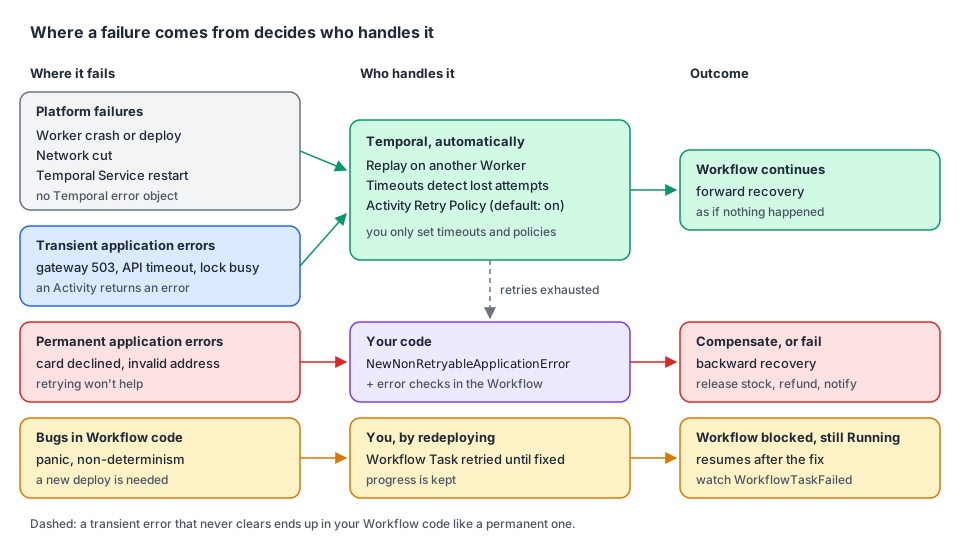
| Platform failures | Application failures | |
|---|---|---|
| Examples | Worker crash, network cut, Service restart, Worker deploy | Card declined, invalid address, business rule broken, a downstream API that keeps rejecting the request |
| Who produces them | The infrastructure | Your code (an Activity or Workflow returns an error) |
| Who handles them | Temporal, transparently | You: Retry Policy settings, error checks in the Workflow, compensation |
| Recovery | Forward recovery: the step runs again and the Workflow continues where it was | Often backward recovery: undo what was already done (release stock, refund) |
| Do retries fix it? | Yes | Only if the cause is transient (a 503). A declined card stays declined |
The Encyclopedia puts it this way: platform failures "do not produce Temporal failure objects"; the platform handles them. Application failures do reach your code, as typed errors (chapter 02).
3. What Temporal does for you (no code)
Durable Execution covers platform failures:
| What happens | What Temporal does | Your code sees |
|---|---|---|
| The Worker running an Activity crashes | The attempt times out (Start-To-Close or Heartbeat), a new attempt runs on another Worker | Nothing, if a later attempt succeeds |
| The Worker running the Workflow crashes | Another Worker replays the Event History and continues | Nothing |
| The Service restarts | State is in its database; Tasks are dispatched again | Nothing |
| An Activity returns a transient error | The default Retry Policy retries it with exponential backoff, forever | Nothing, if a later attempt succeeds |
The last line is the bridge between both families: a 503 is an application failure (your Activity returned an error), but Temporal handles it like a platform failure because Activities retry by default. Retry Policies are chapter 07; detecting a crashed Worker needs timeouts, chapter 08.
4. What you must still handle
Retries can't fix:
- Permanent errors: bad input, a declined card, a business rule. Retrying wastes time and money. Mark them non-retryable (chapter 04).
- The end of retries: when an Activity gives up (non-retryable error,
MaximumAttempts, Schedule-To-Close), the Workflow gets an error. It must decide: fail, compensate, or take another path (chapter 05). - Bugs in Workflow code: a panic or non-determinism doesn't fail the Workflow, it blocks it until you deploy a fix (chapter 03).
- Backward recovery: if stock was reserved and the charge failed, someone must release it. Only your code knows how.
5. A checkout, annotated
The Activities. Infrastructure errors are returned as is (retryable). A declined card is a business answer, so it becomes a non-retryable ApplicationError:
// file: checkout/types.go
package checkout

type PlaceOrderInput struct {
	OrderID    string
	CustomerID string
	SKU        string
	Quantity   int
	CardToken  string
	TotalCents int64
}

type OrderConfirmation struct {
	OrderID       string
	ReservationID string
	PaymentID     string
}// file: checkout/ports.go
package checkout
import (
"context"
"errors"
)
// ErrCardDeclined is returned by the payment gateway client for a declined card.
var ErrCardDeclined = errors.New("card declined")
type Inventory interface {
Reserve(ctx context.Context, orderID, sku string, qty int) (reservationID string, err error)
Release(ctx context.Context, reservationID string) error
}
type PaymentGateway interface {
Charge(ctx context.Context, idempotencyKey, cardToken string, amountCents int64) (paymentID string, err error)
}// file: checkout/activities.go
package checkout
import (
"context"
"errors"
"go.temporal.io/sdk/temporal"
)
type Activities struct {
Inventory Inventory
Payments PaymentGateway
}
// ReserveStock: any error (timeout, 503…) is transient. Temporal retries it.
func (a *Activities) ReserveStock(ctx context.Context, in PlaceOrderInput) (string, error) {
return a.Inventory.Reserve(ctx, in.OrderID, in.SKU, in.Quantity)
}
// ChargeCard: a decline is permanent, everything else is retried.
func (a *Activities) ChargeCard(ctx context.Context, in PlaceOrderInput) (string, error) {
paymentID, err := a.Payments.Charge(ctx, "charge-"+in.OrderID, in.CardToken, in.TotalCents)
if errors.Is(err, ErrCardDeclined) {
return "", temporal.NewNonRetryableApplicationError("card declined", "CardDeclined", err)
}
return paymentID, err
}
func (a *Activities) ReleaseStock(ctx context.Context, reservationID string) error {
return a.Inventory.Release(ctx, reservationID)
}The Workflow. It contains no retry loop and no crash handling. It only decides what a failed charge means for the business:
// file: checkout/workflow.go
package checkout

import (
	"time"

	"go.temporal.io/sdk/workflow"
)

const TaskQueue = "checkout"

func PlaceOrderWorkflow(ctx workflow.Context, in PlaceOrderInput) (OrderConfirmation, error) {
	ctx = workflow.WithActivityOptions(ctx, workflow.ActivityOptions{
		StartToCloseTimeout: 30 * time.Second, // detects a crashed Worker (platform failure)
	})
	var a *Activities

	var reservationID string
	if err := workflow.ExecuteActivity(ctx, a.ReserveStock, in).Get(ctx, &reservationID); err != nil {
		return OrderConfirmation{}, err // nothing to undo yet
	}

	var paymentID string
	if err := workflow.ExecuteActivity(ctx, a.ChargeCard, in).Get(ctx, &paymentID); err != nil {
		// Application failure: backward recovery. Use a disconnected context so the
		// release still runs if the Workflow itself is being canceled.
		releaseCtx, _ := workflow.NewDisconnectedContext(ctx)
		if relErr := workflow.ExecuteActivity(releaseCtx, a.ReleaseStock, reservationID).Get(releaseCtx, nil); relErr != nil {
			workflow.GetLogger(ctx).Error("Stock release failed", "reservationID", reservationID, "error", relErr)
		}
		return OrderConfirmation{}, err
	}

	return OrderConfirmation{OrderID: in.OrderID, ReservationID: reservationID, PaymentID: paymentID}, nil
}// file: cmd/worker/main.go
package main
import (
"context"
"log"
"go.temporal.io/sdk/client"
"go.temporal.io/sdk/worker"
"github.com/acme/shop/checkout"
)
// Fakes stand in for the real inventory service and payment gateway.
type fakeInventory struct{}
func (fakeInventory) Reserve(context.Context, string, string, int) (string, error) {
return "res-1", nil
}
func (fakeInventory) Release(context.Context, string) error { return nil }
type fakeGateway struct{}
func (fakeGateway) Charge(_ context.Context, _, cardToken string, _ int64) (string, error) {
if cardToken == "tok_declined" {
return "", checkout.ErrCardDeclined
}
return "pay-1", nil
}
func main() {
c, err := client.Dial(client.Options{})
if err != nil {
log.Fatalln("Unable to create client", err)
}
defer c.Close()
w := worker.New(c, checkout.TaskQueue, worker.Options{})
w.RegisterWorkflow(checkout.PlaceOrderWorkflow)
w.RegisterActivity(&checkout.Activities{Inventory: fakeInventory{}, Payments: fakeGateway{}})
if err := w.Run(worker.InterruptCh()); err != nil {
log.Fatalln("Unable to start worker", err)
}
}Reading the code against the failure list from section 1:
| Failure | Handled by | Code needed |
|---|---|---|
Worker killed during ChargeCard | Start-To-Close fires, the attempt runs again elsewhere | The timeout. The gateway call uses an idempotency key, so a second attempt doesn't charge twice |
Gateway 503 for 30 s | Default Retry Policy | None |
| Service restart | Durable Execution | None |
| Card declined | Your Workflow | Non-retryable error + release the stock |
The "charge-"+in.OrderID idempotency key matters: an Activity can run more than once (a crash after the charge but before the result was reported). See Activities, chapter 04.
6. Key takeaways
- Platform failures (crashes, network, restarts) are handled by Temporal through forward recovery. Don't write code for them; do set a Start-To-Close Timeout so crashes are detected.
- Application failures come from your code. Transient ones are retried by the default Activity Retry Policy; permanent ones must be marked non-retryable.
- When an Activity finally fails, the Workflow decides: fail, compensate (backward recovery) or take another path.
- Workflow code has no retry loops and no crash handling, only business decisions.