07 · Local Activities: trading durability for latency
Level: execution mode (optimization) · Read time: ~15 min Sources: Encyclopedia — Local Activity · Activity Execution
1. The problem
Every regular Activity makes at least two round trips through the Temporal Service: it is scheduled, dispatched to an Activity Worker, its result is recorded, and the Workflow resumes in a new Workflow Task. It also writes three events to the history. That is fine for a payment call. It is a lot of overhead for "compute the VAT from an in-memory table" when a Workflow does it hundreds of times per second.
A Local Activity runs in the same Worker process as the Workflow that schedules it, through an in-process queue. It never enters an Activity Task Queue. You get much lower latency and fewer history events, and you give up some durability.
📌 Local Activities are a performance optimization, not a replacement for regular Activities. For most business logic, regular Activities are the right default.
2. How they execute
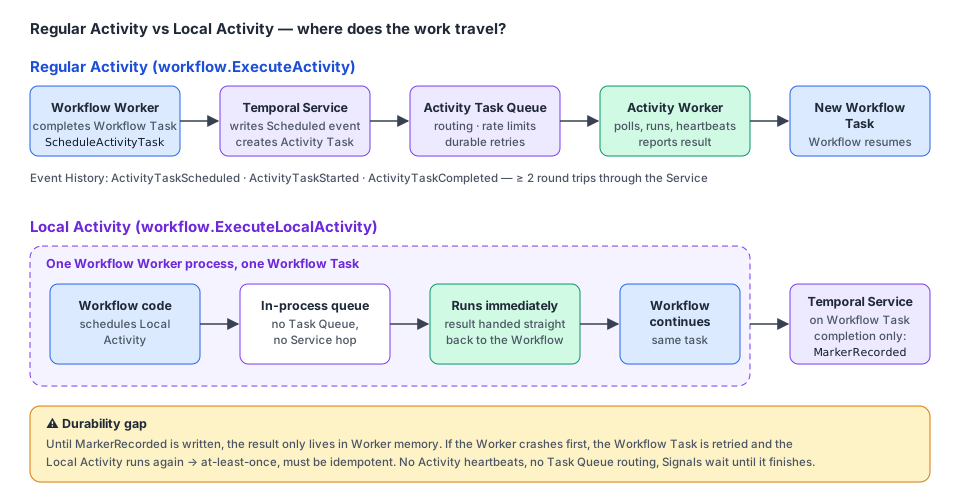
| Regular Activity | Local Activity |
|---|---|
| 1. Workflow schedules the Activity | 1. Workflow schedules a Local Activity |
2. Workflow Task completes with a ScheduleActivityTask command | 2. It is put in an in-process queue in the Workflow Worker |
| 3. The Service creates an Activity Task | 3. The Workflow Worker runs it immediately |
| 4. An Activity Worker polls the queue and runs it | 4. The result goes straight back to the Workflow |
| 5. The result is recorded in the Event History | 5. When the Workflow Task completes, a MarkerRecorded event stores the result |
| 6. The Workflow resumes in a new Workflow Task | Only the marker is persisted |
Failure and durability
- A Local Activity result becomes durable only when the enclosing Workflow Task completes and writes
MarkerRecorded. Until then it exists only in Worker memory. - If the Worker crashes before that, the Workflow Task is retried, and every Local Activity run during that task runs again.
- So Local Activities are at-least-once and must be idempotent.
- Once the marker exists, replay uses the recorded result and doesn't run the Local Activity again.
Workflow Task heartbeating (not Activity heartbeating)
Local Activities can't call RecordHeartbeat. Instead, when a Local Activity approaches about 80% of the Workflow Task Timeout (10s by default), the Worker completes the current Workflow Task and asks for a new one. That lets it run longer than one task timeout, but:
- each of these heartbeats adds events to the history,
- Signals and other external events aren't processed until the Local Activities finish,
- commands from the Workflow aren't sent until the Local Activity completes or the next Workflow Task heartbeat.
If an operation regularly gets close to the Workflow Task Timeout, make it a regular Activity.
3. When to use which
| Use a Local Activity when… | Use a regular Activity when… |
|---|---|
| it finishes in a few seconds, retries included | it talks to external systems (network, DB, APIs) |
| retries are expected to be short | it may take longer than a few seconds |
| it is idempotent | retries may last minutes or hours |
| low latency matters more than full durability | it needs Activity heartbeating |
| no routing, rate limiting or separate Worker pool is needed | you need Task Queue routing or global rate limiting |
| e.g. light data transforms, small computations, reading an in-memory cache, fast local file ops | e.g. network calls, DB operations, external APIs, long work |
| Feature | Activity | Local Activity |
|---|---|---|
| Runs on | Activity Worker | Workflow Worker |
| Task Queue | Yes | No |
| Service round trip | Required | Not required |
| Latency | Higher | Lower |
| Event History | Fully recorded | MarkerRecorded on completion |
| Heartbeating | Activity heartbeats | Workflow Task heartbeating |
| Retry durability | Durable | At-least-once until the marker is recorded |
| Signal responsiveness | Unaffected | Delayed while the Workflow Task runs |
| Activity Operations (Pause, Reset…) | Yes | No |
4. Go implementation
The Activities
The same rules as regular Activities apply: context.Context first, serializable input and output.
// file: pricing/activities.go
package pricing

import (
	"context"
	"errors"
	"strings"
)

type CartLine struct {
	SKU            string
	Quantity       int
	UnitPriceCents int64
}

type PriceCartInput struct {
	CountryCode string
	Lines       []CartLine
}

type PricedCart struct {
	SubtotalCents int64
	VATCents      int64
	TotalCents    int64
}

// PricingActivities keeps an in-memory VAT table loaded at Worker start-up.
// It does no network I/O, which makes it a good fit for a Local Activity.
type PricingActivities struct {
	VATRateByCountry map[string]float64
}

func (p *PricingActivities) PriceCart(ctx context.Context, in PriceCartInput) (PricedCart, error) {
	rate, ok := p.VATRateByCountry[in.CountryCode]
	if !ok {
		return PricedCart{}, errors.New("no VAT rate for " + in.CountryCode)
	}
	var subtotal int64
	for _, l := range in.Lines {
		subtotal += int64(l.Quantity) * l.UnitPriceCents
	}
	vat := int64(float64(subtotal) * rate)
	return PricedCart{SubtotalCents: subtotal, VATCents: vat, TotalCents: subtotal + vat}, nil
}

// NormalizePostalCode is a pure function: also a good Local Activity.
func NormalizePostalCode(ctx context.Context, raw string) (string, error) {
	return strings.ToUpper(strings.ReplaceAll(strings.TrimSpace(raw), " ", "")), nil
}

// CheckoutActivities does real I/O: keep these as regular Activities.
type CheckoutActivities struct{}

func (c *CheckoutActivities) ChargeCard(ctx context.Context, orderID string, amountCents int64) (string, error) {
	return "ch_" + orderID, nil
}
The Workflow: mixing Local and regular Activities
Local Activities use their own options type, workflow.LocalActivityOptions, applied with workflow.WithLocalActivityOptions. It has ScheduleToCloseTimeout, StartToCloseTimeout (at least one is required), RetryPolicy and Summary. There is no Task Queue and no Heartbeat Timeout.
// file: pricing/workflow.go
package pricing

import (
	"time"

	"go.temporal.io/sdk/temporal"
	"go.temporal.io/sdk/workflow"
)

type CheckoutInput struct {
	OrderID     string
	CountryCode string
	PostalCode  string
	Lines       []CartLine
}

type CheckoutResult struct {
	PostalCode string
	Priced     PricedCart
	ChargeID   string
}

func QuickCheckoutWorkflow(ctx workflow.Context, in CheckoutInput) (CheckoutResult, error) {
	// Local Activity options: keep timeouts well under the Workflow Task Timeout (10s default).
	lctx := workflow.WithLocalActivityOptions(ctx, workflow.LocalActivityOptions{
		StartToCloseTimeout:    2 * time.Second,
		ScheduleToCloseTimeout: 5 * time.Second, // short retries only
		RetryPolicy: &temporal.RetryPolicy{
			InitialInterval: 100 * time.Millisecond,
			MaximumAttempts: 3,
		},
	})

	// A) Local Activity with a plain function: runs it directly, no registration needed.
	var postal string
	if err := workflow.ExecuteLocalActivity(lctx, NormalizePostalCode, in.PostalCode).Get(lctx, &postal); err != nil {
		return CheckoutResult{}, err
	}

	// B) Local Activity with a struct method: the struct must be REGISTERED on the Worker,
	//    because the nil receiver below is only used to find the registered instance.
	var pricing *PricingActivities
	var priced PricedCart
	err := workflow.ExecuteLocalActivity(lctx, pricing.PriceCart, PriceCartInput{
		CountryCode: in.CountryCode, Lines: in.Lines,
	}).Get(lctx, &priced)
	if err != nil {
		return CheckoutResult{}, err
	}

	// C) Regular Activity for the network call.
	actx := workflow.WithActivityOptions(ctx, workflow.ActivityOptions{StartToCloseTimeout: 30 * time.Second})
	var checkout *CheckoutActivities
	var chargeID string
	if err := workflow.ExecuteActivity(actx, checkout.ChargeCard, in.OrderID, priced.TotalCents).Get(actx, &chargeID); err != nil {
		return CheckoutResult{}, err
	}

	return CheckoutResult{PostalCode: postal, Priced: priced, ChargeID: chargeID}, nil
}
When the Workflow Task that schedules ChargeCard completes, the Worker sends something like:
MarkerRecorded        (NormalizePostalCode result)
MarkerRecorded        (PriceCart result)
ScheduleActivityTask  (ChargeCard)
If ChargeCard later fails and retries, the Workflow replays from the markers, so the two Local Activities don't run again. Only ChargeCard is retried, according to its Retry Policy.
The Worker
Local Activities run on the Workflow Worker, so register them there:
// file: cmd/checkout-worker/main.go
package main

import (
	"log"

	"github.com/acme/shop/pricing"
	"go.temporal.io/sdk/client"
	"go.temporal.io/sdk/worker"
)

func main() {
	c, err := client.Dial(client.Options{})
	if err != nil {
		log.Fatalln(err)
	}
	defer c.Close()

	w := worker.New(c, "checkout", worker.Options{})
	w.RegisterWorkflow(pricing.QuickCheckoutWorkflow)

	// Used as a Local Activity (struct method -> must be registered here).
	w.RegisterActivity(&pricing.PricingActivities{
		VATRateByCountry: map[string]float64{"FR": 0.20, "DE": 0.19, "ES": 0.21},
	})
	// Used as a regular Activity.
	w.RegisterActivity(&pricing.CheckoutActivities{})

	log.Fatalln(w.Run(worker.InterruptCh()))
}
5. Gotchas
- Long retry intervals are wasteful. A Local Activity retry that waits longer than the Workflow Task allows ends up being implemented with Workflow Timers and extra history events. Keep retries short.
- Signals wait. While Local Activities run inside a Workflow Task, incoming Signals aren't handled.
- No operator controls. Pause, Reset, Update Options and the other Activity Operations don't apply to Local Activities.
- Monitor them with the
local_activity_totalSDK metric, or look forMarkerRecordedentries in the Event History. - Worker shutdown. If the Worker stops before the Workflow Task completes, the Local Activities of that task run again on another Worker. They have no marker yet.
Key takeaways
- Local Activity = runs inside the Workflow Worker, no Task Queue, result stored as a
MarkerRecordedevent. - Use it only for short, idempotent, local work in high-throughput Workflows.
- It is at-least-once until the marker is written. It has no Activity heartbeat, no routing and no operator commands.
- In Go:
workflow.WithLocalActivityOptions+workflow.ExecuteLocalActivity. Register struct-method Local Activities on the Workflow Worker. - When in doubt, use a regular Activity.
⬅️ Previous: 06 · Standalone Activities · ➡️ Next: 08 · Asynchronous Activity Completion