01 · What is an Activity, and why does it exist?
Level: core concept · Read time: ~10 min Sources: Encyclopedia — Activities · Activity Execution · Go SDK — Activities
1. The problem Activities solve
Imagine you write a checkout in plain Go:
func Checkout(order Order) error {
    if err := inventory.Reserve(order); err != nil { return err } // network call
    if err := payments.Charge(order); err != nil { return err }   // network call, may time out
    if err := email.SendConfirmation(order); err != nil { return err }
    return nil
}
Every line can fail, and the failures are hard to handle:
| What goes wrong | What you would have to build yourself |
|---|---|
| The payment API times out once in a while | Retry loops with exponential backoff, jitter, max attempts |
The process crashes after Charge succeeded | Store progress somewhere so you don't charge twice on restart |
| The email provider is down for 2 hours | A queue, a scheduler, a dead-letter queue |
| A long job (video transcoding, a 2 GB CSV import) dies at 80% | Checkpointing, resume logic, liveness detection |
| You need to know if a job is stuck | Timeouts, "last seen" heartbeats, dashboards |
Temporal splits your code in two:
- Workflows hold the orchestration (the order of steps, branching, compensation). They must be deterministic, so they can't do I/O directly.
- Activities hold the side effects. They are plain Go functions that call databases, HTTP APIs, file systems, LLMs, and so on. They can be non-deterministic and use any library.
The Temporal Service wraps every Activity call in a durable Activity Execution. That Execution runs your retries, enforces your timeouts, tracks heartbeats and records the result. You no longer write any of the plumbing from the table above.
💡 One-liner for your notes: an Activity is a normal Go function. Temporal adds durability around it: it retries, times out and tracks it until you get one final result.
Problems Activities can solve, grouped
- Reliability of side effects. Automatic retries with backoff. If a Worker crashes, the Activity is retried on another Worker.
- Failure detection. Timeouts and heartbeats show that a Worker is dead or stuck.
- Long-running work. Heartbeat checkpoints let a retried attempt continue where the previous one stopped.
- Memoization. A completed Activity is never re-executed on Workflow replay, so an expensive LLM call or a large download runs once.
- Background jobs / job queue. Standalone Activities run one durable job without a Workflow.
- Human / external completion. Async completion lets another system finish the Activity.
- Operational control. Operators can Pause, Reset or retune a misbehaving Activity at runtime (Activity Operations).
2. What an Activity is (and isn't)
From the Encyclopedia: an Activity is a normal function or method that executes a single, well-defined action (short or long running), such as calling another service, transcoding a media file, or sending an email message.
| Workflow | Activity | |
|---|---|---|
| Purpose | Orchestration and state | One side-effecting action |
| Determinism | Must be deterministic | Can be non-deterministic |
| I/O (HTTP, DB, files, time.Now, rand) | ❌ Forbidden | ✅ Expected |
| Failure handling | Usually doesn't fail on its own; it reacts to Activity failures | Retried automatically per its Retry Policy |
| Re-execution on replay | Replayed from Event History | Never re-executed after it completed: the recorded result is reused |
| Context type | workflow.Context | context.Context |
Good Activity granularity
The Encyclopedia lists typical Activities:
- a single write: update a user profile, submit a card payment
- a batch of similar writes: create several orders, send several messages
- reads followed by a write: check stock and address, then update the order status
- a read worth memoizing: an LLM call, a large download, a slow-polling read
Split larger pieces of work into several Activities. Small Activities are easier to recover, can use short timeouts, and are easier to make idempotent. See 02 · Defining Activities.
3. One definition, three ways to run it
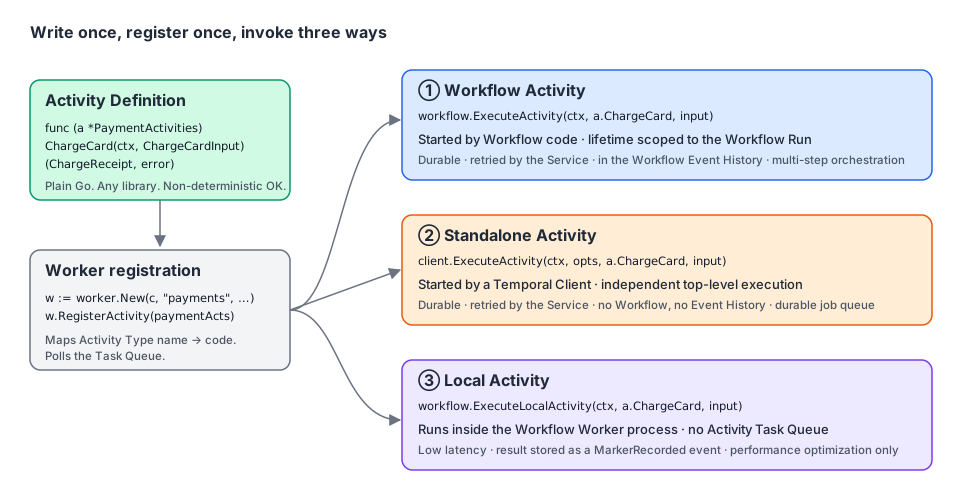
You write the Activity once and register it once on a Worker. You can then invoke it in three ways:
| Mode | Started by | Go API | Use it for | Chapter |
|---|---|---|---|---|
| Workflow Activity | Workflow code | workflow.ExecuteActivity | Multi-step orchestration (sequence, branch, compensate, wait for Signals) | 03 |
| Standalone Activity | A Temporal Client | client.ExecuteActivity | One durable background job (send an email, process a webhook, export data) | 06 |
| Local Activity | Workflow code | workflow.ExecuteLocalActivity | Very short, high-throughput steps where latency matters more than full durability | 07 |
Workflow Activities and Standalone Activities both create a durable Activity Execution in the Temporal Service. A Local Activity skips the Service and the Task Queue: it runs inside the Workflow Worker. It is a performance optimization, not a replacement for the other two.
4. Vocabulary you'll meet everywhere
| Term | Meaning | Go handle |
|---|---|---|
| Activity Definition | Your Go function or struct method | func (a *PaymentActivities) ChargeCard(ctx, in) (out, error) |
| Activity Type | The name under which the definition is registered (defaults to the function name) | activity.RegisterOptions{Name: "..."} |
| Activity Execution | One durable run of an Activity, across all its attempts | workflow.Future / client.ActivityHandle |
| Activity Task | The unit of work the Service puts on a Task Queue for one attempt | — |
| Activity Task Execution | One attempt: a Worker picked up the task and ran your function | activity.GetInfo(ctx).Attempt |
| Activity Worker | Your process that polls a Task Queue and runs registered Activities | worker.New(...) |
| Task Queue | The named queue Activity Tasks are dispatched on | ActivityOptions.TaskQueue |
| Activity ID | Identifier of an Activity Execution (unique among open ones of a Workflow Run; separate ID space for Standalone) | ActivityOptions.ActivityID |
| Task Token | Opaque identifier of one Activity Task Execution, used for async completion and external heartbeats | activity.GetInfo(ctx).TaskToken |
| Retry Policy | Rules for retrying failed attempts (backoff, max attempts, non-retryable types) | temporal.RetryPolicy |
| Heartbeat | A "still alive + progress" ping from a running Activity | activity.RecordHeartbeat |
5. Your first end-to-end Activity in Go
A complete, minimal program: an OrderPlacedWorkflow asks an Activity to send a confirmation email. Create these four files in a module named github.com/acme/shop (go get go.temporal.io/sdk).
The Activity: plain Go with a context.Context, one input struct and one output struct.
// file: notifications/activities.go
package notifications

import (
	"context"
	"fmt"

	"go.temporal.io/sdk/activity"
)

type SendOrderConfirmationInput struct {
	OrderID       string
	CustomerEmail string
	TotalCents    int64
}

type SendOrderConfirmationResult struct {
	MessageID string
}

// EmailActivities holds dependencies (an SMTP client, a template engine...).
// Here we just fake the provider call.
type EmailActivities struct {
	SenderAddress string
}

func (a *EmailActivities) SendOrderConfirmation(ctx context.Context, in SendOrderConfirmationInput) (SendOrderConfirmationResult, error) {
	logger := activity.GetLogger(ctx)
	logger.Info("Sending order confirmation", "orderID", in.OrderID, "to", in.CustomerEmail)

	// Real code would call SendGrid / SES / SMTP here. Any error returned is retried by Temporal.
	messageID := fmt.Sprintf("msg-%s", in.OrderID)
	return SendOrderConfirmationResult{MessageID: messageID}, nil
}
The Workflow schedules the Activity and waits for the result:
// file: notifications/workflow.go
package notifications

import (
	"time"

	"go.temporal.io/sdk/workflow"
)

type OrderPlacedInput struct {
	OrderID       string
	CustomerEmail string
	TotalCents    int64
}

func OrderPlacedWorkflow(ctx workflow.Context, in OrderPlacedInput) (string, error) {
	ctx = workflow.WithActivityOptions(ctx, workflow.ActivityOptions{
		StartToCloseTimeout: 30 * time.Second, // at least one timeout is mandatory
	})

	var a *EmailActivities // nil pointer: only used to reference the method
	var res SendOrderConfirmationResult
	err := workflow.ExecuteActivity(ctx, a.SendOrderConfirmation, SendOrderConfirmationInput{
		OrderID:       in.OrderID,
		CustomerEmail: in.CustomerEmail,
		TotalCents:    in.TotalCents,
	}).Get(ctx, &res)
	if err != nil {
		return "", err
	}
	return res.MessageID, nil
}
The Worker registers both and polls the orders Task Queue:
// file: cmd/worker/main.go
package main
import (
"log"
"github.com/acme/shop/notifications"
"go.temporal.io/sdk/client"
"go.temporal.io/sdk/worker"
)
func main() {
c, err := client.Dial(client.Options{}) // localhost:7233, "default" namespace
if err != nil {
log.Fatalln("unable to create Temporal client", err)
}
defer c.Close()
w := worker.New(c, "orders", worker.Options{})
w.RegisterWorkflow(notifications.OrderPlacedWorkflow)
w.RegisterActivity(¬ifications.EmailActivities{SenderAddress: "orders@acme.example"})
if err := w.Run(worker.InterruptCh()); err != nil {
log.Fatalln("worker stopped", err)
}
}The starter kicks off a Workflow:
// file: cmd/starter/main.go
package main

import (
	"context"
	"log"

	"github.com/acme/shop/notifications"
	"go.temporal.io/sdk/client"
)

func main() {
	c, err := client.Dial(client.Options{})
	if err != nil {
		log.Fatalln("unable to create Temporal client", err)
	}
	defer c.Close()

	run, err := c.ExecuteWorkflow(context.Background(),
		client.StartWorkflowOptions{ID: "order-placed-ORD-1042", TaskQueue: "orders"},
		notifications.OrderPlacedWorkflow,
		notifications.OrderPlacedInput{OrderID: "ORD-1042", CustomerEmail: "jane@example.com", TotalCents: 4999},
	)
	if err != nil {
		log.Fatalln("unable to start workflow", err)
	}

	var messageID string
	if err := run.Get(context.Background(), &messageID); err != nil {
		log.Fatalln("workflow failed", err)
	}
	log.Println("confirmation sent:", messageID)
}
Run it:
temporal server start-dev          # terminal 1 — UI on http://localhost:8233
go run ./cmd/worker                # terminal 2
go run ./cmd/starter               # terminal 3
Open the Web UI and look at the Workflow's Event History. You'll see ActivityTaskScheduled, ActivityTaskStarted and ActivityTaskCompleted, the three events every Workflow Activity produces. Make SendOrderConfirmation return an error and watch Temporal retry it with backoff, without any retry code from you.
6. Key takeaways
- Activities are where side effects live. Workflows orchestrate, Activities act.
- Activity code is plain Go: any library, any I/O, non-determinism allowed.
- Temporal wraps every call in a durable Activity Execution (retries, timeouts, heartbeats, recorded result).
- Write once, register once, then run it as a Workflow Activity, a Standalone Activity or a Local Activity.
- Because of retries, an Activity may run more than once. Design it to be idempotent (next chapter).
➡️ Next: 02 · Defining Activities in Go