02 · Temporal's error types in Go
Level: foundations · Read time: ~18 min Sources: Encyclopedia — Application failures (how Temporal represents failures, how errors propagate) · Go SDK — Error handling ·
go.temporal.io/sdk/temporal
1. The problem
Your Workflow calls ChargeCard and gets an err. Your HTTP handler calls run.Get and gets an err. What is inside? Was the card declined, did the gateway time out, was the order canceled by an operator, did the Activity panic?
In plain Go you would compare with errors.Is(err, ErrCardDeclined). Across Temporal that doesn't work: the error was produced in another process (maybe on another day), serialized, stored in the Event History and rebuilt on your side. This chapter shows what you get back and what survives the trip.
2. No base class: a family of concrete types
Other SDKs have a TemporalFailure base class. Go uses specific error types in go.temporal.io/sdk/temporal, and you inspect them with errors.As:
| Type | Where you meet it | What it tells you |
|---|---|---|
*temporal.ApplicationError | Cause of the wrappers below | Your error: Message(), Type(), NonRetryable(), Details(&v), NextRetryDelay(), Category() |
*temporal.ActivityError | Workflow code, from ExecuteActivity(...).Get | Wrapper: ActivityType(), ActivityID(), RetryState(). The real reason is its cause |
*temporal.ChildWorkflowExecutionError | Parent Workflow, from ExecuteChildWorkflow(...).Get | Wrapper: WorkflowID(), RunID(), WorkflowType(), RetryState() |
*temporal.WorkflowExecutionError | Client code, from run.Get | Wrapper around why the Workflow closed |
*temporal.TimeoutError | Cause of an Activity, child or Workflow failure | TimeoutType() (ScheduleToStart, StartToClose, ScheduleToClose, Heartbeat), LastHeartbeatDetails(&v) |
*temporal.CanceledError | A canceled Activity, Timer, child or Workflow | Details(&v) |
*temporal.TerminatedError | Client code, or a parent whose child was terminated | Someone ran terminate |
*temporal.PanicError | An Activity that panicked; a Workflow panic under FailWorkflow | Error(), StackTrace() |
*temporal.ServerError | Rare: a failure created by the Temporal Service itself | Message() |
*temporal.NexusOperationError | Workflow code, from a Nexus Operation | Wrapper, like ActivityError |
Each type also has an Is… helper that runs errors.As for you: temporal.IsApplicationError, IsCanceledError, IsTimeoutError, IsTerminatedError, IsPanicError. Use them when you only need a yes/no.
The Encyclopedia warns: do not extend the failure classes. The Go equivalent: create failures only with the SDK constructors (temporal.NewApplicationError…, temporal.NewCanceledError) and never write your own types that try to look like Temporal's. Only the SDK's types are converted into Temporal's failure format.
3. The chain: wrapper → cause → cause
An error is a chain. Wrappers say what failed (an Activity, a child, the Workflow), causes say why:
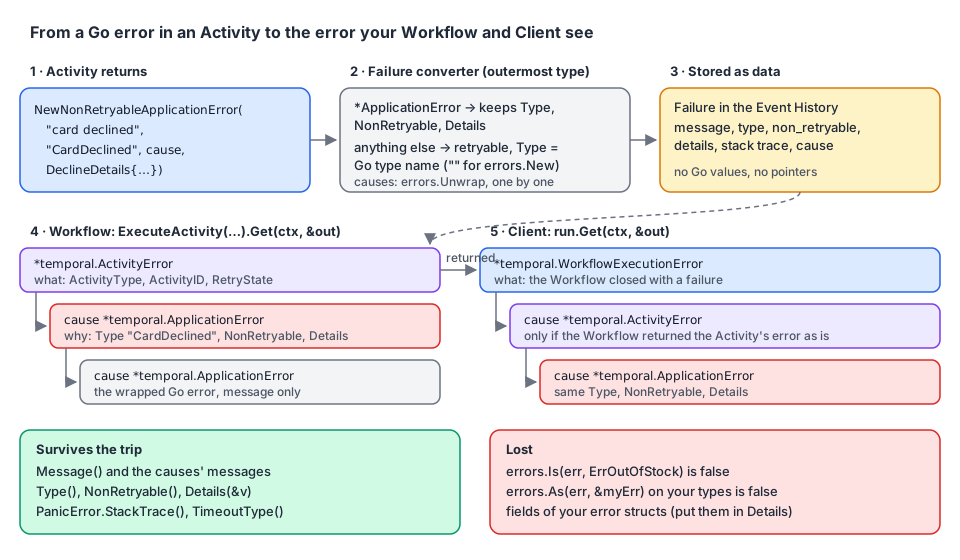
What the probes printed for a non-retryable decline returned by an Activity and passed through unchanged by the Workflow (SDK v1.50.0, Server 1.32.0):
Workflow sees:  activity error (type: ChargeCard, scheduledEventID: 11, …): card declined (type: CardDeclined, retryable: false)
Client sees:    workflow execution error (type: PlaceOrderWorkflow, …): activity error (…): card declined (type: CardDeclined, retryable: false)
errors.As walks the chain, so you can reach the ApplicationError from either side without unwrapping by hand.
Order your checks. A
TimeoutErrorwraps the last attempt's error. An Activity that failed with "inventory service unavailable" until Schedule-To-Close cut its retries producedActivityError (RetryState: Timeout)→TimeoutError (ScheduleToClose)→ApplicationError.errors.As(err, &appErr)is true there too. Check timeouts before application errors.And don't rely on the
TimeoutErrorbeing there. When a Workflow's 3 s Execution Timeout capped an Activity that kept failing with "gateway 503", the chain was justActivityError (RetryState: Timeout)→ApplicationError, with noTimeoutError. The reliable signal that time ran out isRetryState() == RETRY_STATE_TIMEOUTon the wrapper.
A helper that does it in the right order:
// file: failures/classify.go
package failures

import (
	"errors"

	enumspb "go.temporal.io/api/enums/v1"
	"go.temporal.io/sdk/temporal"
)

type Kind string

const (
	KindNone        Kind = ""
	KindCanceled    Kind = "canceled"
	KindTerminated  Kind = "terminated"
	KindTimeout     Kind = "timeout"
	KindPanic       Kind = "panic"
	KindApplication Kind = "application"
	KindOther       Kind = "other"
)

// Classification is a flat view of a Temporal error chain.
type Classification struct {
	Kind         Kind
	AppType      string // ApplicationError.Type(), when Kind is KindApplication
	NonRetryable bool
	TimeoutType  enumspb.TimeoutType
	RetryState   enumspb.RetryState // why retries stopped, for Activity and child failures
}

// Classify works on errors from Workflow code (ActivityError, ChildWorkflowExecutionError)
// and from Client code (WorkflowExecutionError). The order of the checks matters.
func Classify(err error) Classification {
	if err == nil {
		return Classification{Kind: KindNone}
	}
	var c Classification

	var actErr *temporal.ActivityError
	var childErr *temporal.ChildWorkflowExecutionError
	switch {
	case errors.As(err, &actErr):
		c.RetryState = actErr.RetryState()
	case errors.As(err, &childErr):
		c.RetryState = childErr.RetryState()
	}

	var timeoutErr *temporal.TimeoutError
	var appErr *temporal.ApplicationError
	switch {
	case temporal.IsCanceledError(err):
		c.Kind = KindCanceled
	case temporal.IsTerminatedError(err):
		c.Kind = KindTerminated
	case errors.As(err, &timeoutErr): // before ApplicationError: it wraps the last attempt's error
		c.Kind = KindTimeout
		c.TimeoutType = timeoutErr.TimeoutType()
	case c.RetryState == enumspb.RETRY_STATE_TIMEOUT: // retries cut by a timeout, no TimeoutError in the chain
		c.Kind = KindTimeout
	case temporal.IsPanicError(err):
		c.Kind = KindPanic
	case errors.As(err, &appErr):
		c.Kind = KindApplication
		c.AppType = appErr.Type()
		c.NonRetryable = appErr.NonRetryable()
	default:
		c.Kind = KindOther
	}
	return c
}
4. How a plain Go error crosses the boundary
When an Activity (or Workflow) returns an error, the SDK's failure converter turns it into a Temporal failure. In SDK v1.50.0 (internal/failure_converter.go) it does this:
- It looks at the outermost error only, with a type switch:
*ApplicationError,*CanceledError,*PanicError,*TimeoutError, … each map to their own failure kind. - Any other type (your errors,
errors.New,fmt.Errorf) becomes a retryable Application Failure whoseTypeis the Go type name of the outermost error. - It then converts
errors.Unwrap(err)the same way, and stores it as the cause.
The type name comes from getErrType: the name of the type behind the pointer, except the standard library's errorString, which gives an empty name. What we observed:
| The Activity returns | ApplicationError.Type() in the Workflow | Retryable |
|---|---|---|
errors.New("boom") | "" (empty) | yes |
ErrOutOfStock (a sentinel made with errors.New) | "" | yes |
fmt.Errorf("reserve: %w", ErrOutOfStock) | "wrapError" | yes |
&CardDeclinedError{Code: "51"} (your own type) | "CardDeclinedError" | yes |
temporal.NewApplicationError("…", "RateLimited") | "RateLimited" | yes |
temporal.NewNonRetryableApplicationError("…", "InsufficientFunds", nil, details) | "InsufficientFunds" | no |
panic("nil map write") | (a *temporal.PanicError, not an ApplicationError) | yes |
Two things follow:
- A custom error type gives you a usable
Typefor free, so you can list it in a Retry Policy'sNonRetryableErrorTypes(chapter 07):"CardDeclinedError"worked in the probe. Renaming the Go type silently changes that string, so prefer explicit Types (chapter 04). - Because only the outermost type is checked, wrapping a non-retryable error in
fmt.Errorfmakes it retryable. That is chapter 06.
5. What survives the trip, and what doesn't
Failures are stored as data in the Event History, not as Go values. In the Workflow, after an Activity returned these errors:
| Check in the Workflow | Result |
|---|---|
errors.Is(err, ErrOutOfStock) (same sentinel variable) | false |
errors.As(err, &cardDeclined) with *CardDeclinedError | false |
appErr.Type() == "CardDeclinedError" | true |
appErr.Message(), the cause's message | kept |
appErr.Details(&d) for a map[string]int{"missingCents": 1250} | kept, decoded into d |
appErr.NonRetryable() | kept (outermost error only) |
| Stack trace of a panic | kept (PanicError.StackTrace()) |
So across a Temporal boundary:
- Match on
Type(), never on Go identity. - Put data in
Details, not in struct fields.CardDeclinedError.Codeis lost; a detail value isn't.
// file: payments/errors.go
package payments

// Application error Types shared by Activities and Workflows. These strings are a contract:
// they are stored in Event Histories and may be matched by other services.
const (
	ErrTypeCardDeclined      = "CardDeclined"
	ErrTypeInsufficientFunds = "InsufficientFunds"
)

// DeclineDetails travels with a CardDeclined error.
type DeclineDetails struct {
	DeclineCode string // gateway code, e.g. "51"
	Retryable   bool   // e.g. "51" (insufficient funds): the customer may try another card
}// file: payments/activities.go
package payments
import (
"context"
"errors"
"go.temporal.io/sdk/temporal"
)
// GatewayDecline is what our gateway client returns for a decline.
type GatewayDecline struct{ Code string }
func (e *GatewayDecline) Error() string { return "declined with code " + e.Code }
type Gateway interface {
Charge(ctx context.Context, idempotencyKey string, amountCents int64) (string, error)
}
type Activities struct{ Gateway Gateway }
func (a *Activities) ChargeOrder(ctx context.Context, orderID string, amountCents int64) (string, error) {
paymentID, err := a.Gateway.Charge(ctx, "charge-"+orderID, amountCents)
var decline *GatewayDecline
if errors.As(err, &decline) {
// Translate the Go type into a Type string + Details: they survive the trip.
return "", temporal.NewNonRetryableApplicationError(
"card declined", ErrTypeCardDeclined, err,
DeclineDetails{DeclineCode: decline.Code, Retryable: decline.Code == "51"},
)
}
return paymentID, err // anything else: retryable
}// file: payments/workflow.go
package payments
import (
"errors"
"time"
"go.temporal.io/sdk/temporal"
"go.temporal.io/sdk/workflow"
)
type PaymentOutcome struct {
PaymentID string
Declined bool
DeclineCode string
AskNewCard bool
}
func CollectPaymentWorkflow(ctx workflow.Context, orderID string, amountCents int64) (PaymentOutcome, error) {
ctx = workflow.WithActivityOptions(ctx, workflow.ActivityOptions{StartToCloseTimeout: 30 * time.Second})
var a *Activities
var paymentID string
err := workflow.ExecuteActivity(ctx, a.ChargeOrder, orderID, amountCents).Get(ctx, &paymentID)
if err == nil {
return PaymentOutcome{PaymentID: paymentID}, nil
}
var appErr *temporal.ApplicationError
if errors.As(err, &appErr) && appErr.Type() == ErrTypeCardDeclined && appErr.NonRetryable() {
var d DeclineDetails
if err := appErr.Details(&d); err != nil {
workflow.GetLogger(ctx).Warn("Unreadable decline details", "error", err)
}
return PaymentOutcome{Declined: true, DeclineCode: d.DeclineCode, AskNewCard: d.Retryable}, nil
}
return PaymentOutcome{}, err // unknown failure: let the Workflow fail
}On the Client side the same tools apply, with WorkflowExecutionError as the outer wrapper:
// file: api/status.go
package api

import (
	"context"
	"net/http"

	"go.temporal.io/sdk/client"

	"github.com/acme/shop/failures"
)

// OrderStatusCode maps a finished order Workflow to an HTTP status for the checkout API.
func OrderStatusCode(ctx context.Context, c client.Client, workflowID string) int {
	err := c.GetWorkflow(ctx, workflowID, "").Get(ctx, nil)
	switch f := failures.Classify(err); f.Kind {
	case failures.KindNone:
		return http.StatusOK
	case failures.KindApplication:
		if f.AppType == "CardDeclined" {
			return http.StatusPaymentRequired
		}
		return http.StatusUnprocessableEntity
	case failures.KindCanceled, failures.KindTerminated:
		return http.StatusGone
	default:
		return http.StatusInternalServerError
	}
}
When a Workflow times out (WorkflowExecutionTimeout of 2 s on a sleeping Workflow), the Client got a TimeoutError whose TimeoutType() was StartToClose, not a Workflow-specific value. Don't expect to tell a Run Timeout from an Execution Timeout from the error.
6. Key takeaways
- Go has no base failure class: use
errors.Aswith*temporal.ActivityError,*temporal.ApplicationError,*temporal.TimeoutError, … or thetemporal.Is…helpers. - Wrappers (
ActivityError,ChildWorkflowExecutionError,WorkflowExecutionError) say what failed; their cause says why. - A
TimeoutErrorwraps the last attempt's error: check timeouts before application errors, and treatRetryState() == RETRY_STATE_TIMEOUTas a timeout even when noTimeoutErroris present. - A plain Go error becomes a retryable
ApplicationErrorwhoseTypeis its Go type name (""forerrors.New,"wrapError"forfmt.Errorf). - Go identity doesn't survive:
errors.Is/errors.Ason your own errors is false in the Workflow. Match onType()and carry data inDetails.