09 · Backward recovery and an error strategy
Level: production · Read time: ~20 min Sources: Encyclopedia — Application failures · Encyclopedia — Retry Policies · Encyclopedia — Failures and error handling ·
temporal.DefaultFailureConverterOptions
1. The problem
Checkout reserves stock, charges the card, then books the shipment. The carrier rejects the address. Retrying won't help, and failing the Workflow isn't enough either: the customer has been charged and the stock is held for an order that will never ship.
Temporal recovers from platform failures by going forward (retry until it works). An application failure often needs the opposite: go backward and undo what was already done. This chapter puts the previous ones together into a strategy: classify each failure, pick the tool, undo with a Saga, find failures in the history, and keep sensitive error text out of it.
2. Classify, then choose the tool
| Failure kind | Example | Fixes itself? | Tool | Chapter |
|---|---|---|---|---|
| Transient | Gateway 503 during a deploy, a dropped connection | Yes, in seconds | Default Retry Policy | 07 |
| Intermittent / throttled | 429 Retry-After: 30 | Yes, after a known delay | NextRetryDelay on the error | 04 |
| Slow or dead Worker | OOM kill, hung call | Yes, on another Worker | Start-To-Close + Heartbeat Timeout | 08 |
| Permanent, business | Card declined, address undeliverable | No | Non-retryable error, then compensate | 04, this chapter |
| Permanent, bug | Nil map write in Workflow code, non-determinism | No, until redeployed | Let the Workflow Task fail and retry; fix and deploy | 03 |
| Needs a human | Fraud review, manual refund | No | Wait for a Signal or Update, with a Timer as a deadline | 08 |
Two questions decide most cases: will a retry with the same input ever succeed? If not, make it non-retryable. Has anything already happened that must be undone? If so, compensate.
3. Undoing work: the Saga pattern
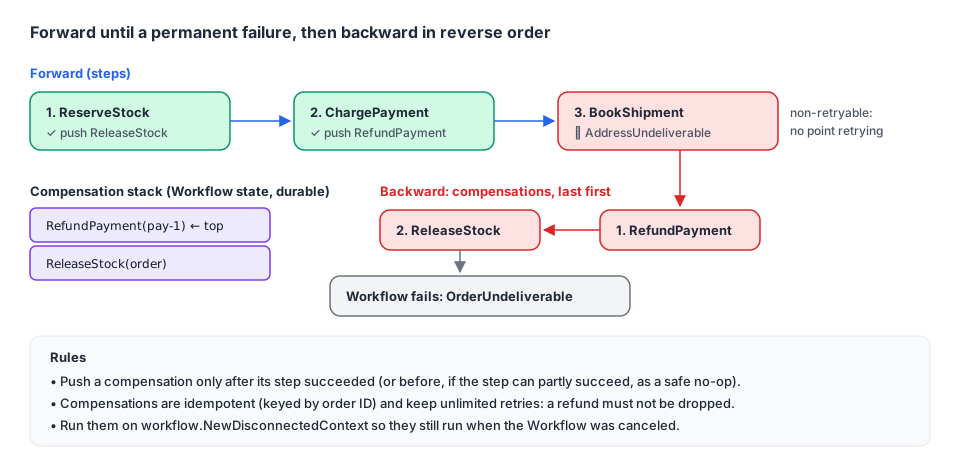
A Saga pairs each step that changes the outside world with a compensation that undoes it. As each step succeeds, its compensation is pushed on a stack. When a later step fails for good, the compensations run in reverse order.
Temporal makes Sagas simple: the list of compensations lives in Workflow state, which is durable. A Worker crash in the middle of compensating doesn't lose track of what's left to undo.
// file: checkout/saga.go
package checkout

import (
	"errors"

	"go.temporal.io/sdk/workflow"
)

// Saga collects compensations and runs them in reverse order.
type Saga struct {
	compensations []func(ctx workflow.Context) error
}

// AddCompensation registers the undo action of a step that has just succeeded.
func (s *Saga) AddCompensation(fn func(ctx workflow.Context) error) {
	s.compensations = append(s.compensations, fn)
}

// Compensate runs every compensation, last one first, on a disconnected context so
// they still run when the Workflow itself was canceled. It runs all of them even if
// one fails, and returns the joined errors.
func (s *Saga) Compensate(ctx workflow.Context) error {
	disconnected, cancel := workflow.NewDisconnectedContext(ctx)
	defer cancel()

	var errs []error
	for i := len(s.compensations) - 1; i >= 0; i-- {
		if err := s.compensations[i](disconnected); err != nil {
			workflow.GetLogger(ctx).Error("compensation failed", "step", i, "error", err)
			errs = append(errs, err)
		}
	}
	return errors.Join(errs...)
}// file: checkout/activities.go
package checkout
import (
"context"
"errors"
"go.temporal.io/sdk/temporal"
)
type Order struct {
OrderID string
CustomerID string
SKU string
Quantity int
AmountCents int64
Address string
}
// The external systems. Every call takes the order ID as an idempotency key.
type InventoryService interface {
Reserve(ctx context.Context, orderID, sku string, qty int) error
Release(ctx context.Context, orderID string) error
}
type PaymentService interface {
Charge(ctx context.Context, orderID string, amountCents int64) (paymentID string, err error)
Refund(ctx context.Context, orderID, paymentID string) error
}
type ShippingService interface {
BookShipment(ctx context.Context, orderID, address string) (trackingID string, err error)
}
// ErrUndeliverable is returned by the carrier for an address it can't serve.
var ErrUndeliverable = errors.New("address undeliverable")
type Activities struct {
Inventory InventoryService
Payments PaymentService
Shipping ShippingService
}
func (a *Activities) ReserveStock(ctx context.Context, o Order) error {
return a.Inventory.Reserve(ctx, o.OrderID, o.SKU, o.Quantity)
}
// ReleaseStock must be idempotent: it can run twice if a Worker crashes after the
// release but before reporting success.
func (a *Activities) ReleaseStock(ctx context.Context, orderID string) error {
return a.Inventory.Release(ctx, orderID)
}
func (a *Activities) ChargePayment(ctx context.Context, o Order) (string, error) {
return a.Payments.Charge(ctx, o.OrderID, o.AmountCents)
}
func (a *Activities) RefundPayment(ctx context.Context, orderID, paymentID string) error {
return a.Payments.Refund(ctx, orderID, paymentID)
}
func (a *Activities) BookShipment(ctx context.Context, o Order) (string, error) {
trackingID, err := a.Shipping.BookShipment(ctx, o.OrderID, o.Address)
if errors.Is(err, ErrUndeliverable) {
// Permanent: convert to a typed, non-retryable error here, inside the Activity.
return "", temporal.NewNonRetryableApplicationError(err.Error(), "AddressUndeliverable", nil, o.Address)
}
return trackingID, err
}// file: checkout/workflow.go
package checkout
import (
"errors"
"time"
"go.temporal.io/sdk/temporal"
"go.temporal.io/sdk/workflow"
)
const TaskQueue = "checkout"
type Receipt struct {
PaymentID string
TrackingID string
}
func CheckoutWorkflow(ctx workflow.Context, o Order) (receipt Receipt, err error) {
ctx = workflow.WithActivityOptions(ctx, workflow.ActivityOptions{
StartToCloseTimeout: 30 * time.Second,
ScheduleToCloseTimeout: 10 * time.Minute,
})
var a *Activities
var saga Saga
// If any step fails, undo the completed ones before failing the Workflow.
defer func() {
if err == nil {
return
}
if compErr := saga.Compensate(ctx); compErr != nil {
err = errors.Join(err, compErr)
}
}()
if err = workflow.ExecuteActivity(ctx, a.ReserveStock, o).Get(ctx, nil); err != nil {
return Receipt{}, err
}
saga.AddCompensation(func(ctx workflow.Context) error {
return workflow.ExecuteActivity(ctx, a.ReleaseStock, o.OrderID).Get(ctx, nil)
})
if err = workflow.ExecuteActivity(ctx, a.ChargePayment, o).Get(ctx, &receipt.PaymentID); err != nil {
return Receipt{}, err
}
paymentID := receipt.PaymentID
saga.AddCompensation(func(ctx workflow.Context) error {
return workflow.ExecuteActivity(ctx, a.RefundPayment, o.OrderID, paymentID).Get(ctx, nil)
})
if err = workflow.ExecuteActivity(ctx, a.BookShipment, o).Get(ctx, &receipt.TrackingID); err != nil {
var appErr *temporal.ApplicationError
if errors.As(err, &appErr) && appErr.Type() == "AddressUndeliverable" {
return Receipt{}, temporal.NewNonRetryableApplicationError(
"order cancelled: carrier cannot deliver", "OrderUndeliverable", err)
}
return Receipt{}, err
}
return receipt, nil
}Things to get right:
- Register a compensation only after its step succeeded. A failed charge has nothing to refund. If a step can partially succeed (a charge that may have gone through before a timeout), register the compensation before the step and make it a no-op when there is nothing to undo.
- Compensations must be idempotent (keyed by order ID). An Activity runs at least once; a refund can be retried after it actually happened.
- Run them on a disconnected context. If the Workflow is canceled,
ctxis canceled too and every Activity started on it fails at once.workflow.NewDisconnectedContextlets cleanup run anyway. - Use
deferfor the call, not forrecover-style tricks. The deferred function here runs after a normalreturn, so it may call Temporal APIs. Calling them while a panic is unwinding fails the Workflow Task (chapter 05). - Give compensations generous retries. They usually keep the default (unlimited) Retry Policy: a refund that fails must be retried, not dropped.
Checked on a dev server with fakes where the carrier rejects the address: the Activities ran in the order ReserveStock, ChargePayment, BookShipment (1 attempt, non-retryable), then RefundPayment, ReleaseStock. The Workflow closed as Failed with type OrderUndeliverable, caused by the AddressUndeliverable Activity failure.
4. Where failures are recorded
In the Event History
| What happened | Event(s) |
|---|---|
| Activity failed for good (no retries left, or non-retryable) | ActivityTaskStarted + ActivityTaskFailed with the failure |
| Activity timed out for good | ActivityTaskStarted + ActivityTaskTimedOut |
| Activity is still retrying | Only ActivityTaskScheduled. Intermediate attempts aren't in the history |
| Workflow failed | WorkflowExecutionFailed, with the failure chain (e.g. the Activity failure as its cause) |
ActivityTaskStarted is written only when the Activity closes, because it carries the final attempt number. So while an Activity is retrying, the history doesn't tell you why. Ask the Service with DescribeWorkflowExecution:
// file: ops/pending.go
package ops

import (
	"context"
	"fmt"
	"io"

	"go.temporal.io/sdk/client"
)

// PrintPendingActivities shows, for each running Activity of a Workflow, its current
// attempt and the error of the previous attempt. It's what the Web UI's
// "Pending Activities" panel shows.
func PrintPendingActivities(ctx context.Context, c client.Client, w io.Writer, workflowID string) error {
	desc, err := c.DescribeWorkflowExecution(ctx, workflowID, "")
	if err != nil {
		return fmt.Errorf("describe %s: %w", workflowID, err)
	}
	for _, pa := range desc.PendingActivities {
		fmt.Fprintf(w, "%s (id %s): state=%s attempt=%d/%d\n",
			pa.GetActivityType().GetName(), pa.GetActivityId(), pa.GetState(),
			pa.GetAttempt(), pa.GetMaximumAttempts())
		if f := pa.GetLastFailure(); f != nil {
			fmt.Fprintf(w, "  last failure: %s\n", f.GetMessage())
		}
		if t := pa.GetLastHeartbeatTime(); t != nil {
			fmt.Fprintf(w, "  last heartbeat: %s\n", t.AsTime())
		}
	}
	return nil
}
MaximumAttempts prints as 0 when attempts are unlimited.
5. Keeping sensitive text out of failures
Error messages and stack traces are stored in plain text in the Event History, even if your payloads are encrypted. A message such as card 4111… declined for jane@example.com is readable by anyone with access to the Web UI.
The Failure Converter can move the message and stack trace into an encoded payload, which your payload codec then encrypts:
// file: internal/temporalcodec/codec.go
package temporalcodec

import (
	"crypto/aes"
	"crypto/cipher"
	"crypto/rand"
	"fmt"

	commonpb "go.temporal.io/api/common/v1"
	"go.temporal.io/sdk/converter"
)

const (
	metadataEncoding = "encoding"
	encodingAESGCM   = "binary/encrypted-aes-gcm"
)

// AESGCMCodec encrypts every payload with AES-GCM. The key comes from your KMS.
type AESGCMCodec struct {
	aead cipher.AEAD
}

func NewAESGCMCodec(key []byte) (*AESGCMCodec, error) {
	block, err := aes.NewCipher(key)
	if err != nil {
		return nil, err
	}
	aead, err := cipher.NewGCM(block)
	if err != nil {
		return nil, err
	}
	return &AESGCMCodec{aead: aead}, nil
}

func (c *AESGCMCodec) Encode(payloads []*commonpb.Payload) ([]*commonpb.Payload, error) {
	out := make([]*commonpb.Payload, len(payloads))
	for i, p := range payloads {
		plain, err := p.Marshal()
		if err != nil {
			return nil, err
		}
		nonce := make([]byte, c.aead.NonceSize())
		if _, err := rand.Read(nonce); err != nil {
			return nil, err
		}
		out[i] = &commonpb.Payload{
			Metadata: map[string][]byte{metadataEncoding: []byte(encodingAESGCM)},
			Data:     c.aead.Seal(nonce, nonce, plain, nil),
		}
	}
	return out, nil
}

func (c *AESGCMCodec) Decode(payloads []*commonpb.Payload) ([]*commonpb.Payload, error) {
	out := make([]*commonpb.Payload, len(payloads))
	for i, p := range payloads {
		if string(p.GetMetadata()[metadataEncoding]) != encodingAESGCM {
			out[i] = p
			continue
		}
		n := c.aead.NonceSize()
		if len(p.Data) < n {
			return nil, fmt.Errorf("encrypted payload too short")
		}
		plain, err := c.aead.Open(nil, p.Data[:n], p.Data[n:], nil)
		if err != nil {
			return nil, err
		}
		decoded := &commonpb.Payload{}
		if err := decoded.Unmarshal(plain); err != nil {
			return nil, err
		}
		out[i] = decoded
	}
	return out, nil
}

var _ converter.PayloadCodec = (*AESGCMCodec)(nil)// file: internal/temporalcodec/options.go
package temporalcodec
import (
"go.temporal.io/sdk/client"
"go.temporal.io/sdk/converter"
"go.temporal.io/sdk/temporal"
)
// SecureClientOptions encrypts payloads AND failure messages/stack traces.
// Use the same options for every Client and Worker of the application.
func SecureClientOptions(base client.Options, key []byte) (client.Options, error) {
codec, err := NewAESGCMCodec(key)
if err != nil {
return client.Options{}, err
}
dc := converter.NewCodecDataConverter(converter.GetDefaultDataConverter(), codec)
base.DataConverter = dc
base.FailureConverter = temporal.NewDefaultFailureConverter(temporal.DefaultFailureConverterOptions{
DataConverter: dc, // encodes the moved attributes with the codec
EncodeCommonAttributes: true, // moves message + stack trace into an encoded payload
})
return base, nil
}What changes, checked on a dev server with the checkout Workflow (the ActivityTaskFailed Event of BookShipment):
| Setup | message in the history / Web UI | encodedAttributes |
|---|---|---|
| Defaults | address undeliverable | none |
EncodeCommonAttributes: true, default data converter | Encoded failure | {"message":"address undeliverable","stack_trace":""}, readable |
EncodeCommonAttributes: true + the AES-GCM codec | Encoded failure | encrypted bytes |
In all three cases the Go code (run.Get, errors.As) saw the real message: the SDK decodes it. The same applies to stack traces, which the Go SDK records for panics (a returned ApplicationError has none).
Both settings are needed: EncodeCommonAttributes alone only moves the text into a JSON payload. Error types (AddressUndeliverable) stay in clear text, so don't put customer data in them. Run a Codec Server if operators need to read failures in the Web UI.
6. Expected failures: benign errors
Some Activities fail on purpose, over and over: WaitForRestock polls a supplier and fails until the item is back. Those failures pollute logs and failure metrics. Mark them benign:
// file: inventory/restock.go
package inventory

import (
	"context"
	"time"

	"go.temporal.io/sdk/temporal"
)

type SupplierAPI interface {
	InStock(ctx context.Context, sku string) (bool, error)
}

type RestockActivities struct {
	Supplier SupplierAPI
}

// WaitForRestock fails with a benign error until the supplier has stock again.
// Use it with a long Retry Policy (e.g. InitialInterval 1m, BackoffCoefficient 1).
func (a *RestockActivities) WaitForRestock(ctx context.Context, sku string) error {
	ok, err := a.Supplier.InStock(ctx, sku)
	if err != nil {
		return err // a real failure: logged and counted
	}
	if !ok {
		return temporal.NewApplicationErrorWithOptions("not in stock yet", "NotYetInStock",
			temporal.ApplicationErrorOptions{
				Category:       temporal.ApplicationErrorCategoryBenign,
				NextRetryDelay: 15 * time.Minute,
			})
	}
	return nil
}
In Go SDK v1.50.0, a benign error is logged at Debug instead of Error ("Activity error.") and isn't counted in the Activity or Workflow failure metrics. Retries are unchanged. Like non-retryable, the category is read from the outermost error only, so return it as is. More in the Activities guide, chapter 05.
7. A checklist
Activities
- [ ] Every Activity has a Start-To-Close; long ones also Heartbeat with a Heartbeat Timeout.
- [ ] Retries are bounded by Schedule-To-Close, not by a guessed
MaximumAttempts. - [ ] Permanent failures are returned as typed, non-retryable
ApplicationErrors, created where the error is understood (inside the Activity). - [ ] Context is added with
NewApplicationErrorWithCauseorNewNonRetryableApplicationError(…, cause), neverfmt.Errorf("%w")around anApplicationError(chapter 06). - [ ] Every side effect is idempotent (keyed by a business ID).
- [ ] Expected, repeated failures are benign.
Workflows
- [ ] Errors are matched with
errors.As+Type(), noterrors.Ison sentinel values (chapter 05). - [ ] Steps with side effects register compensations, run in reverse on a disconnected context.
- [ ] A Workflow fails only through a deliberate
ApplicationError; bugs are left to fail the Workflow Task, so a fix and redeploy resumes them (chapter 03). - [ ] Deadlines are Timers, not Workflow Execution timeouts.
Operations
- [ ] Alerts on Workflow Task failures and Schedule-To-Start latency.
- [ ] Error messages are encrypted (
EncodeCommonAttributes+ codec) if they can contain personal data. - [ ] People know how to read Pending Activities to see what is retrying and why.
8. Key takeaways
- Platform failures recover forward (retries). Business failures often need backward recovery: undo what was done.
- Classify each failure: transient → retry; throttled →
NextRetryDelay; dead Worker → timeouts; permanent → non-retryable + compensate; bug → let the Workflow Task fail and redeploy. - A Saga registers a compensation after each successful step and runs them in reverse, on a disconnected context. Compensations must be idempotent.
- While an Activity retries, the history shows only
ActivityTaskScheduled; useDescribeWorkflowExecution(Pending Activities) to see the attempt and last failure. - Failure messages are plain text by default.
EncodeCommonAttributes: trueplus an encrypting codec hides them. - Mark expected failures benign to keep logs and failure metrics clean.