11 · Versioning: changing Workflow code while Executions are running
Level: core concept for production · Read time: ~25 min Sources: Encyclopedia — Workflow Definition: Versioning · Encyclopedia — Patching · Go SDK — Versioning · Worker Versioning
1. The problem
Workflows live long: an order waits days for a carrier, a subscription runs for years. Your code changes every week. So sooner or later, a Workflow Execution started on old code is resumed by a Worker running new code.
Remember how a Worker resumes an Execution (03): it replays the Workflow function from the start and checks every Command it emits against the Event History. If the new code emits a different Command at the same position, for example ScheduleActivityTask(ReserveCarrierV2) where the history says ActivityTaskScheduled(ReserveCarrierLegacy), the Worker reports a non-determinism error and the Execution is stuck.
| Usually safe without versioning | Needs versioning |
|---|---|
| Changing Activity / Child Workflow arguments, options and timeouts | Adding, removing or reordering Activities, Child Workflows, Timers, Side Effects, external Signals/Cancels |
| Changing a Timer's duration (but not to or from 0) | Changing the type or ID of an Activity or Child Workflow |
| Adding a Signal handler for a Signal that was never sent to this Execution | Changing how the Workflow ends (complete / fail / Continue-As-New) |
Adding or removing calls that don't produce Commands (workflow.GetInfo, logging) | Changing the branch taken before any of the above |
✅ Only the orchestration logic is concerned. Code inside an Activity can change freely: it isn't replayed.
Temporal offers two strategies, and you can combine them:
| Strategy | Idea | When |
|---|---|---|
| Worker Versioning (recommended) | Each Worker build is a Deployment Version. Pinned Workflows keep running on the build that started them. Old and new code never meet. | Default for teams that can run old and new Workers side by side during a rollout. |
Patching (workflow.GetVersion) | One code base with branches: old Executions take the old branch, new ones the new branch. | When Executions must move to new code while running, or you run a single Worker fleet. |
2. Worker Versioning in one page
With Worker Versioning, you tag each Worker with a deployment name and a build ID. Temporal routes tasks by version:
- Pinned Workflows stay on the Deployment Version that started them until they finish (or until someone moves them manually). New code never replays old histories, so you don't need patches.
- Auto-upgrade Workflows move to the current version of the Task Queue when the next task is dispatched. They still need patching for incompatible changes.
The Go side is a few options. The rollout itself (setting the current version, ramping, draining old versions) is done with the CLI or the API; read the official Worker Versioning guide before turning it on.
// file: cmd/shipping-worker/main.go
package main

import (
	"log"
	"os"

	"github.com/acme/shop/shipping"
	"github.com/acme/shop/shipping/stage2"
	"go.temporal.io/sdk/client"
	"go.temporal.io/sdk/worker"
	"go.temporal.io/sdk/workflow"
)

func main() {
	c, err := client.Dial(client.Options{})
	if err != nil {
		log.Fatalln(err)
	}
	defer c.Close()

	w := worker.New(c, shipping.TaskQueue, worker.Options{
		DeploymentOptions: worker.DeploymentOptions{
			UseVersioning: true,
			Version: worker.WorkerDeploymentVersion{
				DeploymentName: "shipping-service",
				BuildID:        os.Getenv("BUILD_ID"), // e.g. the git SHA injected by CI
			},
			// Executions started on this build stay on this build.
			DefaultVersioningBehavior: workflow.VersioningBehaviorPinned,
		},
	})

	// You can also choose the behavior per Workflow Type.
	w.RegisterWorkflowWithOptions(stage2.ShipOrderWorkflow, workflow.RegisterOptions{
		Name:               "ShipOrderWorkflow",
		VersioningBehavior: workflow.VersioningBehaviorPinned,
	})
	w.RegisterActivity(&shipping.CarrierActivities{Carriers: shipping.FakeCarrierAPI{}})

	log.Fatalln(w.Run(worker.InterruptCh()))
}
⚠️ The pre-2025 experimental Worker Versioning (Build ID compatibility sets) was scheduled for removal from Temporal Server in March 2026. Don't start new work on it.
The rest of the chapter is about patching, because you need it with auto-upgrade Workflows, without Worker Versioning, and to understand what goes wrong in the first place.
3. The running example: changing the carrier integration
The shipping team ships orders. The shared Activities live in one package:
// file: shipping/activities.go
package shipping

import (
	"context"
	"fmt"
)

const TaskQueue = "shipping"

type ShipOrderInput struct {
	OrderID   string
	Warehouse string
	WeightKg  float64
}

type Reservation struct {
	Carrier    string
	TrackingID string
}

// CarrierAPI wraps the carriers' HTTP APIs.
type CarrierAPI interface {
	Reserve(ctx context.Context, api string, in ShipOrderInput) (Reservation, error)
	PrintLabel(ctx context.Context, r Reservation) (string, error)
}

type CarrierActivities struct{ Carriers CarrierAPI }

// ReserveCarrierLegacy: the original SOAP integration.
func (a *CarrierActivities) ReserveCarrierLegacy(ctx context.Context, in ShipOrderInput) (Reservation, error) {
	return a.Carriers.Reserve(ctx, "soap-v1", in)
}

// ReserveCarrierV2: the new REST API of the same carrier.
func (a *CarrierActivities) ReserveCarrierV2(ctx context.Context, in ShipOrderInput) (Reservation, error) {
	return a.Carriers.Reserve(ctx, "rest-v2", in)
}

// ReserveCarrierBestRate: compares several carriers and books the cheapest.
func (a *CarrierActivities) ReserveCarrierBestRate(ctx context.Context, in ShipOrderInput) (Reservation, error) {
	return a.Carriers.Reserve(ctx, "rate-shopping", in)
}

func (a *CarrierActivities) PrintLabel(ctx context.Context, r Reservation) (string, error) {
	return a.Carriers.PrintLabel(ctx, r)
}

// FakeCarrierAPI lets the samples run without a real carrier.
type FakeCarrierAPI struct{}

func (FakeCarrierAPI) Reserve(ctx context.Context, api string, in ShipOrderInput) (Reservation, error) {
	return Reservation{Carrier: api, TrackingID: fmt.Sprintf("TRK-%s", in.OrderID)}, nil
}

func (FakeCarrierAPI) PrintLabel(ctx context.Context, r Reservation) (string, error) {
	return "https://labels.example.com/" + r.TrackingID + ".pdf", nil
}
Each stage of the Workflow below is in its own package (shipping/stage0 … shipping/stage4) so every version compiles side by side. In real life it is the same file edited over several releases.
Stage 0: the original code
// file: shipping/stage0/workflow.go
package stage0

import (
	"time"

	"github.com/acme/shop/shipping"
	"go.temporal.io/sdk/workflow"
)

func ShipOrderWorkflow(ctx workflow.Context, in shipping.ShipOrderInput) (string, error) {
	ctx = workflow.WithActivityOptions(ctx, workflow.ActivityOptions{StartToCloseTimeout: time.Minute})
	var a *shipping.CarrierActivities

	var res shipping.Reservation
	if err := workflow.ExecuteActivity(ctx, a.ReserveCarrierLegacy, in).Get(ctx, &res); err != nil {
		return "", err
	}
	var labelURL string
	err := workflow.ExecuteActivity(ctx, a.PrintLabel, res).Get(ctx, &labelURL)
	return labelURL, err
}
Now the carrier retires its SOAP API. If you simply replace ReserveCarrierLegacy with ReserveCarrierV2 and deploy, every Execution that already scheduled ReserveCarrierLegacy fails on replay with a non-determinism error. The Go SDK detects this at runtime (section 7).
4. Patching with workflow.GetVersion
v := workflow.GetVersion(ctx, changeID, minSupported, maxSupported)changeID: a name for this change, unique in the Workflow ("carrier-api").minSupported/maxSupported: the range of versions this code can still run.workflow.DefaultVersion(= -1) means "the code from beforeGetVersionexisted".
How it behaves:
| Situation | GetVersion returns | Side effect |
|---|---|---|
| First execution of this call (not replaying) | maxSupported (unless the Worker sets a PreferredVersionProvider) | Records a marker in the Event History, and adds the value to the TemporalChangeVersion Search Attribute |
Replay, and the history has a marker for this changeID | the recorded version, even if maxSupported changed since | none |
Any later call with the same changeID in the same Execution | the same version as the first call | none |
Replay of a history recorded before the GetVersion call existed (no marker) | workflow.DefaultVersion | none |
The recorded version is outside [minSupported, maxSupported] | — | the Workflow Task fails, so a too-old Execution stops here instead of running the wrong code |
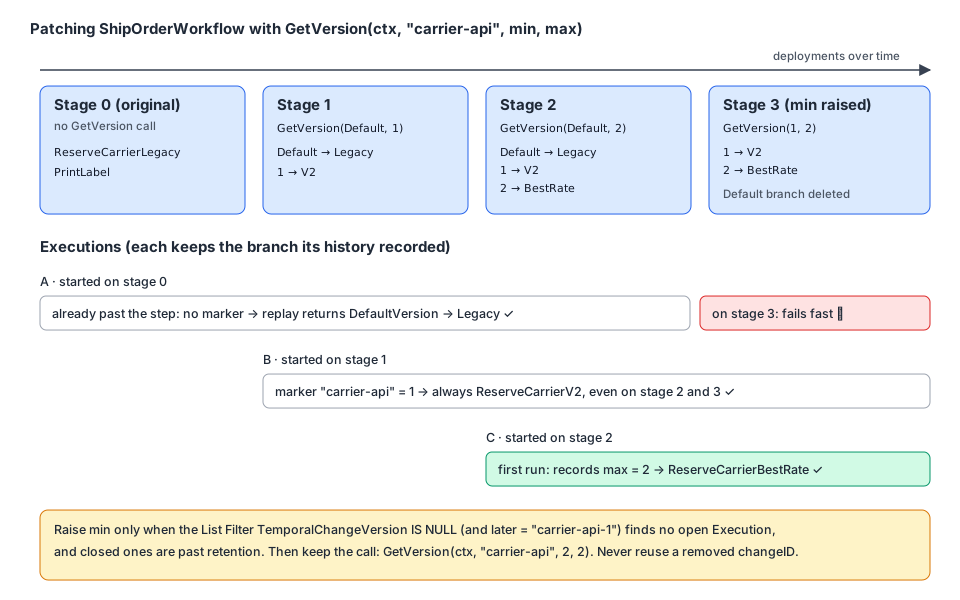
Stage 1: introduce the change
// file: shipping/stage1/workflow.go
package stage1

import (
	"time"

	"github.com/acme/shop/shipping"
	"go.temporal.io/sdk/workflow"
)

func ShipOrderWorkflow(ctx workflow.Context, in shipping.ShipOrderInput) (string, error) {
	ctx = workflow.WithActivityOptions(ctx, workflow.ActivityOptions{StartToCloseTimeout: time.Minute})
	var a *shipping.CarrierActivities

	var res shipping.Reservation
	var err error
	v := workflow.GetVersion(ctx, "carrier-api", workflow.DefaultVersion, 1)
	if v == workflow.DefaultVersion {
		// Executions that already passed this point on stage-0 code.
		err = workflow.ExecuteActivity(ctx, a.ReserveCarrierLegacy, in).Get(ctx, &res)
	} else {
		// New Executions.
		err = workflow.ExecuteActivity(ctx, a.ReserveCarrierV2, in).Get(ctx, &res)
	}
	if err != nil {
		return "", err
	}

	var labelURL string
	err = workflow.ExecuteActivity(ctx, a.PrintLabel, res).Get(ctx, &labelURL)
	return labelURL, err
}
Executions that were waiting before the reservation (say, on a Timer) also replay without a marker, but they haven't scheduled anything yet at that position. When they reach the call for real, GetVersion isn't replaying any more, so it records version 1 and they take the new branch.
Stage 2: a second change on the same spot
Business wants rate shopping across carriers. Same changeID, raise maxSupported to 2, add a branch:
// file: shipping/stage2/workflow.go
package stage2

import (
	"time"

	"github.com/acme/shop/shipping"
	"go.temporal.io/sdk/workflow"
)

func ShipOrderWorkflow(ctx workflow.Context, in shipping.ShipOrderInput) (string, error) {
	ctx = workflow.WithActivityOptions(ctx, workflow.ActivityOptions{StartToCloseTimeout: time.Minute})
	var a *shipping.CarrierActivities

	var res shipping.Reservation
	var err error
	v := workflow.GetVersion(ctx, "carrier-api", workflow.DefaultVersion, 2)
	switch v {
	case workflow.DefaultVersion: // started on stage-0 code
		err = workflow.ExecuteActivity(ctx, a.ReserveCarrierLegacy, in).Get(ctx, &res)
	case 1: // started on stage-1 code
		err = workflow.ExecuteActivity(ctx, a.ReserveCarrierV2, in).Get(ctx, &res)
	default: // 2: new Executions
		err = workflow.ExecuteActivity(ctx, a.ReserveCarrierBestRate, in).Get(ctx, &res)
	}
	if err != nil {
		return "", err
	}

	var labelURL string
	err = workflow.ExecuteActivity(ctx, a.PrintLabel, res).Get(ctx, &labelURL)
	return labelURL, err
}
Stage 3: drop the oldest branch
Once no Execution that ran stage-0 code is left (all closed and past the retention period, so they can't be replayed or queried), raise minSupported to 1 and delete the DefaultVersion branch:
// file: shipping/stage3/workflow.go
package stage3

import (
	"time"

	"github.com/acme/shop/shipping"
	"go.temporal.io/sdk/workflow"
)

func ShipOrderWorkflow(ctx workflow.Context, in shipping.ShipOrderInput) (string, error) {
	ctx = workflow.WithActivityOptions(ctx, workflow.ActivityOptions{StartToCloseTimeout: time.Minute})
	var a *shipping.CarrierActivities

	var res shipping.Reservation
	var err error
	v := workflow.GetVersion(ctx, "carrier-api", 1, 2) // a stage-0 history now fails here, on purpose
	if v == 1 {
		err = workflow.ExecuteActivity(ctx, a.ReserveCarrierV2, in).Get(ctx, &res)
	} else {
		err = workflow.ExecuteActivity(ctx, a.ReserveCarrierBestRate, in).Get(ctx, &res)
	}
	if err != nil {
		return "", err
	}

	var labelURL string
	err = workflow.ExecuteActivity(ctx, a.PrintLabel, res).Get(ctx, &labelURL)
	return labelURL, err
}
Stage 4: one branch left, but keep the call
When version 1 Executions are gone too, only one branch remains. Keep the GetVersion call:
// file: shipping/stage4/workflow.go
package stage4

import (
	"time"

	"github.com/acme/shop/shipping"
	"go.temporal.io/sdk/workflow"
)

func ShipOrderWorkflow(ctx workflow.Context, in shipping.ShipOrderInput) (string, error) {
	ctx = workflow.WithActivityOptions(ctx, workflow.ActivityOptions{StartToCloseTimeout: time.Minute})
	var a *shipping.CarrierActivities

	// Kept on purpose:
	//  1. an Execution still on an older version fails here instead of running the wrong code;
	//  2. the next change to this spot only needs maxSupported 2 → 3 and a new branch.
	workflow.GetVersion(ctx, "carrier-api", 2, 2)

	var res shipping.Reservation
	if err := workflow.ExecuteActivity(ctx, a.ReserveCarrierBestRate, in).Get(ctx, &res); err != nil {
		return "", err
	}
	var labelURL string
	err := workflow.ExecuteActivity(ctx, a.PrintLabel, res).Get(ctx, &labelURL)
	return labelURL, err
}
Rules for the end of a change's life:
- You only need to keep the first
GetVersioncall for a givenchangeID. Later calls with the samechangeIDin the same Workflow can be removed. - You may remove that first call too, but only if all older Executions are past retention, and you never reuse that
changeID. A later change to the same spot uses a new ID ("carrier-api-fix2") starting again fromworkflow.DefaultVersion:
// file: shipping/stage5/workflow.go
package stage5

import (
	"time"

	"github.com/acme/shop/shipping"
	"go.temporal.io/sdk/workflow"
)

func ShipOrderWorkflow(ctx workflow.Context, in shipping.ShipOrderInput) (string, error) {
	ctx = workflow.WithActivityOptions(ctx, workflow.ActivityOptions{StartToCloseTimeout: time.Minute})
	var a *shipping.CarrierActivities

	var res shipping.Reservation
	var err error
	// The "carrier-api" call was removed, so this change needs a NEW change ID.
	if workflow.GetVersion(ctx, "carrier-api-fix2", workflow.DefaultVersion, 1) == workflow.DefaultVersion {
		err = workflow.ExecuteActivity(ctx, a.ReserveCarrierBestRate, in).Get(ctx, &res)
	} else {
		err = workflow.ExecuteActivity(ctx, a.ReserveCarrierV2, in).Get(ctx, &res) // e.g. back to a single carrier
	}
	if err != nil {
		return "", err
	}
	var labelURL string
	err = workflow.ExecuteActivity(ctx, a.PrintLabel, res).Get(ctx, &labelURL)
	return labelURL, err
}
5. When is a version safe to delete? Ask Visibility
Because GetVersion writes the TemporalChangeVersion Search Attribute, you can find open Executions per version with a List Filter (Web UI, temporal workflow list --query …, or ListWorkflow in Go). The value is <changeID>-<version>:
WorkflowType = "ShipOrderWorkflow"
    AND ExecutionStatus = "Running"
    AND TemporalChangeVersion = "carrier-api-1"
Executions started before the GetVersion call was added have no marker at all:
WorkflowType = "ShipOrderWorkflow"
    AND ExecutionStatus = "Running"
    AND TemporalChangeVersion IS NULL
When both queries return nothing (and retention has passed for closed ones you might replay), you can raise minSupported.
// file: cmd/version-audit/main.go
package main

import (
	"context"
	"log"

	"go.temporal.io/api/workflowservice/v1"
	"go.temporal.io/sdk/client"
)

// Counts running ShipOrderWorkflow Executions still pinned to an old carrier-api branch.
func main() {
	c, err := client.Dial(client.Options{})
	if err != nil {
		log.Fatalln(err)
	}
	defer c.Close()

	queries := map[string]string{
		"pre-GetVersion (stage 0)": `WorkflowType = "ShipOrderWorkflow" AND ExecutionStatus = "Running" AND TemporalChangeVersion IS NULL`,
		"carrier-api-1":            `WorkflowType = "ShipOrderWorkflow" AND ExecutionStatus = "Running" AND TemporalChangeVersion = "carrier-api-1"`,
	}
	for label, q := range queries {
		resp, err := c.CountWorkflow(context.Background(), &workflowservice.CountWorkflowExecutionsRequest{Query: q})
		if err != nil {
			log.Fatalln(err)
		}
		log.Printf("%-26s %d running", label, resp.GetCount())
	}
}
6. Patching semantics from the Encyclopedia (patched()), mapped to Go
The Patching page describes the patched() function of the Python, .NET and Ruby SDKs. Go has GetVersion instead, but the underlying idea is the same: a marker in the history decides the branch, and replay must find markers where the code expects them.
patched() behavior (Python/.NET/Ruby) | What to remember in Go |
|---|---|
Not replaying → writes a marker (first time) and returns true | Not replaying → GetVersion records maxSupported and returns it |
Replaying, marker found at this position → true | Replaying, marker found → returns the recorded version |
Replaying, no marker for this ID → false, and every later call with that ID also returns false, even after replay catches up | Same idea: replaying with no marker → DefaultVersion, and the SDK remembers the version per changeID for the Execution, so later calls with that ID return DefaultVersion too. Branch on the returned value, never on "am I replaying" |
| Marker exists later in the history than the call → non-determinism error | Don't move a GetVersion call to an earlier position than where its marker was recorded |
Recommendation: put the newest code first (if patched("v3") … elif patched("v2")) | Not needed in Go: one GetVersion per changeID returns a number, so a switch on it is explicit |
The practical consequence on both sides: an Execution that started on old code doesn't always run the newest code, even after replay. That is the point. It runs the branch that matches its history.
7. The other options, and the safety nets
Workflow cutover: a new Workflow Type
The blunt alternative to patching: copy the function under a new name and register both.
// file: shipping/cutover/workflows.go
package cutover

import (
	"time"

	"github.com/acme/shop/shipping"
	"go.temporal.io/sdk/workflow"
)

// ShipOrderWorkflow is the frozen original. Running Executions finish on it.
func ShipOrderWorkflow(ctx workflow.Context, in shipping.ShipOrderInput) (string, error) {
	return ship(ctx, in, func(a *shipping.CarrierActivities) any { return a.ReserveCarrierLegacy })
}

// ShipOrderWorkflowV2 is the new code. Every starter must switch to this type.
func ShipOrderWorkflowV2(ctx workflow.Context, in shipping.ShipOrderInput) (string, error) {
	return ship(ctx, in, func(a *shipping.CarrierActivities) any { return a.ReserveCarrierBestRate })
}

func ship(ctx workflow.Context, in shipping.ShipOrderInput, reserve func(*shipping.CarrierActivities) any) (string, error) {
	ctx = workflow.WithActivityOptions(ctx, workflow.ActivityOptions{StartToCloseTimeout: time.Minute})
	var a *shipping.CarrierActivities
	var res shipping.Reservation
	if err := workflow.ExecuteActivity(ctx, reserve(a), in).Get(ctx, &res); err != nil {
		return "", err
	}
	var labelURL string
	err := workflow.ExecuteActivity(ctx, a.PrintLabel, res).Get(ctx, &labelURL)
	return labelURL, err
}// file: shipping/cutover/register.go
package cutover
import "go.temporal.io/sdk/worker"
// Register both types on the same Worker until no ShipOrderWorkflow Execution is left.
func Register(w worker.WorkflowRegistry) {
w.RegisterWorkflow(ShipOrderWorkflow)
w.RegisterWorkflow(ShipOrderWorkflowV2)
}Downsides: duplicated code, every starter (APIs, Schedules, parent Workflows) must change the type name, and running Executions never get the new behavior. It is a cutover, not a migration.
The Go SDK runtime check
The Go SDK checks at replay time that these calls still match the history, and fails with a non-determinism error if you add, remove or reorder them without versioning:
workflow.ExecuteActivity() · workflow.ExecuteChildWorkflow() · workflow.NewTimer() · workflow.RequestCancelWorkflow() · workflow.SideEffect() · workflow.SignalExternalWorkflow() · workflow.Sleep()
It is not a full check: it doesn't compare Activity arguments or Timer durations, for example. Don't rely on it to find breaking changes for you.
📝 The docs list
workflow.RequestCancelWorkflow(); in Go SDK v1.50.0 the function is namedworkflow.RequestCancelExternalWorkflow().
Replay tests: the real safety net
Download real histories from production as JSON (Web UI download, or the CLI's temporal workflow show) and replay them against the new code in CI. If a change breaks determinism, the test fails before the deploy does.
// file: shipping/stage2/replay_test.go
package stage2

import (
	"testing"

	"go.temporal.io/sdk/worker"
	"go.temporal.io/sdk/workflow"
)

// Histories captured from production while stage-0 and stage-1 code was running.
var recordedHistories = []string{
	"testdata/ship-order-stage0.json",
	"testdata/ship-order-stage1.json",
}

func TestShipOrderWorkflowReplaysOldHistories(t *testing.T) {
	replayer := worker.NewWorkflowReplayer()
	// Register under the Type name used in the histories.
	replayer.RegisterWorkflowWithOptions(ShipOrderWorkflow, workflow.RegisterOptions{Name: "ShipOrderWorkflow"})

	for _, file := range recordedHistories {
		if err := replayer.ReplayWorkflowHistoryFromJSONFile(nil, file); err != nil {
			t.Fatalf("%s no longer replays on the current code: %v", file, err)
		}
	}
}
8. Checklist before deploying a Workflow change
- Does the change add, remove, reorder or retype a Command-producing call (or change the branch before one)? If not, ship it.
- If yes: are you on Worker Versioning with Pinned Workflows? Deploy a new version; old Executions stay on old Workers.
- Otherwise wrap the change in
GetVersionwith a newchangeID(or bumpmaxSupportedof an existing one). - Add the old histories to the replay test and run it in CI.
- Later, use
TemporalChangeVersionlist filters to know when old branches can be removed. RaiseminSupported, keep the call. - Consider Continue-As-New for long-lived Workflows so they pick up new code regularly (09).
Key takeaways
- Replay + long-lived Executions = old histories meet new code. Changing the sequence of Commands breaks them.
- Worker Versioning (recommended) keeps old Executions on old builds: configure
worker.Options.DeploymentOptionsand a Versioning Behavior (Pinned or Auto-upgrade). workflow.GetVersion(ctx, changeID, min, max)branches per Execution:maxfor new runs, the recorded value on replay,DefaultVersionfor pre-patch histories.- Lifecycle: add a branch → bump
max→ raiseminwhen old versions are gone → keep the call → newchangeIDif you ever remove it. - Find remaining Executions per version with
TemporalChangeVersionList Filters. - A new Workflow Type (cutover) is simple but doesn't migrate running Executions.
- The SDK runtime check is partial. Replay tests with
worker.NewWorkflowReplayer()are the real safety net.
⬅️ Previous: 10 · Schedules, Start Delay & Cron Jobs · ➡️ Next: 12 · Dynamic Workflows