03 · The Temporal Client: talking to the Service
Level: core concept · Read time: ~15 min Sources: Encyclopedia — Client application · How Temporal works — Client · Go SDK — Temporal Client
1. The problem
Your existing services (an HTTP API, a CLI, a back-office UI) need to drive long-running processes: start an order, change its shipping address, ask where it is, cancel it. They should not need to know anything about Tasks, Task Queues or Event Histories.
The Temporal Client is that simple, consistent entry point. It is a library object from the SDK that opens a gRPC connection to the Temporal Server's Frontend Service and sends control requests. It never runs Workflow or Activity code.
2. Everything goes through the Frontend
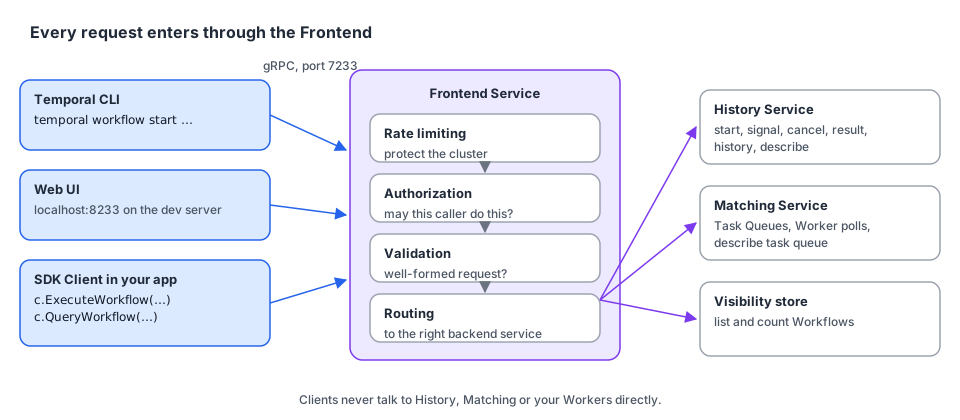
Three kinds of clients talk to the Temporal Server: the CLI, the Web UI and the SDK Client embedded in your applications. All three call the same gRPC API on the Frontend. The Frontend handles rate limiting, authorization and validation, then routes each request to the right backend service. Clients never talk to the History or Matching services directly, and never to your Workers.
This is why the CLI and your Go code are interchangeable for most operations:
| Operation | Go Client | CLI |
|---|---|---|
| Start a Workflow Execution | c.ExecuteWorkflow(ctx, opts, wf, args...) | temporal workflow start |
| Signal it (asynchronous message that changes its behavior) | c.SignalWorkflow(ctx, id, runID, name, arg) | temporal workflow signal |
| Query it (read its current state) | c.QueryWorkflow(ctx, id, runID, name, args...) | temporal workflow query |
| List Workflow Executions | c.ListWorkflow(ctx, &workflowservice.ListWorkflowExecutionsRequest{Query: …}) | temporal workflow list --query … |
| Get its result | c.GetWorkflow(ctx, id, runID).Get(ctx, &out) | temporal workflow result |
| Cancel it (graceful) | c.CancelWorkflow(ctx, id, runID) | temporal workflow cancel |
| Terminate it (immediate) | c.TerminateWorkflow(ctx, id, runID, reason) | temporal workflow terminate |
3. The order-processing example
The Encyclopedia illustrates the Client with an order processing system. A Client lets you:
- start a Workflow Execution when a customer places an order,
- Signal it when the customer changes the shipping address,
- Query it to show the order status,
- list Workflow Executions to see all orders being processed,
- get the result when processing is done.
First, a Workflow that supports those operations: it charges the card, then leaves a short packing window during which the address can change, then ships.
// file: orders/workflow.go
package orders

import (
	"time"

	"go.temporal.io/sdk/workflow"
)

const (
	TaskQueue            = "orders"
	UpdateAddressSignal  = "update-shipping-address"
	OrderStatusQuery     = "order-status"
	packingWindow        = 2 * time.Minute
	activityStartToClose = 30 * time.Second
)

type Address struct {
	Line1      string
	City       string
	PostalCode string
	Country    string
}

type FulfillOrderInput struct {
	OrderID     string
	CustomerID  string
	AmountCents int64
	ShipTo      Address
}

type OrderStatus struct {
	Stage  string // "charging", "packing", "shipping", "shipped"
	ShipTo Address
}

type FulfillOrderResult struct {
	OrderID        string
	TrackingNumber string
}

func FulfillOrderWorkflow(ctx workflow.Context, in FulfillOrderInput) (FulfillOrderResult, error) {
	status := OrderStatus{Stage: "charging", ShipTo: in.ShipTo}

	// Query handler: Clients can read the status at any time.
	if err := workflow.SetQueryHandler(ctx, OrderStatusQuery, func() (OrderStatus, error) {
		return status, nil
	}); err != nil {
		return FulfillOrderResult{}, err
	}

	ctx = workflow.WithActivityOptions(ctx, workflow.ActivityOptions{StartToCloseTimeout: activityStartToClose})
	var a *Activities

	if err := workflow.ExecuteActivity(ctx, a.ChargeCustomer, in.CustomerID, in.AmountCents).Get(ctx, nil); err != nil {
		return FulfillOrderResult{}, err
	}

	// Packing window: accept address changes until the timer fires.
	status.Stage = "packing"
	addressCh := workflow.GetSignalChannel(ctx, UpdateAddressSignal)
	packed := workflow.NewTimer(ctx, packingWindow)
	for done := false; !done; {
		sel := workflow.NewSelector(ctx)
		sel.AddReceive(addressCh, func(ch workflow.ReceiveChannel, _ bool) {
			ch.Receive(ctx, &status.ShipTo)
		})
		sel.AddFuture(packed, func(workflow.Future) { done = true })
		sel.Select(ctx)
	}

	status.Stage = "shipping"
	var tracking string
	if err := workflow.ExecuteActivity(ctx, a.CreateShipment, in.OrderID, status.ShipTo).Get(ctx, &tracking); err != nil {
		return FulfillOrderResult{}, err
	}

	status.Stage = "shipped"
	return FulfillOrderResult{OrderID: in.OrderID, TrackingNumber: tracking}, nil
}// file: orders/activities.go
package orders
import (
"context"
"fmt"
"go.temporal.io/sdk/activity"
)
type Activities struct{}
func (a *Activities) ChargeCustomer(ctx context.Context, customerID string, amountCents int64) error {
activity.GetLogger(ctx).Info("Charging customer", "customerID", customerID, "amountCents", amountCents)
return nil // call your payment gateway here
}
func (a *Activities) CreateShipment(ctx context.Context, orderID string, to Address) (string, error) {
activity.GetLogger(ctx).Info("Creating shipment", "orderID", orderID, "city", to.City)
return fmt.Sprintf("1Z-%s", orderID), nil // call your carrier API here
}Now the orders API: a plain HTTP service that holds one Temporal Client for the whole process and translates HTTP calls into Client calls. It runs no Workflow code at all.
// file: cmd/orders-api/main.go
package main

import (
	"context"
	"encoding/json"
	"errors"
	"fmt"
	"log"
	"net/http"
	"time"

	"go.temporal.io/api/serviceerror"
	"go.temporal.io/api/workflowservice/v1"
	"go.temporal.io/sdk/client"

	"github.com/acme/shop/orders"
)

type api struct {
	temporal client.Client
}

func workflowID(orderID string) string { return "order-" + orderID }

func main() {
	// One Client per process, created at startup and shared by all handlers.
	c, err := client.Dial(client.Options{})
	if err != nil {
		log.Fatalln("unable to create Temporal client", err)
	}
	defer c.Close()

	a := &api{temporal: c}
	mux := http.NewServeMux()
	mux.HandleFunc("POST /orders", a.placeOrder)
	mux.HandleFunc("POST /orders/{id}/address", a.changeAddress)
	mux.HandleFunc("GET /orders/{id}", a.orderStatus)
	mux.HandleFunc("GET /orders/{id}/result", a.orderResult)
	mux.HandleFunc("GET /orders", a.listOrders)
	mux.HandleFunc("DELETE /orders/{id}", a.cancelOrder)

	log.Println("orders API on :8091")
	log.Fatal(http.ListenAndServe(":8091", mux))
}

// Start a Workflow Execution when a customer places an order.
func (a *api) placeOrder(w http.ResponseWriter, r *http.Request) {
	var in orders.FulfillOrderInput
	if err := json.NewDecoder(r.Body).Decode(&in); err != nil {
		http.Error(w, err.Error(), http.StatusBadRequest)
		return
	}
	run, err := a.temporal.ExecuteWorkflow(r.Context(), client.StartWorkflowOptions{
		ID:        workflowID(in.OrderID), // business ID: one running Workflow per order
		TaskQueue: orders.TaskQueue,
	}, orders.FulfillOrderWorkflow, in)
	if err != nil {
		var alreadyStarted *serviceerror.WorkflowExecutionAlreadyStarted
		if errors.As(err, &alreadyStarted) {
			http.Error(w, "order already being processed", http.StatusConflict)
			return
		}
		http.Error(w, err.Error(), http.StatusBadGateway)
		return
	}
	// Returns as soon as the Service has recorded the start. No Worker needed yet.
	writeJSON(w, http.StatusAccepted, map[string]string{"workflowId": run.GetID(), "runId": run.GetRunID()})
}

// Signal the Workflow when the customer changes the shipping address.
func (a *api) changeAddress(w http.ResponseWriter, r *http.Request) {
	var addr orders.Address
	if err := json.NewDecoder(r.Body).Decode(&addr); err != nil {
		http.Error(w, err.Error(), http.StatusBadRequest)
		return
	}
	// Empty runID = the current run of this Workflow ID.
	if err := a.temporal.SignalWorkflow(r.Context(), workflowID(r.PathValue("id")), "", orders.UpdateAddressSignal, addr); err != nil {
		http.Error(w, err.Error(), http.StatusBadGateway)
		return
	}
	w.WriteHeader(http.StatusAccepted)
}

// Query the Workflow to show the current status of the order.
func (a *api) orderStatus(w http.ResponseWriter, r *http.Request) {
	val, err := a.temporal.QueryWorkflow(r.Context(), workflowID(r.PathValue("id")), "", orders.OrderStatusQuery)
	if err != nil {
		http.Error(w, err.Error(), http.StatusBadGateway)
		return
	}
	var status orders.OrderStatus
	if err := val.Get(&status); err != nil {
		http.Error(w, err.Error(), http.StatusInternalServerError)
		return
	}
	writeJSON(w, http.StatusOK, status)
}

// Get the result once processing is finished.
func (a *api) orderResult(w http.ResponseWriter, r *http.Request) {
	ctx, cancel := context.WithTimeout(r.Context(), 5*time.Second)
	defer cancel()

	var result orders.FulfillOrderResult
	err := a.temporal.GetWorkflow(ctx, workflowID(r.PathValue("id")), "").Get(ctx, &result)
	// On timeout, Get returns a *serviceerror.DeadlineExceeded, not context.DeadlineExceeded:
	// check our own context instead of the error type.
	if err != nil && ctx.Err() != nil {
		http.Error(w, "order still in progress", http.StatusAccepted)
		return
	}
	if err != nil {
		http.Error(w, err.Error(), http.StatusBadGateway)
		return
	}
	writeJSON(w, http.StatusOK, result)
}

// List Workflow Executions to see all orders being processed.
func (a *api) listOrders(w http.ResponseWriter, r *http.Request) {
	resp, err := a.temporal.ListWorkflow(r.Context(), &workflowservice.ListWorkflowExecutionsRequest{
		Query:    "WorkflowType = 'FulfillOrderWorkflow' AND ExecutionStatus = 'Running'",
		PageSize: 100,
	})
	if err != nil {
		http.Error(w, err.Error(), http.StatusBadGateway)
		return
	}
	ids := make([]string, 0, len(resp.GetExecutions()))
	for _, e := range resp.GetExecutions() {
		ids = append(ids, e.GetExecution().GetWorkflowId())
	}
	writeJSON(w, http.StatusOK, ids)
}

// Cancel the order: the Workflow receives a cancellation request it can react to.
func (a *api) cancelOrder(w http.ResponseWriter, r *http.Request) {
	if err := a.temporal.CancelWorkflow(r.Context(), workflowID(r.PathValue("id")), ""); err != nil {
		http.Error(w, err.Error(), http.StatusBadGateway)
		return
	}
	w.WriteHeader(http.StatusAccepted)
}

func writeJSON(w http.ResponseWriter, code int, v any) {
	w.Header().Set("Content-Type", "application/json")
	w.WriteHeader(code)
	if err := json.NewEncoder(w).Encode(v); err != nil {
		log.Println(fmt.Errorf("write response: %w", err))
	}
}// file: cmd/worker/main.go
package main
import (
"log"
"go.temporal.io/sdk/client"
"go.temporal.io/sdk/worker"
"github.com/acme/shop/orders"
)
func main() {
c, err := client.Dial(client.Options{})
if err != nil {
log.Fatalln("unable to create Temporal client", err)
}
defer c.Close()
w := worker.New(c, orders.TaskQueue, worker.Options{})
w.RegisterWorkflow(orders.FulfillOrderWorkflow)
w.RegisterActivity(&orders.Activities{})
if err := w.Run(worker.InterruptCh()); err != nil {
log.Fatalln("worker stopped", err)
}
}Try it with the dev server and the Worker running:
curl -X POST localhost:8091/orders -d '{"OrderID":"ORD-1042","CustomerID":"CUS-7","AmountCents":2598,"ShipTo":{"City":"Lyon"}}'
curl localhost:8091/orders/ORD-1042                    # {"Stage":"packing","ShipTo":{"City":"Lyon",...}}
curl -X POST localhost:8091/orders/ORD-1042/address -d '{"City":"Paris"}'
curl localhost:8091/orders/ORD-1042                    # ShipTo.City is now "Paris"
curl localhost:8091/orders                             # ["order-ORD-1042"]
Signal vs. Query, in one line: a Signal is written to the Event History (it changes the Workflow and needs no running Worker to be accepted). A Query is not recorded: it is answered by a Worker that runs the Query handler on the current state, so it needs a Worker to be up.
4. Rules for using the Client
| Rule | Why |
|---|---|
| Create one Client per process and share it. | client.Dial opens a gRPC connection. The Client is safe for concurrent use. |
| Never create or use a Client inside a Workflow. | Workflow code must be deterministic. Calling the network from it breaks replay. Use Child Workflows, workflow.SignalExternalWorkflow or an Activity instead. |
| Using a Client inside an Activity is fine and common. | Activities may do any I/O. Inject the Client into the Activity struct. |
Close it on shutdown (defer c.Close()). | Releases the connection. |
Here is the "Client inside an Activity" pattern: a returns Workflow notifies the original order Workflow through an Activity.
// file: returns/activities.go
package returns

import (
	"context"

	"go.temporal.io/sdk/client"
)

const RefundIssuedSignal = "refund-issued"

type RefundIssued struct {
	ReturnID    string
	AmountCents int64
}

// Activities gets the process-wide Client injected by the Worker's main.
type Activities struct {
	Temporal client.Client
}

// NotifyOrderOfRefund signals another Workflow. Allowed here, never in Workflow code.
func (a *Activities) NotifyOrderOfRefund(ctx context.Context, orderWorkflowID string, refund RefundIssued) error {
	return a.Temporal.SignalWorkflow(ctx, orderWorkflowID, "", RefundIssuedSignal, refund)
}
5. Connecting: defaults, environment, config file
client.Dial needs an address, a Namespace and, for secured services, TLS and credentials. The defaults target the local dev server: 127.0.0.1:7233 and the default Namespace, which is why client.Options{} works in the examples above.
For anything else, the Go SDK recommends loading connection options from environment variables or a TOML configuration file with the envconfig package instead of hard-coding them:
// file: internal/temporalconn/dial.go
package temporalconn

import (
	"go.temporal.io/sdk/client"
	"go.temporal.io/sdk/contrib/envconfig"
)

// Dial reads TEMPORAL_ADDRESS, TEMPORAL_NAMESPACE, TEMPORAL_API_KEY, TLS settings…
// and the "default" profile of ~/.config/temporalio/temporal.toml (or TEMPORAL_CONFIG_FILE).
// Environment variables win over the file.
func Dial() (client.Client, error) {
	return client.Dial(envconfig.MustLoadDefaultClientOptions())
}
Profiles, Temporal Cloud (API key or mTLS) and production settings are covered in chapter 08.
6. Key takeaways
- The Client is an SDK object that sends control requests to the Frontend over gRPC. It never runs your Workflow or Activity code.
- CLI, Web UI and SDK Clients all use the same Frontend API.
- The core operations: start, Signal, Query, list, get result, cancel, terminate.
- One Client per process. Never inside a Workflow. Fine inside an Activity.
- Load connection settings with
envconfigrather than hard-coding them.