05 · Failures, Cancellation & Benign errors
Level: sub-feature · Read time: ~20 min Sources: Encyclopedia — Activity Execution (Cancellation) · Workflow Activity (Cancellation) · Go SDK — Benign exceptions · Go SDK — Activity Execution
Chapter 04 covered how Temporal retries. This chapter covers what happens when retrying is over or no longer wanted:
- How an Activity failure reaches your Workflow, and how to inspect it.
- How to keep expected failures out of your alerts (benign errors).
- How cancellation works, why it needs heartbeats, and how to clean up properly.
1. Anatomy of an Activity failure in Go
An Activity Execution fails when it runs out of retries, returns a non-retryable error, hits Schedule-To-Close, or is cancelled. The Workflow then gets an error from future.Get:
*temporal.ActivityError            ← always the outer wrapper (ActivityType, ActivityID, RetryState…)
   └─ cause, one of:
        *temporal.ApplicationError  ← your Activity returned an error (Type(), Details(), NonRetryable())
        *temporal.TimeoutError      ← a timeout fired (TimeoutType(), LastHeartbeatDetails())
        *temporal.CanceledError     ← the Activity was cancelled
        *temporal.PanicError        ← your Activity panicked
Use errors.As to branch on the cause:
// file: billing/types.go
package billing

type ChargeSubscriptionInput struct {
	SubscriptionID string
	CustomerID     string
	AmountCents    int64
}

type ChargeResult struct {
	ChargeID string
}

// DeclineDetails travels inside an ApplicationError as structured details.
type DeclineDetails struct {
	DeclineCode string // e.g. "insufficient_funds"
	CanRetryAt  string
}// file: billing/activities.go
package billing
import (
"context"
"go.temporal.io/sdk/temporal"
)
type BillingActivities struct{}
func (a *BillingActivities) ChargeSubscription(ctx context.Context, in ChargeSubscriptionInput) (ChargeResult, error) {
declined := in.AmountCents > 100_000_00 // pretend the bank said no
if declined {
// Typed, non-retryable, with structured details for the Workflow.
return ChargeResult{}, temporal.NewNonRetryableApplicationError(
"card declined", "CardDeclined", nil,
DeclineDetails{DeclineCode: "insufficient_funds", CanRetryAt: "2026-11-01"},
)
}
return ChargeResult{ChargeID: "ch_" + in.SubscriptionID}, nil
}// file: billing/renewal_workflow.go
package billing
import (
"errors"
"time"
"go.temporal.io/sdk/temporal"
"go.temporal.io/sdk/workflow"
)
type RenewalOutcome struct {
Status string // "renewed" | "dunning" | "retry-later"
ChargeID string
DeclineCode string
}
func SubscriptionRenewalWorkflow(ctx workflow.Context, in ChargeSubscriptionInput) (RenewalOutcome, error) {
ctx = workflow.WithActivityOptions(ctx, workflow.ActivityOptions{
StartToCloseTimeout: 30 * time.Second,
ScheduleToCloseTimeout: 15 * time.Minute,
})
var a *BillingActivities
var res ChargeResult
err := workflow.ExecuteActivity(ctx, a.ChargeSubscription, in).Get(ctx, &res)
if err == nil {
return RenewalOutcome{Status: "renewed", ChargeID: res.ChargeID}, nil
}
var appErr *temporal.ApplicationError
var timeoutErr *temporal.TimeoutError
var canceledErr *temporal.CanceledError
switch {
case errors.As(err, &appErr) && appErr.Type() == "CardDeclined":
var details DeclineDetails
_ = appErr.Details(&details)
return RenewalOutcome{Status: "dunning", DeclineCode: details.DeclineCode}, nil
case errors.As(err, &timeoutErr):
// Schedule-To-Close elapsed: the payment provider was down for 15 minutes.
return RenewalOutcome{Status: "retry-later"}, nil
case errors.As(err, &canceledErr):
return RenewalOutcome{}, err
default:
var actErr *temporal.ActivityError
if errors.As(err, &actErr) {
workflow.GetLogger(ctx).Error("charge failed",
"activityType", actErr.ActivityType().GetName(),
"retryState", actErr.RetryState().String())
}
return RenewalOutcome{}, err
}
}💡 The type string of an
ApplicationError("CardDeclined") is whatRetryPolicy.NonRetryableErrorTypesmatches. Pick stable, explicit names.
2. Benign errors: expected failures without the noise
Some failures are part of normal operation: polling a warehouse system that is "not ready yet", or a transient failure you fully expect to be retried. Reported as normal errors, they flood logs, metrics and traces and hide real incidents.
Mark them benign with ApplicationErrorCategoryBenign. A benign Activity error:
- is logged at DEBUG instead of ERROR/WARN
- doesn't emit Activity failure metrics
- doesn't set the OpenTelemetry span status to ERROR
It still fails the attempt and is retried like any other error, and your Workflow still sees it if it's final.
// file: billing/benign.go
package billing

import (
	"context"
	"errors"

	"go.temporal.io/sdk/temporal"
)

var errExportNotReady = errors.New("bank export not generated yet")

type BankStatementRequest struct {
	AccountID string
	Date      string // "2026-10-22"
}

// FetchBankStatement polls the bank's SFTP until the daily file appears.
// "Not there yet" is expected for a few hours every morning: keep it out of alerts.
func (a *BillingActivities) FetchBankStatement(ctx context.Context, req BankStatementRequest) (string, error) {
	path, err := lookForStatementFile(req)
	if errors.Is(err, errExportNotReady) {
		return "", temporal.NewApplicationErrorWithOptions(
			err.Error(),
			"StatementNotReady",
			temporal.ApplicationErrorOptions{
				Category: temporal.ApplicationErrorCategoryBenign,
			},
		)
	}
	if err != nil {
		return "", err // a real problem: normal ERROR log + failure metric
	}
	return path, nil
}

func lookForStatementFile(req BankStatementRequest) (string, error) {
	return "", errExportNotReady
}
3. Cancellation
3.1 Why cancellation exists
Cancellation does two things:
- it tells the Activity it can stop working, and
- it gives the Activity time to clean up what it created (locks, temporary files, a half-created resource).
3.2 When an Activity receives a cancellation
- Cancellation was requested. This usually comes from a Workflow cancellation, or from the Workflow cancelling the context it used to schedule the Activity. A Workflow Activity can't be cancelled directly from outside; it goes through its Workflow. Standalone Activities can be cancelled directly (chapter 06).
- The Service considers the attempt failed because a timeout fired, for example a missed heartbeat. The failure message is
TIMED_OUT. - The Workflow Run is closed. The failure message is
NOT_FOUND. - An operator Paused or Reset it (chapter 10).
- Depending on the SDK: the Worker is shutting down, heartbeat details can't be serialized, or a Worker-side timeout fired.
3.3 The golden rule: no heartbeat, no cancellation
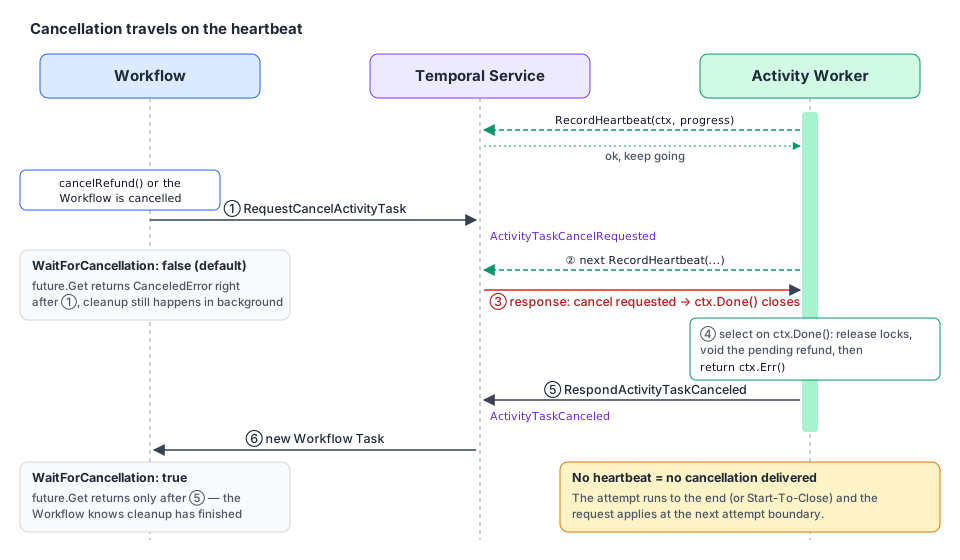
The Service delivers a cancellation request in the response to a heartbeat. An Activity that never calls RecordHeartbeat keeps running until it returns, or until Start-To-Close expires. Also:
- Heartbeats are throttled, so the cancellation may arrive a bit later than you expect.
- Cancellation is requested only once. Asking again doesn't deliver a second request.
- Your Activity can accept it (let the cancellation error propagate) or ignore it (keep going and return a normal result).
In Go, an accepted cancellation shows up as ctx.Done() closing, and you return ctx.Err(). context.Cause(ctx) tells you why the context was cancelled. That's how you tell an operator Pause or Reset apart from a real cancellation (Go SDK v1.34+).
3.4 Activity side: a cancellable, cleaning-up Activity
Usually the work is one long blocking call, like rendering a print job. Heartbeat from a background goroutine so cancellation can reach you:
// file: shipping/activities.go
package shipping

import (
	"context"
	"errors"
	"time"

	"go.temporal.io/sdk/activity"
)

type PrintLabelInput struct {
	ShipmentID string
	PrinterID  string
}

type LabelPrinter interface {
	StartJob(ctx context.Context, shipmentID, printerID string) (jobID string, err error)
	WaitJob(ctx context.Context, jobID string) error // blocks; honors ctx
	CancelJob(ctx context.Context, jobID string) error
}

type ShippingActivities struct {
	Printer LabelPrinter
}

func (a *ShippingActivities) PrintShippingLabel(ctx context.Context, in PrintLabelInput) error {
	logger := activity.GetLogger(ctx)

	jobID, err := a.Printer.StartJob(ctx, in.ShipmentID, in.PrinterID)
	if err != nil {
		return err
	}

	// Heartbeat in the background so cancellation can be delivered while WaitJob blocks.
	stopHeartbeat := make(chan struct{})
	defer close(stopHeartbeat)
	go func() {
		ticker := time.NewTicker(5 * time.Second) // well under HeartbeatTimeout
		defer ticker.Stop()
		for {
			select {
			case <-ticker.C:
				activity.RecordHeartbeat(ctx, jobID)
			case <-stopHeartbeat:
				return
			case <-ctx.Done():
				return
			}
		}
	}()

	err = a.Printer.WaitJob(ctx, jobID)
	if ctx.Err() == nil {
		return err // finished (successfully or not) without being interrupted
	}

	// Interrupted: find out why before cleaning up.
	cause := context.Cause(ctx)
	switch {
	case errors.Is(cause, activity.ErrActivityPaused):
		// Paused by an operator: the Activity will resume later. Keep the print job.
		logger.Info("Paused, keeping print job", "jobID", jobID)
	case errors.Is(cause, activity.ErrActivityReset):
		logger.Info("Reset, the next attempt starts over", "jobID", jobID)
		a.cancelJob(jobID)
	default:
		// Real cancellation (or the Workflow closed): release the printer.
		logger.Info("Cancelled, releasing printer", "jobID", jobID, "cause", cause)
		a.cancelJob(jobID)
	}
	return ctx.Err() // accept the interruption: report the attempt as cancelled
}

// cancelJob uses a fresh context: the Activity context is already cancelled.
func (a *ShippingActivities) cancelJob(jobID string) {
	cleanupCtx, cancel := context.WithTimeout(context.Background(), 10*time.Second)
	defer cancel()
	_ = a.Printer.CancelJob(cleanupCtx, jobID)
}
💡 Graceful Worker shutdown:
activity.GetWorkerStopChannel(ctx)closes when the Worker begins stopping. The Worker then waitsWorkerStopTimeoutbefore it cancels the Activity context. Select on it to checkpoint (heartbeat) and exit early.
3.5 Workflow side: requesting cancellation and WaitForCancellation
A Workflow cancels an Activity by cancelling the context it scheduled it with (workflow.WithCancel). It also decides whether to wait for the Activity to acknowledge:
WaitForCancellation | future.Get returns… | Use when |
|---|---|---|
false (default) | right away, with a CanceledError | You don't care when cleanup finishes |
true | only after the Activity has acknowledged the cancellation (cancelled, completed or failed) | The next steps depend on the cleanup having finished |
// file: shipping/workflow.go
package shipping

import (
	"errors"
	"time"

	"go.temporal.io/sdk/temporal"
	"go.temporal.io/sdk/workflow"
)

const CancelShipmentSignal = "cancel-shipment"

// PrepareShipmentWorkflow prints a label, unless the customer cancels the order first.
func PrepareShipmentWorkflow(ctx workflow.Context, in PrintLabelInput) (string, error) {
	printCtx, cancelPrint := workflow.WithCancel(ctx)
	printCtx = workflow.WithActivityOptions(printCtx, workflow.ActivityOptions{
		StartToCloseTimeout: 10 * time.Minute,
		HeartbeatTimeout:    15 * time.Second, // required to receive the cancellation
		WaitForCancellation: true,             // wait until the printer is released
	})

	var a *ShippingActivities
	printF := workflow.ExecuteActivity(printCtx, a.PrintShippingLabel, in)

	cancelCh := workflow.GetSignalChannel(ctx, CancelShipmentSignal)
	sel := workflow.NewSelector(ctx)
	sel.AddFuture(printF, func(workflow.Future) {})
	sel.AddReceive(cancelCh, func(c workflow.ReceiveChannel, more bool) {
		c.Receive(ctx, nil)
		cancelPrint() // ① request Activity cancellation
	})
	sel.Select(ctx)

	err := printF.Get(ctx, nil) // with WaitForCancellation=true, returns after cleanup
	var canceled *temporal.CanceledError
	switch {
	case errors.As(err, &canceled):
		return "cancelled", nil
	case err != nil:
		return "", err
	}
	return "label-printed", nil
}
3.6 Cleaning up after the Workflow itself is cancelled
When the whole Workflow is cancelled, its root ctx is cancelled too, so any new Activity scheduled with it fails immediately. To run compensation Activities after that, use a disconnected context:
// file: shipping/cleanup.go
package shipping

import (
	"context"
	"errors"
	"time"

	"go.temporal.io/sdk/workflow"
)

type CarrierActivities struct{}

func (c *CarrierActivities) BookCarrierSlot(ctx context.Context, shipmentID string) error {
	return nil
}

func (c *CarrierActivities) ReleaseCarrierSlot(ctx context.Context, shipmentID string) error {
	return nil
}

func BookCarrierWorkflow(ctx workflow.Context, shipmentID string) (err error) {
	ao := workflow.ActivityOptions{StartToCloseTimeout: time.Minute}
	ctx = workflow.WithActivityOptions(ctx, ao)
	var c *CarrierActivities

	defer func() {
		if !errors.Is(ctx.Err(), workflow.ErrCanceled) {
			return
		}
		// The Workflow was cancelled: run cleanup on a context that is NOT cancelled.
		cleanupCtx, _ := workflow.NewDisconnectedContext(ctx)
		cleanupCtx = workflow.WithActivityOptions(cleanupCtx, ao)
		_ = workflow.ExecuteActivity(cleanupCtx, c.ReleaseCarrierSlot, shipmentID).Get(cleanupCtx, nil)
	}()

	if err := workflow.ExecuteActivity(ctx, c.BookCarrierSlot, shipmentID).Get(ctx, nil); err != nil {
		return err
	}
	// ... wait for the pickup: timers, signals ...
	return workflow.Sleep(ctx, 24*time.Hour)
}
Key takeaways
future.Getreturns*ActivityErrorwrapping the real cause. Useerrors.Asto getApplicationError,TimeoutErrororCanceledError.- Give
ApplicationErrors stable types and structured details. That is what policies and Workflows branch on. - Mark expected noise as benign: it is still retried, but no ERROR logs, failure metrics or ERROR spans.
- No heartbeat, no cancellation. Heartbeat from a goroutine during long blocking calls.
- In Go, cancellation =
ctx.Done(). Usecontext.Cause(ctx)to tell Pause and Reset apart from cancel. Clean up with a fresh context. WaitForCancellation: truemakes the Workflow wait for cleanup.NewDisconnectedContextruns compensation after the Workflow itself was cancelled.
⬅️ Previous: 04 · Timeouts, retries & heartbeats · ➡️ Next: 06 · Standalone Activities