05 · Timers, Selectors and concurrency inside a Workflow
Level: core concept · Read time: ~20 min Sources: Encyclopedia: Timers and Start Delays · Workflow Definition: deterministic constraints · Go SDK: Timers · Go SDK: Selectors · Go SDK: Workflow basics
1. The problem
Real business processes wait and race:
- "Wait 2 minutes for the customer to change their mind before we charge."
- "Ask three couriers for a quote and take the first answer."
- "If the food isn't delivered within 45 minutes, send a voucher, but keep tracking the delivery."
In normal Go you'd use time.Sleep, go, chan and select. In a Workflow these are forbidden: they aren't recorded in the Event History, so a replay could take a different path. select even picks a random ready case. The Go SDK gives you deterministic, durable replacements:
| Native Go | In Workflow code | Why |
|---|---|---|
time.Sleep(d) | workflow.Sleep(ctx, d) | Durable Timer, recorded in history |
time.NewTimer(d) | workflow.NewTimer(ctx, d) / NewTimerWithOptions | Same, returns a workflow.Future |
time.Now() | workflow.Now(ctx) | Time of the current Workflow Task, the same on replay |
go f() | workflow.Go(ctx, f) | Deterministic coroutine scheduling |
chan T | workflow.NewChannel(ctx) / NewBufferedChannel | Deterministic channel |
select { … } | workflow.NewSelector(ctx) | No random choice, works with Futures too |
context.Context | workflow.Context (+ workflow.WithCancel) | Cancels Timers, Activities and children |
✅
select, goroutines andtimeare fine inside Activities. The rules only apply to Workflow code.
2. Durable Timers
A Timer is persisted by the Temporal Service. If your Worker or the Service is down when the time is up, the waiting code resumes as soon as they are back. Waiting costs nothing: the Workflow isn't in memory and no thread is blocked. A single Worker can have millions of pending Timers.
// Sleep: the simple form. Returns nil when the time has passed, or *CanceledError if ctx is canceled.
err := workflow.Sleep(ctx, 2*time.Minute)

// Timer: a Future you can combine with other Futures in a Selector (section 4).
timer := workflow.NewTimer(ctx, 45*time.Minute)

// With a summary that shows up in the Web UI / Event History.
sla := workflow.NewTimerWithOptions(ctx, 45*time.Minute, workflow.TimerOptions{Summary: "delivery SLA"})
What you need to know:
- A duration is a minimum. 11.97 seconds will probably fire closer to 12 seconds, because scheduling and firing take time. Don't rely on sub-second accuracy. Durations can range from about a second to years.
- A zero or negative
Sleepreturns immediately. - Cancel a Timer by canceling its Context: create it with
workflow.WithCancel(ctx)and callcancel(). The Timer's Future then resolves with a*CanceledError. - Changing a Timer's duration in code that already has running Executions is a safe change, except from or to 0, which is non-deterministic in Go (03). Adding, removing or reordering Timers needs Versioning (11).
- To start a whole Workflow later (once, not on a recurrence), use Start Delay on the client, not a Sleep at the top of the Workflow. See 10.
💡 Prefer a Timer over a Workflow timeout for business deadlines (04): when a Timer fires, your code decides what to do. A timeout just stops the Workflow.
3. Waiting on a condition: workflow.Await and AwaitWithTimeout
Often you don't wait for a fixed time, you wait for state to change (usually because a Signal arrived). workflow.Await(ctx, cond) blocks until cond() returns true. The condition is re-checked whenever the Workflow's state may have changed. workflow.AwaitWithTimeout(ctx, d, cond) adds a durable timeout. It returns ok=false if the time ran out.
foodReady := false
// … a goroutine or Signal handler sets foodReady = true …
ok, err := workflow.AwaitWithTimeout(ctx, 30*time.Minute, func() bool { return foodReady })
The condition function must only read Workflow state. It must not block or call Temporal APIs.
4. Selectors: deterministic select
A workflow.Selector waits until one of its registered cases is ready, then runs that case's callback:
| Method | Case |
|---|---|
AddFuture(f, func(f workflow.Future)) | An Activity, Child Workflow or Timer Future becomes ready |
AddReceive(ch, func(c workflow.ReceiveChannel, more bool)) | A message is available on a channel (for example a Signal channel) |
AddSend(ch, v, func()) | A send on a channel can proceed |
AddDefault(func()) | Nothing else is ready right now |
Select(ctx) | Block until one case is ready and run its callback (only one per call) |
HasPending() | Is a case ready right now? Useful to avoid losing Signals before completing or Continue-As-New (09) |
Rules that trip people up:
- Nothing runs until
Selectis called.ExecuteActivityonly queues a Command. Commands are sent to the Service at the next point where the Workflow blocks,Selectincluded. - A Future matches only once per Selector, even if you call
Selectagain. CallingSelectN times on N Futures collects all of them. If several are ready at once, the matching order is not defined. AddReceivedoesn't consume the message. Callc.Receive(ctx, &v)in the callback. Otherwise the same message matches again and again.
The soft-timeout race
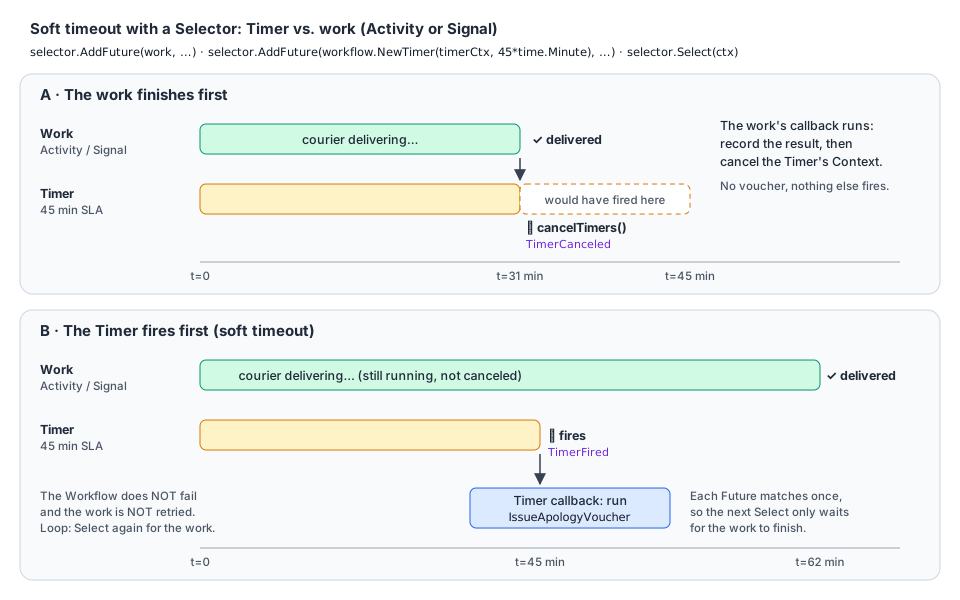
A classic use is a soft timeout: race a Timer against slow work. When the Timer wins, you react (notify, compensate, escalate) without failing or retrying the work. When the work wins, you cancel the Timer.
5. Example: food delivery with quotes, an SLA and reminders
FoodDeliveryWorkflow:
- Grace period:
workflow.Sleepfor 2 minutes so the customer can still cancel for free. - Pick-first: ask three couriers for a quote in parallel, keep the first successful one and cancel the others.
- Kitchen:
workflow.GoplusAwaitWithTimeoutwaits for the restaurant to mark the food ready. - Delivery race: wait for the
order-deliveredSignal. A 20-minute reminder Timer and a 45-minute soft SLA Timer run at the same time. When the SLA passes, the customer gets an apology voucher and the Workflow keeps waiting for the delivery. When the Signal arrives, the timers that haven't fired are canceled.
Activities
// file: delivery/activities.go
package delivery

import (
	"context"
	"time"

	"go.temporal.io/sdk/activity"
)

type QuoteRequest struct {
	Courier       string
	OrderID       string
	PickupAddress string
	DropoffZone   string
}

type CourierQuote struct {
	Courier    string
	PriceCents int64
	PickupETA  time.Duration
}

// CourierGateway wraps the courier partners' HTTP APIs.
type CourierGateway interface {
	Quote(ctx context.Context, req QuoteRequest) (CourierQuote, error)
	Dispatch(ctx context.Context, orderID string, q CourierQuote) (string, error)
}

// CustomerNotifier sends push notifications / SMS.
type CustomerNotifier interface {
	Notify(ctx context.Context, orderID, message string) error
}

// VoucherService issues compensation vouchers.
type VoucherService interface {
	Issue(ctx context.Context, orderID string, amountCents int64) (string, error)
}

type DeliveryActivities struct {
	Couriers CourierGateway
	Notifier CustomerNotifier
	Vouchers VoucherService
}

func (a *DeliveryActivities) RequestCourierQuote(ctx context.Context, req QuoteRequest) (CourierQuote, error) {
	activity.GetLogger(ctx).Info("Requesting quote", "courier", req.Courier)
	return a.Couriers.Quote(ctx, req)
}

func (a *DeliveryActivities) DispatchCourier(ctx context.Context, orderID string, q CourierQuote) (string, error) {
	return a.Couriers.Dispatch(ctx, orderID, q)
}

func (a *DeliveryActivities) SendDeliveryReminder(ctx context.Context, orderID string) error {
	return a.Notifier.Notify(ctx, orderID, "Your courier is on the way, thanks for your patience!")
}

func (a *DeliveryActivities) IssueApologyVoucher(ctx context.Context, orderID string) (string, error) {
	voucherID, err := a.Vouchers.Issue(ctx, orderID, 5_00)
	if err != nil {
		return "", err
	}
	return voucherID, a.Notifier.Notify(ctx, orderID, "Sorry for the delay, here is a 5€ voucher: "+voucherID)
}
Pick-first-and-cancel-the-rest
// file: delivery/quotes.go
package delivery

import (
	"errors"
	"fmt"

	"go.temporal.io/sdk/workflow"
)

// fastestQuote asks every courier in parallel and returns the first successful quote.
// The losing requests are canceled through their shared Context.
func fastestQuote(ctx workflow.Context, order DeliveryOrder) (CourierQuote, error) {
	quoteCtx, cancelQuotes := workflow.WithCancel(ctx)
	defer cancelQuotes()

	var a *DeliveryActivities
	selector := workflow.NewSelector(ctx)
	var (
		winner   CourierQuote
		found    bool
		failures []error
	)
	// order.Couriers is a slice, so the iteration order is deterministic (never range over a map here).
	for _, courier := range order.Couriers {
		f := workflow.ExecuteActivity(quoteCtx, a.RequestCourierQuote, QuoteRequest{
			Courier:       courier,
			OrderID:       order.OrderID,
			PickupAddress: order.RestaurantAddress,
			DropoffZone:   order.DropoffZone,
		})
		selector.AddFuture(f, func(f workflow.Future) {
			var q CourierQuote
			if err := f.Get(ctx, &q); err != nil {
				failures = append(failures, err)
				return
			}
			if !found {
				winner, found = q, true
			}
		})
	}

	// Each Select runs exactly one ready callback. Stop at the first success.
	for i := 0; i < len(order.Couriers) && !found; i++ {
		selector.Select(ctx)
	}
	if !found {
		return CourierQuote{}, fmt.Errorf("no courier available: %w", errors.Join(failures...))
	}
	cancelQuotes() // cancel the quote requests still pending
	return winner, nil
}
The Workflow
// file: delivery/workflow.go
package delivery

import (
	"time"

	"go.temporal.io/sdk/temporal"
	"go.temporal.io/sdk/workflow"
)

const (
	TaskQueue       = "delivery"
	DeliveredSignal = "order-delivered"
	FoodReadySignal = "food-ready"
)

type DeliveryOrder struct {
	OrderID           string
	RestaurantAddress string
	DropoffZone       string
	Couriers          []string // e.g. ["swiftbike", "urbandrop", "citycourier"]
	CancelGracePeriod time.Duration
	ReminderAfter     time.Duration
	DeliverySLA       time.Duration
}

type DeliveryProof struct {
	CourierID  string
	PhotoURL   string
	ReceivedBy string
}

type DeliveryResult struct {
	Courier      string
	DispatchID   string
	FoodReady    bool
	Proof        DeliveryProof
	VoucherID    string // set only if the SLA was missed
	ReminderSent bool
}

func FoodDeliveryWorkflow(ctx workflow.Context, order DeliveryOrder) (DeliveryResult, error) {
	logger := workflow.GetLogger(ctx)
	ctx = workflow.WithActivityOptions(ctx, workflow.ActivityOptions{
		StartToCloseTimeout: 30 * time.Second,
		RetryPolicy:         &temporal.RetryPolicy{MaximumAttempts: 3},
	})
	var a *DeliveryActivities
	var result DeliveryResult

	// 1. Durable grace period: survives Worker restarts, costs nothing while waiting.
	if err := workflow.Sleep(ctx, order.CancelGracePeriod); err != nil {
		return result, err // *CanceledError if the Workflow was canceled during the grace period
	}

	// 2. Parallel quotes, first one wins.
	quote, err := fastestQuote(ctx, order)
	if err != nil {
		return result, err
	}
	result.Courier = quote.Courier
	if err := workflow.ExecuteActivity(ctx, a.DispatchCourier, order.OrderID, quote).Get(ctx, &result.DispatchID); err != nil {
		return result, err
	}

	// 3. A coroutine listens to the kitchen while the main code waits on a condition.
	kitchen := workflow.GetSignalChannel(ctx, FoodReadySignal)
	workflow.Go(ctx, func(gctx workflow.Context) {
		kitchen.Receive(gctx, nil)
		result.FoodReady = true
	})
	ok, err := workflow.AwaitWithTimeout(ctx, 30*time.Minute, func() bool { return result.FoodReady })
	if err != nil {
		return result, err
	}
	if !ok {
		logger.Warn("Kitchen did not confirm within 30 minutes, courier will wait on site")
	}

	// 4. Delivery race: Signal vs reminder Timer vs soft SLA Timer.
	timerCtx, cancelTimers := workflow.WithCancel(ctx)
	defer cancelTimers()
	reminder := workflow.NewTimerWithOptions(timerCtx, order.ReminderAfter, workflow.TimerOptions{Summary: "courier reminder"})
	sla := workflow.NewTimerWithOptions(timerCtx, order.DeliverySLA, workflow.TimerOptions{Summary: "delivery SLA"})

	delivered := false
	selector := workflow.NewSelector(ctx)
	selector.AddReceive(workflow.GetSignalChannel(ctx, DeliveredSignal), func(c workflow.ReceiveChannel, more bool) {
		c.Receive(ctx, &result.Proof) // AddReceive does NOT consume: always Receive in the callback
		delivered = true
	})
	selector.AddFuture(reminder, func(f workflow.Future) {
		if f.Get(ctx, nil) != nil {
			return // canceled: the order was delivered first
		}
		if err := workflow.ExecuteActivity(ctx, a.SendDeliveryReminder, order.OrderID).Get(ctx, nil); err != nil {
			logger.Warn("Reminder failed", "error", err)
			return
		}
		result.ReminderSent = true
	})
	selector.AddFuture(sla, func(f workflow.Future) {
		if f.Get(ctx, nil) != nil {
			return
		}
		// Soft timeout: compensate the customer, but DON'T stop waiting for the delivery.
		if err := workflow.ExecuteActivity(ctx, a.IssueApologyVoucher, order.OrderID).Get(ctx, &result.VoucherID); err != nil {
			logger.Error("Voucher failed", "error", err)
		}
	})

	// Each Future matches once, so after both Timers fired only the Signal case is left.
	for !delivered {
		selector.Select(ctx)
		if ctx.Err() != nil {
			return result, ctx.Err() // the Workflow itself was canceled
		}
	}
	cancelTimers() // the timers that haven't fired are canceled and never fire
	return result, nil
}
Worker, starter and the courier app
// file: cmd/delivery-worker/main.go
package main

import (
	"context"
	"log"
	"time"

	"github.com/acme/shop/delivery"
	"go.temporal.io/sdk/client"
	"go.temporal.io/sdk/worker"
)

type fakeCouriers struct{}

func (fakeCouriers) Quote(ctx context.Context, req delivery.QuoteRequest) (delivery.CourierQuote, error) {
	return delivery.CourierQuote{Courier: req.Courier, PriceCents: 4_90, PickupETA: 12 * time.Minute}, nil
}

func (fakeCouriers) Dispatch(ctx context.Context, orderID string, q delivery.CourierQuote) (string, error) {
	return "disp_" + orderID, nil
}

type logNotifier struct{}

func (logNotifier) Notify(ctx context.Context, orderID, message string) error {
	log.Printf("[notify %s] %s", orderID, message)
	return nil
}

type fakeVouchers struct{}

func (fakeVouchers) Issue(ctx context.Context, orderID string, amountCents int64) (string, error) {
	return "VCH-" + orderID, nil
}

func main() {
	c, err := client.Dial(client.Options{})
	if err != nil {
		log.Fatalln(err)
	}
	defer c.Close()

	w := worker.New(c, delivery.TaskQueue, worker.Options{})
	w.RegisterWorkflow(delivery.FoodDeliveryWorkflow)
	w.RegisterActivity(&delivery.DeliveryActivities{
		Couriers: fakeCouriers{},
		Notifier: logNotifier{},
		Vouchers: fakeVouchers{},
	})
	log.Fatalln(w.Run(worker.InterruptCh()))
}// file: cmd/delivery-start/main.go
package main
import (
"context"
"log"
"time"
"github.com/acme/shop/delivery"
"go.temporal.io/sdk/client"
)
func main() {
c, err := client.Dial(client.Options{})
if err != nil {
log.Fatalln(err)
}
defer c.Close()
order := delivery.DeliveryOrder{
OrderID: "ord_77120",
RestaurantAddress: "12 rue des Lilas, Lyon",
DropoffZone: "lyon-3",
Couriers: []string{"swiftbike", "urbandrop", "citycourier"},
CancelGracePeriod: 2 * time.Minute,
ReminderAfter: 20 * time.Minute,
DeliverySLA: 45 * time.Minute,
}
run, err := c.ExecuteWorkflow(context.Background(), client.StartWorkflowOptions{
ID: "delivery-" + order.OrderID,
TaskQueue: delivery.TaskQueue,
}, delivery.FoodDeliveryWorkflow, order)
if err != nil {
log.Fatalln(err)
}
log.Println("started", run.GetID(), run.GetRunID())
}// file: cmd/courier-app/main.go
package main
import (
"context"
"flag"
"log"
"github.com/acme/shop/delivery"
"go.temporal.io/sdk/client"
)
// courier-app -order ord_77120 -event food-ready|delivered
func main() {
orderID := flag.String("order", "", "order ID")
event := flag.String("event", "delivered", "food-ready or delivered")
flag.Parse()
c, err := client.Dial(client.Options{})
if err != nil {
log.Fatalln(err)
}
defer c.Close()
workflowID := "delivery-" + *orderID
ctx := context.Background()
switch *event {
case "food-ready":
err = c.SignalWorkflow(ctx, workflowID, "", delivery.FoodReadySignal, nil)
default:
err = c.SignalWorkflow(ctx, workflowID, "", delivery.DeliveredSignal, delivery.DeliveryProof{
CourierID: "cr_311",
PhotoURL: "https://cdn.example.com/proofs/ord_77120.jpg",
ReceivedBy: "front desk",
})
}
if err != nil {
log.Fatalln(err)
}
log.Println("signal sent:", *event)
}Signals are covered in depth in 06. The point here is that a Signal channel is just another case in a Selector.
6. What ends up in the Event History
Run the example and open the Workflow in the Web UI (http://localhost:8233). You'll see:
| Code | Events |
|---|---|
workflow.Sleep(ctx, 2*time.Minute) | TimerStarted … TimerFired |
3 × ExecuteActivity for quotes | 3 × ActivityTaskScheduled, then the winner's completion, and ActivityTaskCancelRequested for losers still pending |
NewTimerWithOptions(... "delivery SLA") | TimerStarted (the summary is shown in the UI) |
cancelTimers() before a Timer fired | TimerCanceled |
| Courier sends the Signal | WorkflowExecutionSignaled |
Because every Timer start, fire and cancel is an event, the replayed code makes the same choices, whatever the Worker's clock says. This is what makes Timers and Selectors safe where time and select aren't.
Key takeaways
- Use
workflow.Sleep/workflow.NewTimer(WithOptions), nevertime.Sleep. Timers are durable, cheap and fire at least after their duration. - Cancel a Timer by canceling its
workflow.WithCancelContext. Changing a duration is safe, except from or to 0. workflow.Await/AwaitWithTimeoutwait for state. Timers wait for time.workflow.Selectorreplacesselect:AddFuture,AddReceive(alwaysReceiveinside), one callback perSelect, each Future matches once.- Patterns: pick-first and cancel the rest, and soft timeouts (react when the Timer fires, keep waiting for the real result).
workflow.Goandworkflow.Channelreplacegoandchanin Workflow code. In Activities, plain Go is fine.
⬅️ Previous: 04 · Workflow Executions: status, IDs, timeouts and limits · ➡️ Next: 06 · Message passing