07 · Getting Workflow results
Level: core concept, daily use · Read time: ~15 min Sources: Go SDK — Get Workflow results · Get last completion result ·
client.WorkflowRun
1. The problem
A Workflow can finish in 200 ms or in 3 months. The process that started it may have restarted ten times since. Getting the result must work synchronously (wait right here) and asynchronously (from any process, any time later). It must also handle failures, timeouts and Workflows that continue as new runs.
2. The WorkflowRun handle
ExecuteWorkflow and GetWorkflow both return a client.WorkflowRun:
| Method | Returns |
|---|---|
GetID() | The Workflow ID |
GetRunID() | The Run ID this handle currently points to (see section 6: it can change after Get) |
GetFirstExecutionRunID() | The Run ID of the first run in the chain (empty for handles from GetWorkflow) |
Get(ctx, &result) | Blocks until the Workflow closes, fills result, or returns the Workflow's error |
GetWithOptions(ctx, &result, opts) | Same, with options (DisableFollowingRuns) |
The Workflow ID, Run ID and Namespace together identify one Workflow Execution. The result stays available as long as the execution's Event History is retained by the Namespace.
3. Synchronously: wait in the same process
// file: refunds/workflow.go
package refunds

import (
	"time"

	"go.temporal.io/sdk/temporal"
	"go.temporal.io/sdk/workflow"
)

const TaskQueue = "refunds"

type RefundRequest struct {
	OrderID     string
	AmountCents int64
	Reason      string
}

type RefundResult struct {
	RefundID string
	Status   string // "refunded", "store-credit"
}

func IssueRefundWorkflow(ctx workflow.Context, req RefundRequest) (RefundResult, error) {
	if req.AmountCents <= 0 {
		return RefundResult{}, temporal.NewNonRetryableApplicationError("amount must be positive", "InvalidRefund", nil)
	}
	ctx = workflow.WithActivityOptions(ctx, workflow.ActivityOptions{StartToCloseTimeout: time.Minute})
	var refundID string
	if err := workflow.ExecuteActivity(ctx, "RefundCard", req).Get(ctx, &refundID); err != nil {
		return RefundResult{}, err
	}
	return RefundResult{RefundID: refundID, Status: "refunded"}, nil
}// file: refunds/client.go
package refunds
import (
"context"
"time"
"go.temporal.io/sdk/client"
)
// RefundAndWait starts a refund and waits at most maxWait for it.
func RefundAndWait(c client.Client, req RefundRequest, maxWait time.Duration) (RefundResult, error) {
run, err := c.ExecuteWorkflow(context.Background(), client.StartWorkflowOptions{
ID: "refund-" + req.OrderID,
TaskQueue: TaskQueue,
}, IssueRefundWorkflow, req)
if err != nil {
return RefundResult{}, err
}
ctx, cancel := context.WithTimeout(context.Background(), maxWait)
defer cancel()
var res RefundResult
err = run.Get(ctx, &res)
return res, err
}Get is a blocking call, and the ctx bounds only the wait. If it expires, Get returns an error but the Workflow keeps running. Note that this error is a *serviceerror.DeadlineExceeded from the gRPC layer, not context.DeadlineExceeded, so errors.Is(err, context.DeadlineExceeded) is false. Check your own context instead:
// file: refunds/timeout.go
package refunds

import (
	"context"
	"errors"

	"go.temporal.io/sdk/client"
)

var ErrStillRunning = errors.New("refund still in progress")

// WaitUpTo returns ErrStillRunning if the Workflow didn't finish before ctx expired.
func WaitUpTo(ctx context.Context, run client.WorkflowRun) (RefundResult, error) {
	var res RefundResult
	err := run.Get(ctx, &res)
	if err != nil && ctx.Err() != nil {
		return RefundResult{}, ErrStillRunning
	}
	return res, err
}
4. Asynchronously: from any process, later
All you need is the Workflow ID. That's another reason to use business IDs (chapter 04).
// file: refunds/status.go
package refunds

import (
	"context"

	"go.temporal.io/sdk/client"
)

// RefundOutcome is called by the support back-office, long after the refund was started
// by the checkout service.
func RefundOutcome(ctx context.Context, c client.Client, orderID string) (RefundResult, error) {
	// An empty Run ID means "the latest run with this Workflow ID".
	run := c.GetWorkflow(ctx, "refund-"+orderID, "")
	var res RefundResult
	err := run.Get(ctx, &res)
	return res, err
}

// RefundOutcomeOfRun reads one specific run, e.g. an older refund for the same order.
func RefundOutcomeOfRun(ctx context.Context, c client.Client, orderID, runID string) (RefundResult, error) {
	var res RefundResult
	err := c.GetWorkflow(ctx, "refund-"+orderID, runID).Get(ctx, &res)
	return res, err
}
If you only need the current state of a Workflow that is still running, don't block on Get: send a Query (chapter 08). The SDK docs call Queries an acceptable, even preferred, way to read state and results.
5. When the Workflow didn't succeed
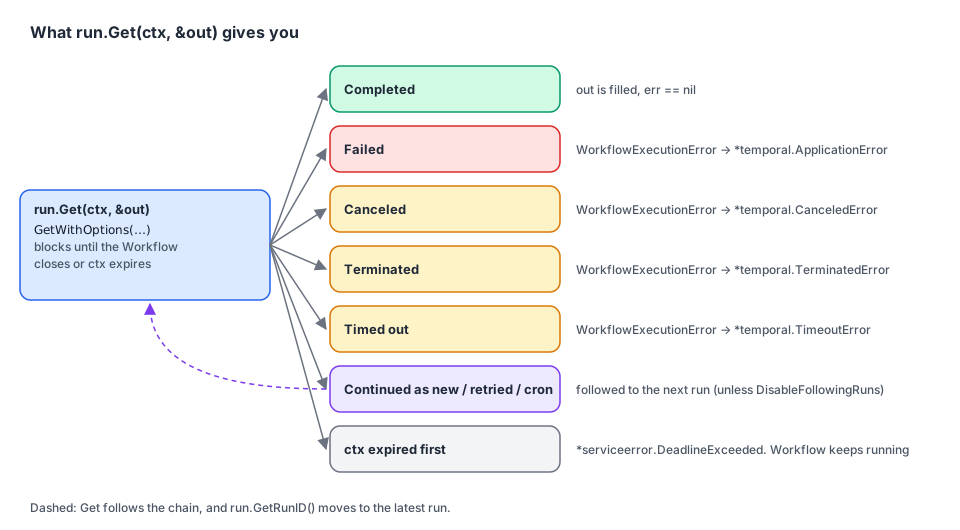
Get returns the Workflow's outcome as an error. In Go, it is a *temporal.WorkflowExecutionError that wraps the cause. Unwrap it with errors.As:
| How the Workflow ended | errors.As target that matches the cause |
|---|---|
Returned an error (e.g. temporal.NewApplicationError(…, "CardDeclined")) | *temporal.ApplicationError (check .Type()) |
| Cancelled | *temporal.CanceledError |
| Terminated | *temporal.TerminatedError |
| Timed out (execution or run timeout) | *temporal.TimeoutError |
// file: refunds/errors.go
package refunds

import (
	"errors"
	"fmt"

	"go.temporal.io/sdk/temporal"
)

// Explain turns a Get error into a message for the support agent.
func Explain(err error) string {
	var appErr *temporal.ApplicationError
	var canceled *temporal.CanceledError
	var terminated *temporal.TerminatedError
	var timeout *temporal.TimeoutError
	switch {
	case err == nil:
		return "refunded"
	case errors.As(err, &appErr) && appErr.Type() == "InvalidRefund":
		return "rejected: " + appErr.Message()
	case errors.As(err, &canceled):
		return "refund cancelled by an operator"
	case errors.As(err, &terminated):
		return "refund terminated (see the Web UI for the reason)"
	case errors.As(err, &timeout):
		return "refund timed out"
	default:
		return fmt.Sprintf("refund failed: %v", err)
	}
}
6. Chains of runs: Continue-As-New, retries and cron
One Workflow ID can have a chain of runs: a Workflow that calls Continue-As-New, a Workflow retried by its RetryPolicy, or a cron Workflow. Each run has its own Run ID.
Get follows the chain by default: it waits for the latest run and returns its result. And the handle's GetRunID() moves along:
// file: billing/chain.go
package billing

import (
	"context"
	"errors"
	"log"

	"go.temporal.io/sdk/client"
	"go.temporal.io/sdk/workflow"
)

const TaskQueue = "billing"

// CloseMonthWorkflow processes invoices page by page and continues as new between pages
// to keep each run's Event History small.
func CloseMonthWorkflow(ctx workflow.Context, month string, page int) (int, error) {
	if page < 3 {
		return 0, workflow.NewContinueAsNewError(ctx, CloseMonthWorkflow, month, page+1)
	}
	return page, nil // pages processed
}

func RunAndInspect(ctx context.Context, c client.Client) error {
	run, err := c.ExecuteWorkflow(ctx, client.StartWorkflowOptions{
		ID: "close-month-2024-11", TaskQueue: TaskQueue,
	}, CloseMonthWorkflow, "2024-11", 1)
	if err != nil {
		return err
	}
	firstRunID := run.GetFirstExecutionRunID() // == run.GetRunID() right after the start

	var pages int
	if err := run.Get(ctx, &pages); err != nil { // follows run 1 → run 2 → run 3
		return err
	}
	log.Printf("pages=%d, handle now points to the last run: %t", pages, run.GetRunID() != firstRunID)

	// To read ONE run without following: DisableFollowingRuns.
	// For a run that continued as new, the "result" is a ContinueAsNewError.
	err = c.GetWorkflow(ctx, run.GetID(), firstRunID).
		GetWithOptions(ctx, &pages, client.WorkflowRunGetOptions{DisableFollowingRuns: true})
	var can *workflow.ContinueAsNewError
	if errors.As(err, &can) {
		log.Println("run 1 continued as new")
		return nil
	}
	return err
}
Observed with SDK v1.50.0: GetRunID() equals the first Run ID right after ExecuteWorkflow, then returns the last run's ID once Get has followed the chain. GetFirstExecutionRunID() keeps the first one. (The Go Client page says GetRunID() "always returns the Run ID of the initial Run", which is no longer accurate. See the README notes.)
Reading the previous run's result in a cron Workflow
A cron Workflow can carry a value from one run to the next with workflow.HasLastCompletionResult and workflow.GetLastCompletionResult. It gets the result of the last successfully completed run, even if the run just before failed.
// file: billing/cron.go
package billing

import "go.temporal.io/sdk/workflow"

type DunningStats struct {
	RunsSoFar       int
	RemindersIssued int
}

// DailyDunningWorkflow runs on a CronSchedule and keeps a running total across runs.
func DailyDunningWorkflow(ctx workflow.Context) (DunningStats, error) {
	stats := DunningStats{}
	if workflow.HasLastCompletionResult(ctx) {
		if err := workflow.GetLastCompletionResult(ctx, &stats); err != nil {
			workflow.GetLogger(ctx).Warn("could not read last result, starting from zero", "error", err)
		}
	}
	stats.RunsSoFar++
	// … send today's reminders with Activities, then add them to stats.RemindersIssued …
	return stats, nil
}
7. Key takeaways
ExecuteWorkflowandGetWorkflowreturn aWorkflowRun.Getblocks until the Workflow closes.- Get a result from any process with
c.GetWorkflow(ctx, workflowID, ""). An empty Run ID means the latest run. - A
ctxtimeout onGetstops the wait, not the Workflow. Detect it withctx.Err(), because the error is a gRPCDeadlineExceeded. - Failures come back as
*temporal.WorkflowExecutionError. Useerrors.Asto findApplicationError,CanceledError,TerminatedErrororTimeoutError. Getfollows Continue-As-New, retry and cron chains.GetRunID()moves to the latest run. UseGetFirstExecutionRunID()for the first, andDisableFollowingRunsto read one run.