05 · Deprecating and deleting Namespaces
Level: advanced · Read time: ~15 min Sources: Go SDK — Manage Namespaces · Encyclopedia — Temporal Namespace ·
DeleteNamespace(OperatorService) ·UpdateNamespaceInfo
1. The problem
Marketing ran a summer sale in its own Namespace, promo-summer-2025. The sale is over, but a few campaign Workflows are still waiting for their final "close campaign" Signal. You want to:
- stop new Workflows from starting there,
- let the running ones finish,
- then remove the Namespace and its data,
without ever touching shop-prod by mistake. Temporal has two tools for this: deprecation and deletion. Both are easy to call and easy to get wrong.
2. The lifecycle
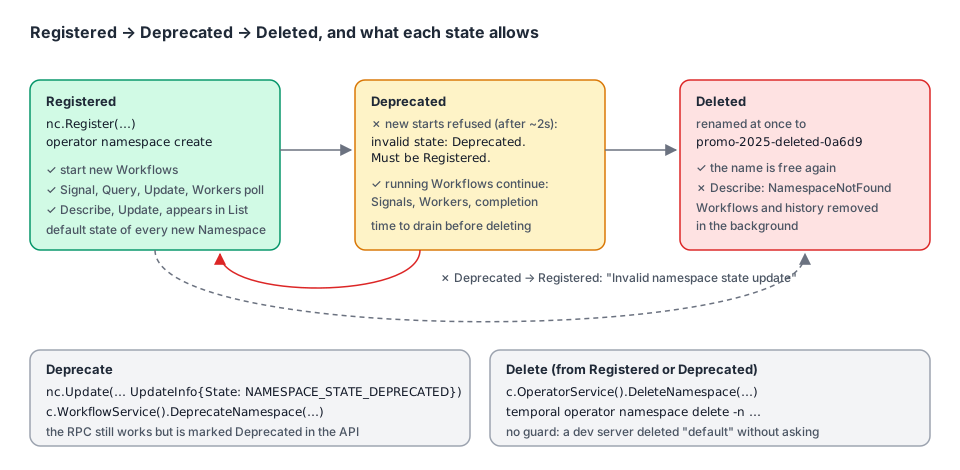
| State | New Workflow starts | Running Workflows | Listed | Describe |
|---|---|---|---|---|
Registered | ✓ | ✓ | ✓ | ✓ |
Deprecated | ✗ refused | ✓ Signals, Workers and completion keep working | ✓ | ✓ |
Deleted (DeleteNamespace) | ✗ | ✗ removed in the background | ✗ | NamespaceNotFound |
The state only moves forward. UpdateNamespaceInfo.State documents the allowed transitions as Registered -> [ Deleted | Deprecated | Handover ]. Trying to bring a Deprecated Namespace back to Registered failed on a dev server with Invalid namespace state update. Deprecation is one-way.
3. Deprecating
NamespaceClient has no Deprecate method. Set the state with Update:
// file: internal/nsadmin/deprecate.go
package nsadmin

import (
	"context"

	enumspb "go.temporal.io/api/enums/v1"
	namespacepb "go.temporal.io/api/namespace/v1"
	"go.temporal.io/api/workflowservice/v1"
	"go.temporal.io/sdk/client"
)

// Deprecate stops new Workflow starts in the Namespace. It can't be undone.
func Deprecate(ctx context.Context, nc client.NamespaceClient, name string) error {
	return nc.Update(ctx, &workflowservice.UpdateNamespaceRequest{
		Namespace:  name,
		UpdateInfo: &namespacepb.UpdateNamespaceInfo{State: enumspb.NAMESPACE_STATE_DEPRECATED},
	})
}
There is also a dedicated RPC, c.WorkflowService().DeprecateNamespace(…). It still works (it deprecated a Namespace on a dev server), but the API marks it "Deprecated." itself. Use Update.
What deprecation does, observed on a dev server (Server 1.32.0):
- New starts are refused, with
Namespace has invalid state: Deprecated. Must be Registered. - Not instantly. A start sent right after the
Updatecall still succeeded; one sent 2 seconds later was refused. The Frontend caches Namespace state, so expect a short window. - Running Workflows continue. A campaign Workflow waiting for a Signal received it after the deprecation and completed normally. Its Worker kept polling. This matches the API comment: "Existing workflow executions will continue to run on deprecated namespaces."
That makes deprecation the right first step of a retirement: it closes the door and lets the house empty itself.
4. Deleting
Deletion goes through the Operator Service:
// file: internal/nsadmin/delete.go
package nsadmin

import (
	"context"

	"go.temporal.io/api/operatorservice/v1"
	"go.temporal.io/sdk/client"
)

// Delete removes a Namespace and all its Workflow Executions. It returns the name
// the Service gave the deleted Namespace. Prefer RetireNamespace, which checks first.
func Delete(ctx context.Context, c client.Client, name string) (string, error) {
	resp, err := c.OperatorService().DeleteNamespace(ctx, &operatorservice.DeleteNamespaceRequest{Namespace: name})
	if err != nil {
		return "", err
	}
	return resp.GetDeletedNamespace(), nil
}
The API describes it as "synchronously deletes a namespace and asynchronously reclaims all namespace resources". On a dev server:
| Step | What happened |
|---|---|
DeleteNamespace("billing-dev") | Returned DeletedNamespace: "billing-dev-deleted-fa1ec": the Namespace is renamed at once |
Describe("billing-dev") right after | NamespaceNotFound |
ListNamespaces | Neither name is listed |
Register("billing-dev") 3 seconds later | Succeeded: the name is free again |
| Its Workflow Executions | Removed in the background, running ones included (the Go page says so too) |
No safety net
The Service doesn't protect anything. On a dev server, DeleteNamespace("default") succeeded with no confirmation, and every Workflow in default went with it. Your tooling must refuse protected names itself (section 6).
"Deleted" through Update is not a delete
UpdateNamespaceInfo.State also accepts NAMESPACE_STATE_DELETED. Setting it doesn't delete anything: on a dev server the Namespace disappeared from ListNamespaces and refused new starts (invalid state: Deleted), but Describe still returned it and its data stayed. It still needed a real DeleteNamespace. Don't use this path.
5. Workers don't notice
Stop the Workers before you delete their Namespace. In a dev-server test, a Worker polling a Namespace kept running after DeleteNamespace: Run didn't return, OnFatalError wasn't called and nothing was logged for 30+ seconds. NamespaceNotFound is one of the errors the SDK treats as fatal (Workers guide, chapter 04), but polling a deleted Namespace didn't produce it.
So a forgotten Worker just sits there, using a connection and showing as healthy. Remove its Deployment first, and alert on Workers whose Namespace no longer exists (for example by checking the Namespace with Describe in the Worker's health check).
6. A guarded RetireNamespace
The three steps (deprecate, drain, delete) in one function. It refuses protected names, waits for running Workflows to finish (counted with a Visibility query, as in the Client guide, chapter 08), and deletes only when the Namespace is empty, unless you force it:
// file: internal/nsadmin/retire.go
package nsadmin

import (
	"context"
	"errors"
	"fmt"
	"log/slog"
	"time"

	enumspb "go.temporal.io/api/enums/v1"
	"go.temporal.io/api/workflowservice/v1"
	"go.temporal.io/sdk/client"
)

// protected Namespaces can never be retired by this tool. The Service itself
// doesn't stop you: a dev server deleted "default" without a question.
var protected = map[string]bool{
	"default":         true,
	"temporal-system": true,
	"shop-prod":       true,
	"billing-prod":    true,
}

var ErrProtected = errors.New("namespace is protected")

type RetireOptions struct {
	// How long to wait for running Workflows to finish after deprecation.
	DrainTimeout time.Duration
	// How often to count running Workflows while draining.
	PollInterval time.Duration
	// Delete even if Workflows are still running when DrainTimeout expires.
	Force bool
}

// RetireNamespace deprecates a Namespace (no new Workflows), waits for its running
// Workflows to drain, then deletes it. It returns the name the Service gave the
// deleted Namespace (e.g. "promo-2025-deleted-1a2b3").
//
// c is any Client on the same Service; nc is a NamespaceClient.
func RetireNamespace(ctx context.Context, c client.Client, nc client.NamespaceClient, name string, opts RetireOptions, log *slog.Logger) (string, error) {
	if protected[name] {
		return "", fmt.Errorf("retire %q: %w", name, ErrProtected)
	}

	// 1. Deprecate (section 3), unless a previous run already did.
	desc, err := nc.Describe(ctx, name)
	if err != nil {
		return "", fmt.Errorf("describe %q: %w", name, err)
	}
	if desc.GetNamespaceInfo().GetState() == enumspb.NAMESPACE_STATE_REGISTERED {
		if err := Deprecate(ctx, nc, name); err != nil {
			return "", fmt.Errorf("deprecate %q: %w", name, err)
		}
		log.Info("namespace deprecated, new Workflow starts are refused", "namespace", name)
	}

	// 2. Drain: running Workflows keep going in a Deprecated Namespace.
	nsClient, err := client.NewClientFromExisting(c, client.Options{Namespace: name})
	if err != nil {
		return "", err
	}
	defer nsClient.Close()

	deadline := time.Now().Add(opts.DrainTimeout)
	for {
		resp, err := nsClient.CountWorkflow(ctx, &workflowservice.CountWorkflowExecutionsRequest{
			Namespace: name,
			Query:     `ExecutionStatus = "Running"`,
		})
		if err != nil {
			return "", fmt.Errorf("count running workflows in %q: %w", name, err)
		}
		running := resp.GetCount()
		if running == 0 {
			break
		}
		if time.Now().After(deadline) {
			if !opts.Force {
				return "", fmt.Errorf("retire %q: %d Workflows still running after %s", name, running, opts.DrainTimeout)
			}
			log.Warn("deleting with running Workflows", "namespace", name, "running", running)
			break
		}
		log.Info("waiting for Workflows to finish", "namespace", name, "running", running)
		select {
		case <-ctx.Done():
			return "", ctx.Err()
		case <-time.After(opts.PollInterval):
		}
	}

	// 3. Delete (section 4). The Namespace is renamed at once and its Workflows are
	// removed in the background.
	renamed, err := Delete(ctx, c, name)
	if err != nil {
		return "", fmt.Errorf("delete %q: %w", name, err)
	}
	log.Info("namespace deleted", "namespace", name, "renamedTo", renamed)
	return renamed, nil
}
A command around it, for the platform team:
// file: cmd/retire-namespace/main.go
package main

import (
	"context"
	"flag"
	"log"
	"log/slog"
	"os"
	"time"

	"go.temporal.io/sdk/client"
	"go.temporal.io/sdk/contrib/envconfig"

	"github.com/acme/shop/internal/nsadmin"
)

func main() {
	drain := flag.Duration("drain-timeout", 30*time.Minute, "how long to wait for running Workflows")
	force := flag.Bool("force", false, "delete even if Workflows are still running")
	flag.Parse()
	if flag.NArg() != 1 {
		log.Fatal("usage: retire-namespace [-drain-timeout 30m] [-force] <namespace>")
	}
	name := flag.Arg(0)

	opts, err := envconfig.LoadDefaultClientOptions()
	if err != nil {
		log.Fatal(err)
	}
	c, err := client.Dial(opts)
	if err != nil {
		log.Fatal(err)
	}
	defer c.Close()
	nc, err := client.NewNamespaceClient(opts)
	if err != nil {
		log.Fatal(err)
	}
	defer nc.Close()

	logger := slog.New(slog.NewTextHandler(os.Stderr, nil))
	ctx, cancel := context.WithTimeout(context.Background(), *drain+time.Minute)
	defer cancel()
	renamed, err := nsadmin.RetireNamespace(ctx, c, nc, name, nsadmin.RetireOptions{
		DrainTimeout: *drain,
		PollInterval: 5 * time.Second,
		Force:        *force,
	}, logger)
	if err != nil {
		log.Fatal(err)
	}
	logger.Info("done", "deletedAs", renamed)
}
And the campaign Workflow from section 1, still running when retirement starts:
// file: promotions/workflow.go
package promotions

import (
	"go.temporal.io/sdk/workflow"
)

const TaskQueue = "promotions"

// SummerSaleWorkflow runs until marketing closes the campaign.
func SummerSaleWorkflow(ctx workflow.Context, campaignID string) (string, error) {
	var closedBy string
	workflow.GetSignalChannel(ctx, "close-campaign").Receive(ctx, &closedBy)
	return "campaign " + campaignID + " closed by " + closedBy, nil
}
A dev-server run, with one campaign still open (log trimmed, Namespace name adapted):
retire "default": namespace is protected
level=INFO msg="namespace deprecated, new Workflow starts are refused" namespace=promo-summer-2025
level=INFO msg="waiting for Workflows to finish" namespace=promo-summer-2025 running=1
level=INFO msg="waiting for Workflows to finish" namespace=promo-summer-2025 running=1
   new start in the deprecated Namespace → Namespace has invalid state: Deprecated. Must be Registered.
   Signal "close-campaign" → delivered, Workflow completed: "campaign summer-2025 closed by marketing@acme"
level=INFO msg="namespace deleted" namespace=promo-summer-2025 renamedTo=promo-summer-2025-deleted-0a6d9
What to adapt for production:
- Keep the protected list in configuration, and include every production Namespace.
- Make the drain timeout match your longest Workflows. If some never end (entity Workflows), close them first with a Signal or cancellation (Workflows guide, chapter 08).
- Run it after removing the Namespace's Workers (section 5).
- On Temporal Cloud, deletion goes through the Cloud UI or
temporal cloud namespace delete, with its own protection settings.
7. Key takeaways
- Deprecate with
nc.Update(… UpdateInfo{State: NAMESPACE_STATE_DEPRECATED}). It refuses new starts after a short delay, lets running Workflows finish, and can't be undone. - Delete with
c.OperatorService().DeleteNamespace. The Namespace is renamed to<name>-deleted-<id>at once, the name is reusable, and all its Workflows are removed in the background. - The Service has no guard: it deleted
defaulton a dev server. Protect names in your own tools. - Setting the state to
DeletedwithUpdatehides a Namespace but doesn't delete it. - Workers of a deleted Namespace keep running silently. Stop them first.