07 · Child Workflows: composing Workflows
Level: sub-feature · Read time: ~20 min Sources: Go SDK — Child Workflows · Encyclopedia — Cancellation and Termination · Encyclopedia — Workflow Execution limits · Encyclopedia — Events and Event History
1. The problem
The marketing team wants to change prices on 40 categories at once ("-10% on everything in Garden and Outdoor"). Each category has thousands of products. You could write one Workflow that calls RepriceProduct for every product, but:
- one history gets huge. Every Activity adds events to the Workflow's Event History. A history is limited to 51,200 events or 50 MB, and Temporal warns at 10,240 events or 10 MB.
- you can't act on one category. Support asks "is Garden done?" or "stop Garden, the supplier changed its prices". With one big Workflow there is nothing to query or cancel at that level.
- some work belongs to another team. The compliance team owns the audit trail of price changes, runs its own Workers, and its process must keep going even if the batch fails.
A Child Workflow Execution is a Workflow Execution started from inside another Workflow. It is a full Workflow: its own Workflow ID, its own Event History, its own Task Queue if you want, and it can be queried, signalled and cancelled on its own. The parent can wait for its result like it waits for an Activity.
2. How a Child Workflow is started
childCtx := workflow.WithChildOptions(ctx, workflow.ChildWorkflowOptions{ /* ... */ })
future := workflow.ExecuteChildWorkflow(childCtx, RepriceCategoryWorkflow, input) // ChildWorkflowFuture
err := future.Get(ctx, &result) // wait for the resultworkflow.ChildWorkflowOptionshas the same fields asclient.StartWorkflowOptions(Workflow ID, Task Queue, timeouts, Retry Policy, ID Reuse Policy, Memo…) plus child-only fields such asParentClosePolicyandWaitForCancellation.- Fields you don't set are inherited from the parent's options. If you don't set
WorkflowID, one is generated for you. ExecuteChildWorkflowreturns aChildWorkflowFuture:Get(ctx, &result)waits for the child's resultGetChildWorkflowExecution()returns another Future that resolves when the child has started. It gives you aworkflow.Execution(Workflow ID + Run ID).SignalChildWorkflow(ctx, name, data)sends a Signal to that child
The parent's Event History records the child's life:
| Event in the parent's history | Meaning |
|---|---|
StartChildWorkflowExecutionInitiated | the parent asked to start the child. It comes from a Command, so the call must stay deterministic (chapter 03) |
ChildWorkflowExecutionStarted | the child is running. Must be recorded before the parent completes, or the child isn't started |
ChildWorkflowExecutionCompleted (or …Failed, …Canceled, …TimedOut, …Terminated) | the child closed. Its result or error is now available to Get |
The child's own Activities, Timers and Signals live in the child's history, not the parent's. That is what keeps the parent's history small.
3. Parent Close Policy: what happens to children when the parent closes
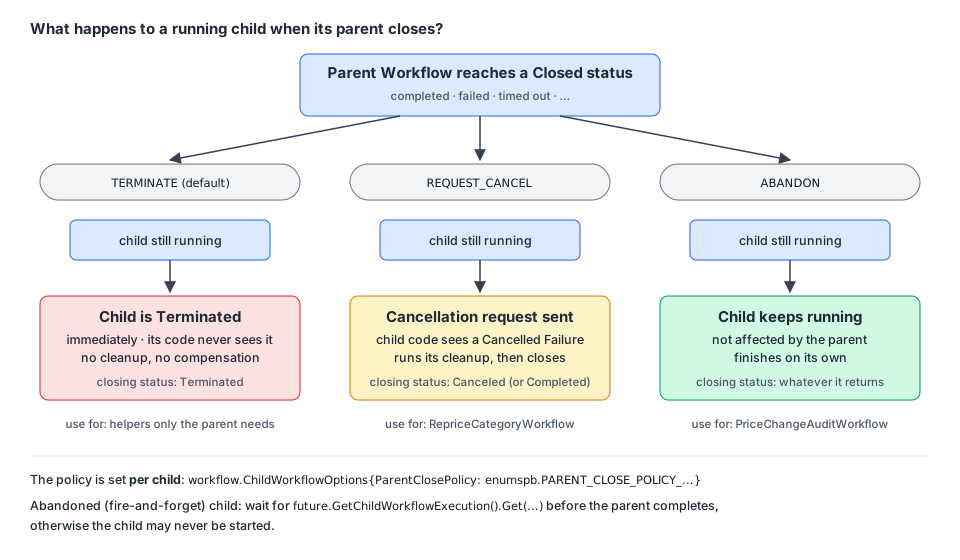
The Parent Close Policy is set per child, in ChildWorkflowOptions.ParentClosePolicy. It decides what happens to that child when the parent reaches a Closed status (completed, failed, timed out…). Values come from go.temporal.io/api/enums/v1:
| Policy | What happens to a still-running child | Use it when |
|---|---|---|
PARENT_CLOSE_POLICY_TERMINATE (default) | Terminated immediately. Its code never sees it and no cleanup runs | the child is only useful to its parent |
PARENT_CLOSE_POLICY_REQUEST_CANCEL | gets a Cancellation request, and can run its cleanup | the child should stop, but cleanly (release holds, compensate) |
PARENT_CLOSE_POLICY_ABANDON | not affected. It keeps running on its own | the child's work must finish whatever the parent does (audit, notifications) |
Because the policy is per child, one parent can terminate some children, cancel others, and leave the rest running.
4. The example: bulk repricing
BulkRepriceWorkflow  (batch "spring-sale")                    Task Queue: catalog
├── RepriceCategoryWorkflow  reprice-spring-sale-garden        Request Cancel on parent close
├── RepriceCategoryWorkflow  reprice-spring-sale-outdoor       Request Cancel on parent close
├── ...
└── PriceChangeAuditWorkflow price-audit-spring-sale           Abandon · Task Queue: compliance
Types and Activities
// file: catalog/types.go
package catalog

import "time"

const (
	TaskQueue           = "catalog"
	ComplianceTaskQueue = "compliance"
)

type BulkRepriceInput struct {
	BatchID       string
	Categories    []string
	PercentChange int64         // -10 means 10% cheaper
	MaxDuration   time.Duration // 0 = no deadline
	RequestedBy   string        // internal employee ID
}

type BulkRepriceResult struct {
	BatchID         string
	Categories      []RepriceCategoryResult
	TotalUpdated    int
	AuditWorkflowID string
}

type RepriceCategoryInput struct {
	BatchID       string
	Category      string
	PercentChange int64
}

type RepriceCategoryResult struct {
	Category        string
	ProductsUpdated int
}

type PriceChangeAuditInput struct {
	BatchID     string
	Categories  []string
	RequestedBy string
}

// RepriceWorkflowID gives every child a meaningful, unique ID: easy to find, query or cancel.
func RepriceWorkflowID(batchID, category string) string {
	return "reprice-" + batchID + "-" + category
}

func AuditWorkflowID(batchID string) string { return "price-audit-" + batchID }// file: catalog/activities.go
package catalog
import "context"
// PriceStore is your pricing database or service.
type PriceStore interface {
ApplyPercentChange(ctx context.Context, category string, percent int64, idempotencyKey string) (int, error)
}
// AuditLog is the compliance team's system of record.
type AuditLog interface {
Record(ctx context.Context, batchID string, categories []string, requestedBy string) error
}
type PricingActivities struct {
Prices PriceStore
}
// RepriceCategory updates every product of one category. The batch ID makes retries idempotent.
func (a *PricingActivities) RepriceCategory(ctx context.Context, in RepriceCategoryInput) (int, error) {
return a.Prices.ApplyPercentChange(ctx, in.Category, in.PercentChange, in.BatchID+"/"+in.Category)
}
type AuditActivities struct {
Log AuditLog
}
func (a *AuditActivities) RecordPriceChange(ctx context.Context, in PriceChangeAuditInput) error {
return a.Log.Record(ctx, in.BatchID, in.Categories, in.RequestedBy)
}The Child Workflows
A child is a regular Workflow Definition. Nothing in its code says "I am a child".
// file: catalog/children.go
package catalog

import (
	"time"

	"go.temporal.io/sdk/workflow"
)

// RepriceCategoryWorkflow reprices one category. It can also be started on its own.
func RepriceCategoryWorkflow(ctx workflow.Context, in RepriceCategoryInput) (RepriceCategoryResult, error) {
	ctx = workflow.WithActivityOptions(ctx, workflow.ActivityOptions{StartToCloseTimeout: 10 * time.Minute})

	var a *PricingActivities
	var updated int
	if err := workflow.ExecuteActivity(ctx, a.RepriceCategory, in).Get(ctx, &updated); err != nil {
		return RepriceCategoryResult{}, err
	}
	return RepriceCategoryResult{Category: in.Category, ProductsUpdated: updated}, nil
}

// PriceChangeAuditWorkflow is owned by the compliance team and runs on their Task Queue.
func PriceChangeAuditWorkflow(ctx workflow.Context, in PriceChangeAuditInput) error {
	ctx = workflow.WithActivityOptions(ctx, workflow.ActivityOptions{StartToCloseTimeout: time.Minute})

	var a *AuditActivities
	return workflow.ExecuteActivity(ctx, a.RecordPriceChange, in).Get(ctx, nil)
}
The parent: fan out, then collect
Start all children first and keep their futures. Only then call Get. If you called Get right after each ExecuteChildWorkflow, the categories would run one after another.
// file: catalog/parent.go
package catalog

import (
	"errors"
	"fmt"

	enumspb "go.temporal.io/api/enums/v1"
	"go.temporal.io/sdk/temporal"
	"go.temporal.io/sdk/workflow"
)

func BulkRepriceWorkflow(ctx workflow.Context, in BulkRepriceInput) (BulkRepriceResult, error) {
	logger := workflow.GetLogger(ctx)
	result := BulkRepriceResult{BatchID: in.BatchID}

	// Cancelling childrenCtx sends a Cancellation request to every child started with it.
	childrenCtx, cancelChildren := workflow.WithCancel(ctx)
	defer cancelChildren()
	if in.MaxDuration > 0 {
		// The Timer uses childrenCtx, so the deferred cancelChildren() also cancels it.
		workflow.Go(childrenCtx, func(ctx workflow.Context) {
			// A durable Timer: if the batch takes too long, stop the remaining categories.
			if err := workflow.NewTimer(ctx, in.MaxDuration).Get(ctx, nil); err == nil {
				logger.Warn("Batch deadline reached, cancelling remaining categories", "batchID", in.BatchID)
				cancelChildren()
			}
		})
	}

	// 1. Fan out: one child per category.
	futures := make([]workflow.ChildWorkflowFuture, 0, len(in.Categories))
	for _, category := range in.Categories {
		cctx := workflow.WithChildOptions(childrenCtx, workflow.ChildWorkflowOptions{
			WorkflowID: RepriceWorkflowID(in.BatchID, category),
			// If the parent closes early (failure, timeout), stop the children cleanly.
			ParentClosePolicy: enumspb.PARENT_CLOSE_POLICY_REQUEST_CANCEL,
			// When we cancel a child, wait until it has really ended before Get returns.
			WaitForCancellation: true,
		})
		futures = append(futures, workflow.ExecuteChildWorkflow(cctx, RepriceCategoryWorkflow, RepriceCategoryInput{
			BatchID:       in.BatchID,
			Category:      category,
			PercentChange: in.PercentChange,
		}))
	}

	// 2. Collect: wait for each child's result.
	var failed []string
	for i, future := range futures {
		var r RepriceCategoryResult
		if err := future.Get(ctx, &r); err != nil {
			var childErr *temporal.ChildWorkflowExecutionError
			if errors.As(err, &childErr) && temporal.IsCanceledError(err) {
				logger.Warn("Category cancelled", "category", in.Categories[i])
			} else {
				logger.Error("Category failed", "category", in.Categories[i], "error", err)
			}
			failed = append(failed, in.Categories[i])
			continue
		}
		result.Categories = append(result.Categories, r)
		result.TotalUpdated += r.ProductsUpdated
	}

	// 3. Fire-and-forget audit child (see section 5).
	auditID, err := startAudit(ctx, in)
	if err != nil {
		return result, err
	}
	result.AuditWorkflowID = auditID

	if len(failed) > 0 {
		return result, fmt.Errorf("%d of %d categories not repriced: %v", len(failed), len(in.Categories), failed)
	}
	return result, nil
}
When a child fails, Get returns a *temporal.ChildWorkflowExecutionError. It wraps the real cause, which can be an *ApplicationError, a *TimeoutError or a *CanceledError. Use errors.As on it, or helpers like temporal.IsCanceledError.
5. Async ("fire-and-forget") children
Sometimes the parent must start a child but not wait for it. The audit trail is a good example: it belongs to the compliance team, and it must be written even if the parent fails right after. Two rules from the docs:
- Set
ParentClosePolicy: PARENT_CLOSE_POLICY_ABANDON. Otherwise the default policy terminates the child when the parent closes. - Wait until the child has started before the parent completes:
future.GetChildWorkflowExecution().Get(ctx, &execution). If the parent callsExecuteChildWorkflowand completes right away, the child is not started.
// file: catalog/audit.go
package catalog

import (
	enumspb "go.temporal.io/api/enums/v1"
	"go.temporal.io/sdk/workflow"
)

// startAudit starts the audit child and returns as soon as it is running.
func startAudit(ctx workflow.Context, in BulkRepriceInput) (string, error) {
	cctx := workflow.WithChildOptions(ctx, workflow.ChildWorkflowOptions{
		WorkflowID:        AuditWorkflowID(in.BatchID),
		TaskQueue:         ComplianceTaskQueue, // polled by the compliance team's Workers
		ParentClosePolicy: enumspb.PARENT_CLOSE_POLICY_ABANDON,
	})
	future := workflow.ExecuteChildWorkflow(cctx, PriceChangeAuditWorkflow, PriceChangeAuditInput{
		BatchID:     in.BatchID,
		Categories:  in.Categories,
		RequestedBy: in.RequestedBy,
	})

	// Wait for ChildWorkflowExecutionStarted, not for the result.
	var execution workflow.Execution
	if err := future.GetChildWorkflowExecution().Get(ctx, &execution); err != nil {
		return "", err
	}
	return execution.ID, nil
}
❌ Don't start an abandoned child and return immediately without waiting for
GetChildWorkflowExecution(). The start is requested, but the child is only guaranteed to exist onceChildWorkflowExecutionStartedis in the parent's history.
6. Cancelling children
There are three ways a child receives a Cancellation request:
| Trigger | How |
|---|---|
| The parent cancels it on purpose | cancel the context passed to ExecuteChildWorkflow (workflow.WithCancel), like the deadline in BulkRepriceWorkflow |
| The parent closes | PARENT_CLOSE_POLICY_REQUEST_CANCEL |
| An operator | temporal workflow cancel --workflow-id reprice-spring-sale-garden: children have their own Workflow ID |
When the child handles it, the parent's history records ChildWorkflowExecutionCanceled and Get returns a ChildWorkflowExecutionError whose cause is a CanceledError.
WaitForCancellation controls when Get returns after you cancel:
false(default):Getreturns right away with the cancellation error. The child may still be running its cleanup.true:Getreturns only once the child has really ended (completed, failed, timed out, terminated or cancelled).
Use true when the parent must not continue until the child's cleanup is done. Chapter 08 covers how a Workflow reacts to a Cancellation request and runs its cleanup.
7. The Workers
The parent and its repricing children share the catalog Task Queue. The audit child runs on the compliance team's Workers. A child can run on any Task Queue; the Worker there must register the Workflow Type.
// file: cmd/catalog-worker/main.go
package main

import (
	"context"
	"log"

	"github.com/acme/shop/catalog"
	"go.temporal.io/sdk/client"
	"go.temporal.io/sdk/worker"
)

type fakePriceStore struct{}

func (fakePriceStore) ApplyPercentChange(ctx context.Context, category string, percent int64, key string) (int, error) {
	return 1200, nil
}

func main() {
	c, err := client.Dial(client.Options{})
	if err != nil {
		log.Fatalln("Unable to create client", err)
	}
	defer c.Close()

	w := worker.New(c, catalog.TaskQueue, worker.Options{})
	w.RegisterWorkflow(catalog.BulkRepriceWorkflow)
	w.RegisterWorkflow(catalog.RepriceCategoryWorkflow)
	w.RegisterActivity(&catalog.PricingActivities{Prices: fakePriceStore{}})

	if err := w.Run(worker.InterruptCh()); err != nil {
		log.Fatalln("Unable to start Worker", err)
	}
}// file: cmd/compliance-worker/main.go
package main
import (
"context"
"log"
"github.com/acme/shop/catalog"
"go.temporal.io/sdk/client"
"go.temporal.io/sdk/worker"
)
type stdoutAuditLog struct{}
func (stdoutAuditLog) Record(ctx context.Context, batchID string, categories []string, requestedBy string) error {
log.Printf("AUDIT batch=%s categories=%v by=%s", batchID, categories, requestedBy)
return nil
}
func main() {
c, err := client.Dial(client.Options{})
if err != nil {
log.Fatalln("Unable to create client", err)
}
defer c.Close()
w := worker.New(c, catalog.ComplianceTaskQueue, worker.Options{})
w.RegisterWorkflow(catalog.PriceChangeAuditWorkflow)
w.RegisterActivity(&catalog.AuditActivities{Log: stdoutAuditLog{}})
if err := w.Run(worker.InterruptCh()); err != nil {
log.Fatalln("Unable to start Worker", err)
}
}And the starter:
// file: cmd/start-reprice/main.go
package main

import (
	"context"
	"log"
	"time"

	"github.com/acme/shop/catalog"
	"go.temporal.io/sdk/client"
)

func main() {
	c, err := client.Dial(client.Options{})
	if err != nil {
		log.Fatalln("Unable to create client", err)
	}
	defer c.Close()

	in := catalog.BulkRepriceInput{
		BatchID:       "spring-sale",
		Categories:    []string{"garden", "outdoor", "bbq"},
		PercentChange: -10,
		MaxDuration:   2 * time.Hour,
		RequestedBy:   "emp-0451",
	}
	run, err := c.ExecuteWorkflow(context.Background(), client.StartWorkflowOptions{
		ID:        "bulk-reprice-" + in.BatchID,
		TaskQueue: catalog.TaskQueue,
	}, catalog.BulkRepriceWorkflow, in)
	if err != nil {
		log.Fatalln("Unable to start", err)
	}

	var result catalog.BulkRepriceResult
	if err := run.Get(context.Background(), &result); err != nil {
		log.Fatalln("Batch failed", err)
	}
	log.Printf("Repriced %d products, audit in %s", result.TotalUpdated, result.AuditWorkflowID)
}
8. Child Workflow or Activity?
A child is not "a bigger Activity". Workflow code still can't do I/O. A child orchestrates, and Activities do the work. Pick a child when you need one of these:
| You need… | Child Workflow | Activity |
|---|---|---|
| To call an API, a DB, a file system | ❌ (it calls Activities itself) | ✅ |
| To split a big job so no history gets too large | ✅ each child has its own history. The parent only records a few events per child | ❌ every Activity adds events to the caller's history |
| A separate Task Queue / team / service | ✅ TaskQueue option | ✅ TaskQueue option |
| Its own ID to query, signal or cancel | ✅ | ❌ |
| To keep running after the caller is gone | ✅ PARENT_CLOSE_POLICY_ABANDON | ❌ |
| Long waits (Timers, Signals) inside the step | ✅ | ❌ |
Limits still apply. By default, a Workflow can have at most 2,000 incomplete Child Workflows at the same time (NumPendingChildExecutionsLimit). Past that, starting another one makes the Workflow Task fail and retry. For a really large fan-out, start children in batches, or give each child a slice of the work. And a parent that starts many children over time can still reach its own history limit. Combine children with Continue-As-New (chapter 09).
Key takeaways
- A Child Workflow is a full Workflow Execution started from a Workflow:
workflow.ExecuteChildWorkflow(workflow.WithChildOptions(ctx, opts), ChildFn, input). - Options you don't set are inherited from the parent. Set a meaningful
WorkflowIDanyway. - Start all children first, then
Getthe futures, to run them in parallel. - The Parent Close Policy is per child: Terminate (default), Request Cancel, or Abandon.
- For fire-and-forget, use Abandon and wait for
GetChildWorkflowExecution()before the parent completes. - Cancel a child by cancelling its context.
WaitForCancellation: truemakesGetwait for the child to really end. - Children split work across histories and teams. Activities still do the I/O.
⬅️ Previous: 06 · Message passing · ➡️ Next: 08 · Cancel, terminate, pause & reset