04 · Timeouts, Retry Policies & Heartbeats
Level: core concept · Read time: ~20 min Sources: Go SDK — Activity Timeouts · Go SDK — Activity Execution · Encyclopedia — Activity Definition (retry policy)
Timeouts, Retry Policies and Heartbeats are how Temporal makes an Activity durable:
- Timeouts tell the Service when to stop waiting. They are its only way to notice that a Worker died.
- The Retry Policy says what to do after a failure: retry when, how often, and up to when.
- Heartbeats let long Activities prove they are alive, save a checkpoint, and receive cancellation.
1. The four Activity timeouts
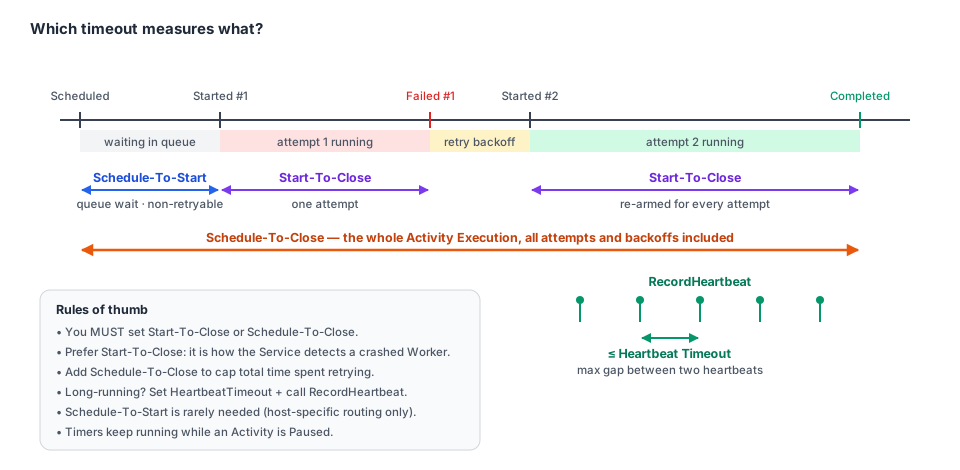
| Timeout | Measures | Retryable? | When to set it |
|---|---|---|---|
| Start-To-Close | One attempt, from the moment a Worker picks it up to the result | ✅ a timed-out attempt is retried | Almost always. It's how a crashed Worker is detected. Set it a bit above the longest normal attempt. |
| Schedule-To-Close | The whole Activity Execution: all attempts and backoffs | ❌ ends the Execution | To cap the total time spent retrying (an SLA) |
| Schedule-To-Start | Time an Activity Task waits in the queue before a Worker picks it up | ❌ non-retryable by design: retrying would put the task back in the same queue | Rarely; mainly for host-specific routing |
| Heartbeat | Max gap between two heartbeats of a running attempt | ✅ treated as a failed attempt | For long-running Activities (see §4) |
⚠️ You must set Start-To-Close or Schedule-To-Close. If you set only Schedule-To-Close, Start-To-Close defaults to the same value. Then a single hung attempt can use the whole budget. Prefer setting Start-To-Close explicitly.
// file: catalog/timeouts_example.go
package catalog

import (
	"time"

	"go.temporal.io/sdk/workflow"
)

func timeoutsExample(ctx workflow.Context) workflow.Context {
	return workflow.WithActivityOptions(ctx, workflow.ActivityOptions{
		StartToCloseTimeout:    30 * time.Second, // each attempt: 30s max
		ScheduleToCloseTimeout: 10 * time.Minute, // give up after 10 min of retries in total
		// ScheduleToStartTimeout: 1 * time.Minute, // only with host-specific Task Queues
	})
}
2. What Temporal guarantees about attempts
- Temporal guarantees that an Activity Task either runs or times out. A task can be lost on its way to a Worker, or after the function started and the Worker crashed. Temporal doesn't detect this directly: the Start-To-Close timeout expires and the Retry Policy applies.
- Each attempt starts from the beginning of your function, unless you use Heartbeat details as a checkpoint (§5).
3. Retry Policy
Activities retry automatically by default: exponential backoff and unlimited attempts, bounded only by Schedule-To-Close. The default policy is:
// file: catalog/retry_default.go
package catalog

import (
	"time"

	"go.temporal.io/sdk/temporal"
)

// What you get if you set no RetryPolicy at all:
var DefaultActivityRetryPolicy = &temporal.RetryPolicy{
	InitialInterval:        time.Second,
	BackoffCoefficient:     2.0,
	MaximumInterval:        100 * time.Second, // 100 × InitialInterval
	MaximumAttempts:        0,                 // 0 = unlimited
	NonRetryableErrorTypes: []string{},        // none
}| Field | Meaning |
|---|---|
InitialInterval | Delay before the first retry |
BackoffCoefficient | Multiplier applied to the delay after each retry |
MaximumInterval | Upper bound for the delay |
MaximumAttempts | 0 = unlimited, 1 = no retries (at-most-once) |
NonRetryableErrorTypes | ApplicationError types that stop retries immediately |
A custom policy replaces the individual fields you set. You still need a timeout.
Example: a supplier API
// file: catalog/activities.go
package catalog

import (
	"context"
	"errors"
	"fmt"
	"time"

	"go.temporal.io/sdk/activity"
	"go.temporal.io/sdk/temporal"
)

type SupplierPriceRequest struct {
	SupplierID string
	SKU        string
}

type SupplierPrice struct {
	SKU        string
	PriceCents int64
}

// Errors returned by the (fake) supplier HTTP client.
var (
	ErrUnknownSKU  = errors.New("supplier: unknown SKU")
	ErrRateLimited = errors.New("supplier: 429 too many requests")
)

type SupplierClient interface {
	GetPrice(ctx context.Context, supplierID, sku string) (int64, error)
}

type CatalogActivities struct {
	Supplier SupplierClient
	Rows     RowSource
}

func (a *CatalogActivities) FetchSupplierPrice(ctx context.Context, in SupplierPriceRequest) (SupplierPrice, error) {
	price, err := a.Supplier.GetPrice(ctx, in.SupplierID, in.SKU)
	switch {
	case errors.Is(err, ErrUnknownSKU):
		// Retrying won't help: fail the Activity Execution now.
		return SupplierPrice{}, temporal.NewNonRetryableApplicationError(
			fmt.Sprintf("SKU %s not sold by %s", in.SKU, in.SupplierID), "UnknownSKU", err)

	case errors.Is(err, ErrRateLimited):
		// Retry, but wait longer on each attempt instead of using the policy's interval.
		attempt := activity.GetInfo(ctx).Attempt
		return SupplierPrice{}, temporal.NewApplicationErrorWithOptions(
			"supplier rate limited", "RateLimited", temporal.ApplicationErrorOptions{
				NextRetryDelay: 3 * time.Second * time.Duration(attempt),
				Cause:          err,
			})

	case err != nil:
		return SupplierPrice{}, err // plain error: retryable, default backoff
	}
	return SupplierPrice{SKU: in.SKU, PriceCents: price}, nil
}
Three ways to stop or shape retries:
- From the Activity: return
temporal.NewNonRetryableApplicationError(msg, type, cause). - From the caller: list error types in
RetryPolicy.NonRetryableErrorTypes. Only that caller treats them as fatal. - Override the next delay: return an
ApplicationErrorwithNextRetryDelay. It replaces the interval the Retry Policy would have computed for that retry.
// file: catalog/workflow_prices.go
package catalog

import (
	"time"

	"go.temporal.io/sdk/temporal"
	"go.temporal.io/sdk/workflow"
)

func RefreshSupplierPricesWorkflow(ctx workflow.Context, supplierID string, skus []string) (map[string]int64, error) {
	ctx = workflow.WithActivityOptions(ctx, workflow.ActivityOptions{
		StartToCloseTimeout:    15 * time.Second,
		ScheduleToCloseTimeout: 5 * time.Minute,
		RetryPolicy: &temporal.RetryPolicy{
			InitialInterval:        2 * time.Second,
			BackoffCoefficient:     2.0,
			MaximumInterval:        30 * time.Second,
			MaximumAttempts:        8,
			NonRetryableErrorTypes: []string{"UnknownSKU", "InvalidSupplier"},
		},
	})

	var a *CatalogActivities
	prices := make(map[string]int64, len(skus))
	for _, sku := range skus {
		var p SupplierPrice
		err := workflow.ExecuteActivity(ctx, a.FetchSupplierPrice, SupplierPriceRequest{SupplierID: supplierID, SKU: sku}).Get(ctx, &p)
		if err != nil {
			workflow.GetLogger(ctx).Warn("price refresh failed", "sku", sku, "error", err)
			continue
		}
		prices[sku] = p.PriceCents
	}
	return prices, nil
}
💡 At-most-once: for something that must never run twice and can't be made idempotent, set
MaximumAttempts: 1. You then handle the failure yourself in the Workflow.
⚠️ Don't hand-roll retry loops inside the Activity. Return the error and let the policy work. You keep metrics and UI visibility, and your timeouts stay short.
4. Heartbeats
An Activity Heartbeat is a ping from the Worker running the Activity to the Service. It says "I'm alive and making progress". Heartbeats give you three things:
| Benefit | How |
|---|---|
| Fast failure detection for long attempts | If no heartbeat arrives within HeartbeatTimeout, the attempt fails (timeout type Heartbeat) and is retried. You don't wait for a long Start-To-Close. |
| Checkpointing | Heartbeat details are stored. The next attempt can read the last ones and resume. |
| Cancellation delivery | Cancel, Pause and Reset requests are delivered only through the heartbeat response. An Activity that never heartbeats can't be cancelled while it runs. |
Rules of thumb:
- An Activity should either finish within a few minutes or heartbeat.
- Set
HeartbeatTimeoutand callactivity.RecordHeartbeatwell within that interval. - The Worker throttles heartbeats, so not every call reaches the Service, and cancellation can arrive a bit later than expected.
// file: catalog/heartbeat_simple.go
package catalog

import (
	"context"
	"fmt"

	"go.temporal.io/sdk/activity"
)

type ResizeImagesInput struct {
	ProductID string
	ImageKeys []string
}

type ResizeImagesResult struct {
	ProcessedCount int
}

func (a *CatalogActivities) ResizeProductImages(ctx context.Context, in ResizeImagesInput) (ResizeImagesResult, error) {
	for i, key := range in.ImageKeys {
		// ... download, resize, upload `key` ...
		_ = key
		activity.RecordHeartbeat(ctx, fmt.Sprintf("processed image %d/%d", i+1, len(in.ImageKeys)))
	}
	return ResizeImagesResult{ProcessedCount: len(in.ImageKeys)}, nil
}
5. Heartbeat details as a resumable checkpoint

A retry restarts your function from the top. It does not resume in the middle. What carries over is the last recorded heartbeat details. Read them at the start and skip the work that is already done.
// file: catalog/import.go
package catalog

import (
	"context"
	"time"

	"go.temporal.io/sdk/activity"
)

// RowSource streams rows of a large supplier CSV stored in object storage.
type RowSource interface {
	Count(ctx context.Context, fileKey string) (int, error)
	UpsertRow(ctx context.Context, fileKey string, row int) error // idempotent upsert by SKU
}

type ImportCatalogInput struct {
	FileKey string // e.g. "s3://supplier-feeds/acme-2026-10-23.csv"
}

type ImportCatalogResult struct {
	RowsImported int
}

func (a *CatalogActivities) ImportProductCatalog(ctx context.Context, in ImportCatalogInput) (ImportCatalogResult, error) {
	logger := activity.GetLogger(ctx)

	// 1) Resume from the last checkpoint if a previous attempt recorded one.
	startRow := 0
	if activity.HasHeartbeatDetails(ctx) {
		var lastDone int
		if err := activity.GetHeartbeatDetails(ctx, &lastDone); err == nil {
			startRow = lastDone + 1
			logger.Info("Resuming import", "fromRow", startRow, "attempt", activity.GetInfo(ctx).Attempt)
		}
	}

	total, err := a.Rows.Count(ctx, in.FileKey)
	if err != nil {
		return ImportCatalogResult{}, err
	}

	// 2) Process and heartbeat the index of the last finished row.
	for row := startRow; row < total; row++ {
		select {
		case <-ctx.Done(): // cancelled / timed out / paused: stop cleanly (chapter 05)
			return ImportCatalogResult{}, ctx.Err()
		default:
		}
		if err := a.Rows.UpsertRow(ctx, in.FileKey, row); err != nil {
			return ImportCatalogResult{}, err // retried; next attempt resumes after the last heartbeat
		}
		activity.RecordHeartbeat(ctx, row)
	}
	return ImportCatalogResult{RowsImported: total}, nil
}

// ImportTimeouts: a long Start-To-Close, but a short Heartbeat Timeout so a dead
// Worker is detected in ~30s instead of 2h.
const (
	ImportStartToClose = 2 * time.Hour
	ImportHeartbeat    = 30 * time.Second
)
⚠️ The rows processed between the last heartbeat that reached the Service and the crash run again. Keep the per-row work idempotent (an upsert, not an insert).
Setting the Heartbeat Timeout and reading heartbeat details on failure
When an attempt times out because of a missed heartbeat, and no retry is left, the Workflow gets a *temporal.TimeoutError with TimeoutType() == TIMEOUT_TYPE_HEARTBEAT. The last heartbeat details are attached to it.
// file: catalog/workflow_import.go
package catalog

import (
	"errors"

	enumspb "go.temporal.io/api/enums/v1"
	"go.temporal.io/sdk/temporal"
	"go.temporal.io/sdk/workflow"
)

func ImportCatalogWorkflow(ctx workflow.Context, fileKey string) (int, error) {
	ctx = workflow.WithActivityOptions(ctx, workflow.ActivityOptions{
		StartToCloseTimeout: ImportStartToClose,
		HeartbeatTimeout:    ImportHeartbeat,
		RetryPolicy:         &temporal.RetryPolicy{MaximumAttempts: 5},
	})

	var a *CatalogActivities
	var res ImportCatalogResult
	err := workflow.ExecuteActivity(ctx, a.ImportProductCatalog, ImportCatalogInput{FileKey: fileKey}).Get(ctx, &res)

	var timeoutErr *temporal.TimeoutError
	if errors.As(err, &timeoutErr) && timeoutErr.TimeoutType() == enumspb.TIMEOUT_TYPE_HEARTBEAT {
		var lastRow int
		if timeoutErr.HasLastHeartbeatDetails() {
			_ = timeoutErr.LastHeartbeatDetails(&lastRow)
		}
		workflow.GetLogger(ctx).Error("import kept losing its Worker", "lastCheckpointRow", lastRow)
		return lastRow, err
	}
	if err != nil {
		return 0, err
	}
	return res.RowsImported, nil
}
Heartbeating from outside the Worker
If the work is done by another system, as in async completion, that system can heartbeat with the Task Token through a Temporal Client:
// file: catalog/external_heartbeat.go
package catalog

import (
	"context"

	"go.temporal.io/sdk/client"
)

// ReportTranscodeProgress runs in the external transcoding service, not in a Worker.
func ReportTranscodeProgress(ctx context.Context, c client.Client, taskToken []byte, percent int) error {
	return c.RecordActivityHeartbeat(ctx, taskToken, percent)
}
6. Picking values: a cheat sheet
| Activity kind | Start-To-Close | Schedule-To-Close | Heartbeat | Retry |
|---|---|---|---|---|
| DB write / fast API call | 5–30 s | optional (SLA) | – | default |
| Payment charge (idempotent key) | 30 s | 10–30 min | – | default + NonRetryableErrorTypes: {"CardDeclined"} |
| File / media processing (minutes–hours) | ≥ longest run | optional | 10–60 s + checkpoint | default |
| Non-idempotent legacy call | short | – | – | MaximumAttempts: 1 |
| Waiting for a human via async completion | days | – | optional, from the external system | small MaximumAttempts |
Key takeaways
- Set Start-To-Close on every call. Add Schedule-To-Close to cap the total retry time.
- Default retries are unlimited with exponential backoff. Stop them with non-retryable errors or
MaximumAttempts. NextRetryDelaylets the Activity choose its next backoff, for example to honor aRetry-After.- Long Activities heartbeat: you get faster failure detection, checkpoints, and cancellation delivery.
- Heartbeat details survive retries, but a retry restarts the function, so resume explicitly.
⬅️ Previous: 03 · Workflow Activities · ➡️ Next: 05 · Failures, cancellation & benign errors