07 · Replay testing
Level: advanced · Read time: ~15 min Sources: Go SDK — Replay a Workflow Execution · Go SDK — Debugging ·
worker.WorkflowReplayer
1. The problem
The fraud team wants every order screened before the card is charged. The change is three lines in PlaceOrderWorkflow, and every unit test from chapter 02 and chapter 03 stays green: they all start new Executions.
But thousands of orders are already running, recorded with the old code. When a new Worker picks one up, it replays the Event History through the new code (Workflows guide, chapter 03). If the new code produces different Commands than the ones recorded, the Workflow Task fails with a non-determinism error and the order is stuck until you roll back or patch.
Unit tests can't catch this. Replay tests can: they run real recorded histories through the new code, in go test or in CI, before anything is deployed.
2. How replay testing works
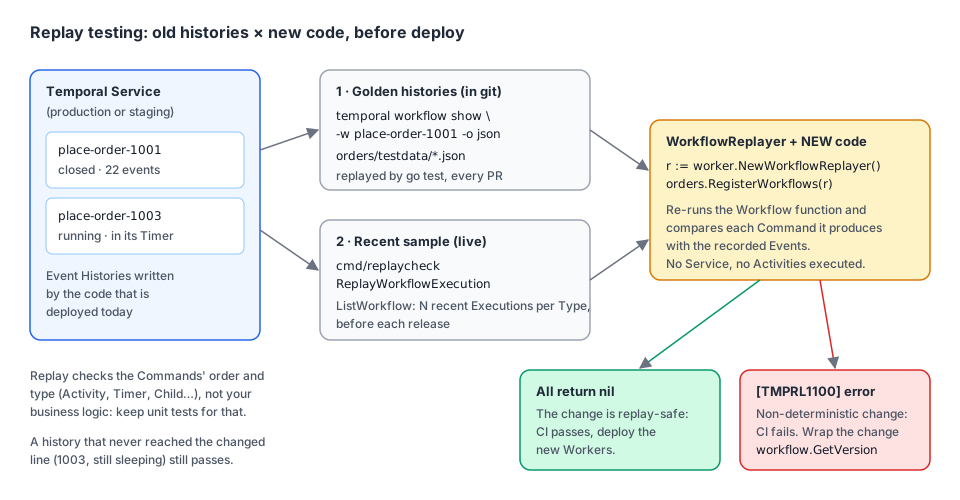
A worker.WorkflowReplayer is a Worker without a Service. You register your Workflow functions on it and hand it an Event History. It re-runs the Workflow function and checks each Command against the recorded Events, exactly as a real Worker would after a cache eviction:
| Replay result | Meaning |
|---|---|
nil | The current code produces the same Commands as the code that wrote the history |
[TMPRL1100] nondeterministic workflow: … | A Command doesn't match an Event (different Activity, missing Timer, extra Command…) |
unable to find workflow type: … | Nothing is registered under the Workflow Type name stored in the history |
Activities are not executed: their results come from the history. Replay checks the order and type of Commands, not your business logic; keep the unit tests for that.
The Go SDK docs recommend this CI recipe:
- Determine which Workflow Types or Task Queues the Worker code under test serves.
- Download the Event Histories of a representative set of recent open and closed Workflows.
- Run them through replay.
- Fail CI if any replay returns an error.
This chapter builds both halves: golden histories committed to git (section 4) and a tool that samples live histories before a release (section 6).
3. The Workflow under test, registered once
The replayer must register each function under the same Workflow Type name as the history. If the Worker uses RegisterWorkflowWithOptions with a custom name and the replayer uses RegisterWorkflow, replay fails before it starts:
unable to find workflow type: PlaceOrder. Supported types: [PlaceOrderWorkflow]So put the registration in one function that both the Worker and the replayer call. worker.Worker and worker.WorkflowReplayer both have RegisterWorkflowWithOptions, so one small interface covers both:
// file: orders/workflow.go
package orders

import (
	"time"

	"go.temporal.io/sdk/workflow"
)

// PlaceOrderWorkflowType is the Workflow Type name stored in every Event History.
// Worker and replayer must both register the function under this name.
const PlaceOrderWorkflowType = "PlaceOrder"

// WorkflowRegistry is implemented by worker.Worker and worker.WorkflowReplayer.
type WorkflowRegistry interface {
	RegisterWorkflowWithOptions(w any, options workflow.RegisterOptions)
}

// RegisterWorkflows is the single place that names our Workflow Types.
func RegisterWorkflows(r WorkflowRegistry) {
	r.RegisterWorkflowWithOptions(PlaceOrderWorkflow, workflow.RegisterOptions{Name: PlaceOrderWorkflowType})
}

type PlaceOrderInput struct {
	OrderID     string
	CustomerID  string
	AmountCents int64
	SKUs        []string
	// CancelWindow is how long the customer can still cancel before we charge.
	CancelWindow time.Duration
}

type PlaceOrderResult struct {
	ReservationID string
	PaymentID     string
}

func PlaceOrderWorkflow(ctx workflow.Context, in PlaceOrderInput) (PlaceOrderResult, error) {
	ctx = workflow.WithActivityOptions(ctx, workflow.ActivityOptions{StartToCloseTimeout: 30 * time.Second})
	var a *Activities
	var res PlaceOrderResult

	if err := workflow.ExecuteActivity(ctx, a.ReserveInventory, in.OrderID, in.SKUs).Get(ctx, &res.ReservationID); err != nil {
		return res, err
	}
	if err := workflow.Sleep(ctx, in.CancelWindow); err != nil {
		return res, err
	}
	if err := workflow.ExecuteActivity(ctx, a.ChargePayment, in.CustomerID, in.AmountCents).Get(ctx, &res.PaymentID); err != nil {
		return res, err
	}
	workflow.GetLogger(ctx).Info("Order placed", "OrderID", in.OrderID, "PaymentID", res.PaymentID)
	return res, nil
}// file: orders/activities.go
package orders
import "context"
type InventoryService interface {
Reserve(ctx context.Context, orderID string, skus []string) (reservationID string, err error)
}
type PaymentGateway interface {
Charge(ctx context.Context, customerID string, amountCents int64) (paymentID string, err error)
}
type Activities struct {
Inventory InventoryService
Payments PaymentGateway
}
func (a *Activities) ReserveInventory(ctx context.Context, orderID string, skus []string) (string, error) {
return a.Inventory.Reserve(ctx, orderID, skus)
}
func (a *Activities) ChargePayment(ctx context.Context, customerID string, amountCents int64) (string, error) {
return a.Payments.Charge(ctx, customerID, amountCents)
}// file: cmd/worker/main.go
package main
import (
"context"
"fmt"
"log"
"os"
"go.temporal.io/sdk/client"
"go.temporal.io/sdk/worker"
"github.com/acme/shop/orders"
)
type fakeInventory struct{}
func (fakeInventory) Reserve(_ context.Context, orderID string, _ []string) (string, error) {
return "rsv-" + orderID, nil
}
type fakeGateway struct{}
func (fakeGateway) Charge(_ context.Context, customerID string, _ int64) (string, error) {
return fmt.Sprintf("pay-%s", customerID), nil
}
func main() {
c, err := client.Dial(client.Options{HostPort: os.Getenv("TEMPORAL_ADDRESS")}) // empty: localhost:7233
if err != nil {
log.Fatalln("dial:", err)
}
defer c.Close()
w := worker.New(c, "orders", worker.Options{})
orders.RegisterWorkflows(w) // registers "PlaceOrder", exactly like the replayer
w.RegisterActivity(&orders.Activities{Inventory: fakeInventory{}, Payments: fakeGateway{}})
if err := w.Run(worker.InterruptCh()); err != nil {
log.Fatalln("worker:", err)
}
}4. Golden histories in testdata/
Export a few real histories (one per important code path) with the CLI and commit them:
$ temporal workflow show -w place-order-1001 -o json > orders/testdata/place-order-1001.json
$ temporal workflow show -w place-order-1002 -o json > orders/testdata/place-order-1002.json
The JSON has one events array: 22 Events for this Workflow (start, Activity, Timer, Activity, completion).
Then replay every file in a normal test. Pass a logger that discards output: with nil, the replayer does not stay quiet (the godoc says "Defaults to the noop logger", but the code uses the SDK's default logger), and every mismatch prints an ERROR Workflow panic … line with a stack trace on top of the error it returns.
// file: internal/replaylog/replaylog.go
package replaylog

import (
	"io"
	"log/slog"

	"go.temporal.io/sdk/log"
)

// Discard returns a logger that drops everything.
// Passing nil to the replayer does NOT do that: it falls back to the SDK's default
// logger, which prints a "Workflow panic" ERROR with a stack trace on every mismatch.
func Discard() log.Logger {
	return log.NewStructuredLogger(slog.New(slog.NewTextHandler(io.Discard, nil)))
}// file: orders/replay_test.go
package orders_test
import (
"path/filepath"
"testing"
"go.temporal.io/sdk/worker"
"github.com/acme/shop/internal/replaylog"
"github.com/acme/shop/orders"
)
// TestReplayRecordedHistories replays every history exported to testdata/
// against the current code. A non-deterministic change fails here, in CI,
// instead of in production.
func TestReplayRecordedHistories(t *testing.T) {
files, err := filepath.Glob(filepath.Join("testdata", "place-order-*.json"))
if err != nil {
t.Fatal(err)
}
if len(files) == 0 {
t.Fatal("no histories in testdata/: export some with `temporal workflow show -o json`")
}
replayer := worker.NewWorkflowReplayer()
orders.RegisterWorkflows(replayer) // same names as the production Worker
for _, f := range files {
t.Run(filepath.Base(f), func(t *testing.T) {
if err := replayer.ReplayWorkflowHistoryFromJSONFile(replaylog.Discard(), f); err != nil {
t.Fatalf("%s no longer replays with the current code: %v", f, err)
}
})
}
}$ go test -v ./orders
=== RUN TestReplayRecordedHistories
=== RUN TestReplayRecordedHistories/place-order-1001.json
=== RUN TestReplayRecordedHistories/place-order-1002.json
--- PASS: TestReplayRecordedHistories (0.05s)
--- PASS: TestReplayRecordedHistories/place-order-1001.json (0.04s)
--- PASS: TestReplayRecordedHistories/place-order-1002.json (0.00s)
PASSOne replayer can replay many histories: register every Workflow Type once, then call ReplayWorkflowHistoryFromJSONFile in a loop.
5. Catching the breaking change
Here is the fraud-screening change, written the naive way:
 	if err := workflow.Sleep(ctx, in.CancelWindow); err != nil {
 		return res, err
 	}
+	if err := workflow.ExecuteActivity(ctx, a.ScreenForFraud, in.CustomerID, in.AmountCents).Get(ctx, nil); err != nil {
+		return res, err
+	}
 	if err := workflow.ExecuteActivity(ctx, a.ChargePayment, in.CustomerID, in.AmountCents).Get(ctx, &res.PaymentID); err != nil {
The replay test fails on both golden histories (output trimmed):
$ go test ./orders
--- FAIL: TestReplayRecordedHistories (0.04s)
    --- FAIL: TestReplayRecordedHistories/place-order-1001.json (0.04s)
        replay_test.go:32: testdata/place-order-1001.json no longer replays with the current code:
        [TMPRL1100] nondeterministic workflow: history event is ActivityTaskScheduled: (ActivityId:16,
        ActivityType:(Name:ChargePayment), …), replay command is ScheduleActivityTask: (ActivityId:16,
        ActivityType:(Name:ScreenForFraud), …)
    --- FAIL: TestReplayRecordedHistories/place-order-1002.json (0.00s)
        …
FAIL
The message says exactly what went wrong: the history has ChargePayment at that point, the new code asks for ScreenForFraud. The fix is to version the change so old Executions keep the old path (Workflows guide, chapter 11):
-	if err := workflow.ExecuteActivity(ctx, a.ScreenForFraud, in.CustomerID, in.AmountCents).Get(ctx, nil); err != nil {
-		return res, err
+	if v := workflow.GetVersion(ctx, "fraud-screening", workflow.DefaultVersion, 1); v == 1 {
+		if err := workflow.ExecuteActivity(ctx, a.ScreenForFraud, in.CustomerID, in.AmountCents).Get(ctx, nil); err != nil {
+			return res, err
+		}
 	}
With GetVersion, both golden histories replay cleanly again.
6. Replaying live histories before a release
Golden files only cover the paths you thought of. Before a release, also replay a sample of recent Executions straight from the Service. ReplayWorkflowExecution downloads the history for you; to replay one Execution you already fetched (to save it, or to inspect it), use GetWorkflowHistory and ReplayWorkflowHistory, as the Go docs show:
// file: internal/histories/fetch.go
package histories

import (
	"context"

	"go.temporal.io/api/enums/v1"
	"go.temporal.io/api/history/v1"
	"go.temporal.io/sdk/client"
)

// Fetch downloads the full Event History of one Workflow Execution.
// An empty runID means the latest run.
func Fetch(ctx context.Context, c client.Client, workflowID, runID string) (*history.History, error) {
	var h history.History
	iter := c.GetWorkflowHistory(ctx, workflowID, runID, false, enums.HISTORY_EVENT_FILTER_TYPE_ALL_EVENT)
	for iter.HasNext() {
		event, err := iter.Next()
		if err != nil {
			return nil, err
		}
		h.Events = append(h.Events, event)
	}
	return &h, nil
}// file: cmd/replayone/main.go
package main
import (
"context"
"flag"
"log"
"os"
"go.temporal.io/sdk/client"
"go.temporal.io/sdk/worker"
"github.com/acme/shop/internal/histories"
"github.com/acme/shop/internal/replaylog"
"github.com/acme/shop/orders"
)
// replayone replays a single Execution: handy when a ticket names one order.
func main() {
workflowID := flag.String("workflow-id", "", "Workflow ID to replay")
runID := flag.String("run-id", "", "Run ID (empty: latest run)")
flag.Parse()
c, err := client.Dial(client.Options{HostPort: os.Getenv("TEMPORAL_ADDRESS")})
if err != nil {
log.Fatalln("dial:", err)
}
defer c.Close()
h, err := histories.Fetch(context.Background(), c, *workflowID, *runID)
if err != nil {
log.Fatalln("fetch history:", err)
}
replayer := worker.NewWorkflowReplayer()
orders.RegisterWorkflows(replayer)
if err := replayer.ReplayWorkflowHistory(replaylog.Discard(), h); err != nil {
log.Fatalf("%s does not replay: %v", *workflowID, err)
}
log.Printf("%s replays cleanly (%d events)", *workflowID, len(h.Events))
}$ TEMPORAL_ADDRESS=127.0.0.1:7255 go run ./cmd/replayone -workflow-id place-order-1001
2026/10/25 23:05:27 place-order-1001 replays cleanly (22 events)cmd/replaycheck does the CI recipe from section 2: it lists recent Executions of each Workflow Type with a Visibility query, replays them all, and exits with status 1 on any failure:
// file: cmd/replaycheck/main.go
package main

import (
	"context"
	"flag"
	"fmt"
	"log"
	"os"
	"time"

	"go.temporal.io/api/workflowservice/v1"
	"go.temporal.io/sdk/client"
	"go.temporal.io/sdk/worker"
	"go.temporal.io/sdk/workflow"

	"github.com/acme/shop/internal/replaylog"
	"github.com/acme/shop/orders"
)

// replaycheck downloads recent Executions of each Workflow Type from a real
// Namespace and replays them against the code being built. CI fails on any error.
func main() {
	address := flag.String("address", "localhost:7233", "Temporal frontend address")
	namespace := flag.String("namespace", "default", "Namespace to sample")
	perType := flag.Int("per-type", 50, "Executions to replay per Workflow Type")
	since := flag.Duration("since", 7*24*time.Hour, "only Executions started this recently")
	flag.Parse()

	c, err := client.Dial(client.Options{HostPort: *address, Namespace: *namespace})
	if err != nil {
		log.Fatalln("dial:", err)
	}
	defer c.Close()

	replayer := worker.NewWorkflowReplayer()
	orders.RegisterWorkflows(replayer)

	ctx, cancel := context.WithTimeout(context.Background(), 10*time.Minute)
	defer cancel()

	failed := 0
	for _, wfType := range []string{orders.PlaceOrderWorkflowType} {
		query := fmt.Sprintf("WorkflowType = '%s' AND StartTime > '%s'",
			wfType, time.Now().Add(-*since).UTC().Format(time.RFC3339))
		execs, err := listExecutions(ctx, c, *namespace, query, *perType)
		if err != nil {
			log.Fatalln("list:", err)
		}
		for _, e := range execs {
			err := replayer.ReplayWorkflowExecution(ctx, c.WorkflowService(), replaylog.Discard(), *namespace, e)
			if err != nil {
				failed++
				fmt.Printf("FAIL %s %s/%s: %v\n", wfType, e.ID, e.RunID, err)
				continue
			}
			fmt.Printf("ok   %s %s/%s\n", wfType, e.ID, e.RunID)
		}
	}
	if failed > 0 {
		fmt.Printf("%d Execution(s) don't replay with this build\n", failed)
		os.Exit(1)
	}
}

func listExecutions(ctx context.Context, c client.Client, namespace, query string, limit int) ([]workflow.Execution, error) {
	var out []workflow.Execution
	var token []byte
	for len(out) < limit {
		resp, err := c.ListWorkflow(ctx, &workflowservice.ListWorkflowExecutionsRequest{
			Namespace:     namespace,
			Query:         query,
			PageSize:      int32(limit),
			NextPageToken: token,
		})
		if err != nil {
			return nil, err
		}
		for _, info := range resp.GetExecutions() {
			out = append(out, workflow.Execution{ID: info.GetExecution().GetWorkflowId(), RunID: info.GetExecution().GetRunId()})
			if len(out) == limit {
				break
			}
		}
		token = resp.GetNextPageToken()
		if len(token) == 0 {
			break
		}
	}
	return out, nil
}
Against a dev server with two closed orders and one still sleeping in its cancel window, using the naive (unversioned) change, the output was (trimmed):
$ go run ./cmd/replaycheck -address 127.0.0.1:7255
ok   PlaceOrder place-order-1003/01a17515-bd72-7b27-81a3-6f9fe8ad81a9
FAIL PlaceOrder place-order-1002/01a17515-…: [TMPRL1100] nondeterministic workflow: history event is ActivityTaskScheduled: (… ChargePayment …), replay command is ScheduleActivityTask: (… ScreenForFraud …)
FAIL PlaceOrder place-order-1001/01a17515-…: [TMPRL1100] nondeterministic workflow: …
2 Execution(s) don't replay with this build
exit status 1
Note place-order-1003: it was still in its Timer, so its history ends before the changed line and it replays fine. When its Timer fires, the new code simply schedules ScreenForFraud as a new Command. A sample made only of young Executions can hide a break, which is why the sample should include closed Executions that went through the whole Workflow. With the GetVersion fix, all three lines are ok and the tool exits 0.
In CI, run it against staging (or production with a read-only API key) with the code of the pull request: go run ./cmd/replaycheck -address … -namespace shop-prod -per-type 50.
7. What replay testing doesn't catch
| Problem | Caught by replay? | Use instead |
|---|---|---|
| Activity added, removed, reordered or renamed | Yes | — |
| Timer added or removed, Child Workflow changes | Yes | — |
| Changed Activity input or options | No: only type and order are compared | Unit tests (chapter 03) |
| Non-determinism on a path no history took | No | More golden histories, a bigger sample |
| Changed result for the same Commands | No | Unit tests |
| Workflow Type renamed | Yes, as unable to find workflow type | Keep names in RegisterWorkflows |
8. Key takeaways
- Unit tests start new Executions; only replay proves running Executions survive a deploy.
- Register Workflows under the same name in the Worker and the replayer: share one
RegisterWorkflowsfunction. - Commit golden histories from
temporal workflow show -o jsonand replay them ingo testwithReplayWorkflowHistoryFromJSONFile. - Before a release, replay a sample of recent Executions with
ListWorkflowandReplayWorkflowExecution, and fail CI on any error. - Pass a discarding logger:
nilfalls back to the default logger and prints a stack trace for every mismatch. - A
[TMPRL1100]error names the recorded Event and the new Command. Fix it withworkflow.GetVersion, then replay again.
⬅️ Previous: 06 · Mocking Nexus Operations · ➡️ Next: 08 · End-to-end tests with a dev server