05 · Workflow IDs and duplicate starts
Level: daily use · Read time: ~15 min Sources: Go SDK — Set a Workflow ID · StartWorkflowOptions reference (
WorkflowIDReusePolicy,WorkflowExecutionErrorWhenAlreadyStarted)
1. The problem
Networks retry. A customer double-clicks "Pay". A Kafka consumer re-delivers a message. Your checkout API calls ExecuteWorkflow twice for the same order. Should the second call:
- start a second Workflow (and charge the card twice)?
- return the Workflow that's already running?
- fail, so the caller knows?
- replace the old Workflow with a fresh one?
Temporal lets you choose, per start, with three options on StartWorkflowOptions. Choosing them deliberately is how you make starting a Workflow idempotent.
2. The rule behind everything
A Workflow ID is unique among running Workflow Executions in a Namespace.
So a start with an existing ID meets one of two situations, and each has its own option:
| Situation | Option that decides | Values | Default |
|---|---|---|---|
| A Workflow with this ID is running | WorkflowIDConflictPolicy | FAIL, USE_EXISTING, TERMINATE_EXISTING | FAIL |
| Only closed Workflows with this ID exist | WorkflowIDReusePolicy | ALLOW_DUPLICATE, ALLOW_DUPLICATE_FAILED_ONLY, REJECT_DUPLICATE (and the legacy TERMINATE_IF_RUNNING) | ALLOW_DUPLICATE |
And a third option decides how a refusal reaches your code:
WorkflowExecutionErrorWhenAlreadyStarted | When the start is refused |
|---|---|
false (default) | ExecuteWorkflow returns no error and a WorkflowRun for the existing (running or last) run |
true | ExecuteWorkflow returns a *serviceerror.WorkflowExecutionAlreadyStarted error |
The Go Client page lists WorkflowIDReusePolicy and WorkflowExecutionErrorWhenAlreadyStarted, but not WorkflowIDConflictPolicy, which is the one that governs running Workflows. All three are in StartWorkflowOptions in SDK v1.50.0.
3. What actually happens
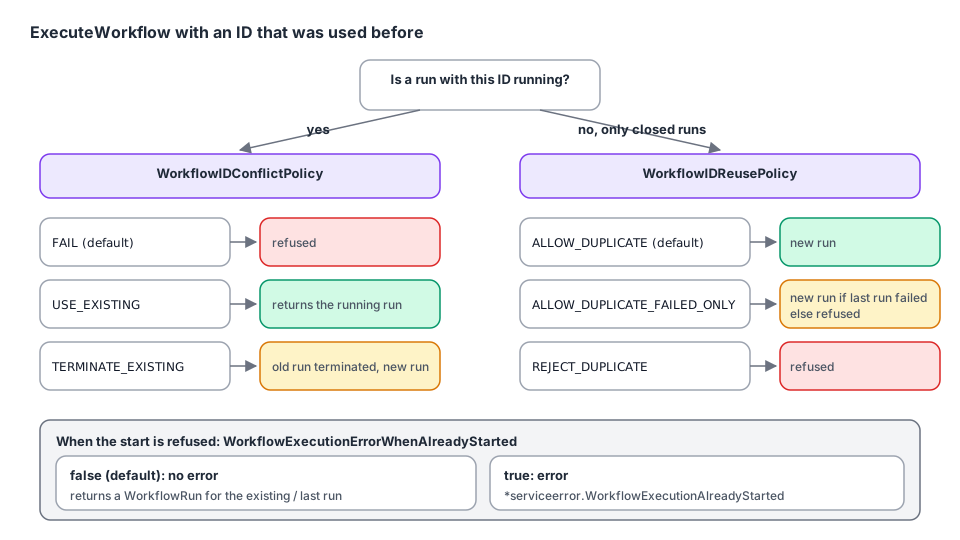
Observed against a dev server (Temporal Server 1.32.0, Go SDK v1.50.0):
| Existing Workflow with this ID | Options on the second start | Result |
|---|---|---|
| Running | defaults | No error. Returns the existing run. Nothing new starts |
| Running | ErrorWhenAlreadyStarted: true | WorkflowExecutionAlreadyStarted error |
| Running | ConflictPolicy: USE_EXISTING (even with ErrorWhenAlreadyStarted: true) | No error, returns the existing run |
| Running | ConflictPolicy: TERMINATE_EXISTING | Old run Terminated, a new run starts |
| Completed | defaults (ALLOW_DUPLICATE) | A new run starts |
| Completed | ReusePolicy: REJECT_DUPLICATE | No error, returns the last run |
| Completed | REJECT_DUPLICATE + ErrorWhenAlreadyStarted: true | WorkflowExecutionAlreadyStarted error |
| Completed | ALLOW_DUPLICATE_FAILED_ONLY + ErrorWhenAlreadyStarted: true | WorkflowExecutionAlreadyStarted error (only failed, canceled, terminated or timed-out runs can be restarted) |
The surprise: with all defaults, starting a running Workflow ID twice doesn't fail. You silently get a handle to the first run. That's usually what you want for idempotency, but if your code needs to know, set
WorkflowExecutionErrorWhenAlreadyStarted: true.
4. Recipes
All recipes use the same Workflow:
// file: payments/workflow.go
package payments

import (
	"time"

	"go.temporal.io/sdk/workflow"
)

const TaskQueue = "payments"

type ChargeOrderInput struct {
	OrderID     string
	CustomerID  string
	AmountCents int64
}

type ChargeReceipt struct {
	OrderID   string
	PaymentID string
}

func ChargeOrderWorkflow(ctx workflow.Context, in ChargeOrderInput) (ChargeReceipt, error) {
	ctx = workflow.WithActivityOptions(ctx, workflow.ActivityOptions{StartToCloseTimeout: 30 * time.Second})
	var paymentID string
	if err := workflow.ExecuteActivity(ctx, "CapturePayment", in).Get(ctx, &paymentID); err != nil {
		return ChargeReceipt{}, err
	}
	return ChargeReceipt{OrderID: in.OrderID, PaymentID: paymentID}, nil
}
4.1 "Start it, or give me the one already running" (idempotent API)
The most common need. USE_EXISTING states it explicitly. The defaults behave the same for a running Workflow, but spelling it out documents the intent.
// file: payments/start.go
package payments

import (
	"context"

	enumspb "go.temporal.io/api/enums/v1"
	"go.temporal.io/sdk/client"
)

func chargeWorkflowID(orderID string) string { return "charge-" + orderID }

// StartCharge is safe to call many times for the same order: while a charge Workflow
// is running, every call returns that same run.
func StartCharge(ctx context.Context, c client.Client, in ChargeOrderInput) (client.WorkflowRun, error) {
	return c.ExecuteWorkflow(ctx, client.StartWorkflowOptions{
		ID:                       chargeWorkflowID(in.OrderID),
		TaskQueue:                TaskQueue,
		WorkflowIDConflictPolicy: enumspb.WORKFLOW_ID_CONFLICT_POLICY_USE_EXISTING,
		// Once the charge has completed, never charge this order again.
		WorkflowIDReusePolicy: enumspb.WORKFLOW_ID_REUSE_POLICY_REJECT_DUPLICATE,
	}, ChargeOrderWorkflow, in)
}
With REJECT_DUPLICATE and the default ErrorWhenAlreadyStarted: false, a call made after the charge completed also returns the completed run. run.Get then returns the original receipt. Every caller gets the same answer, however many times it retries.
4.2 "Tell me if it already exists" (exactly-once side effect)
When a duplicate is an error the caller must see (e.g. to answer HTTP 409):
// file: payments/start_once.go
package payments

import (
	"context"
	"errors"

	enumspb "go.temporal.io/api/enums/v1"
	"go.temporal.io/api/serviceerror"
	"go.temporal.io/sdk/client"
)

var ErrChargeAlreadyExists = errors.New("a charge already exists for this order")

func StartChargeOnce(ctx context.Context, c client.Client, in ChargeOrderInput) (client.WorkflowRun, error) {
	run, err := c.ExecuteWorkflow(ctx, client.StartWorkflowOptions{
		ID:                                       chargeWorkflowID(in.OrderID),
		TaskQueue:                                TaskQueue,
		WorkflowIDReusePolicy:                    enumspb.WORKFLOW_ID_REUSE_POLICY_REJECT_DUPLICATE,
		WorkflowExecutionErrorWhenAlreadyStarted: true,
	}, ChargeOrderWorkflow, in)

	var alreadyStarted *serviceerror.WorkflowExecutionAlreadyStarted
	if errors.As(err, &alreadyStarted) {
		return nil, ErrChargeAlreadyExists
	}
	return run, err
}
4.3 "Retry only if the last attempt failed"
A nightly report may be re-run by an operator, but only if the previous run didn't succeed:
// file: reports/start.go
package reports

import (
	"context"
	"time"

	enumspb "go.temporal.io/api/enums/v1"
	"go.temporal.io/sdk/client"
)

func StartDailySalesReport(ctx context.Context, c client.Client, day time.Time) (client.WorkflowRun, error) {
	return c.ExecuteWorkflow(ctx, client.StartWorkflowOptions{
		ID:                                       "sales-report-" + day.Format("2006-01-02"),
		TaskQueue:                                "reports",
		WorkflowIDReusePolicy:                    enumspb.WORKFLOW_ID_REUSE_POLICY_ALLOW_DUPLICATE_FAILED_ONLY,
		WorkflowExecutionErrorWhenAlreadyStarted: true,
	}, "DailySalesReportWorkflow", day)
}
4.4 "Replace whatever is running"
A price-sync Workflow for a product should always run with the latest catalog. A new start kills the old one:
// file: catalog/start.go
package catalog

import (
	"context"

	enumspb "go.temporal.io/api/enums/v1"
	"go.temporal.io/sdk/client"
)

func RestartPriceSync(ctx context.Context, c client.Client, productID string) (client.WorkflowRun, error) {
	return c.ExecuteWorkflow(ctx, client.StartWorkflowOptions{
		ID:                       "price-sync-" + productID,
		TaskQueue:                "catalog",
		WorkflowIDConflictPolicy: enumspb.WORKFLOW_ID_CONFLICT_POLICY_TERMINATE_EXISTING,
	}, "PriceSyncWorkflow", productID)
}
Terminating skips any cleanup in the old run. If the old run must clean up, Signal or cancel it instead (chapter 08).
5. Choosing
| You want… | ConflictPolicy | ReusePolicy | ErrorWhenAlreadyStarted |
|---|---|---|---|
| Idempotent start, same answer forever | USE_EXISTING | REJECT_DUPLICATE | false |
| Idempotent while running, re-runnable after | USE_EXISTING | ALLOW_DUPLICATE (default) | false |
| Caller must know about duplicates | FAIL (default) | REJECT_DUPLICATE | true |
| Re-run only after a failure | FAIL | ALLOW_DUPLICATE_FAILED_ONLY | true |
| Newest start wins | TERMINATE_EXISTING | ALLOW_DUPLICATE | false |
The reuse policy only applies while closed Workflows are still retained by the Namespace. After the retention period, the ID is free again.
6. Key takeaways
- The Workflow ID is your deduplication key. Derive it from a business identifier.
- Running duplicate →
WorkflowIDConflictPolicy(defaultFAIL). Closed duplicate →WorkflowIDReusePolicy(defaultALLOW_DUPLICATE). - By default a refused start returns the existing run without an error. Set
WorkflowExecutionErrorWhenAlreadyStarted: trueto get*serviceerror.WorkflowExecutionAlreadyStarted. USE_EXISTING+REJECT_DUPLICATEmakes a start fully idempotent.