05 · Time, Signals, Queries and Updates
Level: daily use · Read time: ~16 min Sources: Go SDK: Query tests · Go SDK: Skip time ·
testsuite.TestWorkflowEnvironment
1. The problem
A free trial lasts 30 days. Three days before the end, the customer gets a reminder. If they upgrade, they move to a paid plan; if not, they go back to the free plan. Support can extend a trial, and the account page shows how many days are left.
That one Workflow mixes everything that is hard to test with a real Service:
- Time: nobody wants a test that takes 30 days.
- Signals that arrive in the middle of the run ("upgrade" on day 10).
- Queries whose answer depends on when you ask.
- Updates that can be accepted or rejected.
The Workflow test environment runs on a mock clock and lets you schedule Signals, Queries and Updates at precise Workflow times. The 30-day trial runs in milliseconds.
2. The mock clock
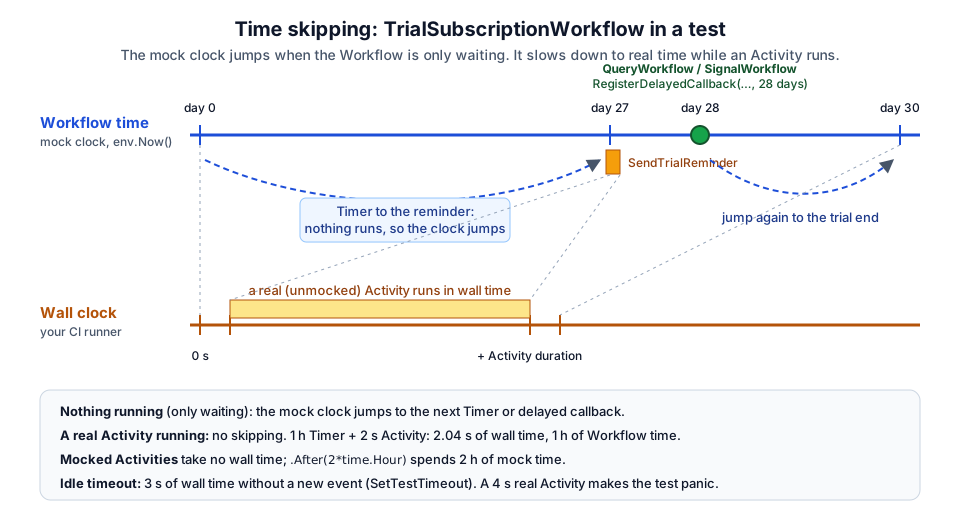
The environment never sleeps for real. When the Workflow is only waiting (on a Timer, a Signal, an Update), the mock clock jumps straight to the next event: the next Timer, the next delayed callback, or the end of a mocked Activity's .After() delay.
The one exception is a real (unmocked) Activity. While it runs, the clock doesn't skip; it follows the wall clock. Measured on SDK v1.50.0: a Workflow that started a real Activity taking 2 s and, in parallel, a 1-hour workflow.Sleep, took 2.04 s of wall time and saw exactly 1 h of Workflow time. The Timer waited for the Activity, then the clock jumped.
So:
- Mock Activities (
OnActivity, chapter 03) in time-heavy tests. - Use
workflow.Sleep,workflow.NewTimerandworkflow.Nowin Workflow code, nevertime.Sleeportime.Now. The mock clock only controls the Workflow APIs. - The wall-clock idle limit of 3 s (
SetTestTimeout) and the Workflow-time limit (SetWorkflowRunTimeout) are explained in chapter 02.
| You want to… | API |
|---|---|
| Fix the Workflow's start time | env.SetStartTime(t) (before ExecuteWorkflow) |
| Read the mock clock | env.Now() |
| Run code at a Workflow time | env.RegisterDelayedCallback(fn, delay) |
| Send a Signal | env.SignalWorkflow(name, arg) (inside a callback) |
| Signal-With-Start | env.RegisterDelayedCallback(…, 0) |
| Query | env.QueryWorkflow(name, args…) (inside a callback, or after ExecuteWorkflow) |
| Send an Update | env.UpdateWorkflow(name, id, callbacks, args…) |
| Spend mock time in a mocked Activity | env.OnActivity(…).Return(…).After(d) |
3. The Workflow under test
The Activities talk to the mailer and the billing system. The Workflow tests mock them all:
// file: subscriptions/activities.go
package subscriptions

import (
	"context"
	"time"
)

// Mailer and Billing are external systems. Workflow tests mock the Activities instead.
type Mailer interface {
	Send(ctx context.Context, to, template string, data map[string]any) error
}

type Billing interface {
	StartPlan(ctx context.Context, customerID, plan string) error
	Downgrade(ctx context.Context, customerID string) error
}

type Activities struct {
	Mailer  Mailer
	Billing Billing
}

func (a *Activities) SendTrialReminder(ctx context.Context, email string, endsAt time.Time) error {
	return a.Mailer.Send(ctx, email, "trial-ending", map[string]any{"ends_at": endsAt})
}

func (a *Activities) StartPaidPlan(ctx context.Context, customerID, plan string) error {
	return a.Billing.StartPlan(ctx, customerID, plan)
}

func (a *Activities) DowngradeToFree(ctx context.Context, customerID string) error {
	return a.Billing.Downgrade(ctx, customerID)
}
The Workflow keeps its state in a TrialStatus that the Query returns. It waits with workflow.AwaitWithTimeout until the next deadline (the reminder, then the end of the trial), or until a Signal or an Update changes the state:
// file: subscriptions/workflow.go
package subscriptions

import (
	"errors"
	"time"

	"go.temporal.io/sdk/workflow"
)

const (
	TrialLength    = 30 * 24 * time.Hour
	ReminderBefore = 3 * 24 * time.Hour

	StatusQuery   = "trial-status"
	UpgradeSignal = "upgrade"
	ExtendUpdate  = "extend-trial"
)

type TrialInput struct {
	CustomerID string
	Email      string
}

type Upgrade struct {
	Plan string
}

type TrialStatus struct {
	EndsAt        time.Time
	Plan          string // empty while on trial
	RemindersSent int
}

type TrialOutcome struct {
	Plan    string // "free" when the trial ran out
	EndedAt time.Time
}

// TrialSubscriptionWorkflow runs a 30-day free trial: a reminder 3 days before
// the end, then a paid plan (if the customer upgraded) or the free plan.
func TrialSubscriptionWorkflow(ctx workflow.Context, in TrialInput) (TrialOutcome, error) {
	ctx = workflow.WithActivityOptions(ctx, workflow.ActivityOptions{StartToCloseTimeout: time.Minute})
	var a *Activities
	st := TrialStatus{EndsAt: workflow.Now(ctx).Add(TrialLength)}

	if err := workflow.SetQueryHandler(ctx, StatusQuery, func() (TrialStatus, error) {
		return st, nil
	}); err != nil {
		return TrialOutcome{}, err
	}

	upgrades := workflow.GetSignalChannel(ctx, UpgradeSignal)
	workflow.Go(ctx, func(ctx workflow.Context) {
		var u Upgrade
		upgrades.Receive(ctx, &u)
		st.Plan = u.Plan
	})

	if err := workflow.SetUpdateHandlerWithOptions(ctx, ExtendUpdate,
		func(ctx workflow.Context, days int) (time.Time, error) {
			st.EndsAt = st.EndsAt.Add(time.Duration(days) * 24 * time.Hour)
			return st.EndsAt, nil
		},
		workflow.UpdateHandlerOptions{Validator: func(ctx workflow.Context, days int) error {
			if days < 1 || days > 14 {
				return errors.New("a trial can be extended by 1 to 14 days")
			}
			if st.Plan != "" {
				return errors.New("customer already upgraded")
			}
			return nil
		}},
	); err != nil {
		return TrialOutcome{}, err
	}

	reminded := false
	for st.Plan == "" && workflow.Now(ctx).Before(st.EndsAt) {
		endsAt := st.EndsAt
		remindAt := endsAt.Add(-ReminderBefore)
		wakeAt := endsAt
		if !reminded && workflow.Now(ctx).Before(remindAt) {
			wakeAt = remindAt
		}
		// Wake up at the next deadline, or as soon as the customer upgrades or extends.
		if _, err := workflow.AwaitWithTimeout(ctx, wakeAt.Sub(workflow.Now(ctx)), func() bool {
			return st.Plan != "" || !st.EndsAt.Equal(endsAt)
		}); err != nil {
			return TrialOutcome{}, err
		}
		if !reminded && st.Plan == "" && st.EndsAt.Equal(endsAt) && !workflow.Now(ctx).Before(remindAt) {
			if err := workflow.ExecuteActivity(ctx, a.SendTrialReminder, in.Email, st.EndsAt).Get(ctx, nil); err != nil {
				return TrialOutcome{}, err
			}
			reminded = true
			st.RemindersSent++
		}
	}

	if st.Plan != "" {
		err := workflow.ExecuteActivity(ctx, a.StartPaidPlan, in.CustomerID, st.Plan).Get(ctx, nil)
		return TrialOutcome{Plan: st.Plan, EndedAt: workflow.Now(ctx)}, err
	}
	err := workflow.ExecuteActivity(ctx, a.DowngradeToFree, in.CustomerID).Get(ctx, nil)
	return TrialOutcome{Plan: "free", EndedAt: workflow.Now(ctx)}, err
}
The suite fixes the start time with SetStartTime, so every date in the assertions is a constant. AfterTest checks that every mock marked .Once() was called:
// file: subscriptions/trial_suite_test.go
package subscriptions

import (
	"testing"
	"time"

	"github.com/stretchr/testify/suite"
	"go.temporal.io/sdk/testsuite"
)

var signupDay = time.Date(2026, time.March, 1, 9, 0, 0, 0, time.UTC)

const day = 24 * time.Hour

type TrialSuite struct {
	suite.Suite
	testsuite.WorkflowTestSuite

	env *testsuite.TestWorkflowEnvironment
	a   *Activities
	in  TrialInput
}

func (s *TrialSuite) SetupTest() {
	s.env = s.NewTestWorkflowEnvironment()
	s.env.SetStartTime(signupDay) // workflow.Now() starts here: dates are predictable
	s.a = &Activities{}
	s.env.RegisterActivity(s.a)
	s.in = TrialInput{CustomerID: "cus-1042", Email: "ada@example.com"}
}

func (s *TrialSuite) AfterTest(suiteName, testName string) {
	s.env.AssertExpectations(s.T())
}

func (s *TrialSuite) outcome() TrialOutcome {
	s.Require().True(s.env.IsWorkflowCompleted())
	s.Require().NoError(s.env.GetWorkflowError())
	var out TrialOutcome
	s.Require().NoError(s.env.GetWorkflowResult(&out))
	return out
}

func TestTrialSuite(t *testing.T) {
	suite.Run(t, new(TrialSuite))
}
4. Skipping 30 days
The simplest scenario: nobody upgrades. The reminder goes out on day 27, the downgrade on day 30.
// file: subscriptions/trial_timers_test.go
package subscriptions

import (
	"time"

	"github.com/stretchr/testify/mock"
)

func (s *TrialSuite) Test_NoUpgrade_RemindsThenDowngrades() {
	ends := signupDay.Add(30 * day)
	s.env.OnActivity(s.a.SendTrialReminder, mock.Anything, "ada@example.com", ends).Return(nil).Once()
	s.env.OnActivity(s.a.DowngradeToFree, mock.Anything, "cus-1042").Return(nil).Once()

	start := time.Now()
	s.env.ExecuteWorkflow(TrialSubscriptionWorkflow, s.in)

	out := s.outcome()
	s.Equal("free", out.Plan)
	s.Equal(ends, out.EndedAt)
	// The mock clock moved 30 days. env.Now() is in local time: compare instants.
	s.True(ends.Equal(s.env.Now()))
	s.T().Logf("30 days of Workflow time took %s of wall time", time.Since(start).Round(time.Microsecond))
}$ go test -run 'TestTrialSuite/Test_NoUpgrade' -v ./subscriptions
trial_timers_test.go:23: 30 days of Workflow time took 41.348ms of wall time
--- PASS: TestTrialSuite (0.04s)Two details:
- The mock on
SendTrialReminderpins the exact arguments, includingends. If someone breaks the date arithmetic, the mock doesn't match and the test fails. env.Now()returns the time in the local time zone, even thoughSetStartTimegot a UTC time.s.Equal(ends, s.env.Now())fails on a machine that isn't in UTC (it failed on ours, in UTC+2:time.Date(2026, time.March, 31, 11, 0, 0, 0, time.Local)). Compare instants withEqual.
5. Signals in the middle of a run
RegisterDelayedCallback(fn, d) runs fn when the mock clock reaches start + d. Inside it, send the Signal with env.SignalWorkflow:
// file: subscriptions/trial_signals_test.go
package subscriptions

import (
	"time"

	"github.com/stretchr/testify/mock"
)

func (s *TrialSuite) Test_UpgradeOnDay10() {
	s.env.RegisterDelayedCallback(func() {
		s.env.SignalWorkflow(UpgradeSignal, Upgrade{Plan: "pro"})
	}, 10*day)
	// The billing system takes 2 hours: After() spends mock time, not wall time.
	s.env.OnActivity(s.a.StartPaidPlan, mock.Anything, "cus-1042", "pro").Return(nil).After(2 * time.Hour).Once()

	s.env.ExecuteWorkflow(TrialSubscriptionWorkflow, s.in)

	out := s.outcome()
	s.Equal("pro", out.Plan)
	s.Equal(signupDay.Add(10*day+2*time.Hour), out.EndedAt)
	s.env.AssertActivityNotCalled(s.T(), "SendTrialReminder", mock.Anything, mock.Anything, mock.Anything)
}

func (s *TrialSuite) Test_SignalWithStart() {
	// Upgrade sent together with the start (Signal-With-Start): delay 0.
	s.env.RegisterDelayedCallback(func() {
		s.env.SignalWorkflow(UpgradeSignal, Upgrade{Plan: "team"})
	}, 0)
	s.env.OnActivity(s.a.StartPaidPlan, mock.Anything, "cus-1042", "team").Return(nil).Once()

	s.env.ExecuteWorkflow(TrialSubscriptionWorkflow, s.in)

	out := s.outcome()
	s.Equal("team", out.Plan)
	s.Equal(signupDay, out.EndedAt)
}
Test_UpgradeOnDay10 shows two things:
- The callback fires at day 10 of Workflow time, between the Workflow's own Timers.
.After(2 * time.Hour)on the mock makesStartPaidPlantake 2 hours of Workflow time and no wall time. The outcome'sEndedAtis day 10 + 2 h.
AssertActivityNotCalled checks that no reminder went out. It takes the Activity name and the arguments (mock.Anything for each, context included).
Test_SignalWithStart registers the callback with a delay of 0: the Signal is delivered before the Workflow's first Timer, like a Signal-With-Start from a Client. The upgrade happens on day 0 and nothing is mocked except StartPaidPlan.
6. Queries
env.QueryWorkflow runs the Query handler and returns a converter.EncodedValue. Call it inside a delayed callback to see the state at a given time, or after ExecuteWorkflow to see the final state:
// file: subscriptions/trial_query_test.go
package subscriptions

import (
	"github.com/stretchr/testify/mock"
)

func (s *TrialSuite) Test_StatusQuery() {
	s.env.OnActivity(s.a.SendTrialReminder, mock.Anything, mock.Anything, mock.Anything).Return(nil)
	s.env.OnActivity(s.a.DowngradeToFree, mock.Anything, mock.Anything).Return(nil)

	// Day 28: the reminder (day 27) has gone out, the trial is still running.
	s.env.RegisterDelayedCallback(func() {
		val, err := s.env.QueryWorkflow(StatusQuery)
		s.Require().NoError(err)
		var st TrialStatus
		s.Require().NoError(val.Get(&st))
		s.Equal(1, st.RemindersSent)
		s.Equal("", st.Plan)
		s.Equal(signupDay.Add(30*day), st.EndsAt)
	}, 28*day)

	s.env.ExecuteWorkflow(TrialSubscriptionWorkflow, s.in)
	s.outcome()

	// A completed Workflow can still be queried.
	val, err := s.env.QueryWorkflow(StatusQuery)
	s.Require().NoError(err)
	var st TrialStatus
	s.Require().NoError(val.Get(&st))
	s.Equal(1, st.RemindersSent)
}
Calling QueryWorkflow before ExecuteWorkflow doesn't return an error: it panics with runtime error: invalid memory address or nil pointer dereference, as the Go SDK page warns. The Workflow doesn't exist yet. Put the Query in a callback instead.
7. Updates
env.UpdateWorkflow(name, updateID, callbacks, args…) sends an Update. The callbacks receive the outcome:
| Callback | Called when |
|---|---|
OnAccept() | The validator passed |
OnReject(err) | The validator returned an error (the handler doesn't run) |
OnComplete(result, err) | The handler returned |
testsuite.TestUpdateCallback is a ready-made struct with these three fields. An empty updateID gets a generated UUID.
// file: subscriptions/trial_update_test.go
package subscriptions

import (
	"github.com/stretchr/testify/mock"
	"go.temporal.io/sdk/testsuite"
)

func (s *TrialSuite) Test_ExtendTrial() {
	newEnd := signupDay.Add(37 * day)
	s.env.OnActivity(s.a.SendTrialReminder, mock.Anything, "ada@example.com", newEnd).Return(nil).Once()
	s.env.OnActivity(s.a.DowngradeToFree, mock.Anything, "cus-1042").Return(nil).Once()

	s.env.RegisterDelayedCallback(func() {
		s.env.UpdateWorkflow(ExtendUpdate, "support-ticket-881", &testsuite.TestUpdateCallback{
			OnAccept: func() {},
			OnReject: func(err error) { s.Fail("update rejected", err.Error()) },
			OnComplete: func(result any, err error) {
				s.NoError(err)
				s.Equal(newEnd, result)
			},
		}, 7)
	}, 5*day)

	s.env.ExecuteWorkflow(TrialSubscriptionWorkflow, s.in)

	s.Equal(newEnd, s.outcome().EndedAt)
}

func (s *TrialSuite) Test_ExtendTrial_RejectedWhenTooLong() {
	s.env.OnActivity(s.a.SendTrialReminder, mock.Anything, mock.Anything, mock.Anything).Return(nil)
	s.env.OnActivity(s.a.DowngradeToFree, mock.Anything, mock.Anything).Return(nil)

	var rejected error
	s.env.RegisterDelayedCallback(func() {
		s.env.UpdateWorkflow(ExtendUpdate, "", &testsuite.TestUpdateCallback{
			OnAccept:   func() { s.Fail("update should be rejected") },
			OnReject:   func(err error) { rejected = err },
			OnComplete: func(any, error) {},
		}, 30)
	}, 5*day)

	s.env.ExecuteWorkflow(TrialSubscriptionWorkflow, s.in)

	s.Equal(signupDay.Add(30*day), s.outcome().EndedAt)
	s.ErrorContains(rejected, "1 to 14 days")
}- In
Test_ExtendTrial, support extends the trial by 7 days on day 5. The reminder mock expects the new end date (day 37), so the test also proves the Workflow recomputed its Timers. - In
Test_ExtendTrial_RejectedWhenTooLong, the validator rejects 30 days; the trial still ends on day 30. - In
OnComplete,resultis the handler's return value as is (here atime.Time), not an encoded payload. - When you only care that an Update is accepted,
env.UpdateWorkflowNoRejection(name, id, t, args…)fails the test on rejection. It isn't on the Go SDK page.
8. A safety net on Workflow time
By default, the Workflow run timeout of the environment is 10 years of mock time. A Workflow that waits for a Signal nobody sends doesn't hang: the clock skips 10 years and the Workflow fails with deadline exceeded (type: ScheduleToClose) (chapter 02).
SetWorkflowRunTimeout makes that limit match your business rule. A trial must be over within 20 days of Workflow time in this deliberately wrong test, so it fails the same way:
// file: subscriptions/trial_timeout_test.go
package subscriptions

import (
	"errors"

	"github.com/stretchr/testify/mock"
	"go.temporal.io/sdk/temporal"
)

func (s *TrialSuite) Test_RunTimeoutCatchesARunawayTrial() {
	s.env.OnActivity(s.a.SendTrialReminder, mock.Anything, mock.Anything, mock.Anything).Return(nil).Maybe()
	s.env.OnActivity(s.a.DowngradeToFree, mock.Anything, mock.Anything).Return(nil).Maybe()
	s.env.SetWorkflowRunTimeout(20 * day) // Workflow time, not wall time

	s.env.ExecuteWorkflow(TrialSubscriptionWorkflow, s.in)

	s.Require().True(s.env.IsWorkflowCompleted())
	err := s.env.GetWorkflowError()
	var timeoutErr *temporal.TimeoutError
	s.Require().True(errors.As(err, &timeoutErr), "got %v", err)
	s.T().Log(err)
} trial_timeout_test.go:22: workflow execution error (type: TrialSubscriptionWorkflow, workflowID: default-test-workflow-id, runID: default-test-run-id): deadline exceeded (type: ScheduleToClose)The error is a *temporal.TimeoutError with type ScheduleToClose, even though it is the Workflow's run timeout. Use .Maybe() on mocks that the run may or may not reach, or AfterTest fails on the uncalled ones.
9. Key takeaways
- The mock clock jumps whenever the Workflow is only waiting. A 30-day trial runs in milliseconds. A real Activity stops the jump: mock Activities in time-heavy tests.
SetStartTimemakes dates predictable.env.Now()is in local time: compare withEqual.RegisterDelayedCallback(fn, d)is how you act at a Workflow time: Signals, Queries, Updates. Delay0simulates Signal-With-Start.- Query inside a callback or after
ExecuteWorkflow, never before (it panics). UpdateWorkflowwithtestsuite.TestUpdateCallbacktests both the validator and the handler..After(d)on a mock spends Workflow time, not wall time.SetWorkflowRunTimeoutturns "the Workflow should be done by now" into a failing test.