01 · What is a Temporal Client, and why does it exist?
Level: core concept · Read time: ~10 min Sources: Encyclopedia — Temporal Client · Go SDK — Temporal Client
1. The problem
You wrote a Workflow and a Worker. Now the rest of your system has to use them:
- the checkout API must start an order Workflow when a customer pays,
- the support back-office must show where an order is and change its delivery address,
- a nightly job must list the orders stuck for more than a day,
- the mobile app must wait for or fetch the result.
None of these programs should run Workflow code, poll Task Queues or know what an Event History looks like. They need a small, typed API to talk to the Temporal Service. That's the Temporal Client.
2. What a Temporal Client is
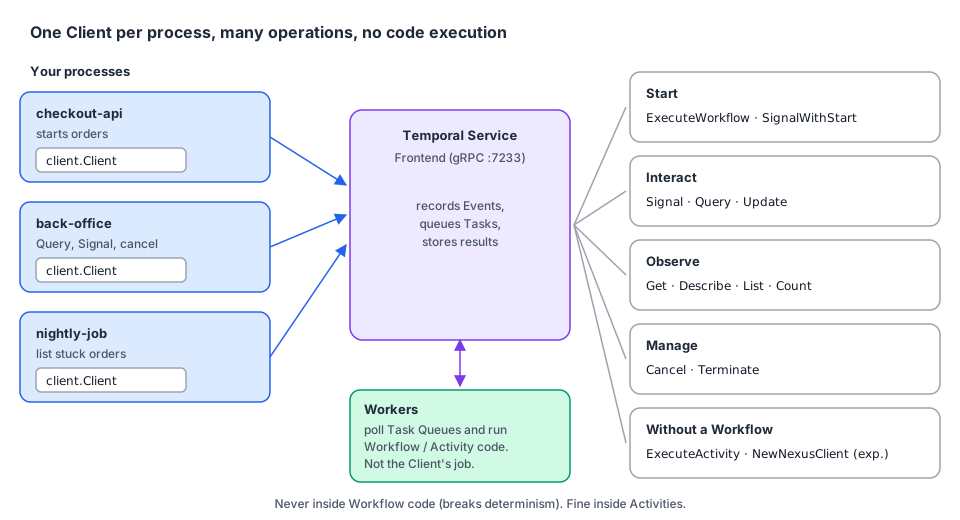
A Temporal Client is an object from the SDK that lets your code communicate with the Temporal Service. In Go it is the client.Client interface from go.temporal.io/sdk/client, created with client.Dial. It opens a gRPC connection to the Service's Frontend and sends requests on your behalf.
The Encyclopedia lists the most common operations:
| Operation | Go method | Chapter |
|---|---|---|
| Start a Workflow Execution | c.ExecuteWorkflow | 04 |
| Get the result of a Workflow Execution | run.Get, c.GetWorkflow(...).Get | 07 |
| List Workflow Executions | c.ListWorkflow, c.CountWorkflow | 08 |
| Query a Workflow Execution | c.QueryWorkflow | 08 |
| Signal a Workflow Execution | c.SignalWorkflow, c.SignalWithStartWorkflow | 08 |
| Start and manage Standalone Activities (no Workflow) | c.ExecuteActivity, c.GetActivityHandle | 08 |
| Start a Standalone Nexus Operation (no caller Workflow) | c.NewNexusClient(...) (experimental) | 08 |
The Go Client can do more than the Encyclopedia lists: Updates, cancel, terminate, describe, read the Event History, reset, complete an Activity asynchronously, manage Schedules. All of these are requests to the same Service.
3. What a Client is not
| A Client… | Because… |
|---|---|
| does not run Workflow or Activity code | That's the Worker's job. A Client only sends requests. |
| does not need a Worker to be running to start a Workflow | The Service records the start and queues the first Task. A Worker picks it up later. |
| cannot be used inside a Workflow | Workflow code must be deterministic. A network call from Workflow code breaks replay. Use Child Workflows, workflow.SignalExternalWorkflow or an Activity. |
| can be used inside an Activity (and often is) | Activities may do any I/O. Inject the Client into your Activity struct. |
A Worker also holds a Client: worker.New(c, …) uses it to poll the Service. The same process can share one Client between its Worker and its own requests.
4. A first Client, end to end
The examples in this guide revolve around a shop. Here is the Workflow the Client will drive:
// file: orders/workflow.go
package orders

import (
	"time"

	"go.temporal.io/sdk/workflow"
)

const TaskQueue = "orders"

type PlaceOrderInput struct {
	OrderID     string
	CustomerID  string
	AmountCents int64
}

type OrderConfirmation struct {
	OrderID   string
	PaymentID string
}

func PlaceOrderWorkflow(ctx workflow.Context, in PlaceOrderInput) (OrderConfirmation, error) {
	ctx = workflow.WithActivityOptions(ctx, workflow.ActivityOptions{StartToCloseTimeout: 30 * time.Second})
	var a *Activities
	var paymentID string
	if err := workflow.ExecuteActivity(ctx, a.ChargeCustomer, in.CustomerID, in.AmountCents).Get(ctx, &paymentID); err != nil {
		return OrderConfirmation{}, err
	}
	return OrderConfirmation{OrderID: in.OrderID, PaymentID: paymentID}, nil
}// file: orders/activities.go
package orders
import (
"context"
"fmt"
)
type Activities struct{}
func (a *Activities) ChargeCustomer(_ context.Context, customerID string, amountCents int64) (string, error) {
return fmt.Sprintf("pay_%s_%d", customerID, amountCents), nil // call your payment gateway here
}// file: cmd/worker/main.go
package main
import (
"log"
"go.temporal.io/sdk/client"
"go.temporal.io/sdk/worker"
"github.com/acme/shop/orders"
)
func main() {
c, err := client.Dial(client.Options{})
if err != nil {
log.Fatalln("unable to create Temporal client", err)
}
defer c.Close()
w := worker.New(c, orders.TaskQueue, worker.Options{})
w.RegisterWorkflow(orders.PlaceOrderWorkflow)
w.RegisterActivity(&orders.Activities{})
if err := w.Run(worker.InterruptCh()); err != nil {
log.Fatalln("worker stopped", err)
}
}And the Client side, a checkout service: dial once, start the Workflow, wait for the result.
// file: cmd/checkout/main.go
package main

import (
	"context"
	"log"

	"go.temporal.io/sdk/client"

	"github.com/acme/shop/orders"
)

func main() {
	// 1. Create the Client: one per process. Defaults: 127.0.0.1:7233, Namespace "default".
	c, err := client.Dial(client.Options{})
	if err != nil {
		log.Fatalln("unable to create Temporal client", err)
	}
	defer c.Close()

	// 2. Start a Workflow Execution.
	run, err := c.ExecuteWorkflow(context.Background(), client.StartWorkflowOptions{
		ID:        "order-ORD-1042",
		TaskQueue: orders.TaskQueue,
	}, orders.PlaceOrderWorkflow, orders.PlaceOrderInput{OrderID: "ORD-1042", CustomerID: "CUS-7", AmountCents: 2598})
	if err != nil {
		log.Fatalln("unable to start workflow", err)
	}
	log.Println("started", "WorkflowID", run.GetID(), "RunID", run.GetRunID())

	// 3. Wait for the result.
	var confirmation orders.OrderConfirmation
	if err := run.Get(context.Background(), &confirmation); err != nil {
		log.Fatalln("workflow failed", err)
	}
	log.Printf("order %s paid: %s", confirmation.OrderID, confirmation.PaymentID)
}temporal server start-dev # terminal 1
go run ./cmd/worker # terminal 2
go run ./cmd/checkout # terminal 35. The Client in a real service
In a real service, the Client is created once at startup and shared by every request handler. It is safe for concurrent use.
// file: internal/checkoutapi/server.go
package checkoutapi

import (
	"encoding/json"
	"net/http"

	"go.temporal.io/sdk/client"

	"github.com/acme/shop/orders"
)

// Server holds the process-wide Temporal Client.
type Server struct {
	Temporal client.Client
}

func (s *Server) Routes() http.Handler {
	mux := http.NewServeMux()
	mux.HandleFunc("POST /orders", s.placeOrder)
	return mux
}

func (s *Server) placeOrder(w http.ResponseWriter, r *http.Request) {
	var in orders.PlaceOrderInput
	if err := json.NewDecoder(r.Body).Decode(&in); err != nil {
		http.Error(w, err.Error(), http.StatusBadRequest)
		return
	}
	run, err := s.Temporal.ExecuteWorkflow(r.Context(), client.StartWorkflowOptions{
		ID:        "order-" + in.OrderID,
		TaskQueue: orders.TaskQueue,
	}, orders.PlaceOrderWorkflow, in)
	if err != nil {
		http.Error(w, err.Error(), http.StatusBadGateway)
		return
	}
	// Don't wait for the result in the HTTP request: return 202 and let the caller poll.
	w.WriteHeader(http.StatusAccepted)
	_ = json.NewEncoder(w).Encode(map[string]string{"workflowId": run.GetID()})
}
And the Client inside an Activity, injected by the Worker's main:
// file: loyalty/activities.go
package loyalty

import (
	"context"

	"go.temporal.io/sdk/client"
)

const PointsEarnedSignal = "points-earned"

type Activities struct {
	Temporal client.Client // the Worker's Client, injected at registration
}

// CreditLoyaltyPoints tells the customer's long-running loyalty Workflow about new points.
// Allowed in an Activity. Never call the Client from Workflow code.
func (a *Activities) CreditLoyaltyPoints(ctx context.Context, customerID string, points int) error {
	return a.Temporal.SignalWorkflow(ctx, "loyalty-"+customerID, "", PointsEarnedSignal, points)
}
6. Key takeaways
- A Temporal Client is the SDK object your code uses to talk to the Temporal Service over gRPC.
- Core operations: start, get result, list, Query, Signal, plus Standalone Activities and Nexus Operations. The Go Client also does Updates, cancel, terminate and more.
- It never runs Workflow or Activity code. Starting a Workflow doesn't need a running Worker.
- Create one Client per process, share it, close it on shutdown. Never use it in Workflow code. It's fine in Activities.